

Imagine a model that runs twice as fast as flagship models without sacrificing performance. Claude 4.5 Haiku from Anthropic is a fast AI model that changes how we think about balancing speed, intelligence, and cost. In this Claude 4.5 Haiku review:
- We'll break down why this model could become your next choice for coding, content creation, and analytics.
- You'll learn about the technical improvements that set Haiku 4.5 apart from its predecessors,
- You'll see concrete benchmarks demonstrating its coding and analytical abilities
- You'll get ready-made examples of using Claude 4.5 Haiku in GPTunneL for coding, financial analysis, content creation, and other areas.
This model, with reasoning support and a 200,000-token context window, is available worldwide through GPTunneL with no extra subscriptions required. Test the model right now to discover its capabilities for yourself! You can check the cost of using the model on our pricing page.
Key takeaways
- Balance of price and quality: Claude 4.5 Haiku achieves roughly 90% of the performance of the flagship Sonnet 4.5, making it an optimal choice for scalable applications.
- First Haiku with extended reasoning: The model supports "extended thinking," letting you tune the depth of analysis from a quick answer to deep deliberation.
- Instant responses: With processing speeds averaging over 100 tokens per second, it's one of the fastest models available.
- Easy access: Claude 4.5 Haiku is already available in GPTunneL, both in chat and when working with AI assistants.
Key improvements in Claude 4.5 Haiku and new capabilities
To understand why Claude 4.5 Haiku is a significant step forward, it helps to look at the technical improvements that set it apart. Every change — from reasoning support to context awareness — has practical value for your tasks.
Reasoning support (Extended Thinking)
Haiku 4.5 is the first model in its line to support extended chain-of-thought reasoning. This lets it consider a problem from multiple angles across several steps before answering. In GPTunneL, you can set a reasoning budget:
- At 1,000 tokens, the model will respond almost instantly;
- At 32,000 tokens, Claude 4.5 Haiku will spend more time on deep analysis.
Let's take a practical example. You give the model a task: "Analyze why AI startups get more investment than companies in other industries, and what risks that carries." Here's how the model responds at different thinking levels:
- Without reasoning, the model quickly gives a brief answer: investors see AI's potential, demand is growing, so more money flows into the sector.
- With a larger budget, it performs deep analysis and produces a structured plan: comparing investment trends across industries, ROI analysis, an assessment of market bubble risk, capital concentration risks, and long-term consequences for the ecosystem.
Context window and output volume
Claude 4.5 Haiku works with a 200,000-token context window, like other models in the family, and can generate up to 64,000 tokens at once — eight times more than the 8,196 tokens of Claude 3.5 Haiku.
This means you can upload a 100-page annual report and ask: "Find all clauses related to early termination, and note whether there are any contradictions among them." The model will read the entire document and give a precise answer without missing details from the first pages.
Context awareness and safety
According to the model's system card, Claude Haiku 4.5 was specifically trained to track context window usage, which helps it avoid "laziness" — prematurely stopping work on a task. Here's what the developers say about it in their paper:
"We trained Claude Haiku 4.5 to be explicitly context-aware, with precise information about how much of the context window has been used. This has two effects:
- The model learns when and how to wrap up its response as it approaches the limit;
- The model learns to keep reasoning more persistently when the limit is further away.
We found that this intervention, along with others, effectively curbs agent 'laziness' (the phenomenon where models prematurely stop working on a problem, give incomplete answers, or oversimplify tasks)."
We gave it a complex, multi-part prompt: "Analyze this Python code, find potential memory leaks, suggest optimization options, and rewrite the most problematic section with comments." See the response in our chat!
Instead of stopping after the first step, the model completes all four:
- Performs the analysis;
- Identifies the issues;
- Suggests solutions;
- Delivers the refactored code.
The model also meets the AI Safety Level 2 (ASL-2) standard, showing fewer violations and safer behavior overall. In practice, this means that during normal use it's less likely to produce offensive or unsafe content, making interactions more predictable and reliable.
Claude 4.5 Haiku's impressive performance on key benchmarks
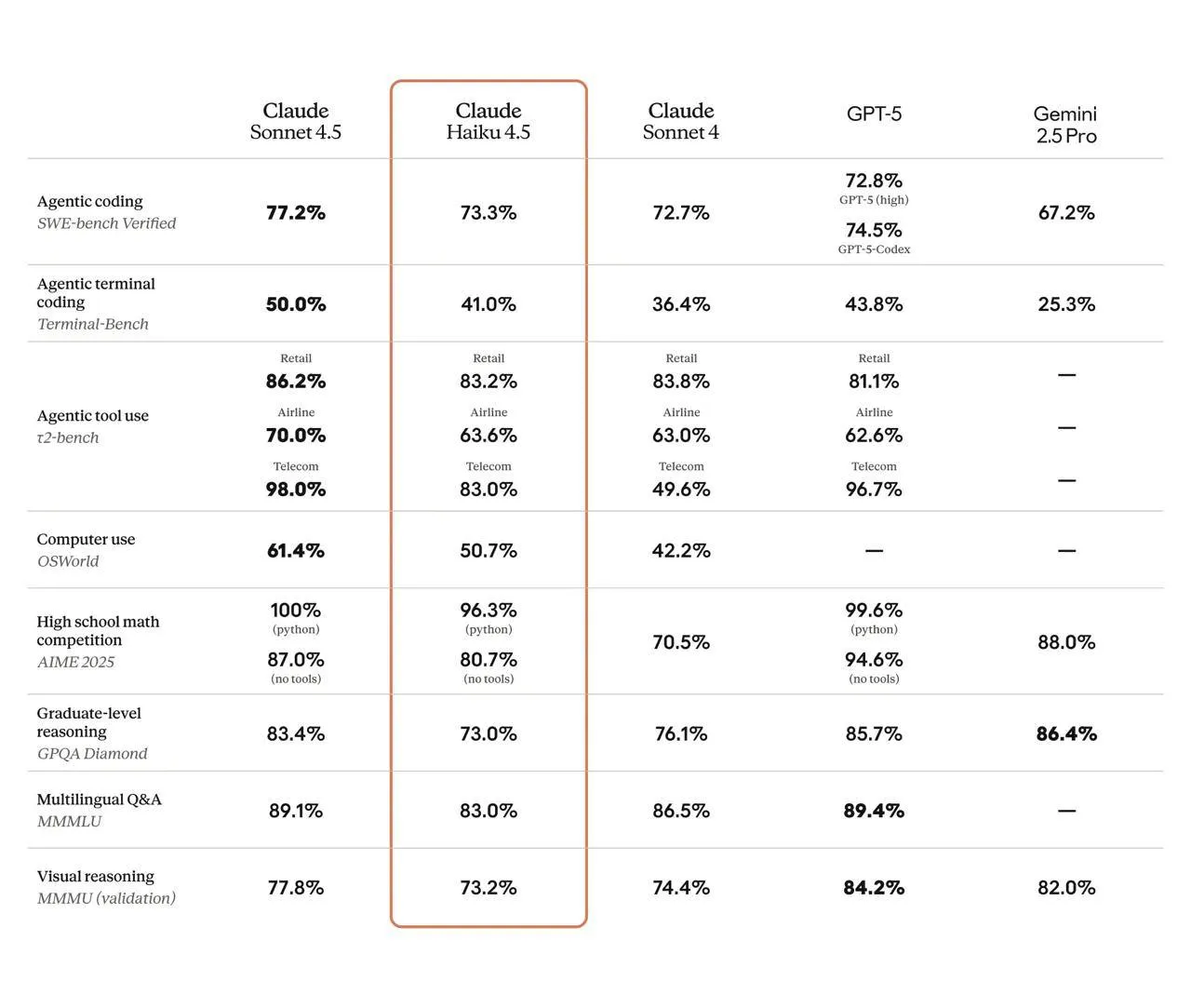
Benchmark numbers aren't just statistics — they indicate how the model will handle your real-world tasks. Claude Haiku 4.5 demonstrates results that until recently were only available to expensive flagship models.
- Coding (SWE-bench Verified): Haiku 4.5 scores 73.3%, nearly matching Sonnet 4.5 (77.2%) and outperforming Sonnet 4 (72.7%). This means a high probability of correct debugging and refactoring.
- Graduate-level reasoning (GPQA Diamond): With a score of 73.0%, the model handles complex questions requiring expert knowledge, building logical chains to arrive at answers.
- Visual reasoning (MMMU): A score of 73.2% shows strong ability to analyze images — upload a chart and get an accurate explanation of the trends.
- General knowledge and multilingualism (MMLU): Haiku 4.5 scores 83.0%, confirming broad expertise across dozens of fields, from history to physics.
While Claude Sonnet 4.5 remains Anthropic's flagship model, Haiku 4.5 reaches 90% of its performance on reasoning and coding tasks while running faster. According to independent testing from Artificial Analysis, the model shows an average output speed of over 100 tokens per second with reasoning mode disabled. This makes Haiku 4.5 an optimal choice for balancing speed and quality.
Practical applications: from development to analytics
Theory only becomes valuable once you see concrete results. Below are real-world scenarios where Claude 4.5 Haiku shows its strengths, with example prompts for each case.
Software development: a smart, fast coding assistant
Prompt: "Here's my Python script for parsing web server logs. It uses regular expressions and runs very slowly on files > 1 GB. Task: 1. Rewrite it using pandas.read_csv for speed. 2. Add try-except exception handling for cases where a log line is corrupted. 3. Write a docstring for the new function explaining what it does, what arguments it accepts, and what it returns."
The model shows strong competence in writing and modifying code. Its response speed lets you iterate quickly, getting optimized code almost instantly, which makes it a valuable tool for everyday use.
Analysis and research: processing large documents
Prompt: "[McKinsey report on the Asian market, 84 pages] Task: Analyze the McKinsey report on entering Asian markets from the perspective of a business strategist. I need a compressed, structured summary for decision-making.
Focus on the following:
- Key findings: 3-5 core insights from the report.
- Main trends: Key shifts in consumer behavior, technology, and the economy.
- Key risks: Major geopolitical, operational, and competitive threats.
- Strategic recommendations: McKinsey's main advice on market entry models, localization, and digital strategy.
- Promising markets and industries: Which countries and economic sectors are named as most promising.
Present the result as a clear list with headings. Be concise and to the point." See the response in our chat!
The ability to process up to 200,000 tokens lets analysts load entire reports and studies into a single chat. The model finds connections and extracts key information from a huge volume of data, saving hours of manual work.
Fast content generation
Prompt: "Source: [Article about Claude 4.5 Sonnet in GPTunneL]. Task: Based on the article, create a content package for an announcement. 1. Write two tweets with placeholders for links. 2. Compose a LinkedIn post aimed at technical specialists. 3. Prepare a bright, casual message for our Telegram channel using emoji." See the response in our chat!
For content managers, the model acts as a "content factory," generating multiple text variants for different platforms while keeping the logic consistent. This makes it easy to quickly adapt one piece of news for different communication channels.
Educational applications
Prompt: "Imagine you're a physics tutor, and I'm a student who doesn't understand Newton's second law. Explain its essence to me with a simple everyday example (like a shopping cart in a supermarket). After your explanation, ask me one or two questions to check my understanding. Don't give me all the answers right away." See the response in our chat!
For educational purposes, instant responses create the effect of a live dialogue with a tutor. The high safety standard ensures the learning environment stays free of inappropriate content, and the reasoning ability helps the model tailor explanations and check understanding.
Start using Claude 4.5 Haiku in GPTunneL
You've explored the technical capabilities, seen the benchmarks, and learned about practical applications. Now it's time to act and try the model on your own tasks. Test the model to personally evaluate its performance and speed. Claude 4.5 Haiku combines speed, intelligence, and accessibility, making it a versatile tool for a wide range of tasks.
In GPTunneL, you can get started without complex setup or international subscriptions. The model is available in our model library and when working with AI assistants.
Frequently Asked Questions (FAQ)
What is Claude 4.5 Haiku?
It's the fastest and most cost-effective model in Anthropic's Claude 4.5 family. It's built for tasks where instant response matters, such as chatbots and coding assistance, delivering flagship-level performance at a significantly lower price.
What tasks is this model best suited for?
It's well suited for software development (debugging and refactoring), fast content generation, and analysis of large documents. Its strengths are speed, low cost, and high performance on tasks involving code and logic.
What's the main difference between Haiku 4.5 and Sonnet 4.5?
The main difference lies in the balance of speed and power. Sonnet 4.5 is the flagship with maximum performance. Haiku 4.5 offers about 90% of its coding capabilities while running twice as fast and costing less, making it optimal for scalable, fast applications.
Is Claude 4.5 Haiku better than GPT-5?
They're strong competitors with different strengths. Haiku 4.5 often wins on speed and price-to-quality ratio in text tasks. Benchmarks show that Haiku 4.5 outperforms competitors on some reasoning (GPQA) and coding (SWE-bench) tasks, while GPT-5 may be stronger in other areas.
How can I start using Claude 4.5 Haiku?
The simplest way is to use the GPTunneL service. It provides direct access to the model with no need for extra subscriptions or complicated setup, removing barriers for users everywhere.