

Google DeepMind is preparing to unveil Gemini 3.0 — a model set to become an important milestone in the evolution of artificial intelligence. The promises are ambitious:
- Advanced reasoning;
- More precise understanding of visual information;
- Seamless multimodal integration capable of competing with GPT-5 and Claude 4.5.
Given the speed at which Google rolled out Gemini 2.5 in March 2025, the announcement of a third generation raises questions: is this a genuine technological breakthrough or a strategic move to seize the market initiative?
In this article, we'll break down what's known about Gemini 3.0 based on publicly available preview tests, what improvements are expected, how the model performs on benchmarks, what use cases it opens up for businesses and developers, and — most importantly — when the model will become available on the GPTunneL AI hub.
What's new in Gemini 3.0?
According to several technical overviews and insider reports, the third generation of Gemini continues the architectural line of previous models and uses an improved Mixture-of-Experts architecture: only a portion of the parameters is activated per request, which allows the model to maintain high performance at lower compute cost and latency.
Given this, we can also expect the third version to include a strengthened structured-planning and self-correction mechanism during the reasoning process, reducing the likelihood of hallucinations and improving reliability in professional use cases.
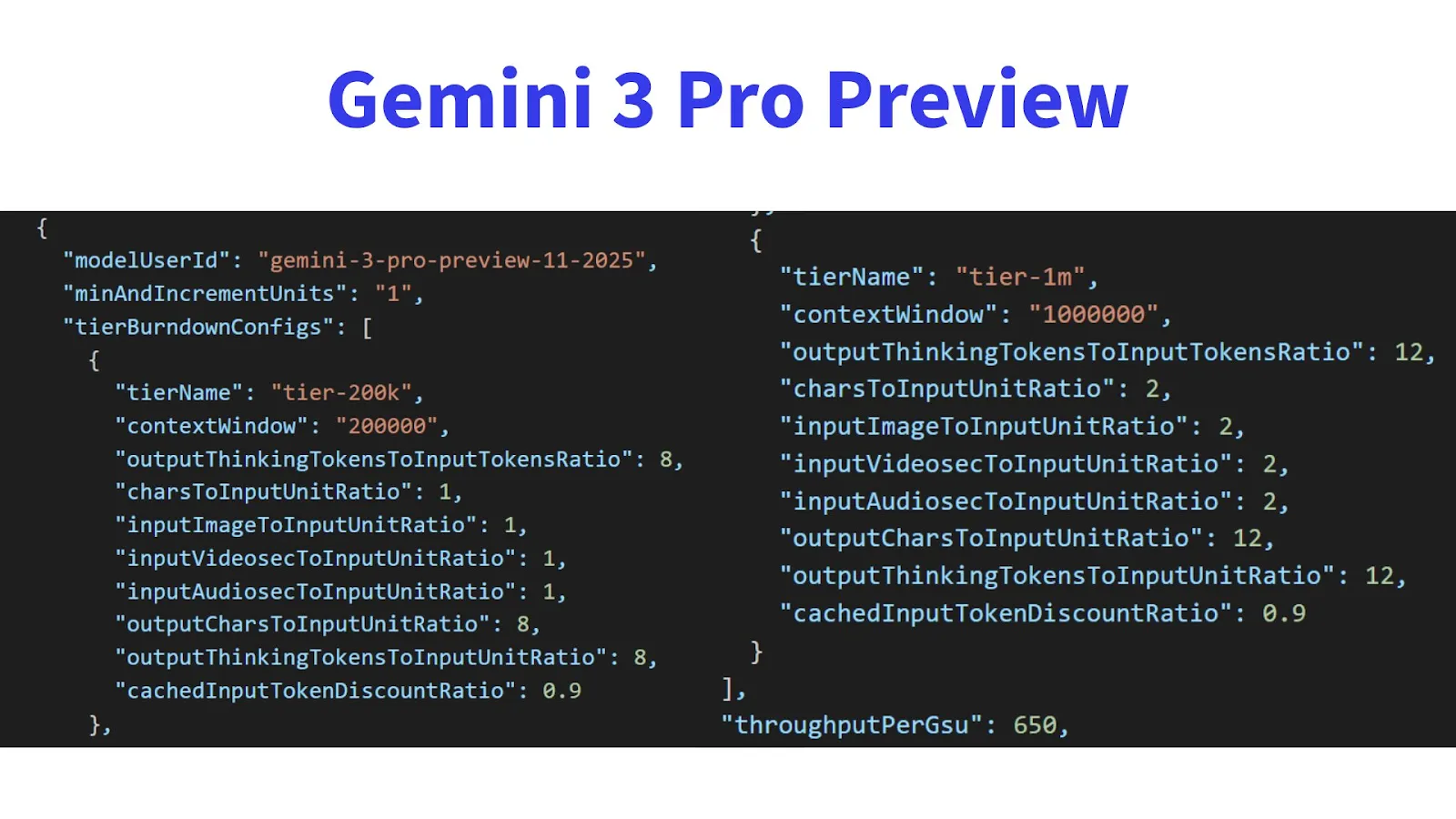
The model also retains a massive 1-million-token context window, roughly equivalent to 750,000 English words or a 300-page book. Google offers two configurations:
- Tier-200k, capable of handling up to 200,000 tokens for regular tasks;
- Tier-1m with a context window of up to 1 million tokens for processing extremely long documents.
This flexibility gives users the ability to balance performance and budget, choosing the optimal option for a given scenario.
Key improvements in Gemini 3.0
The new model shows notable progress in areas that were previously challenging even for top-tier systems. Developers are highlighting four directions where Gemini 3.0 outperforms earlier versions.
Advanced reasoning and creative problem-solving
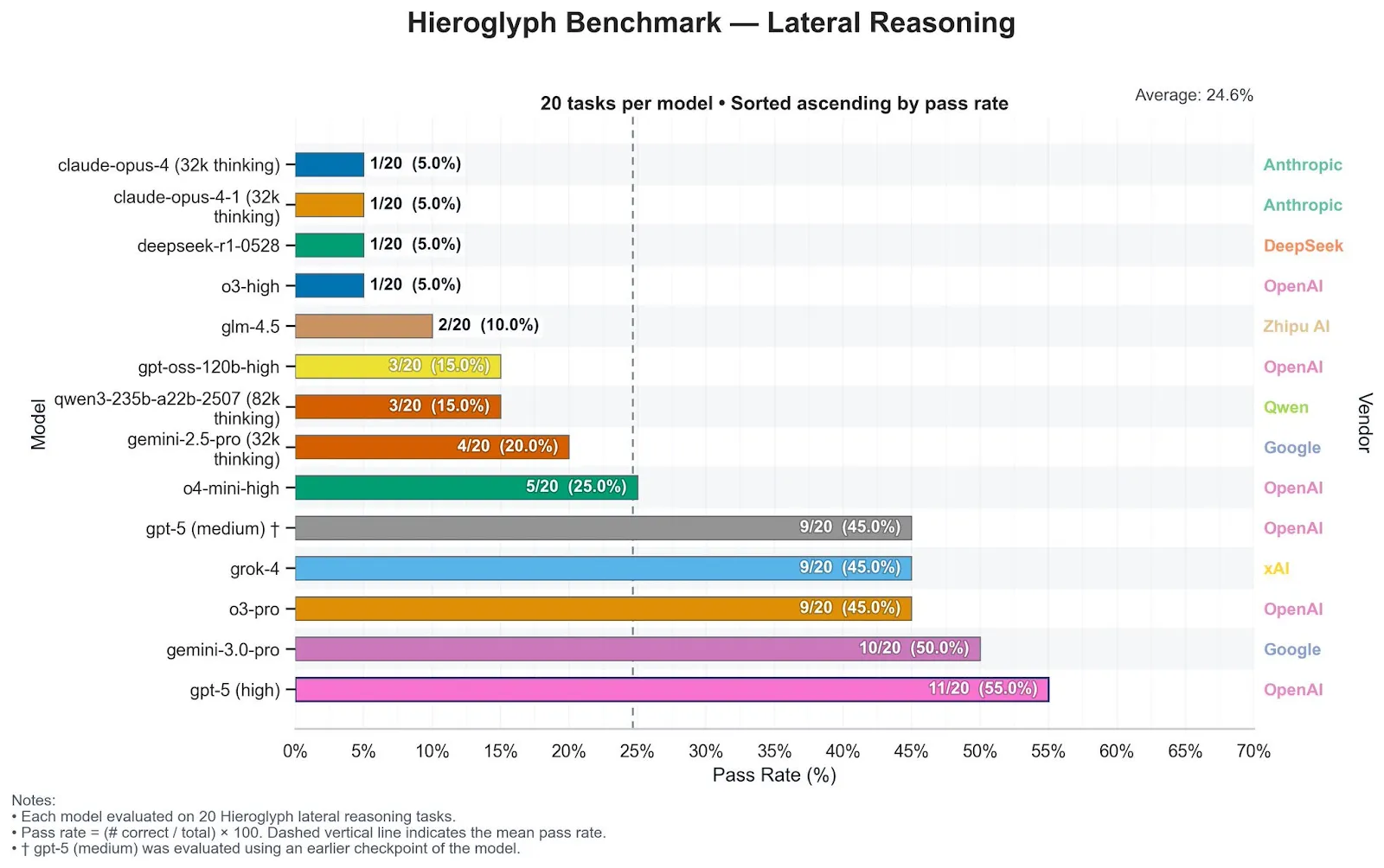
Gemini 3.0 demonstrates exceptional literal and abstract reasoning abilities on the Hieroglyph Benchmark and KingBench, showing a high level of suitability for tasks requiring an unconventional approach. The model is expected to be capable of a range of complex tasks:
- Building complex chains of logic;
- Decomposing large problems into subtasks;
- Identifying logical gaps during analysis;
- Providing step-by-step explanations with reasoning for each step.
This is especially useful in scenarios such as strategic planning, mathematical proofs, and system design, where multi-step argumentation is required.
Improved visual understanding
Gemini 3.0's visual capabilities can currently only be described by analogy and preliminary observations: previous versions (1.5 and 2.5) were already able to reliably parse complex PDF documents with tables, diagrams, and charts and extract structured data from them — this is shown by official examples of Gemini's document understanding. At the product level, these same models are already used in Google Sheets, where Gemini can analyze several tables at once and build charts (bar, line, pie, and others) from tabular data on request.
Given this backdrop, along with early reviews and benchmarks of checkpoints the community associates with Gemini 3.0 Pro (for example, "lithiumflow" on LMArena and analyses of its strong visual and tabular logic), it's reasonable to expect that the final release of Gemini 3.0 will keep its focus on deep analysis of complex documents and charts: correctly reconstructing table structure, understanding relationships between cells, and translating visual representations (charts, diagrams) into meaningful textual descriptions and analytical insights — though until official specifications are released this remains a well-founded expectation rather than a guarantee.
Increased code generation efficiency
According to AI experts on Reddit and Twitter, Gemini 3.0 will be able to generate over 2,000 lines of frontend code in a single request, including complete functional modules, responsive layouts, animations, and transitions.
In game development tests, the model showed impressive results:
- A full implementation of "Space Invaders," complete with game logic, collision detection, and a scoring system, was completed on the first attempt.
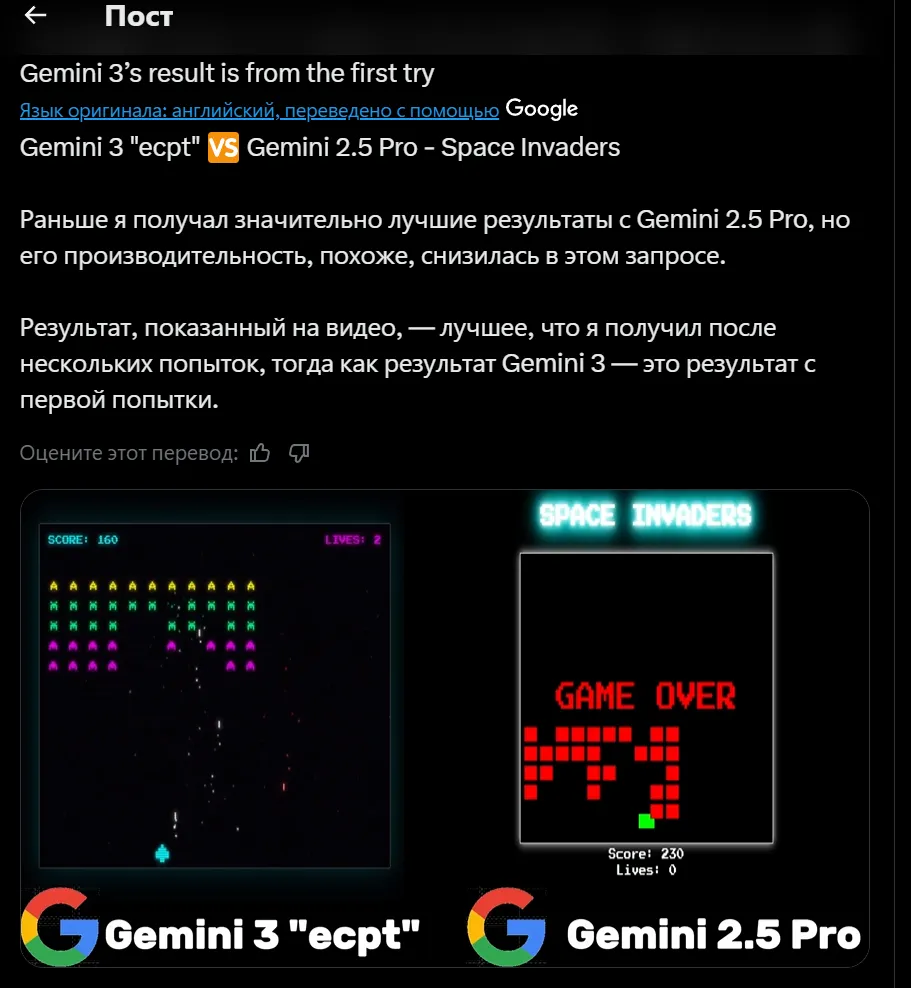
- Similar success was achieved in creating a Tower Defense game and a Minecraft-style game, where the resulting code turned out to be well-structured and easy to maintain.

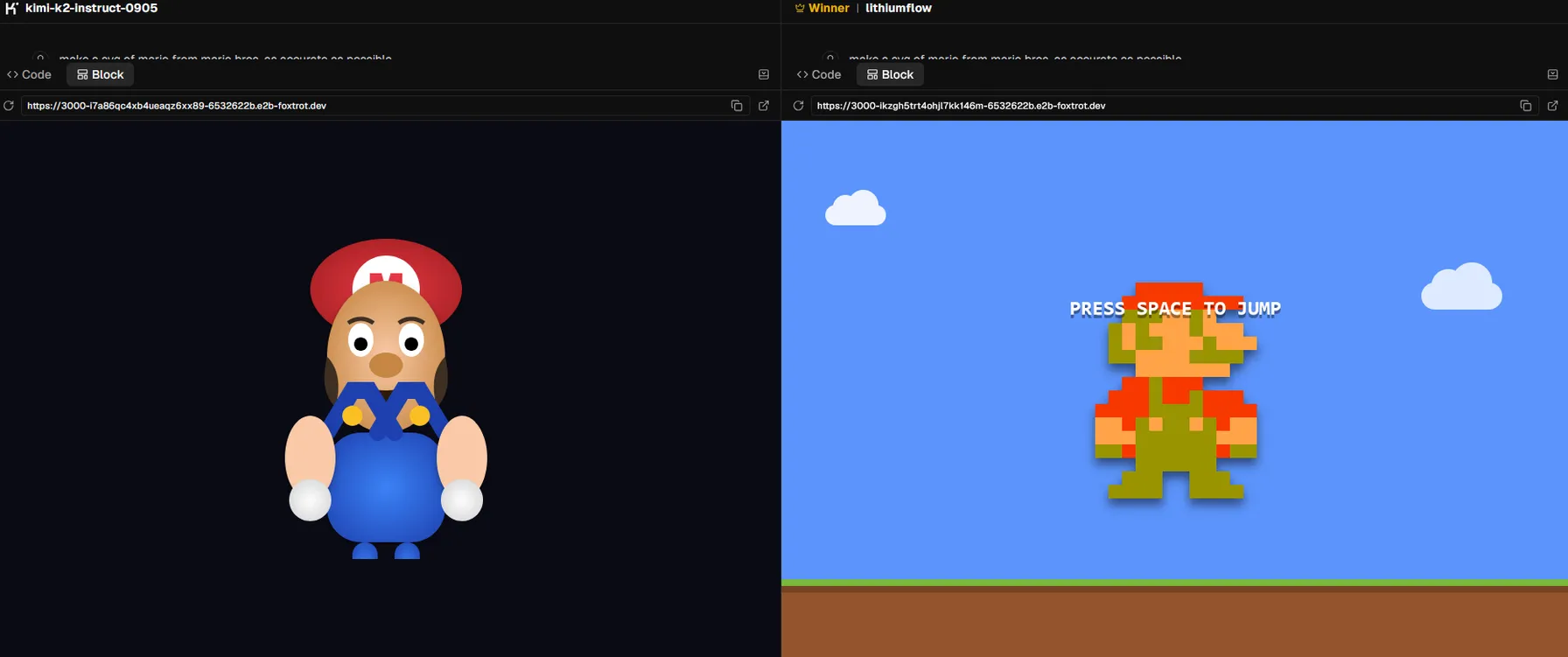
The model also generates high-quality SVG code, understanding complex design requirements, supporting animations and interactive effects, and optimizing performance and file size. Early tests of the LithiumFlow checkpoint, which the community associates with Gemini 3.0 Pro, already show that the model handles SVG code confidently: in a comparison test on Reddit it produced cleaner, neater SVG images (for example, a pelican and a PS4 controller) than Gemini 2.5 Pro and other models.
Based on these cases, it's more accurate to say that Gemini 3.0 is **reasonably expected** to deliver high-quality SVG code for icons, interfaces, and complex illustrations, including support for complex structures and potentially animations — but details on file-size optimization and advanced interactive effects will only become clear after the official release.
Seamless multimodal integration
Gemini 3.0 will be a natively multimodal model, just like its predecessor, Gemini 2.5 Pro. This means it's designed from the ground up to understand and generate content across multiple formats. The model will handle:
- Text (natural language, code, structured data);
- Images (photos, charts, screenshots);
- Audio (speech, music, ambient sounds);
- Video (analysis of sequential frames, action recognition);
- Real-time streaming video.
Cross-modal reasoning will let the model understand text within images and connect it to context, analyze video content and generate detailed descriptions, recognize speech in audio, and synthesize information across multiple modalities to provide comprehensive answers. This capability will bring Gemini 3.0 closer to handling tasks resembling real-world scenarios, rather than working with single-modality information alone.
How Gemini 3.0 performs on benchmarks
Leaked benchmarks, as well as tests of the LithiumFlow endpoint on LMArena, have shown superiority over competitors on key metrics. Two benchmarks demonstrate the model's technological edge and its ability to redefine performance standards in the AI industry.
On the Hieroglyph Benchmark, which evaluates creative problem-solving and lateral reasoning, Gemini 3.0 Pro showed a substantial improvement over Gemini 2.5. This test measures the model's ability to find unconventional solutions and work with abstract concepts, which is critical for strategic planning and innovation tasks.
The Kingbench Leaderboard focuses on real-world reasoning, coding, and adaptability — and here, Gemini 3.0 Pro took first place, ahead of Claude 4.5.
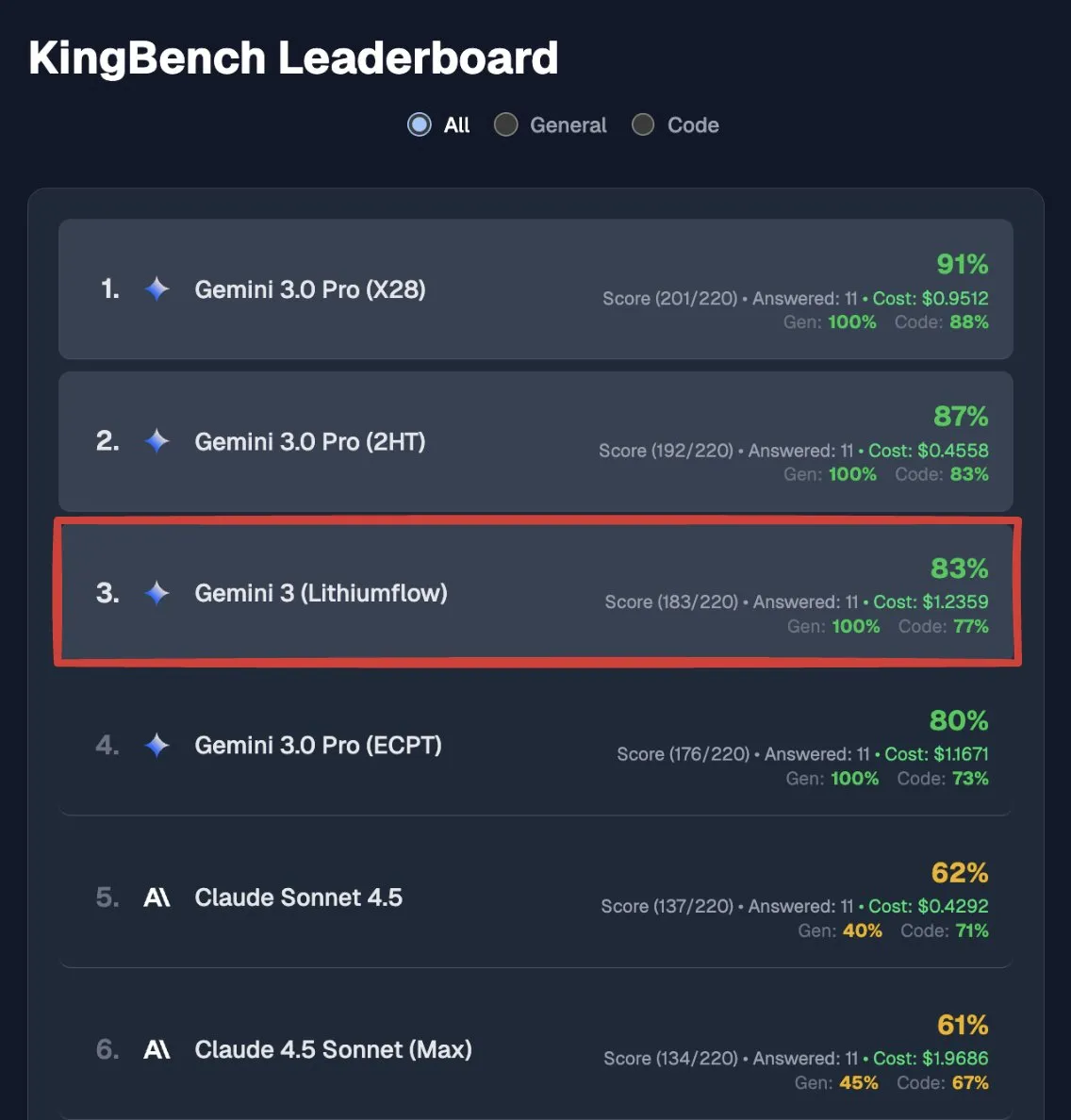
These results not only confirm Gemini 3.0's achievements but also signal a shift in competitive focus from raw intelligence toward specialization, integration, and controllability.
Gemini 3.0 use cases for businesses and developers
Improvements in reasoning, visual understanding, and multimodality open up a wide range of applied scenarios.
- Enterprise tasks. Gemini 3.0 will be able to process entire codebases, reports, and arrays of documents (up to 1+ million tokens per chat), understand business tasks more precisely, identify issues, provide recommendations and forecasts, compare versions of texts on the fly, and generate guides on complex topics for you, your employees, and your customers.
- Development and code automation. The model will serve as a smart developer assistant: code autocompletion, unit test generation, review and optimization, technical documentation creation, rapid prototyping, and entire frontend/backend modules, as well as automating common functions (login, access rights, basic cross-platform design).
- Science and education. Gemini 3.0 will become a tool for literature reviews, planning and analyzing experiments, working with data, writing and editing texts, and translation. Learning materials can be flexibly adapted to your level, and complex subject-matter questions can be resolved with just a few precise, short prompts.
The model offers unique value in areas that previously required several specialized tools or significant manual effort.
Access to Gemini 3.0 on GPTunneL
It's worth noting right away: the improvements mentioned above will be fully reflected only in the main Gemini app — the API version of the model may have limitations that will only become known at launch. This means that features such as analyzing video with both sound and visuals may not be available through us.
Since Gemini 3.0 Pro Preview is in a limited testing phase, Google's official pricing strategy has not yet been announced either. That said, Google CEO Sundar Pichai stated the model would launch before the end of 2025.
We can make reasonable forecasts based on the company's approach to previous releases and general industry trends. Here's what to keep in mind:
- Gemini 2.5 Pro delivers a high level of performance and reliability at a cost of just $0.0035 for text input and $0.015 for generation per 1,000 tokens.
- Gemini 2.5 Flash, in turn, offers faster response times, the same context window, and a lower price — $0.0006 / $0.0018 for input and output per 1,000 tokens respectively.
- Given Gemini 3.0's flagship status, it's reasonable to assume the model's cost will be 20–40% higher than Gemini 2.5 Pro, likely with additional fees for using the tier-1m context.
GPTunneL is already preparing to provide access to the model. We're following the updates and plan to add the model to our platform on launch day. Our advantages include:
- A lower barrier to entry, with no need to deal with international payments;
- Simplified sign-up with no VPN and no subscriptions required;
- Flexible switching between models (Gemini, GPT, Claude) through a single interface;
- Built-in image generation tools.
The release of Gemini 3.0 shows that Google is prioritizing release speed and product quality to compete with OpenAI (GPT-5.1) and Anthropic (Claude's iterations). This fast-paced race will push every other major developer to accelerate work on their own innovative models to keep up with the pace of innovation.
FAQ
When will Gemini 3.0 be released?
Google CEO Sundar Pichai announced that Gemini 3.0 would launch before the end of 2025. A preview version, Gemini 3 Pro Preview, is already available through limited access for enterprise customers and partners, while the official (GA) release is expected in early 2026.
What are the main differences between Gemini 3.0 and Gemini 2.5?
Gemini 3.0 outperforms its predecessor in structured reasoning with a self-correction mechanism, frontend code generation (over 2,000 lines per request), visual understanding (leading SVG benchmarks), and multimodal integration. The model also uses a MoE architecture with more than 1 trillion parameters, activating only 15–20 billion per request to reduce latency.
What is the expected cost of the Gemini 3.0 API?
Official pricing hasn't been announced, but Gemini 3.0 Pro is expected to cost 20–40% more than Gemini 2.5 Pro per million tokens, with additional fees for tier-1m context.
What use cases are best suited for Gemini 3.0?
The model is ideal for analyzing large codebases, legal and financial analysis, generating complex frontend code, processing scientific publications and business reports, and cross-disciplinary research. Its 1-million-token context window makes it well suited for tasks that require processing extremely long documents.
How can I get access to Gemini 3.0 Pro Preview?
You'll be able to get access through GPTunneL on the day the model launches, with no VPN and no subscriptions required. The platform also offers easy access to more than 100 AI models, top-up bonuses, a unified interface for switching between models, and technical support.