

GPT-5 promises to be a defining event for artificial intelligence in 2025. It's not just another ChatGPT update, but potentially a new stage that will determine the balance of power between OpenAI and its fast-closing rivals.
By integrating the achievements of previous generations, GPT-5 could remove many of the limitations of current systems. Users and businesses expect a qualitative leap from the new model — from deeper reasoning to universal task-solving ability.
What's known and what the rumors say
OpenAI has hinted that GPT-5 will become a single "unified" model instead of several separate ones. The company says it will merge the achievements of two lines:
- Powerful reasoning (as in the O-series experiments)
- The multimodality of GPT-4o
The new engine is meant to combine the best of both branches. In other words, users will no longer have to choose between response speed, depth of analysis, or multimodality — a single model will be able to deliver all of it.
There's no official release date yet, but OpenAI leadership points to summer 2025. Altman himself said only that a release is expected "this summer," without specifics. This is reinforced by rumors: competitors are already preparing for GPT-5's imminent arrival.
There's no direct data on the size or architecture of the new model — OpenAI traditionally keeps such details secret. However, leaks indirectly reveal some plans. For example, the code of the latest ChatGPT app version was found to contain references to tools for autonomous actions, hinting at a new agentic feature.
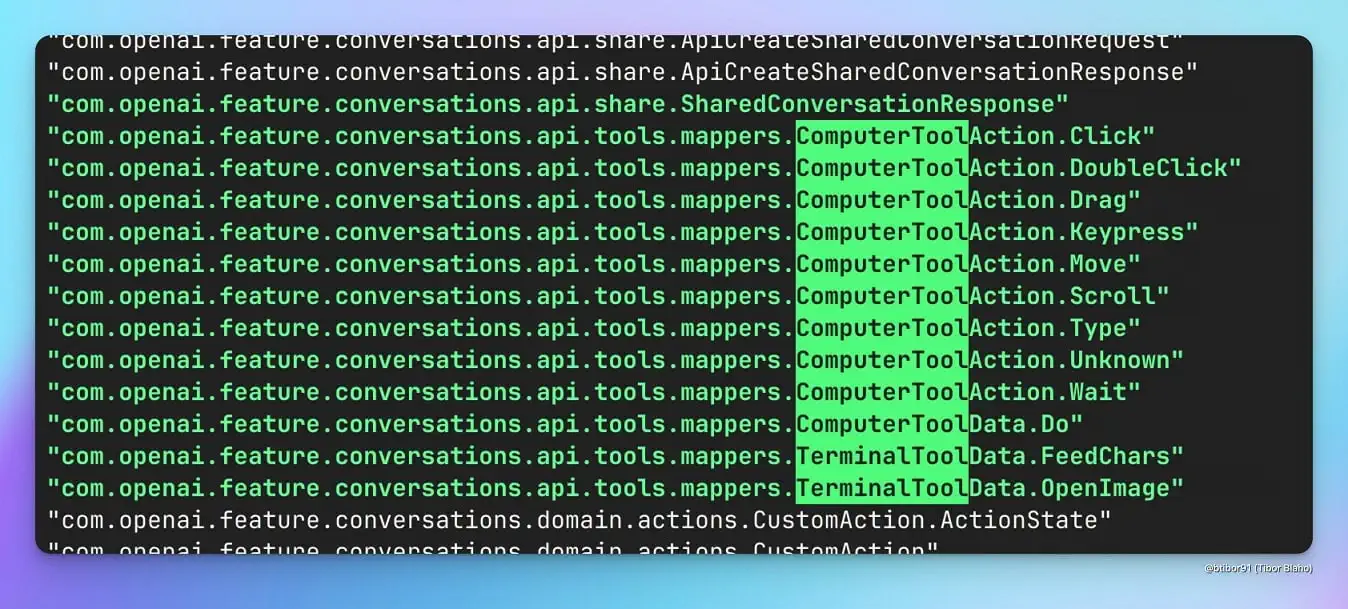
Source: Article by BleepingComputer
GPT-4o's limitations: what's expected from GPT-5
Even the most popular OpenAI model today — GPT-4o — has limitations that are obvious to professionals. For all its power, it sometimes makes logical errors and "hallucinates" facts. In complex tasks it lacks step-by-step reasoning, and the conversation context is still limited by the size of the window.
Users hope the new version will close these gaps. The main expectations for GPT-5 can be summed up in a few key improvements:
- A significantly longer context for input and data storage.
- The ability to reason step by step (chain-of-thought) to solve complex problems, as in o1, o3, and o4.
- The ability to independently use tools: a browser, APIs, external applications.
- Robust multimodal understanding: accurate handling of images, audio, and other data formats.
- Personalized communication: a more flexible style and the ability to set a "personality" for the AI to fit your tasks.
From GPT-4.1 to AI agents: OpenAI's strategy ahead of the GPT-5 launch
OpenAI has been gradually laying the groundwork for a unified model. In spring 2025, GPT-4.1 was released — a version with a context of ~1 million tokens and a focus on programming. GPT-4.5 also launched, a model with a minimal hallucination rate (19%) and a focus on creative writing. Many see these models as the final step before GPT-5.
At the same time, other ChatGPT capabilities have been expanding through 2025:
- The platform has become a leader in coding, especially after the release of the Codex AI agent;
- It integrated image generation (GPT Img 1), setting a high bar for image-generation quality;
- It added the Deep Research agent, which can study dozens of sites and then deliver a research report.
By working on GPT-5, OpenAI is effectively building the foundation for a "super-assistant" capable of understanding different communication formats and giving users answers to any question, opening up new areas of science, developing technologies, and automating routine work.
The company has also stated its intention to release its first open-weight model. Although the release was delayed, Sam Altman said the development team had made something "unexpected and amazing." This could point to a new approach that will also be reflected in GPT-5.
OpenAI's direction is clear: bring all the key technologies (reasoning, multimodality, voice, tools) together under one roof. In doing so, the company is preparing for the era of AI agents — universal assistants that can be embedded directly into business processes.
Access to GPT-5: possible restrictions and risks
There's a chance GPT-5 will initially be available only to paying customers. OpenAI traditionally restricts access to its most powerful models through ChatGPT Pro subscriptions or an expensive API tier. The quality of the new version will require enormous computing resources, and therefore cost.
OpenAI's products are already among the most expensive on the market:
- Processing 1 million input tokens on GPT-4o costs around $10, while Google Gemini 2.5 Flash costs less than $1.
- OpenAI o1 costs $150 per 1 million input tokens, and $600 per 1 million output tokens.
GPT-5 is unlikely to be an exception: top-tier AI will come at a higher price, especially at first.
Beyond pricing, GPT-5 will certainly remain a closed model under OpenAI's full control. Content filtering and request limits will likely tighten for safety reasons. New features (such as an autonomous agent mode) will also be rolled out gradually — possibly by invitation only at first.
Access restrictions are a risk in their own right: part of the audience may be left without GPT-5 due to high pricing or policies. Corporate clients who care about privacy may have to wait for a dedicated version or turn to open-source models like Mistral or Llama. Still, many will accept the restrictions in exchange for GPT-5's outstanding capabilities.
Outlook: what GPT-5 could become
If GPT-5 lives up to the high expectations, the AI market is in for a notable leap. A unified model that confidently handles a wide range of tasks could become the new de facto standard. This would accelerate the adoption of AI assistants in business processes and push competitors to speed up their own development.
The other scenario is more restrained. GPT-5 might turn out to be an evolution rather than a revolution: improving answer quality and convenience without instantly changing the rules of the game. In that case, roles would be split among several strong models, and users would keep choosing tools to fit their tasks and budget.
Either way, the launch of GPT-5 will set new benchmarks for the industry. OpenAI will try to cement its leadership, while everyone else will have to adapt — cutting prices, opening up models, or seeking niche approaches. The winners will be those who manage to get the most out of the new model's capabilities.