

How to use neural networks in recruitment
Artificial intelligence in HR has evolved from experimental solutions into core infrastructure that modern people teams can no longer do without. Automated sourcing, candidate analysis across hundreds of parameters, job description generation — all of this is significantly changing processes and workplace culture. In 2025, AI for HR is becoming the standard, able to process data faster and more accurately than a human can.
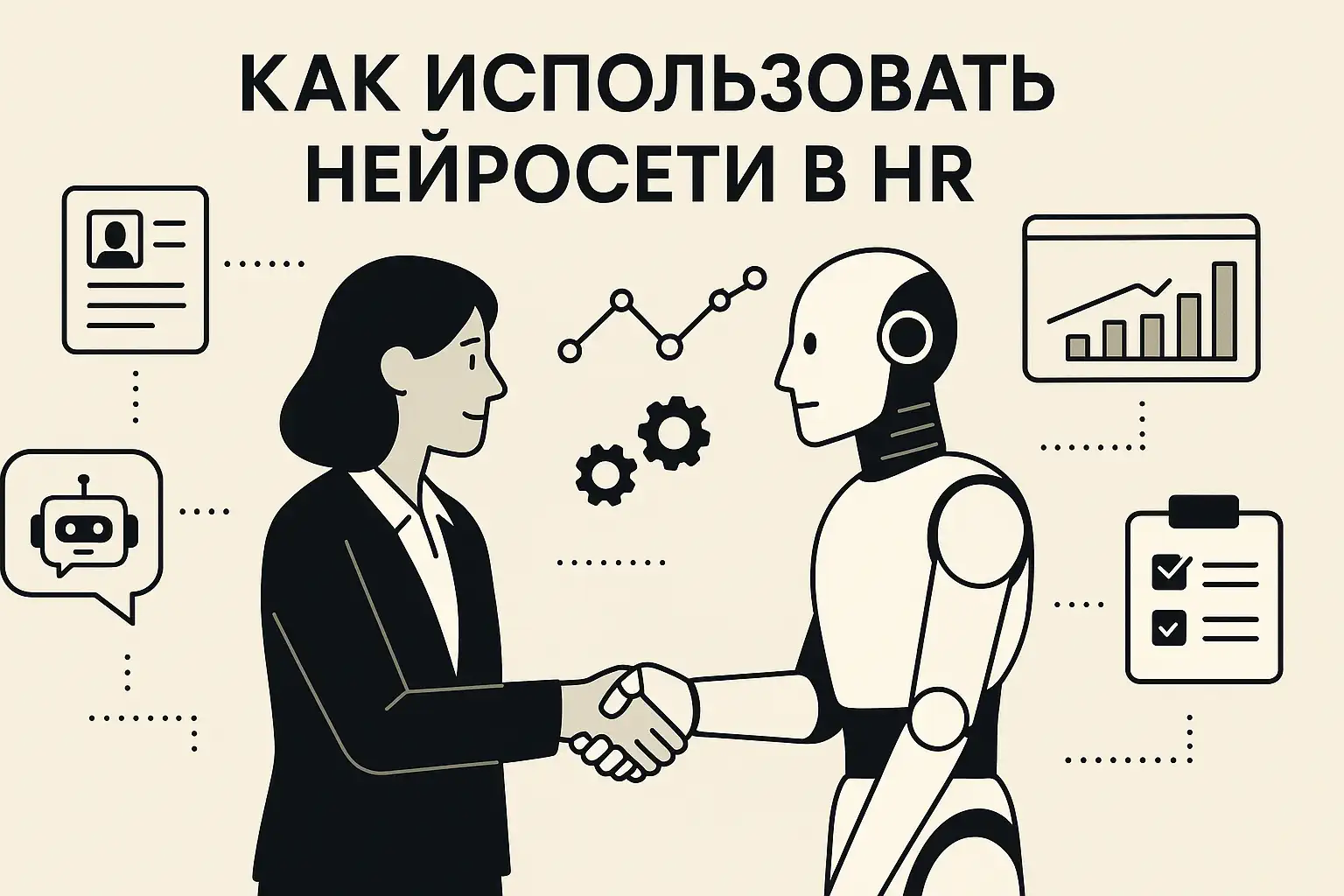
Large companies are automating stages of the hiring funnel:
- Initial screening;
- Competency assessment;
- Online testing.
Recruitment automation frees up HR specialists' time and reduces the risk of overlooking a strong candidate due to fatigue or subjective filters. Neural networks for recruiting speed up the candidate search cycle, and automated resume screening lets teams select suitable specialists regardless of how they choose to present themselves.
A new challenge emerges: how to integrate AI tools for recruiting into practice in a way that preserves human expertise while improving its precision and foresight. Neural networks in recruitment don't just filter standard cases — they also uncover talent where a human might not think to look.
What neural networks can do in HR and recruiting
The core tasks that modern neural networks solve in talent management can be broken down into several areas.
First and foremost — fast, precise matching of resumes against job requirements. A typical process: ChatGPT 4.1 acts as a neural network for resume analysis. It scans the document, identifies key skills, and matches them against templates and success profiles for a specific role. There are other examples too:
- Automated resume screening: AI instantly classifies experience and skills against set criteria, filtering out irrelevant candidates.
- Screening and ranking: AI-based recruiting tools generate a shortlist of the best-matched candidates along with the reasoning behind each choice.
- Hard and soft skills assessment: Many modern companies use interview bots to gauge communication ability or stress resilience. For example, you can create a Telegram bot in GPTunneL and configure it to review resumes, ask questions, and answer queries about a job posting.
Job description generation has also reached a new level: a neural network writes job postings tailored to the target audience and market best practices. Claude 4 Opus, ChatGPT 4o, and Gemini 2.5 Pro all handle this task well, each in its own way depending on your prompts. AI embeds automation into every stage: from receiving an application to forecasting employee turnover based on profile and behavior.
Another key strength is AI-powered HR analytics. By accumulating hiring and turnover data, systems can predict attrition risks, analyze motivation, and surface non-obvious patterns between hiring stages and team performance. This is reshaping the traditional HR role — from filtering candidates to managing a multi-layered talent strategy.
3 best AI tools for HR and recruitment
GPTunneL generative AI assistants for recruiting
In GPTunneL, you can configure a generative assistant based on almost any neural network to help write job postings, answer users' questions, and connect to the APIs of various services to work with them. With minimal technical skills, you can set up an assistant for any task, including recruitment.
What it can do:
- Generate job descriptions
- Analyze soft skills and resumes
- Automate candidate testing via neural networks
- Quickly launch hiring auto-funnels (20+ vacancies in parallel)
- Anything you configure your assistant to do
- Embed the assistant into a Telegram bot or any other messenger/service via API integration
Examples of AI use from GPTunneL for HR:
- Telegram bot: drag-and-drop setup with no coding, directly through the GPTunneL interface, instant launch of a recruiting bot (registration and configuration take minutes). You can set up your own bot to answer candidate questions about your job posting. Choose a model, write a prompt, and add integrations.
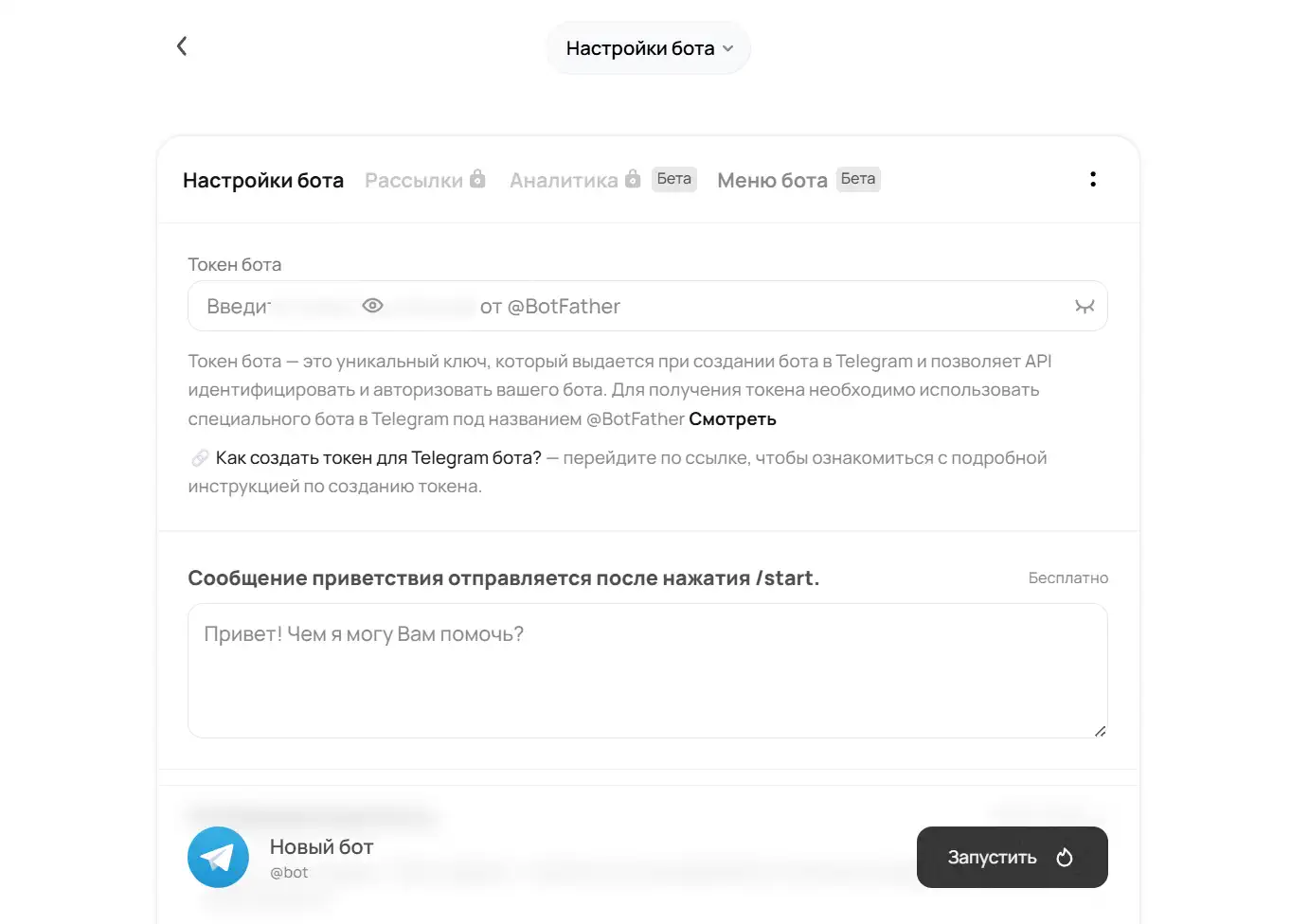
- HR department: an AI assistant created by one of our users. It can answer questions about HR, share tips on how to run interviews, generate job descriptions, and more.
- An AI agent that can analyze resumes itself, send email invitations, and collect candidate responses. This is a comprehensive solution for enterprise clients that we can build to order — leave a request on our business page.
Skillaz
What it does: analyzes resumes, evaluates fit against a job profile, generates recommendations for HR, integrates with ATS platforms.
Interface: a SaaS platform with an API for enterprise ecosystems.
- Examples: Fast pre-screening of project managers — the system builds a shortlist within minutes, noting each candidate's strengths and weaknesses.
- Automatic assessment and personalized development recommendations for building a talent pipeline.
Pros: high assessment accuracy, detailed reports, easy to implement.
Cons: requires careful configuration of criteria for complex profiles.
Huntflow AI
What it does: automated resume screening, prioritizing applications by relevance, integration with communication channels, automatic replies to candidates.
Interface: SaaS, integrates with popular messengers and internal CRMs.
- Examples: Screening for high-volume roles — the algorithm passes only relevant candidates through to interviews, automatically notifying the rest.
- Convenient auto-funnel setup for mass recruitment.
Pros: saves time in high-volume hiring stages, flexible integration.
Cons: limited customization for rare or unique positions, requires payment in foreign currency.
How to use neural networks in HR in practice
Integrating neural networks into HR starts with choosing tasks suited for delegation to AI. For example, automated resume screening saves hours of manual work during mass hiring. A neural network for resume analysis extracts key parameters (experience, education, tools) and compares them against the hiring manager's requirements.
- Grouping candidates by meta-profile lets HR quickly configure auto-funnels for different types of roles.
- Generating questions for automated interviews — the system adapts the dialogue script to the specific role profile.
- Using an interview bot to assess soft skills, when non-standard communication needs to scale across many candidates.
Practice shows that HR platforms powered by neural networks work best in tandem with a human. The final decision always rests with the expert, while AI improves the accuracy of talent recognition and reduces the risk of missing an unconventional candidate.
AI-powered HR analytics helps track auto-funnel performance, forecast attrition points, and identify areas for improvement when building a talent pipeline.
Pros and cons of neural networks in recruitment
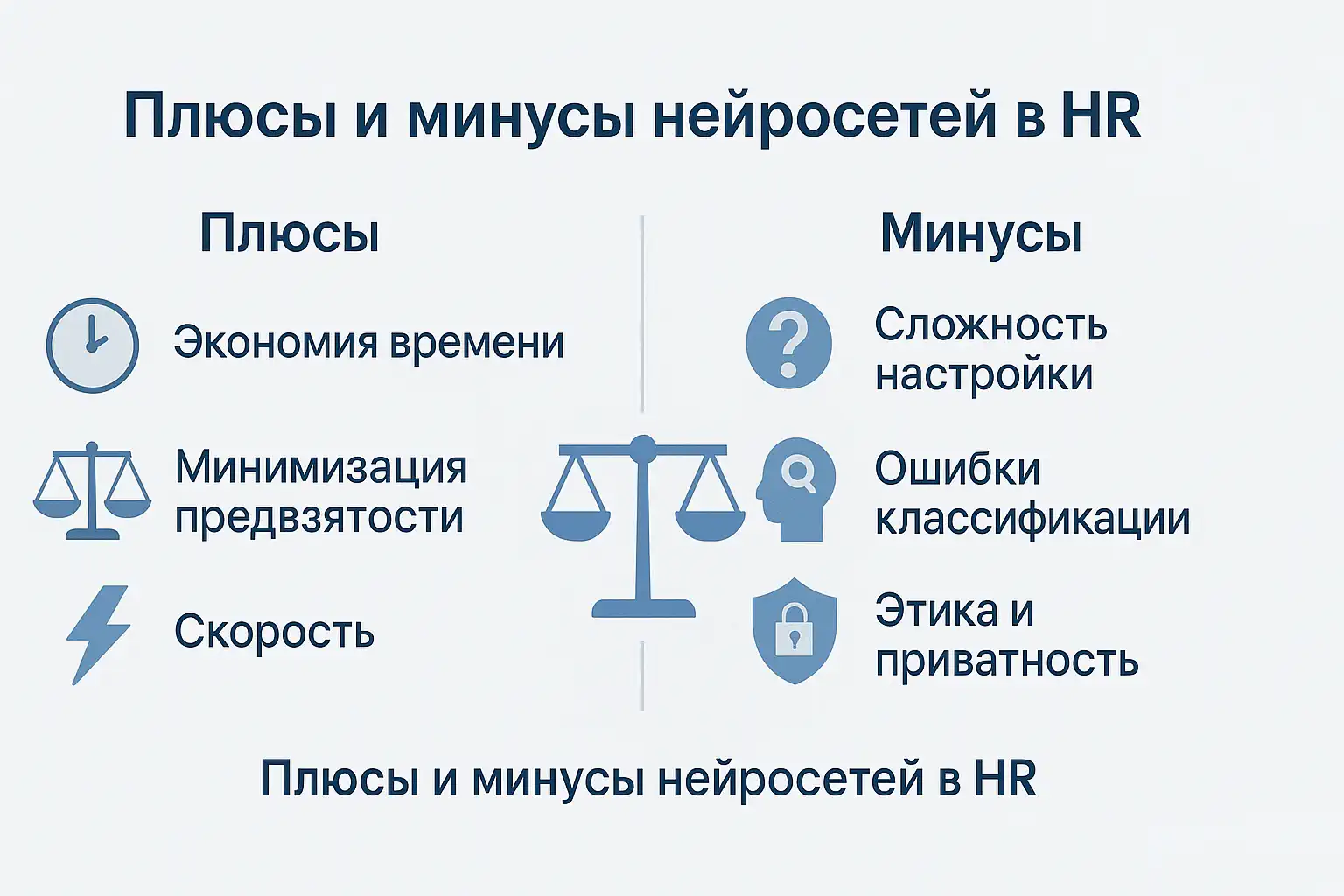
Pros:
- Time savings: automating routine processes frees up resources for strategic work.
- Minimized bias: algorithms rank candidates by objective metrics.
- High processing speed: AI for recruitment processes hundreds of resumes in minutes.
Cons:
- Setup complexity: adapting criteria for each type of role requires expertise.
- Potential errors: unconventional profiles can be misclassified.
- Ethical questions: transparency of decision-making processes and protection of personal data remain areas of concern.
In summary
Adopting neural networks in recruitment isn't a one-time automation step — it's a long-term shift in talent management. Redistributing roles between humans and AI is changing workplace culture: the expert manages strategy, while artificial intelligence uncovers hidden patterns and speeds up onboarding.
In the long run, new approaches to hiring will be built on a balance of automation and human involvement, creating a fair, well-designed space for organizations and people to grow.
FAQ
Can recruitment be fully automated with AI?
Full automation is possible for high-volume, standardized roles where decisions fit clear-cut criteria. For complex managerial or creative positions, AI serves as an assistant rather than a replacement, complementing HR's expertise.
Which neural networks can analyze resumes?
Today, resumes can be analyzed both by specialized solutions (Skillaz, Huntflow AI) and by AI assistants from GPTunneL — from chatbots to ATS platform integrations. Their job is to highlight relevant experience, assess fit against a profile, and provide recommendations.
How can bias be avoided when using AI in HR?
Control over the selection process stays with HR experts. Regular review of criteria, sample analysis, and algorithm adjustments help reduce the risk of discrimination and improve transparency. Combining automation with human judgment remains the most reliable approach.