

Modern science and business inevitably deal with huge volumes of data. The ability to quickly analyze information is a competitive advantage for both large corporations and individual users. However, studying long tables, multi-page reports, and manually organizing data is a tedious task that eats up a lot of human effort.
This is where an AI model for data analysis can become a great assistant. Using AI for data analysis opens up a wide range of possibilities:
- Quickly clean up a table;
- Find patterns in sales;
- Draw conclusions from hundreds of pages of a report;
- Organize fresh analytics from open online sources.
The GPTunneL platform offers an interface that brings together different AI models for data analysis: GPT, Claude, Gemini, DeepSeek, YandexGPT, and others. In this review, we'll break down what the most popular models offer when working with both regular data and big data.
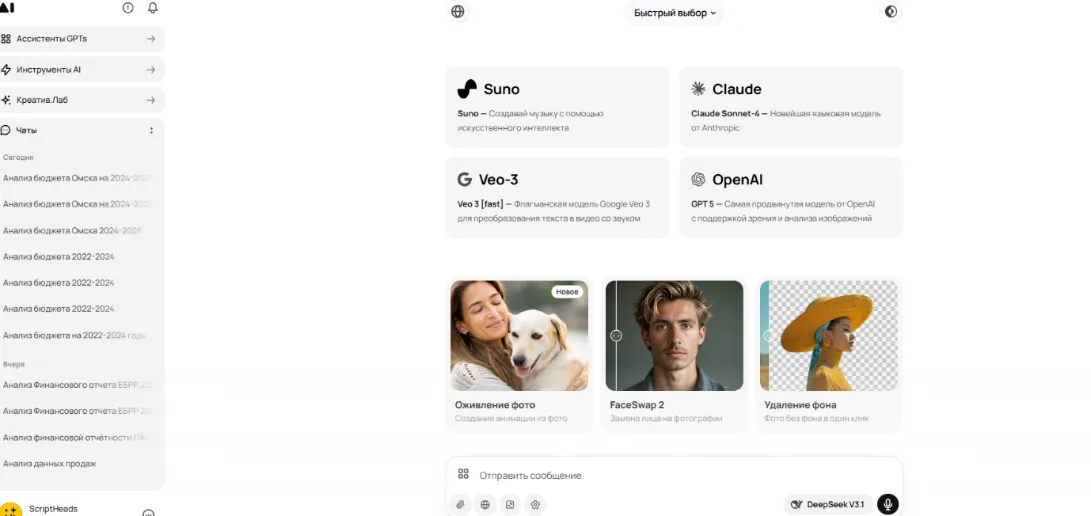
Claude: deep analysis of long documents
When you need to process a truly large volume of information — for example, analyzing a medical report with many entries or a multi-page legal document — some models start to struggle. Claude, on the other hand, handles this kind of work exceptionally well.
The versions of Claude you can find on GPTunneL pay special attention to analytics with full context in mind. This AI doesn't just summarize text — it can:
- Build tables based on specified criteria;
- Highlight key indicators;
- Compare different parts of a document and find contradictions in it.
Its winning trait is processing documents that run hundreds or even thousands of pages. This means that when using AI for medical data analysis with Claude, you won't have to split the document into chunks — you can simply upload the full file.
Sample task and prompt for analysis
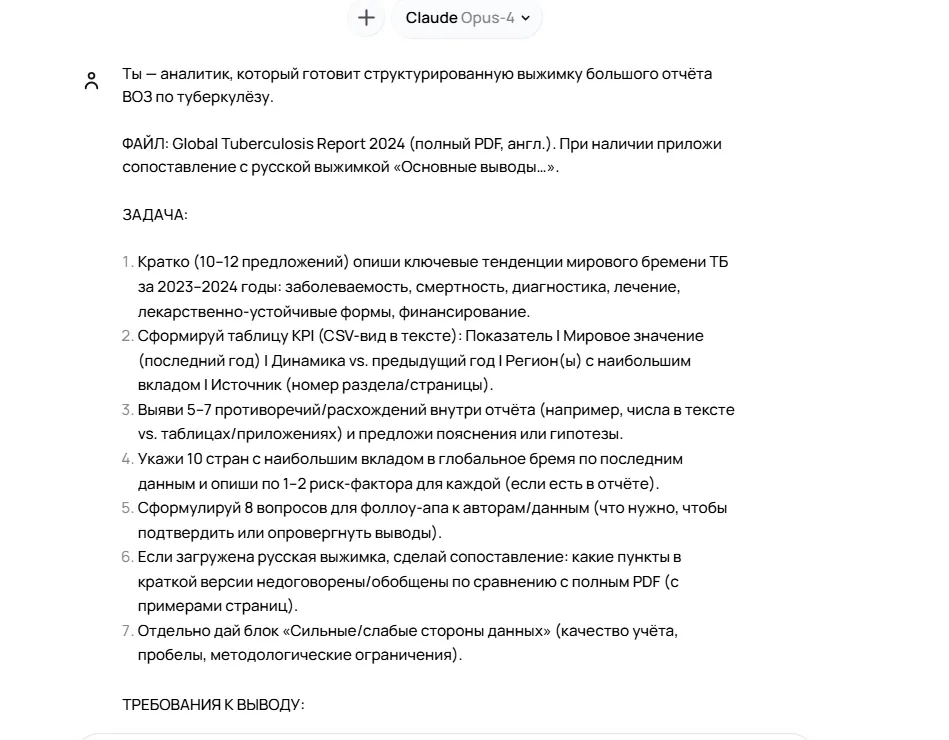
We tested Claude Opus 4 on the report WHO Global Tuberculosis Report 2024 — more than 200 pages of statistics, charts, and methodology.
The prompt included the task of producing a structured summary of the WHO 2024 tuberculosis report: key trends, a KPI table, contradictions, a list of countries with the largest contribution, and follow-up questions.
Result
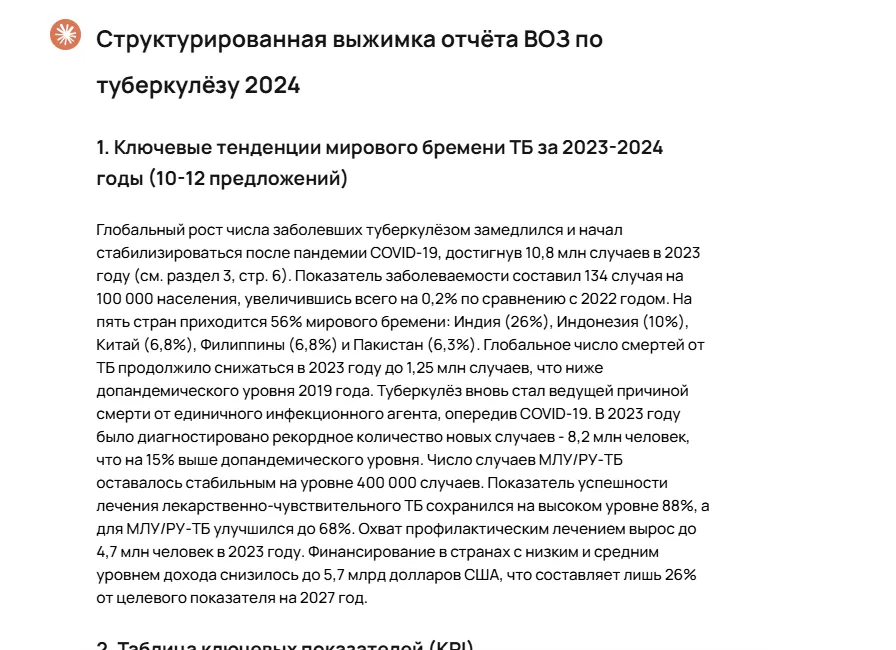
Claude prepared a complete analytical report within minutes. The strongest parts:
- Highlighted key trends: the growth in incidence has slowed, mortality dropped to 1.25 million;
- Compiled a KPI table with dynamics compared to 2022;
- Noted contradictions, such as the gap between the high treatment success rate (88%) and persistently high mortality;
- Listed the 10 countries with the largest contribution to the global TB burden;
- Formulated 8 clarifying questions for researchers.
See the full report via the link to the chat with Claude.
GPT-5: a universal analyst for tables and large datasets
Working with data isn't just about being able to count. It also requires other skills:
- Establishing connections;
- Spotting various patterns and quirks;
- Turning clusters of numbers into a clear system.
This is exactly where GPT-5 excels. Compared to previous versions, it handles large datasets better, understands table structures faster, and produces more accurate, logically grounded conclusions.
On the GPTunneL AI hub, GPT-5's analytical power can be used to the fullest. The platform's interface lets you upload a CSV or Excel file, ask all the questions you're interested in, and get a ready-made summary. The model doesn't just add up totals — it reveals relationships:
- Which regions show the highest profit;
- What's going on with underperforming products;
- Where the price doesn't match the cost.
Sample task and prompt for analysis
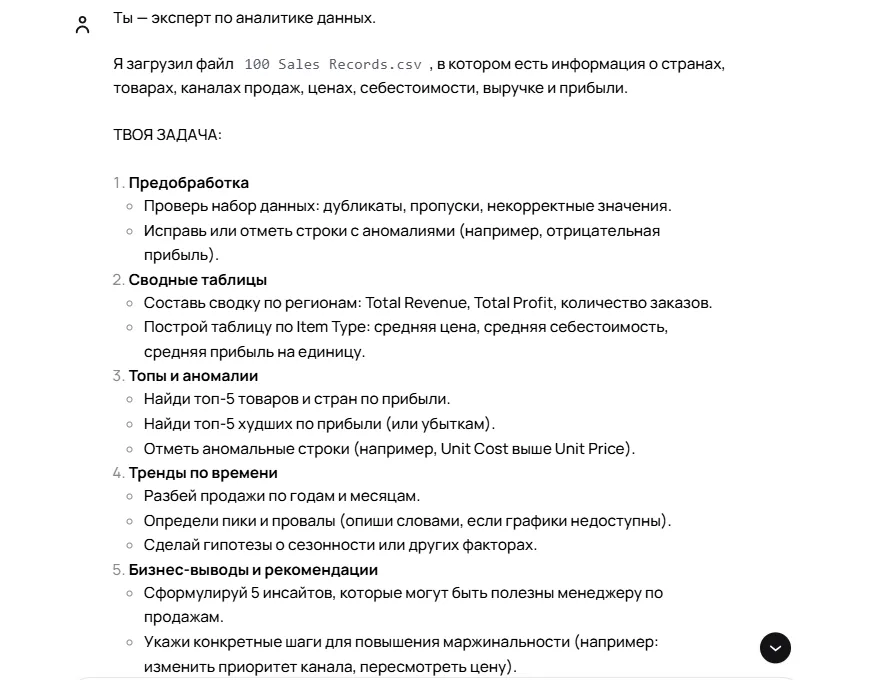
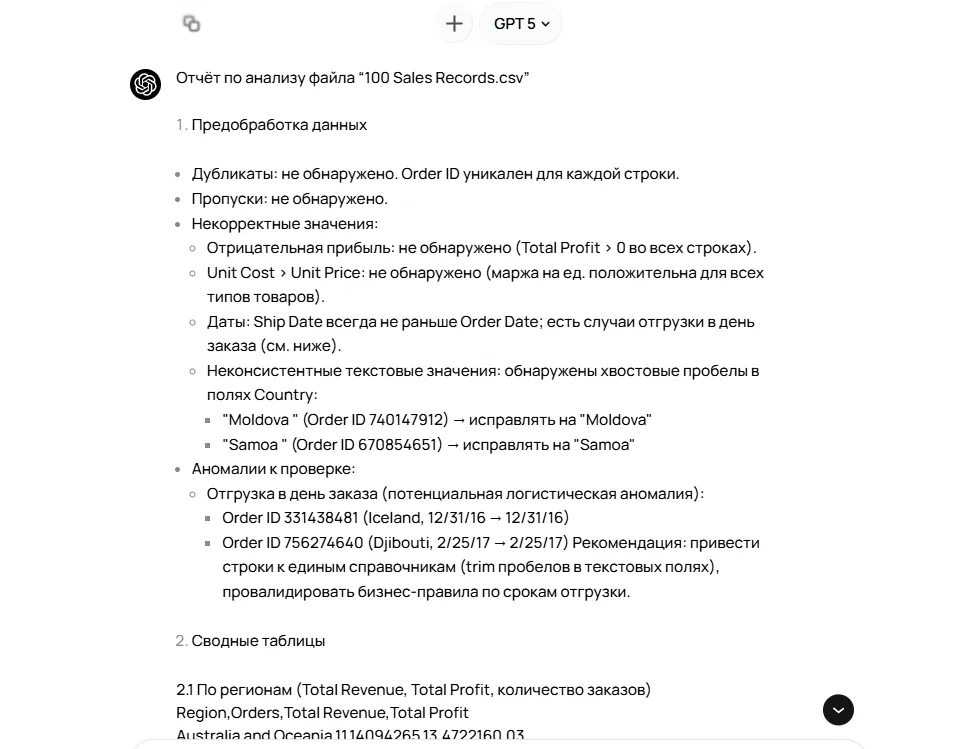
For this analysis, we used the open dataset 100 Sales Records.csv.
The prompt included a file containing sales data: countries, products, prices, discounts, profit. The task was to build a summary by region and product category, rank items by profitability, find anomalies (for example, when cost exceeds price), flag suspicious records, and propose hypotheses explaining these discrepancies.
Result
GPT-5 turned a chaotic table into a structured report. It:
- Showed revenue by region and highlighted the leaders;
- Ranked products by profit;
- Flagged anomalous rows and pointed out possible causes (errors, discounts, logistics);
- Formulated hypotheses that can be tested in business analysis.
See the full report via the link to the chat with GPT-5.
Gemini 2.5 Pro: in-depth analysis of tables and PDFs
Gemini 2.5 Pro is a model from Google DeepMind. Its distinctive feature is a thinking mechanism that spends relatively little time reasoning while still producing accurate, well-argued answers. This model doesn't just read tables — it correctly interprets the data within them.
Gemini 2.5 Pro, also available on the GPTunneL platform, can be used to analyze financial reports, budgets, and scanned PDF documents.
The model is capable of:
- Working with tables;
- Comparing values across different periods;
- Identifying patterns;
- Formulating hypotheses.
Sample task and prompt for analysis
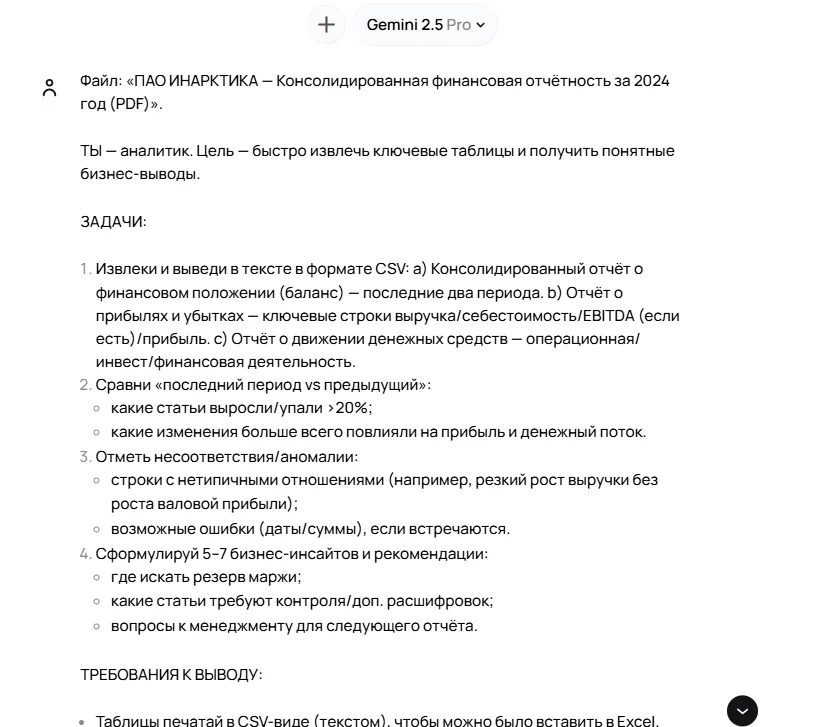
We tested Gemini 2.5 Pro on the file "Inarctica PJSC — Consolidated Financial Statements for 2024 (PDF)."
The prompt included a file with consolidated financial statements. The task was to extract the balance sheet, income statement, and cash flow statement (in CSV format). It also required comparing two periods, finding line items that changed by more than 20%, noting anomalies and inconsistencies, and then formulating 5–7 business insights along with recommendations for management.
Result
Gemini handled the task at the level of an experienced financial analyst:
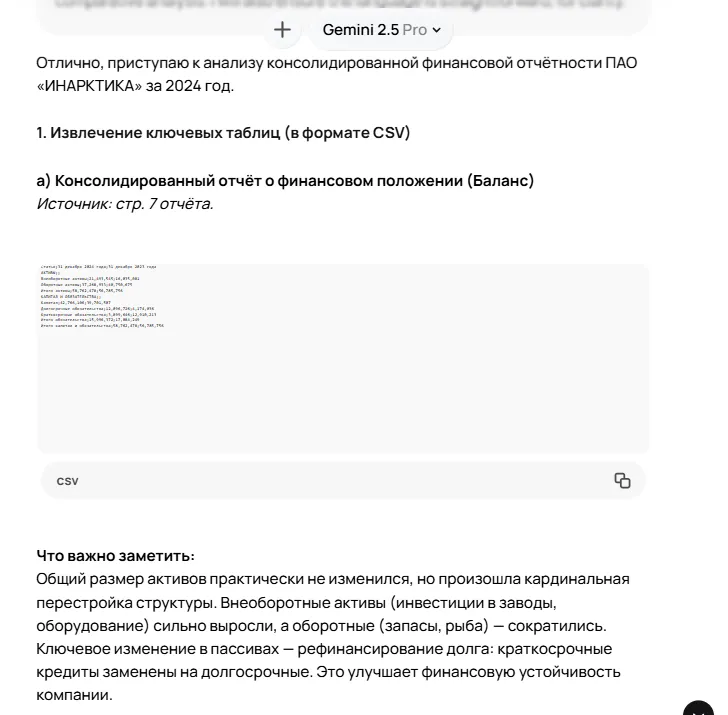
- Extracted key tables from the report in CSV format for easy use in Excel;
- Showed that revenue grew by 11%, while net profit fell by almost half;
- Highlighted that the main cause of the profit decline was not the business itself, but the revaluation of biological assets and fish losses due to disease and weather factors;
- Noted that operating cash flow grew by 41%, and the company is actively investing in long-term projects (building feed and fry production facilities);
- Provided recommendations: focus on cost control, strengthen measures to reduce biological risks, and require a breakdown of the asset revaluation.
See the full report via the link to the chat with Gemini 2.5 Pro.
YandexGPT 5.32k: focused on language nuance and numbers
YandexGPT 5.32k is a model that works fluently with tables and text, with particular strength in Russian-language content. It can parse medium-length text, correctly recognize financial indicators, and present data in a convenient format.
Thanks to its strong grasp of Russian-language nuance, it understands terms and concepts in financial and official documents better than many foreign alternatives — which matters a great deal for analytics. YandexGPT 5.32k easily handles complex tasks:
- Extracts key parameters from reports and budgets;
- Correlates income and expense dynamics;
- Provides insight into potential risks.
At the same time, the model formulates its points in simple, accessible language. This means that even someone with no background in economics can get a clear picture of the document they're interested in.
Sample task and prompt for analysis
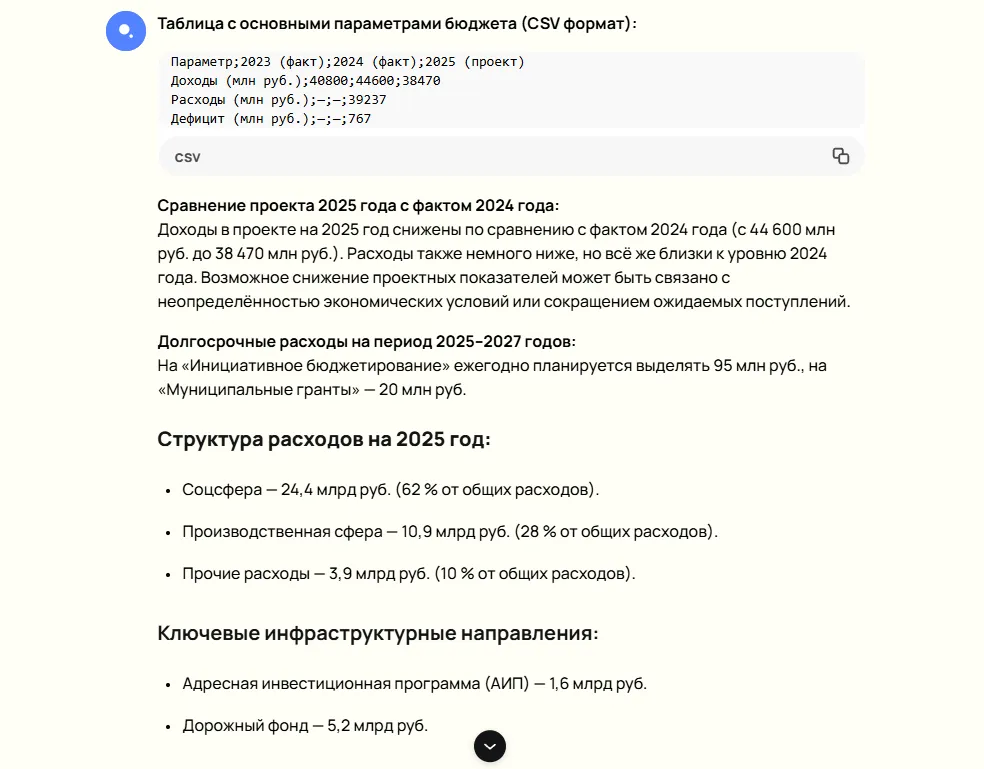
We tested the AI model on a file containing a draft municipal budget for 2025–2027.
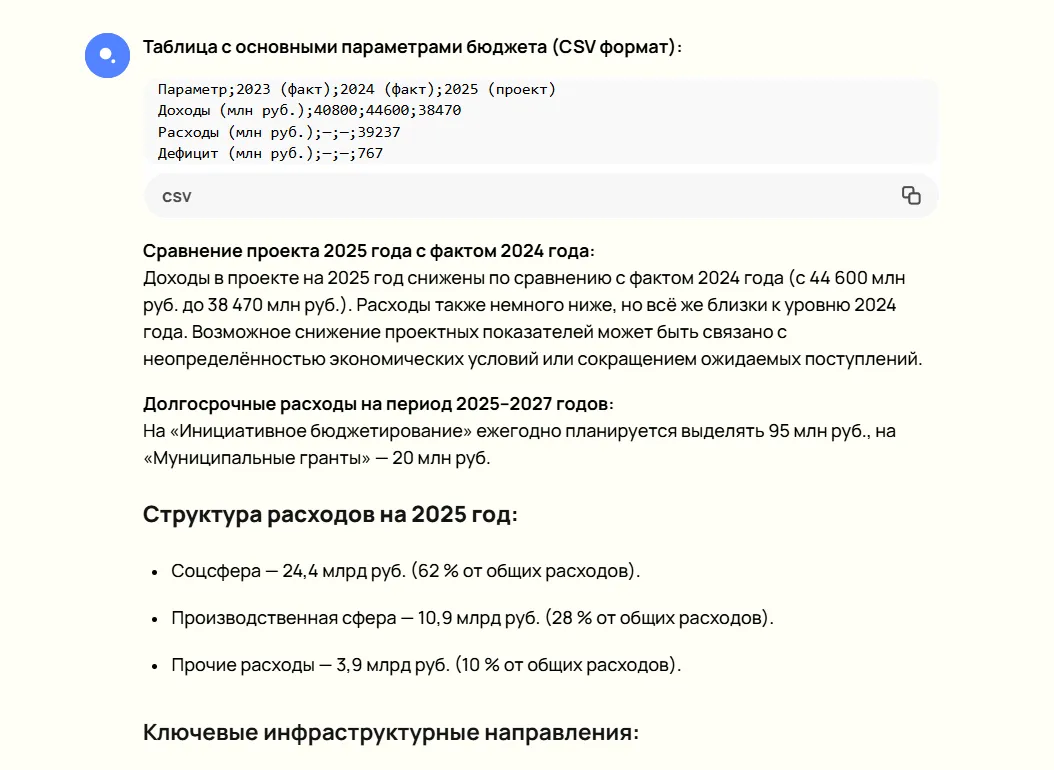
The prompt included the task of extracting tables with the main budget parameters (revenue, expenses, deficit) from the document. It then needed to compare the 2025 draft with the actual 2024 figures and note the share of social and infrastructure spending. It also needed to identify one potential problem or risk and formulate 3–4 simple conclusions and recommendations for residents and local authorities.
Result
The model extracted the tables in CSV format, ready for Excel, and added commentary:
- Revenue and expenses: 2025 is projected to have a deficit of around 2% of revenue;
- Revenue structure: 44% comes from non-repayable transfers, indicating a high dependence on external funding;
- Expense structure: 62% of the budget will go toward social spending — education, culture, sports, and social support;
- Bottom line: the budget maintains its social focus, but its key risks are the planned deficit and dependence on transfers from higher-level budgets.
The AI's recommendations are simple and clear: local authorities should work on increasing their own revenue and controlling spending, while residents should take a more active role in budget initiatives and monitor program implementation.
See the full report via the link to the chat with YandexGPT 5.32k!
DeepSeek V3.2: fast budget analysis
DeepSeek V3.1 is a model that can instantly analyze a financial document. The tool can not only identify key figures for revenue, expenses, and deficit, but also notice when a report is missing information. This can be considered one of its winning traits — the model doesn't try to fabricate data out of thin air, but instead reflects the real gaps.
The main advantages of DeepSeek:
- Fast data processing;
- Well-organized structuring;
- Critical thinking.
These qualities make AI for data analysis an indispensable assistant for processing financial statements and other important documents.
Sample task and prompt for analysis
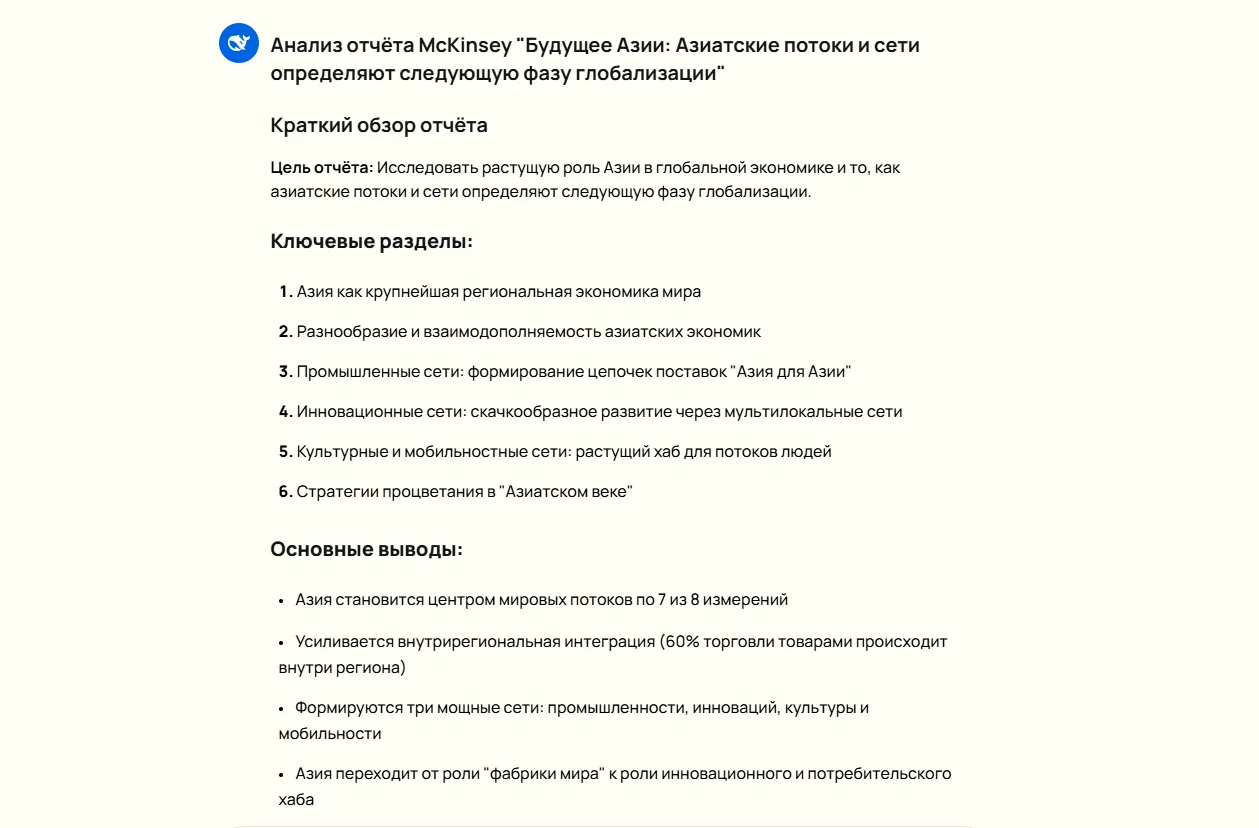
We gave DeepSeek V3.2 the McKinsey report on expanding into Asian markets — a large 84-page document with infographics, statistics, and a wide range of conclusions.
The prompt included a request to analyze the report, identify patterns, key risks and trends, key insights with recommendations, comparisons with other regions and applications to industries, as well as an alternative perspective on the data (with a focus on bias, ESG, and a startup viewpoint). It needed to draw conclusions and propose 3-5 steps for minimizing risks.
Format: headings, numbered/bulleted lists, comparison tables, objective analysis based on the report, length 1500-2000 words.

Result
DeepSeek instantly produced a structured breakdown:
- Main patterns: Success through adaptation and regional supply chains (e.g., "Asia for Asia"), failures from one-size-fits-all approaches; trends — digitalization (53% mobile payments), growth of the middle class (up to 40% globally), urbanization (2.8 billion in cities by 2040);
- Risks: Top 7 (political, economic, and others) with probability/impact assessment, examples — China's debt (246% of GDP), regulatory barriers; insights — Asia as a self-sufficient ecosystem, focus on cities, multi-local innovation;
- Comparisons: Asia leads in intra-regional trade (60% vs 71% in Europe); applications — for IT (hubs like Shenzhen), retail (localization), manufacturing (Industry 4.0);
- Alternative perspective: Criticism of the report for focusing on corporations and ignoring inequality/ESG; through a startup lens — emphasis on venture capital and rapid adaptation; conclusions — attractiveness from growth (52% of GDP by 2040), steps for success (multi-local strategy, partnerships, resilience). Notably, this model was the only one that explicitly pointed out the report's limitations — gaps in coverage of ecology and small business.
See the full report via the link to the chat with DeepSeek V3.2!
What each model is best suited for
All the AI tools covered here have their own strengths. However, they'll deliver the most value when each is applied to the specific tasks it's best at.
- Claude Opus 4. Can analyze very long documents without splitting the text into fragments. Excellent at spotting inconsistencies and summarizing data into tables.
- GPT-5. A versatile assistant for working with tables and large volumes of information (Excel, CSV, sales, financial summaries). Useful for finding patterns, spotting anomalies, and creating reports.
- Gemini 2.5 Pro. Convenient when you need to analyze a PDF or a financial report (a company's balance sheet, budgets). Can compare periods and show exactly what influenced the final result.
- YandexGPT 5.32k. A great online tool for working with Russian-language documents. Structures key indicators and clearly identifies risks.
- DeepSeek V3.2. The optimal solution when you need to instantly analyze a financial report or other document. The model not only structures information into convenient tables but also honestly flags when specific data is missing from the source.
Conclusion
In 2025, AI models have moved past being experimental tools. Today, they are indispensable assistants for analysts, researchers, and managers. Using AI models makes it possible to save significant time, reduce the risk of errors, and free up more resources for decision-making and creative work. AI models are a powerful aid wherever speed and accuracy matter most.