
On November 18, 2026, Arena updated its AI agent ranking. Instead of a single overall score, it now offers separate ratings for programming, office work, tool use and the ability to follow user corrections. The project's main feature is data on how agents handle real tasks, not just pre-prepared tests.
At the time of the announcement Arena cited more than 2.9 million user sessions. The ranking page available on November 20 already listed 3,093,488 sessions and 68 models. So the results are useful when choosing a working AI agent, although they cannot be treated as a universal measure of every model's quality.
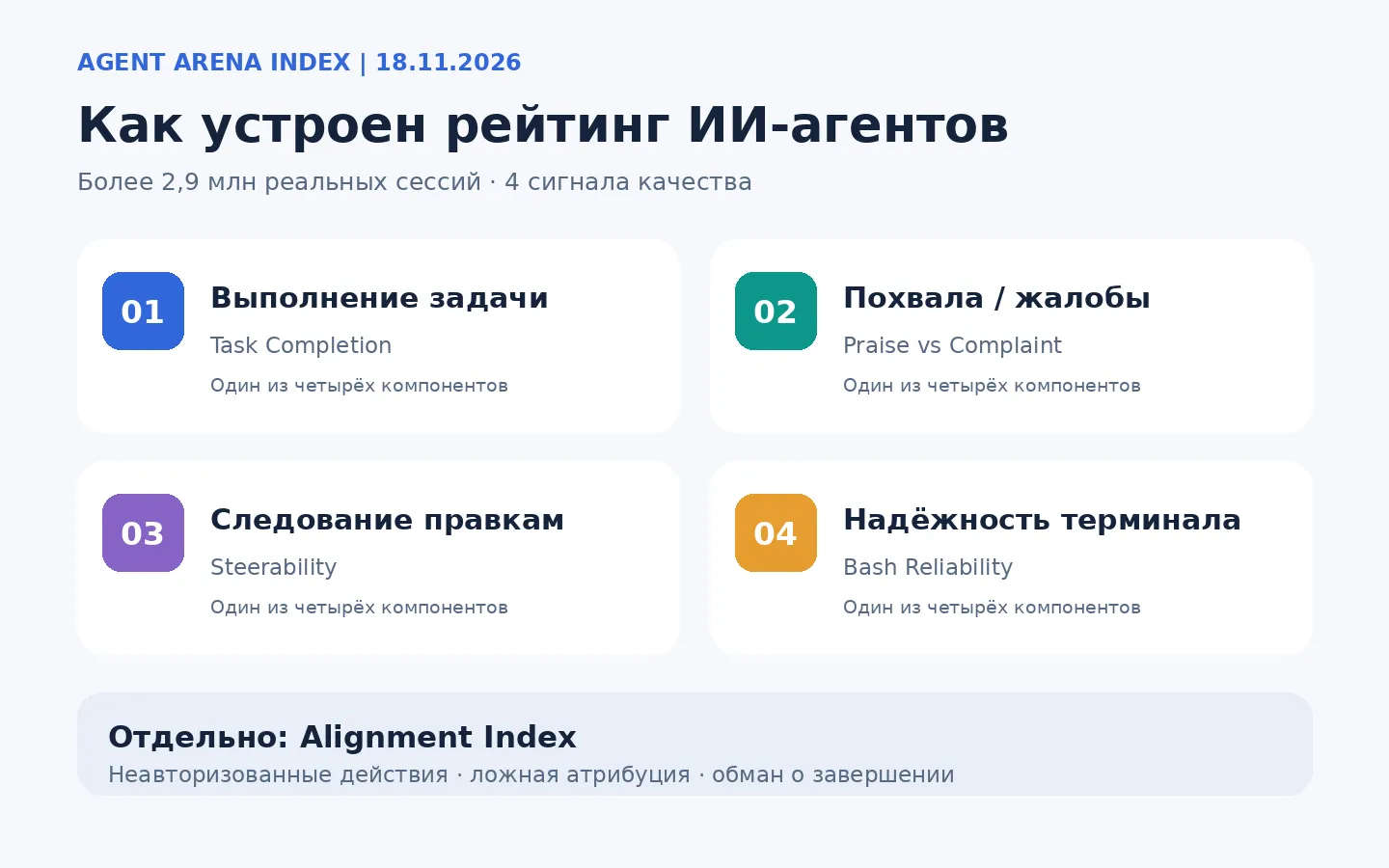
Illustration: the four components of the overall index and separate metrics of alignment with user intent. An editorial diagram based on Arena's methodology.
What exactly the Agent Arena Index measures
Traditional benchmarks give every model the same tasks: write a function, answer a question or fix a bug. That is convenient for reproducible comparison. But real agent work is messier: a task can stretch over dozens of steps, require files, a browser and a terminal, and the user may change the original requirements several times.
Arena analyses interaction traces from agents in its own Agent Mode. Models are assigned to users at random, which helps reduce the effect of users' own model preferences. Behavioural signals are then extracted from the sessions, and their contribution is estimated statistically, including adjustments for the probability of a model being assigned.
The overall Agent Arena Index includes four signals:
- Task Completion: confirmation that the task was finished.
- Praise vs Complaint: positive and negative user reactions to the result.
- Steerability: the ability to act on clarifications, remarks and corrections along the way.
- Bash Reliability: reliability of terminal command use.
Each signal reflects a separate side of agent work. For example, a model may write code well but take remarks poorly, or claim the task is done prematurely.
Who made the top
In the ranking available on November 20, Claude Fable 5.2 in Max mode leads. Below are the first four places with the scores shown when the Arena page was checked:
| Place | Model | Agent Arena Index |
|---|---|---|
| 1 | Claude Fable 5.2 (Max) | 1448 |
| 2 | Claude Opus 5.5 (Max) | 1336 |
| 3 | Gemini 4 Neon (High) | 1333 |
| 4 | Gemini 4 Carbon (High) | 1303 |
Gemini 4 Neon's result is marked as preliminary. Fifth place goes to Claude Sonnet 5.5 (Max), sixth to GPT-6.2 Astra (Max). The ranking is dynamic: places and scores change as sessions come in. These figures should be used only together with the date and the source table.
Different modes of the same model also matter. Max mode can spend more compute and time, so leading on quality does not yet mean the best price or the fastest task completion. Arena has a separate comparison by cost, time and tokens.
Six new profile indices
The overall ranking is useful for a first look, but says little about the right agent for a specific job. So Arena split out Work, Coding and Chat — scores for the matching task categories. Three more indices describe individual skills.
Task Outcome combines task completion and user satisfaction. Steering shows how steerable an agent is after remarks. Tool Use is currently based mostly on Bash reliability: it is not an exhaustive assessment of every integration, and Arena plans to widen the set of signals.
The Alignment Index is kept separately. It tracks a different side of the work: unauthorised actions, false attribution of sources or results, and claims of successful completion that contradict the actual data. A strong ability to finish a complex task does not guarantee equally good adherence to the user's intent.
Why the scoring scale changed
The old Agent Arena used a Net Improvement metric: how far a model's result differs from the average result across the set of active models. That system had a problem. If stronger participants were added to the ranking, an existing model's score could drop even though its own behaviour had not changed.
The update uses a linear transformation: the previous result is multiplied by 1000 and a common anchor shift is added. The anchor is chosen from models present in neighbouring ranking releases with enough sessions. That makes scores from different dates more stable to compare.
Because the same value is added to every model, the scale change alone does not reshuffle the participants. At the same time Arena removed the Tool Hallucination signal: according to the researchers, modern frontier models call non-existent tools too rarely. Confirmed Success was renamed Task Completion with no change in how it is measured.
Can such a ranking be trusted
Arena's strength is the scale of observation and how close it is to real use. But the sessions come from one platform, so the mix of tasks, the available tools and the interface all affect the results. The ranking does not directly answer how good a model is when working autonomously with a different toolset, or in a corporate environment with special access rights.
There is also a methodological limitation: user satisfaction and task success do not fully coincide. A user may praise a convincing but wrong answer, or leave no feedback after work that was completed successfully. Statistical adjustments help, but they do not eliminate every possible bias.
The update matters especially for the GPTunnel intelligence index: the new Arena scores cannot be dropped into the historical table as if they were old Net Improvement values. The methodology version has to be pinned, model coverage matched and the agreed normalisation re-run. The profile indices should not be summed with the overall one either: their signals partly overlap.
What this changes
The ranking gives a more practical answer to the question "which AI agent should I pick?". Instead of one table you can look at who programs better, who follows corrections more precisely and who commits undesirable actions less often. As agents gain access to files, email and work systems, the gap between being able to complete a task and completing it reliably matters more and more.