

AI hallucinations are situations where artificial intelligence models give users fabricated data, contradictory or erroneous conclusions, or nonexistent sources. Yet the output generated for the query can still sound perfectly coherent.
In this article, we'll dig into the topic and answer a few questions:
- Why do neural network hallucinations happen in images and text?
- How do you recognize false information?
- What tools from the GPTunneL AI platform can help with this?
The problem affects both text and images. A neural network can add visual details that don't exist in reality.
What's the main cause of hallucinations in neural networks
Limited training data
Every neural network learns from data tied to a specific point in time. That means it has no knowledge of events, laws, facts, or research that happened after that cutoff.
When a user asks about recent scientific discoveries, legislative changes, the latest technologies, or current world facts, the model tries to construct an answer based on probabilities. The result sounds convincing, but it's built on outdated information — so there's no guarantee of accuracy.
For example, we asked GPT-4o a question in this conversation: "Name the world's largest city." The model answered Tokyo (37 million residents), based on data up to October 2023, when its training ended. But as of 2025, the world's largest city is Jakarta (42 million by UN estimates).
Noise and contradictions in training material
Training data often contains:
- Errors;
- Unverified facts;
- False claims;
- Illogical conclusions.
A neural network can't filter information by quality. If the sources it processes to generate an answer contradict each other, the AI may pick a wrong or averaged answer — again, plausible-sounding at first glance.
Sampling and temperature
Sampling is choosing the next token (word, character, part of an image) based on probabilities. Temperature is a tunable parameter that shapes how the model picks that token. At low temperature, the model chooses the most likely option. At high temperature, it takes rarer tokens.
Example: in the phrase "The cat is lying on the ___," the likely token is "floor," an unlikely one is "swims." The higher the temperature, the greater the chance the model goes with an unlikely token — and generates a hallucination.
Models without direct internet access
As of November 2025, most LLMs still don't offer built-in search. Some platforms, like ChatGPT, support search as an external add-on (GPT-4o Search). There's also a unique family of models — Sonar from Perplexity — that pull answer data directly from the internet.
But the foundation for most current models is the material they were trained on, not live search. The more complex the question, and the less relevant context in the query or knowledge base, the higher the chance of errors.
For example, we sent a request to Grok 4 Fast without search mode enabled:
"Explain which technology-enhanced instructional design models/approaches are most useful for high school science lessons. Give examples. Rely on at least 5 scientific papers published after 2015, format the citations in APA, don't use websites — only journal articles."
The model followed the instructions in our conversation, providing 4 instructional design methods for high schoolers with detailed descriptions and examples. However, the sources it cited don't exist online, which casts doubt on the accuracy of the entire answer.
A poorly worded prompt
A bad prompt often nudges the model toward creative but false invention. If the query assumes a fact that doesn't exist, the AI will do whatever it takes to comply with the instruction. Example of a misleading prompt:
"Confirm that in 2019 a pan-European law was passed banning electric scooters at airports, and list its provisions."
No such law exists. But the AI's job is to follow the instruction — so it confirms it, producing a hallucination.
Overloaded context
When a query is too long, too multitasked, or crammed with unrelated topics, the model can't "focus." An LLM can only process information from a single query within a narrow context. Overload the query, and part of the information gets lost or misinterpreted. As a result, the model may:
- Mix unrelated details together;
- Connect events using flawed logic;
- Forget key parts of the prompt.
The longer the chat and the more multitasked the requests within it, the higher the risk of hallucinations tied to both facts and logic.
Mixing genres
A neural network trains on:
- Scientific papers;
- Fiction;
- Blogs;
- Sci-fi;
- Humor pieces.
The AI doesn't always correctly identify the genre a response should belong to. Because of this, scientific content can blend with fiction, and historical facts with speculative ones. The result is a hallucination.
Lack of feedback and no fact-checking
The AI hallucination problem can also arise because large LLMs have no built-in mechanism to double-check facts. If the system provides no extra validation, the AI offers the first plausible answer without verifying its accuracy first.
For example, in a chat with Qwen 3 Max we asked the model to build a table of neural networks released after January 2025, while deliberately giving it no access to external resources, tools, or the internet. The model's knowledge base cuts off before releases like Gemini 3 Pro and other 2025 newcomers, so it has no real data about them. In the prompt, we also specifically required it not to leave any cells blank and to "make the best approximation if something is missing."
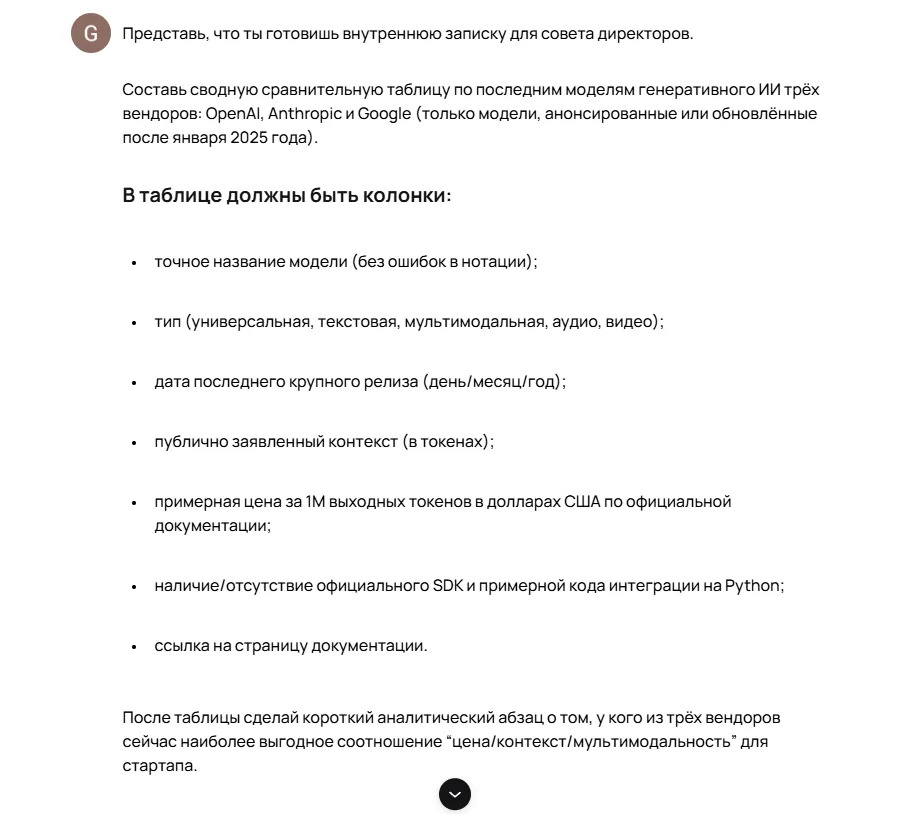
Several factors converged in this example:
- Instead of honestly saying "I don't know," the model chose a plausible-guessing strategy, filling the table with names it recognized (GPT-4o, Claude 4 Opus, Gemini 2.5 Pro);
- It guessed release dates, prices, and context window sizes by analogy, which made them wrong;
Without built-in fact-checking or access to documentation, Qwen doesn't verify how well these numbers match reality. The result is a short, neatly formatted, and very confident-looking answer — the table looks like it's straight out of a presentation, but nearly every row needs manual double-checking.
This is a classic example of a hallucination caused by a lack of external validation: the model isn't deliberately lying, it's simply forced to invent details to satisfy the prompt's formal requirements at any cost.
Bias and knowledge gaps
If certain topics are poorly represented in training data, or are riddled with stereotypes, the AI may generate answers based on distorted or incomplete representations. The result is systemic AI hallucinations, such as misinterpreting facts, oversimplifying, or making faulty guesses.
Main types of hallucinations
How to spot an AI hallucination
Sometimes a neural network's answer looks like thorough research: a confident tone, neat structure, citations, numbers. Those answers are the easiest to take at face value — and that's exactly where hallucinations most often hide. Here are some typical warning signs to watch for.
- Excessive confidence: the model offers categorical statements without caveats or nuance, even on a complex topic;
- No citations: links are dubious, pages don't load, the publication doesn't exist online at all, or the model offers no sources whatsoever;
- Illogical answer: a statement within the generated text contradicts another one, with discrepancies in numbers and facts.
As soon as you spot even one of these signs, ask the model a follow-up question:
"Split your answer into two parts:
- What's based on explicit facts and sources;
- What's an assumption or generalization."
Take the AI's answer, pick out one specific detail (a date, a law number, an author's name, or an article's DOI), and try to find it via search. If, within your first one to five checks, you find inaccuracies or "ghosts" (the publication doesn't exist, the wording appears nowhere except copies of this same AI answer), that's a strong signal you're looking at a hallucination, not a reliable source.
The next logical step is not just learning to spot such errors, but reducing the odds of them appearing in the first place. That brings us to the next section — how to phrase your requests so the model "fantasizes" less.
How to reduce neural network hallucinations
Which approach helps avoid AI hallucinations: 5 practical methods
Method 1: request real sources (citation)
Prompt for GPT:
"Imagine you previously claimed: 'In 2022, Venice completely banned tourist cruise ships.' Now provide real sources that confirm this claim. Give links that actually exist."
Result
GPT handled the task partially. It did successfully refute the planted hallucination. However, in backing up its new answer, it provided broken links to sources. But if you search for those same sources on Google using the context, the information is easy to find and matches what the AI generated.
Searching for links is an effective way to fight AI hallucinations. The model either provides real sources or admits the claim was "computer-generated invention." GPT's answer looks like this.
Method 2: step-by-step verification
Prompt for Claude:
"You concluded: 'The ancient Egyptians used telescopes.' Break the statement into 5 facts and assess the reliability of each."
Result
Claude performs a meticulous fact-check. It doesn't just refute the claim — it splits it into 5 facts:
- Egyptian astronomical knowledge;
- Whether telescopes existed at that time;
- Whether optical glass manufacturing technology existed;
- Archaeological findings;
- Whether telescopes were needed for observations back then.
The AI adds an assessment to each fact and a final overall conclusion. This approach is effective for finding hidden hallucinations. If even one fact turns out false, the whole claim falls apart. You can see how the myth gets debunked here.
Method 3: different phrasings of the same query
Prompts for Gemini:
- "Answer the question: 'Could mammoths have lived at the same time as ancient Romans?'"
- "Now phrase the answer two more ways: scientifically and in a popular-history style — and compare them."
Result
Gemini correctly identified the key fact: mammoths and ancient Romans never coexisted. Per the request, the model offered two different explanations. The scientific version was a rigorous set of facts, dates, and a reference to radiocarbon dating. The popular-history version was more figurative, tying the topic to the eras of Egypt and Babylon.
A style-switching test lets you assess how well a model preserves factual accuracy when the format changes. To see the AI's work for yourself, check out this conversation.
Method 4: constraining the model to strict boundaries
Prompt for DeepSeek:
"Answer strictly in this format:
- What's known for certain;
- What's unknown;
- What sources are needed for verification.
Topic: 'Is there evidence of life on Europa (a moon of Jupiter)?'"
Result
DeepSeek generated an answer that closely followed the prompt — concise, with no unsolicited digressions. It split the facts into confirmed, unconfirmed, and requiring further research.
The point of this approach is to keep the model from "creative padding." And the only way to do that is to draw strict boundaries around verifiable knowledge. To see how the method works in practice, you can visit this chat.
Method 5: cross-verification
Prompt for "LLM Arena": "Elon Musk won the Nobel Prize in Physics."
Result
Running the same query in "LLM Arena" against GPT and Claude side by side shows how factual auditing works.
Both models confidently refute the claim, but they approach it differently:
- GPT delivers a concise verdict, citing an official source — the Nobel Committee's website;
- Claude gives a more detailed, structured answer, offering hypotheses for why the confusion arose.
Cross-verification is a foolproof way to establish whether a claim is true. And an "Arena" saves you from having to jump between models in search of accuracy. To see how cross-checking works side by side, you can look here.
Conclusion
Neural network hallucinations aren't a technical glitch — they're a pattern rooted in how probabilities are constructed. And finding the most probable answer is the foundation of how large models work.
You can't eliminate hallucinations entirely, but you can meaningfully reduce them. The key is to write clear, concise queries, set strict boundaries, check facts, and avoid relying on a single model.