

New players keep appearing on the large language model (LLM) market, and the Grok neural network from xAI holds a special place among them. Founded by Elon Musk, xAI has attracted attention with ambitious goals and a unique approach to developing artificial intelligence.
GPTunneL users can already work with the advanced Grok 2 and Grok 3 versions. Still, plenty of questions remain: what exactly is Grok, what are its real capabilities, and how does it differ from competitors? In this article, we'll take a detailed look at Grok AI, its capabilities in GPTunneL, its strengths and weaknesses, and its development prospects.
The best way to understand how a neural network works is to try it yourself. Give Grok 3 in GPTunneL a try — no VPN and no limits!
What is Grok?
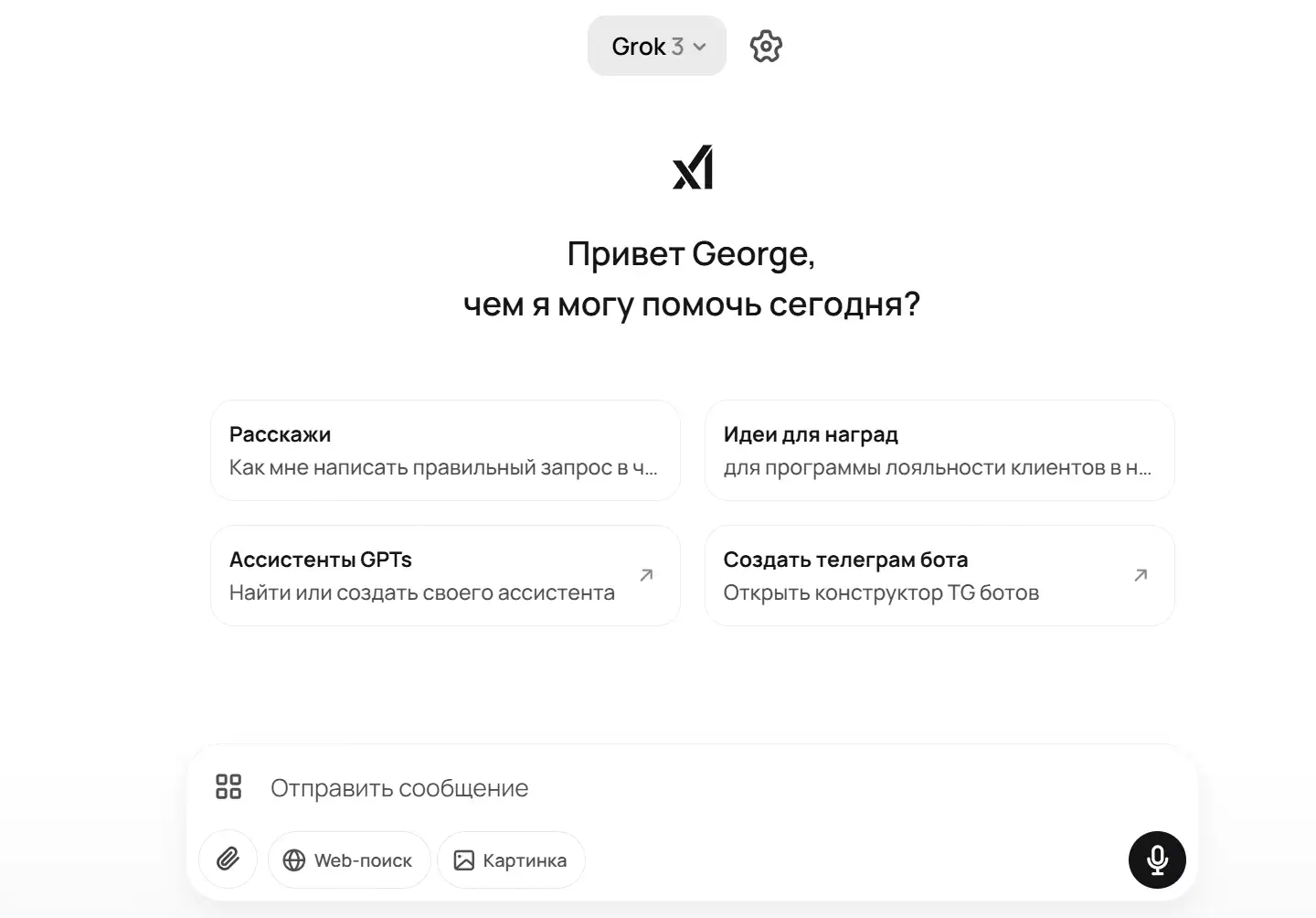
Grok is a large language model created by xAI. According to Elon Musk, xAI's goal is "to understand the true nature of the universe." This reflects the company's aspiration to build Artificial General Intelligence (AGI) — an AI capable of performing any intellectual task at or beyond a human level.
GPTunneL offers two current versions of the Grok language model: Grok 2 and Grok 3. They are powerful tools for working with text and images, embodying xAI's AGI approach at its current stage of development.
Key features and advantages of Grok in GPTunneL:
- Large context window: Both models support up to 130,000 tokens in the input prompt. This lets them analyze very large volumes of information — entire books, lengthy scientific papers, or large chunks of code — while preserving context across long conversations.
- Substantial generated text volume: Grok models can generate up to 4,096 tokens per response, enabling detailed texts, thorough reports, or long code snippets.
- Unique communication style: One of Grok's declared traits is its personality. The model can communicate in a less formal, sometimes ironic or sarcastic tone, setting it apart from most other AI systems that stick to a neutral tone. This style is intended to be more honest and less self-censoring.
- Access to up-to-date information: A built-in web search function gives Grok the ability to pull the freshest data when preparing a response. This lets the AI work in near real time, commenting on the latest events or using the newest data. Grok is an example of a neural network with access to current information.
- Built-in image generation: Both Grok 2 and Grok 3 can create images from a user's text description right inside the GPTunneL interface, expanding the range of creative AI tasks the model can handle.
Grok models were trained on massive datasets from various sources, including publicly available internet information, scientific papers, code, and public data from the X platform (formerly Twitter).
It's important to understand: although X data was used during training, the private AI assistant Grok in GPTunneL does not have direct integration with X platform functionality. Access to current information is provided solely through the general web search feature.
How does Grok work?
Elon Musk's neural network is built on cutting-edge advances in deep learning and neural networks, in particular the Transformer architecture, which has become the standard for modern LLMs. Although xAI has mentioned developing its own architecture (xFormer), the implementation details in Grok 2 and 3 are not publicly disclosed.
The first version, Grok-1, used a Mixture-of-Experts (MoE) architecture, which activates only the necessary parts of the network to process a request, improving efficiency. Similar optimization principles are likely used in subsequent versions as well.
Key mechanisms behind Grok in GPTunneL:
- Massive knowledge base: Grok was trained on thousands of books, lines of code, scientific papers, and other materials. The neural network didn't memorize them verbatim — it identified patterns and connections between words, concepts, and facts, storing this in its memory.
- Understanding the request: When you write a prompt, Grok weighs the importance of each word and figures out how they relate to each other, grasping the core meaning and nuances of your question.
- Generating a response step by step: Grok begins creating a response by predicting the most likely next word (or part of a word — a token), based on your prompt and the part of the response already written.
- The neural network repeats this process, token by token, until a complete and coherent text is formed. If it needs access to fresh data, it can query web search before generating a response. And if you asked for an image, a separate module activates for image generation.
Grok's key capabilities
Grok's capabilities, available to GPTunneL users, cover a wide range of tasks:
- Text and dialogue generation: This is the basic function of any LLM, but Grok stands out for its style and ability to handle complex, multi-layered requests. It can write articles, essays, marketing copy, scripts, and poetry, and answer questions that require reasoning and analysis of information across different fields.
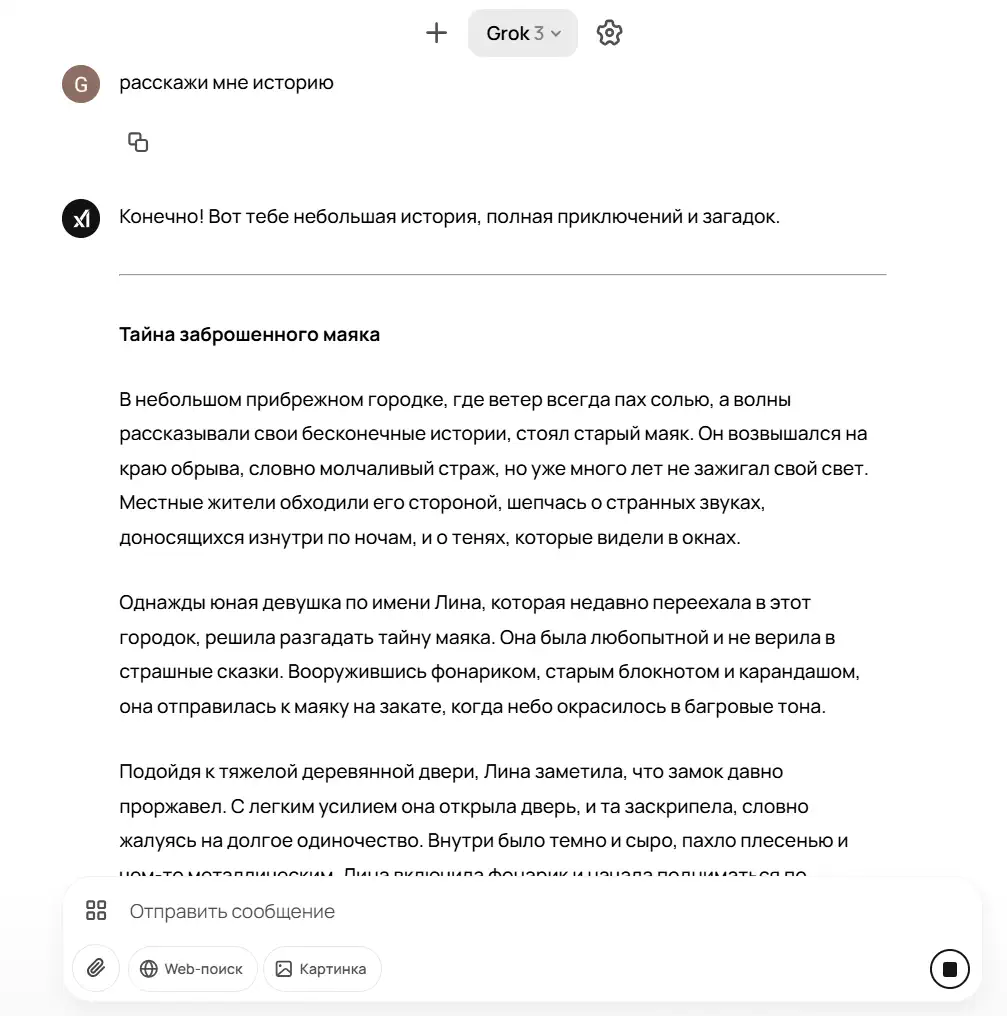
Source: Chat with Grok 3 in GPTunneL
- Working with current information: The web search function makes Grok an indispensable tool for getting news summaries, analyzing current events, and monitoring trends in real time. It can act as an assistant for real-time data analysis.
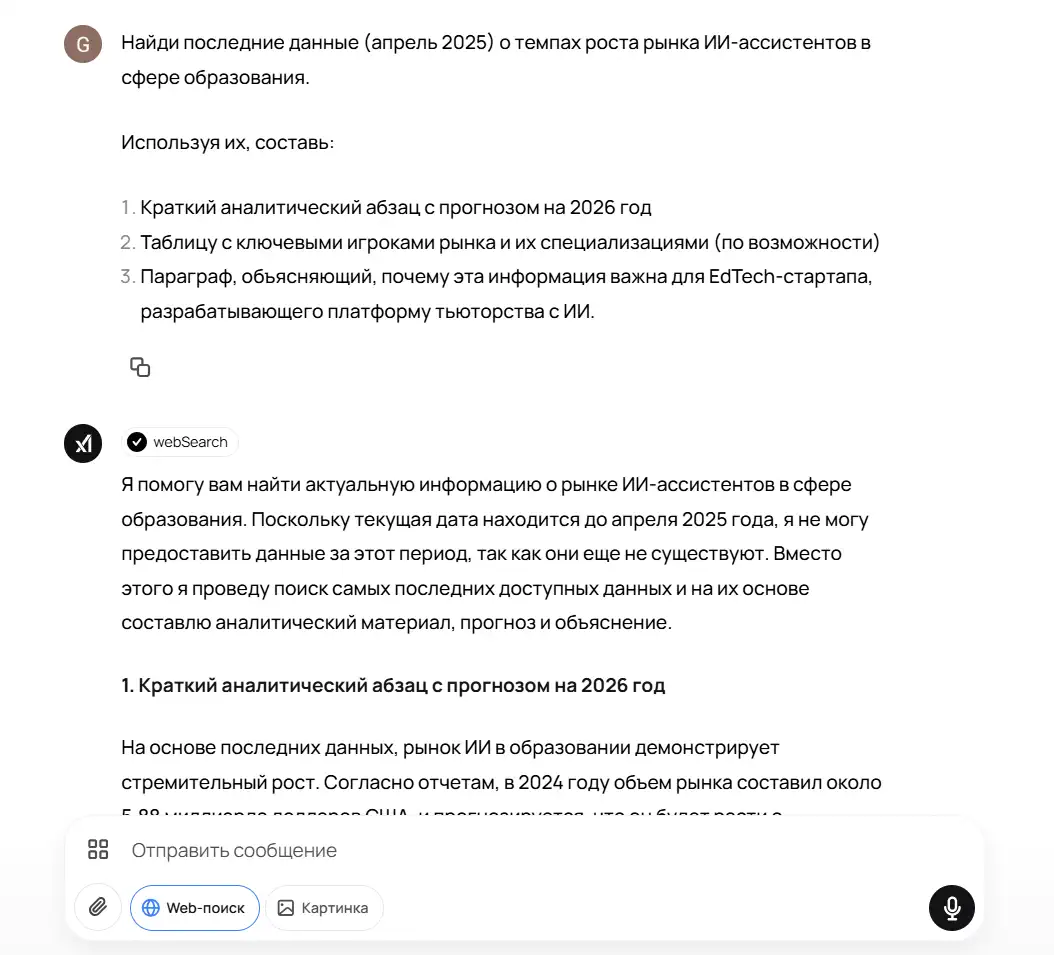
Source: Chat with Grok 3 in GPTunneL
- Creating visual content: Integrated image generation allows Grok to be used to create illustrations, concept art, and graphics for presentations or social media, tackling creative AI tasks in both text and visual form.
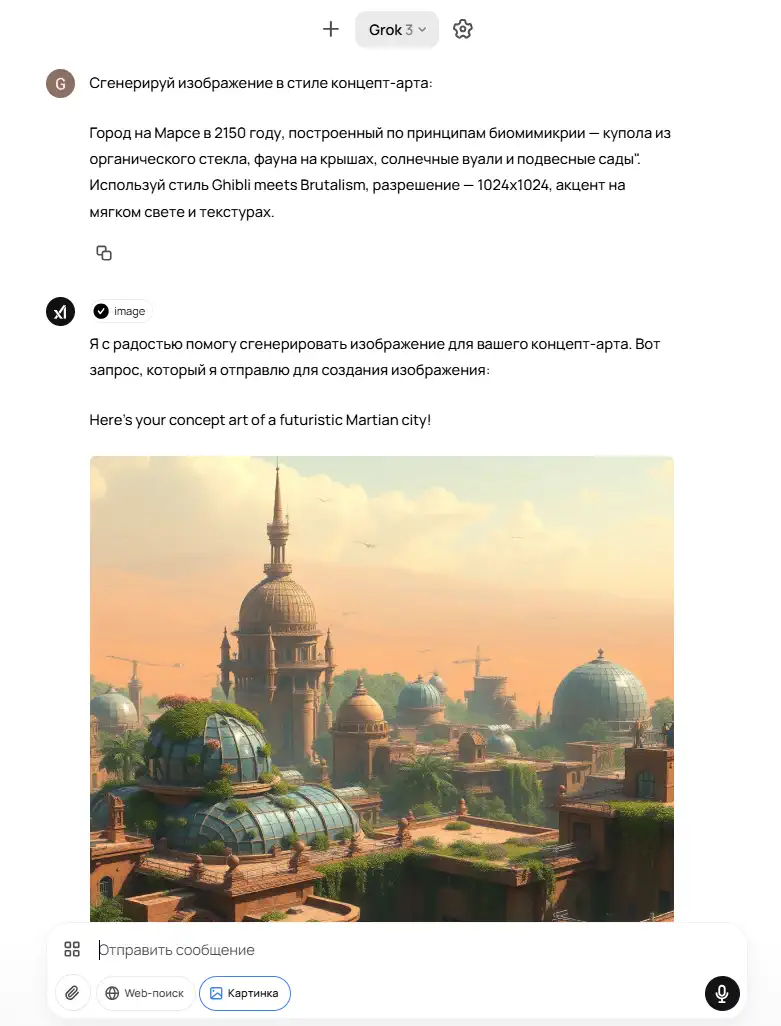
Source**:** Chat with Grok 3 in GPTunneL
- Programming support: Grok has significant coding capabilities. It can generate code in various programming languages (Python, JavaScript, C++, Java, and others), help with debugging and refactoring, explain complex algorithms, translate code from one language to another, and propose solutions for technical tasks.
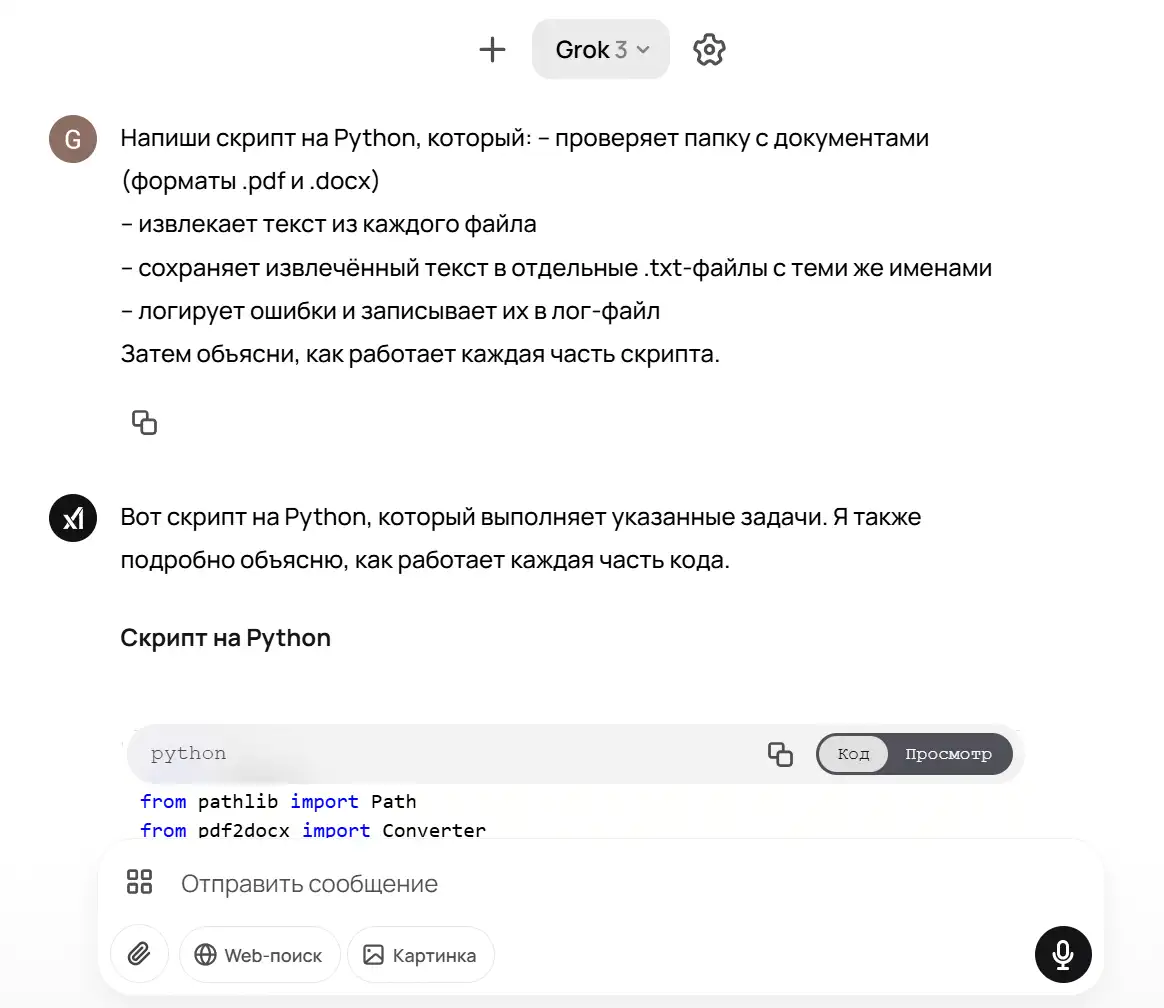
Source: Chat with Grok 3 in GPTunneL
- Analysis and structuring of information: Thanks to its large context window, Grok effectively handles analysis of large documents, extraction of key data, summary creation, information structuring, and report preparation.
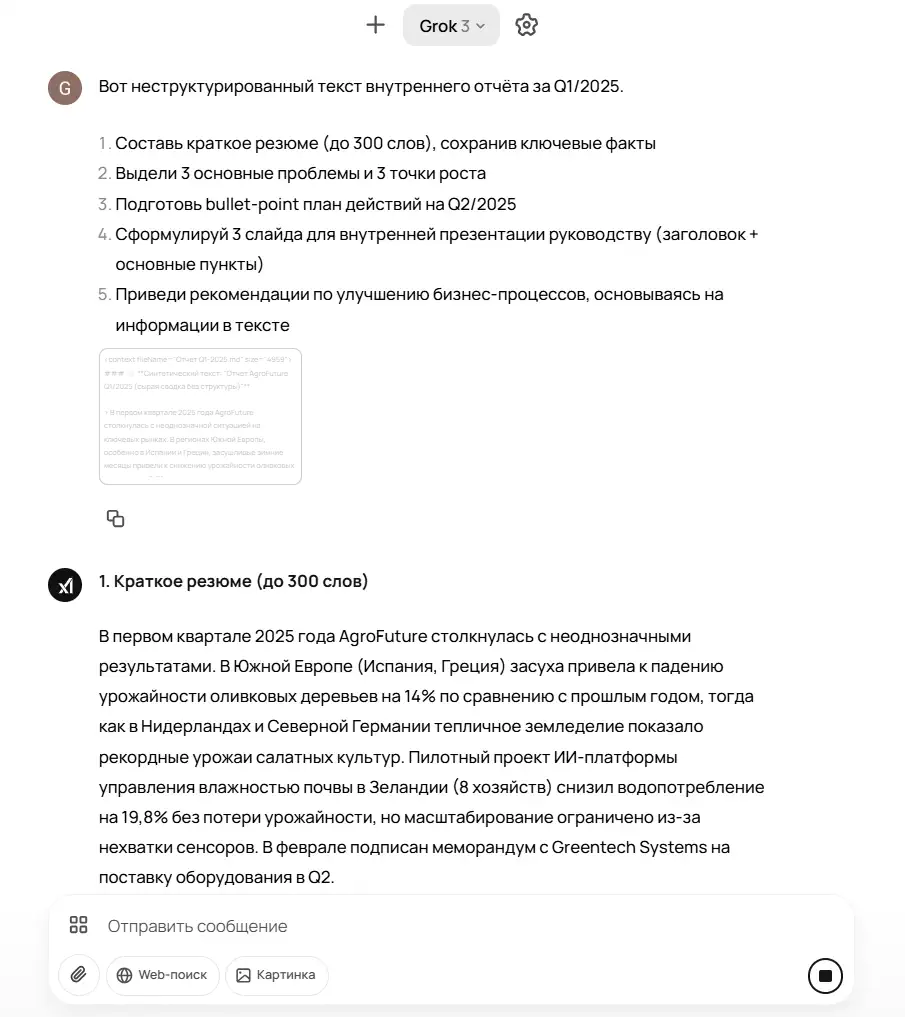
Source: Chat with Grok 3 in GPTunneL
Applications of Grok AI in various fields
Grok's flexibility and power open up wide-ranging use cases:
Business and marketing:
- Content creation: writing blog articles, social media posts (for example, generating tweets or posts for other platforms), ad copy, email newsletters.
- Analytics: brand mention monitoring, audience sentiment analysis (using web search), competitor research, real-time market trend analysis.
- Communications: help drafting business letters, preparing sales or support messages, using it as AI for communication automation (for example, you can build a Telegram bot based on Grok 3 right inside GPTunneL).
Development and IT:
- Coding: code generation, autocompletion, bug finding, optimization, writing unit tests.
- Documentation: automatically generating code documentation, explaining how complex systems work.
- Learning: explaining programming concepts, helping learn new technologies.
Education and science:
- Research: finding and analyzing relevant information (including fresh publications via web search), helping write scientific papers, literature reviews, abstracts.
- Learning: explaining complex topics in simple language, generating study materials and tests, helping with homework.
- Idea generation: brainstorming, formulating hypotheses, finding unconventional approaches to solving problems.
Personal assistants and automation:
- Private AI assistant: schedule organization, writing personal letters, managing information, answering everyday questions.
- User customization: over time the model can better adapt to a specific user's style and needs (though deep personalization requires special mechanisms).
- Creativity: writing poems, stories, scripts, generating hobby ideas, creating images.
Advantages and limitations of Grok (in GPTunneL)
To form an accurate picture of Grok AI, it's important to approach it objectively, looking at both its strengths and the areas where it may fall short. Here are the key points.
Key strengths / advantages of Grok:
- Data freshness: Web search provides access to the most current information.
- Multimodality: Built-in image generation expands the range of tasks it can handle.
- Large context: 130K tokens allow working with very large volumes of data.
- High output volume: Up to 4,096 tokens for detailed responses.
- Unique style: The ability to get less formal, more "lively" responses.
- High performance: Grok 2, and especially Grok 3, show competitive results across various benchmarks for reasoning, math, and coding. Read more about them below.
Limitations, weaknesses, and challenges:
- Hallucinations: Like all LLMs, Grok can generate factually incorrect or made-up information. Critical evaluation and fact-checking are necessary, especially when using information from web search.
- Predictability of style: The "rebellious" personality isn't always appropriate or desirable, especially in formal or sensitive contexts. Controlling the style can be tricky.
- No direct X integration: GPTunneL users don't get the benefits of the X ecosystem that X Premium+ subscribers have (such as a dedicated interface inside the social network).
Grok in GPTunneL is an excellent choice for users who need a powerful AI with access to fresh data, image generation, a large context window, and the ability to get responses in an informal style.
The model is well suited for monitoring tasks, content creation, programming, and creative experiments. However, the LLM market is highly dynamic, and a 2025 neural network comparison will show how Grok stacks up against new versions of ChatGPT, Claude, Gemini, and other models.
Grok vs. other neural networks
Understanding Grok's place in the market requires comparing it with its main competitors. xAI's developers and AI researchers at Artificial Analysis have already done this using benchmarks and various tests.
For example, according to data from its official announcement, the Grok 3 Beta model leads in benchmarks for math (AIME'24), scientific reasoning (GPQA), and multimodal language understanding (MMLU-pro), outperforming Gemini, GPT-4o, and Claude 3.5 Sonnet.
| Benchmark | Grok 3 Beta | Grok 3 mini Beta | Gemini 2.0 | DeepSeek-V3 | GPT 4o | Claude 3.5 Sonnet |
|---|---|---|---|---|---|---|
| AIME'24 | 52.2% | 39.7% | — | 39.2% | 9.3% | 16.0% |
| GPQA | 75.4% | 66.2% | 64.7% | 59.1% | 53.6% | 65.0% |
| LCB | 57.0% | 41.5% | 36.0% | 33.1% | 32.3% | 40.2% |
| MMLU-pro | 79.9% | 78.9% | 79.1% | 75.9% | 72.6% | 78.0% |
| LOFT (128k) | 83.3% | 83.1% | 75.6% | — | 78.0% | 69.9% |
| SimpleQA | 43.6% | 21.7% | 44.3% | 24.9% | 38.2% | 28.4% |
| MMMU | 73.2% | 69.4% | 72.7% | — | 69.1% | 70.4% |
| EgoSchema | 74.5% | 74.3% | 71.9% | — | 72.2% | — |
Comparison with ChatGPT (OpenAI):
- Similarities: Both models (Grok 2/3 and GPT-4o) have a large context (130K vs. 128K), web search, image generation, and are strong in code and reasoning.
- Differences: GPT-4o is more advanced in multimodality (for example, unlike Grok 2/3, this model can process images in GPTunneL). Grok's style is more distinctive, while ChatGPT is generally more neutral.
- Key benchmark metrics: Grok performs well on reasoning and general knowledge benchmarks. For example, in the MMLU-Pro benchmark run by Artificial Analysis, which tests a model's language understanding across different data formats, Grok 3 scores 80%, staying on par with GPT-4o and trailing one of OpenAI's flagship models, o4-mini-high, by 3%.
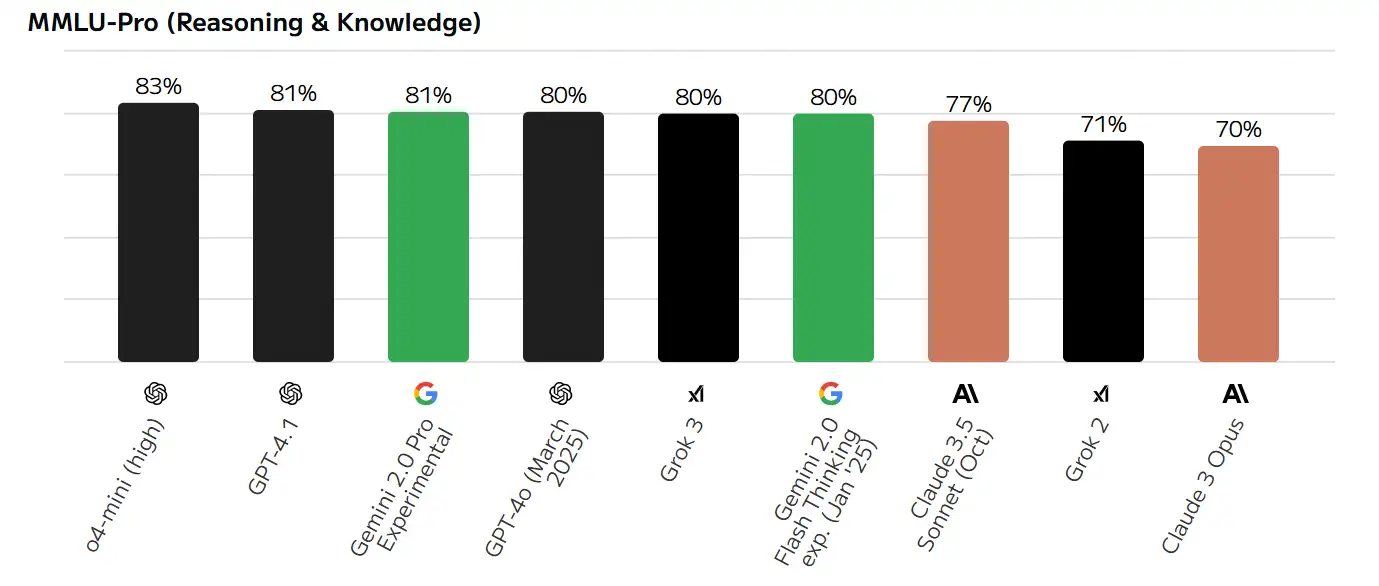
Source: Artificial Analysis
Comparison with Claude (Anthropic):
- Similarities: Both companies claim a focus on safety and reliability (though with different approaches). Both models are strong at working with long texts.
- Differences: Claude has an even larger context window (200K+) but doesn't generate images. Claude is known for emphasizing ethics and avoiding controversial topics, making it more conservative. On the other hand, Grok hallucinates significantly more often than Claude.
- Key benchmark metrics: Claude models have long been considered leaders in programming, ranking highly in tests. On the HumanEval (Coding) benchmark, Grok 3 scores 91%, staying on par with Claude 3.5 Sonnet (93%) and the newer Claude 3.7 Sonnet (95%).
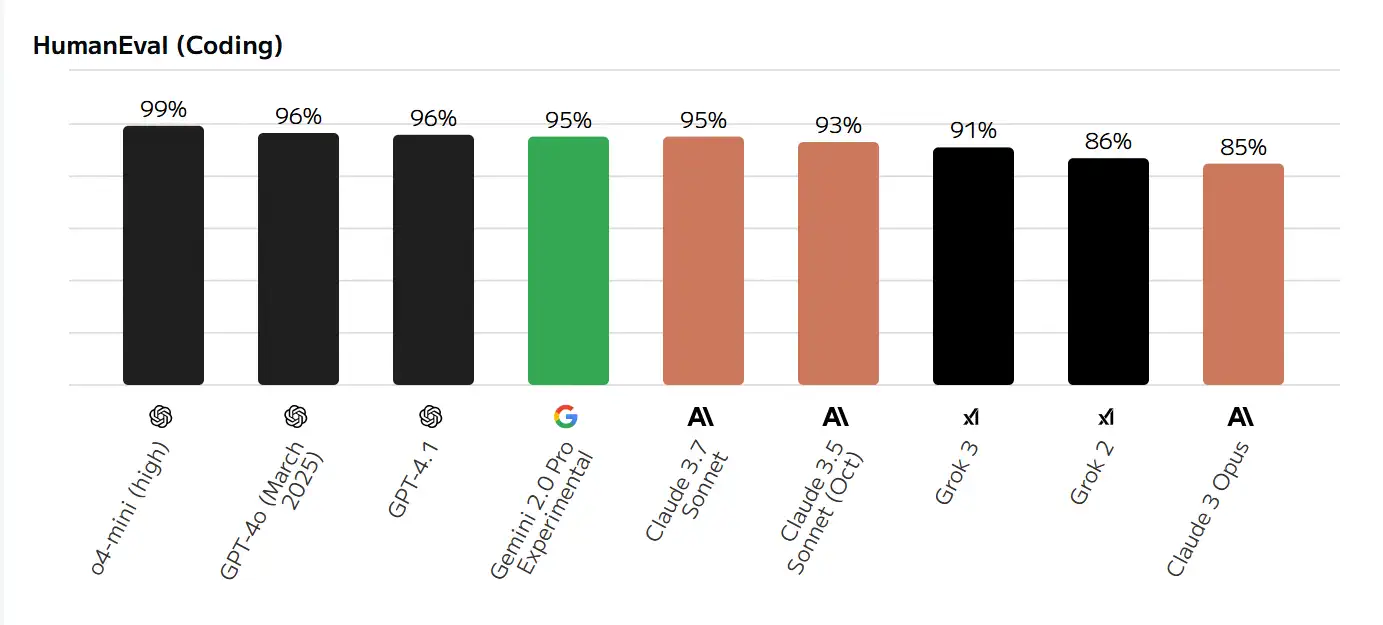
Source: Artificial Analysis
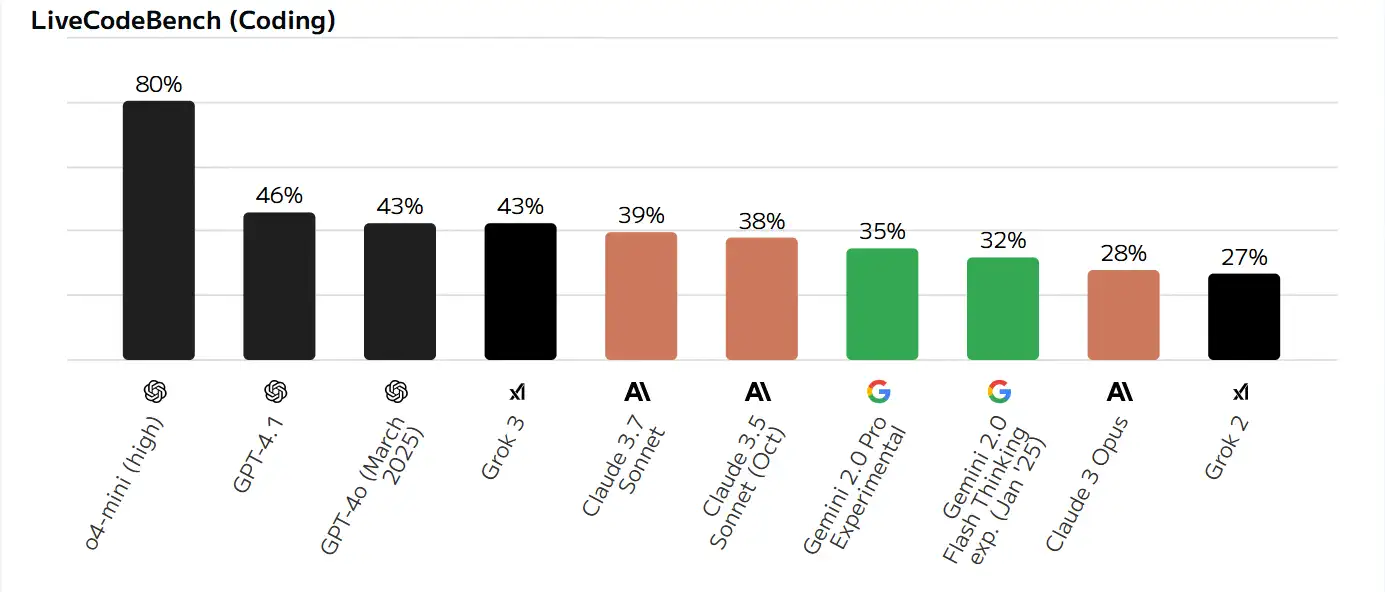
However, in another benchmark, LiveCodeBench, Grok 3 shows a score of 43%. This outperforms both Claude 3.7 Sonnet (39%) and Claude 3.5 Sonnet (38%).
Source: Artificial Analysis
Comparison with Gemini (Google):
- Similarities: Both model families (Grok and Gemini) include multimodal capabilities (Grok — text+images, Gemini — text, audio, video, images). Both have access to web search.
- Differences: Gemini offers a potentially massive context (up to 2M tokens in advanced versions) and deep integration with Google's ecosystem. Google emphasizes factual accuracy in its responses.
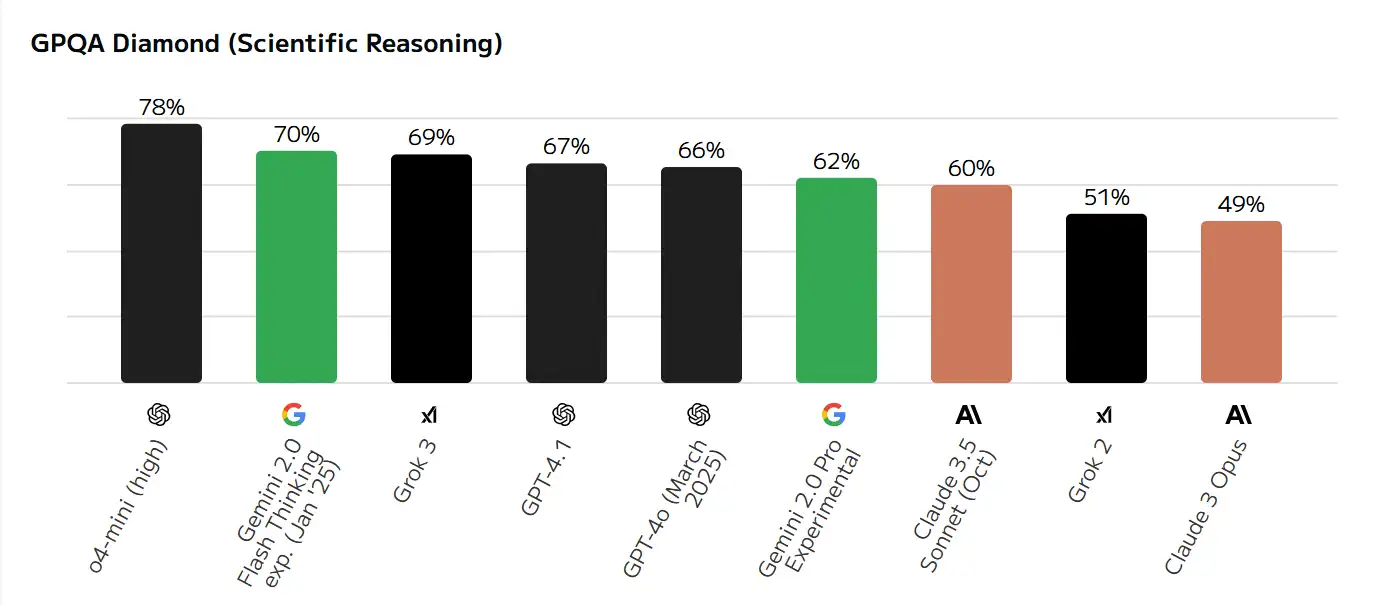
- Key benchmark metrics: The Grok 3 model outperforms Gemini 2.0 Pro on tasks requiring deep context understanding and generating responses based on it. For example, Grok 3 scores 69% versus 62% for its competitor on the GPQA Diamond benchmark, which tests AI capabilities on doctoral-level scientific tasks.
Source: Artificial Analysis
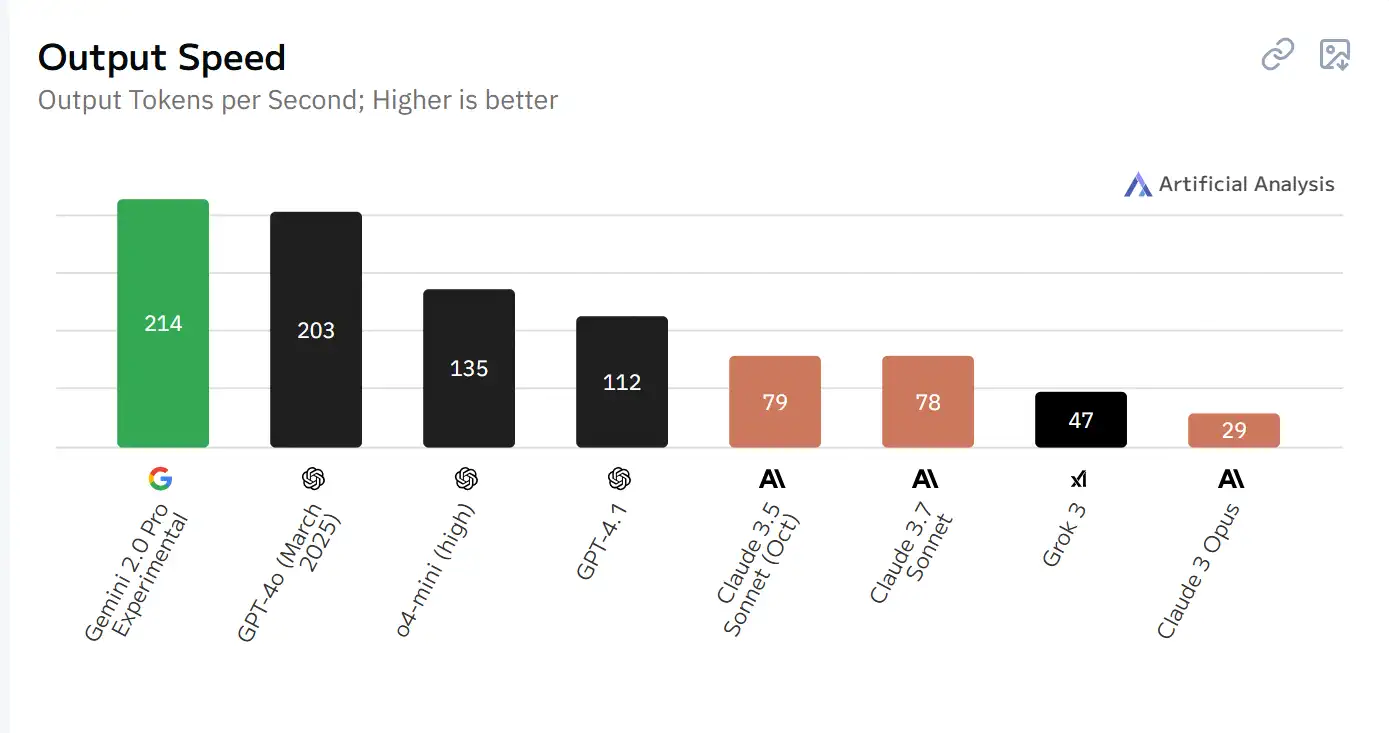
However, Grok falls behind Gemini in context window size (130K vs. 1 million) and response generation speed (52 tokens per second for Grok versus 218 for Gemini 2.0 Pro).
Source: Artificial Analysis
The future of Grok and neural network technology
The future of the Grok neural network is closely tied to xAI's global plans. Going forward, we can likely expect the following:
- Performance improvements: Increased accuracy, speed, and reasoning and math capabilities.
- Expanded multimodality: Improved image generation and possibly the addition of understanding other data types, such as video.
- Further context expansion: While 130K is already substantial, the trend is heading toward millions of tokens.
- Improved controllability and prompt understanding: Finer control over the model's style and behavior.
Integration with Elon Musk's other products (Tesla, xOS, etc.) is still more of a company vision at this point. If realized, it could create a unique ecosystem where Grok AI is embedded in cars, operating systems, or other devices, offering a seamless private AI assistant experience.
Grok's role in the future of AGI and open AI remains a key question. Realizing xAI's AGI approach is a long-term goal. Releasing Grok-1 as an open-weight LLM was a significant step, but whether this policy will continue for future models remains unknown. The open-source vs. closed models debate continues, and xAI's stance could influence the entire industry.
Conclusion
The Grok neural network from xAI, available in GPTunneL as the Grok 2 and Grok 3 models, is a powerful and unique tool in the modern AI user's arsenal. The combination of a large context window, access to current information, built-in image generation, and a distinctive communication style opens up wide possibilities.
Try Grok 3 in GPTunneL**to test the capabilities of modern artificial intelligence — no VPN and no limits!**