

Claude Sonnet 4.5 launched on September 29, 2025, and Anthropic immediately called it the best coding model in the world — and the benchmarks backed that up. The model topped SWE-bench Verified, learned to work on a task for dozens of hours straight, and kicked off much of the agentic coding boom. Since then, though, Anthropic has shipped Sonnet 4.6 and Sonnet 5, and 4.5 itself has moved into legacy territory.
This article covers what Claude Sonnet 4.5 gave the industry, whether you can still use it, and which Claude Sonnet version to pick in 2026.
What made Claude Sonnet 4.5 memorable
At release the model set several records at once:
- SWE-bench Verified — 77.2% (82% with parallel compute): solving real tasks from GitHub repositories. That was above GPT-5 (72.8%) and even the flagship Claude Opus 4.1 (74.5%) — the first time a Sonnet beat its own Opus at coding.
- OSWorld — 61.4%: the best computer-use score of its day — working with browsers, spreadsheets, and desktop apps.
- 30+ hour marathons. Sonnet 4.5 could work autonomously on a complex project for more than a day without losing the thread — earlier models ran out of steam within hours.
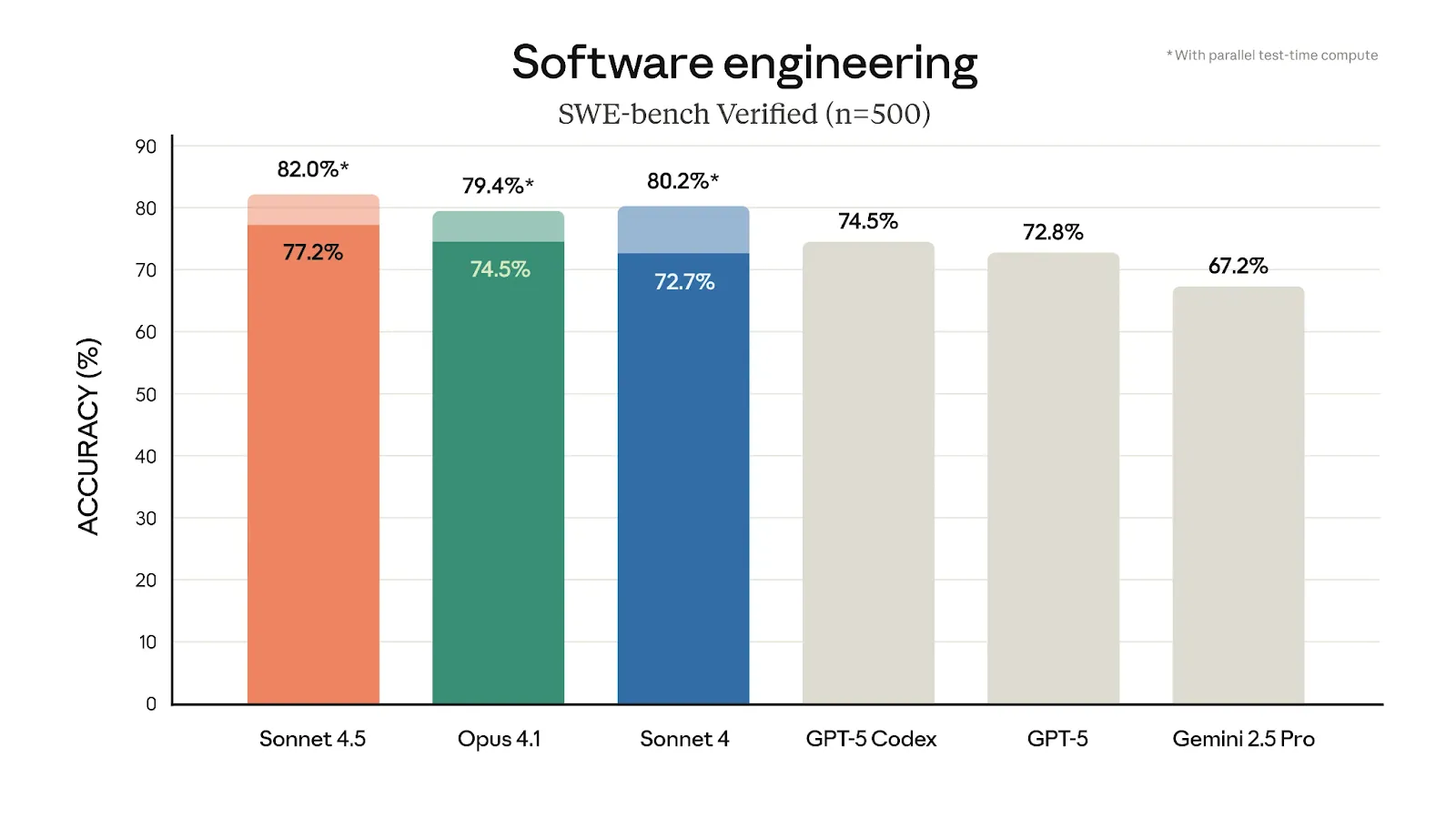
What shipped alongside the model changed the industry as much as the numbers did:
- Thinking budget. You could set the reasoning depth manually — from quick answers to methodical analysis tens of thousands of tokens deep. The idea stuck and evolved into adaptive thinking in later generations.
- Claude Agent SDK and checkpoints in Claude Code. Anthropic opened up the same infrastructure it used to build its own agents — and agentic coding went mainstream from that moment.
In short, Sonnet 4.5 cemented the formula Anthropic still repeats: a mid-tier workhorse that plays at flagship level in coding and agentic tasks.
Does Claude Sonnet 4.5 still work in 2026?
The honest answer: there's no point looking for it. Anthropic moved Sonnet 4.5 to legacy status, and it has been removed from the GPTunneL catalog as well — its place is now taken by Claude Sonnet 4.6 and Claude Sonnet 5.
That's the normal model lifecycle: each new Sonnet generation is smarter, faster, and better value than the last, so there's no reason to keep old versions in production. Everything 4.5 could do — code, long agentic chains, document analysis — the current Sonnets do better, and their context window has grown from 200K to 1 million tokens.
Sonnet 4.5 → 4.6 → Sonnet 5: what changed
| Version | Release | What it added | Status |
|---|---|---|---|
| Claude Sonnet 4.5 | September 2025 | SWE-bench 77.2%, thinking budget, 30+ hour autonomous runs | outdated, removed from catalogs |
| Claude Sonnet 4.6 | February 2026 | adaptive thinking, 1M-token context | available in GPTunneL |
| Claude Sonnet 5 | summer 2026 | agency, answer self-checking, 1M context | current version |
For a closer look at the successors, see our Claude Sonnet 5 review and Claude Sonnet 4.6 vs Opus 4.6. And if you're curious where the line started, read about Claude Sonnet 3.5.
What to use instead of Claude Sonnet 4.5
- Claude Sonnet 5 — the default choice. The direct heir to the 4.5 philosophy: it plans multi-step tasks on its own, checks its answers before responding, and handles up to 1 million tokens of context. It's now the standard model for most Claude users.
- Claude Sonnet 4.6 — if your prompts and workflows are tuned for the 4.x generation: it's the closest relative of 4.5, and migration usually needs no changes at all.
A rule of thumb going forward: Sonnet is the everyday workhorse, Opus is maximum depth for tasks where mistakes are expensive. The whole family lives on the Claude page in GPTunneL.
How much do the current Sonnets cost?
No subscription required: in GPTunneL you top up your balance and pay only for the tokens you use. Claude Sonnet 5 costs $0.004 per 1K input and $0.02 per 1K output tokens; Sonnet 4.6 — $0.012 and $0.045 respectively. A typical conversation costs next to nothing. See the pricing page for exact numbers for your workload.
FAQ
Where can I try Claude Sonnet 4.5 now? Nowhere in the major catalogs — the model is outdated, and platforms have replaced it with newer versions. In GPTunneL its role is filled by Claude Sonnet 5: no subscriptions, pay per use, local payment methods supported.
Is Claude Sonnet 4.5 available via API? There's no reason to wire it up anymore: both at Anthropic and in the GPTunneL API, the current models are Sonnet 4.6 and Sonnet 5 — they're compatible in request format and deliver better results on the same prompts.
Can I download Claude Sonnet 4.5 and run it locally? No, Anthropic's model weights are closed. Claude Sonnet runs only in the cloud: on claude.ai with a subscription, or in GPTunneL with pay-per-token pricing.
Which is better: Claude Sonnet 4.5, GPT-5, or Gemini 3 Pro? At release, Sonnet 4.5 beat GPT-5 at coding (77.2% vs 72.8% on SWE-bench). But Gemini 3 Pro came out later, so comparing it to 4.5 isn't fair — the honest matchup today is Claude Sonnet 5 versus the current GPT and Gemini, and all of these models are available in GPTunneL in a single chat.
What about Claude Code? Sonnet 4.5 was the default Claude Code model at launch; the tool now runs on current generations. See how agentic coding with Claude works in our Claude Code breakdown.
Is there a free tier? No free tier — but no mandatory subscription either: you top up your balance with any amount and pay only for the tokens you actually use.
Bottom line
Claude Sonnet 4.5 did its job: it raised the bar in coding, taught models to think on a budget, and to work for days unsupervised. But in 2026 its place is in history. Try Claude Sonnet 5 in GPTunneL — no subscriptions, pay per use: open a chat and run your own tasks through the model, from refactoring to long-document analysis. Everything 4.5 was praised for simply works better here.