

A couple of weeks ago I noticed Opus 5.5 in High mode occasionally struggling with simple tasks and responding with the familiar “Sorry, that was my mistake.” My experience proves nothing, so I looked for similar reports.
Claude Code users are debating whether Anthropic quietly makes models worse after release or whether changes to the agent system are being mistaken for a decline in model intelligence. A Reddit investigation found server configuration identifiers in local logs and tried to connect them with changes in behavior.
Users compared responses and token usage with and without an experimental parameter. LiveNerf found no significant regression in Opus 5.5, but its own validation showed limited sensitivity: it could not reliably distinguish Opus 5 from Opus 5.5. Meanwhile Anthropic is strengthening access controls and protection against distillation, and financial filings reveal the cost of compute ahead of its IPO. What is connected, what has been demonstrated, and how can you inspect your own account?
From suspicions to experimental IDs
In early November, Reddit user DerAlbi published “The nerf is real”, noting experimental identifiers in local Claude Code files that could be compared with session histories.
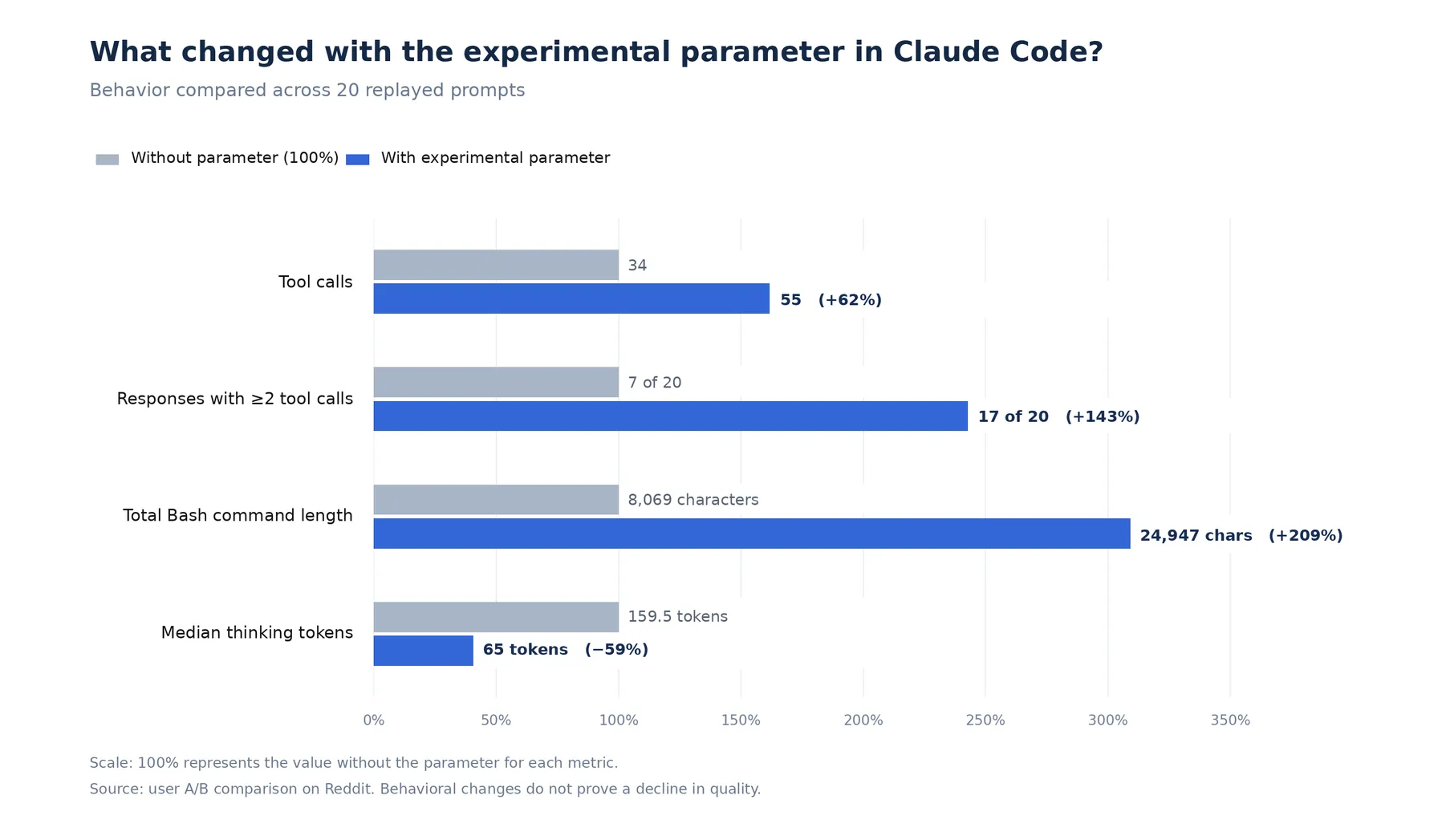
The investigation drew on WuM1ha1nho's post. The researcher examined client logs and replayed 20 saved prompts with and without an experimental parameter. The prompts were identical.
| Measure | Without parameter | With parameter |
|---|---|---|
| Generated tool calls | 34 | 55 |
| Responses with two or more tool calls | 7 of 20 | 17 of 20 |
| Total Bash command length | 8,069 characters | 24,947 characters |
| Median reasoning tokens | 159.5 | 65 |
With the parameter, Claude combined operations more often, generated longer commands and produced fewer reasoning tokens before execution. This is an observed change in behavior, but the test did not evaluate whether tasks were solved correctly. Longer commands can be more efficient or more error-prone; passing the parameter does not guarantee a complete reproduction of a server-side A/B group.
The result does not prove deliberate degradation. It does show that the same model name does not necessarily mean identical behavior across the entire Claude Code system.
Complaints about token usage
In late October, developers reported that their Claude Code limits were running out faster. One r/ClaudeAI user reported a roughly 3.8-fold increase in the rate at which the weekly allowance was consumed, attributing it to more delegation to subagents, repeated file reads and unnecessary steps.
In the later “Usage Explosion” discussion, users described rapidly depleted five-hour limits. Others reported no deterioration or attributed higher usage to more complex projects. Faster limit consumption, more tokens and incorrect answers are different measurements and need to be assessed separately.
An analysis of 6,638 responses
In GitHub issue #105112, a user analyzed 6,638 Opus 5.5 responses from their own sessions. The proxy metric was the share corrected by the user or later acknowledged as wrong by the model.
| Period | Responses | Corrected |
|---|---|---|
| Before October 19 | 5,738 | 5.2% |
| From October 19 | 900 | 25.4% |
The difference was nearly fivefold. Even when comparing only first responses to new questions, the author estimated an increase from 5.2% to 15.4%. This was one workflow with a non-blind assessment of conversation history. It merits investigation but does not establish a broad regression for all Claude users.
A change in displayed thinking does not necessarily mean a model change
Users also observed changes in the style of Claude Code's displayed thinking under the same Opus 5.5 name, appearing on different accounts on different days. Anthropic's documentation explains that displayed thinking can be a summary of the underlying reasoning. A change in wording therefore does not establish a change in model weights; the display mechanism may have changed.
LiveNerf: a test that could not distinguish Opus 5 from 5.5
LiveNerf tests Opus 5.5 daily through Claude Code on a fixed task set. Data published by November 8, 2026 showed no statistically significant accuracy decline during the observation period. That does not convincingly disprove the complaints: the authors measured important limits in the test's sensitivity.
In validation, Opus 5 was substituted for Opus 5.5 at effort high. Accuracy changed by −3.8 percentage points, with a 6.3-point standard error: the test could not reliably distinguish the models.
Comparison with Opus 5.5 at effort high | Accuracy change | Standard error |
|---|---|---|
Opus 5, effort high | −3.8 pp | 6.3 pp |
Opus 5.5, effort medium | −4.2 pp | 3.9 pp |
Opus 5.5, effort low | −8.3 pp | 4.5 pp |
The authors estimate a minimum detectable effect of about 7.5 percentage points over ten days under their chosen statistical criteria. Smaller regressions can therefore go undetected. The test was more sensitive to output-token changes: moving from high effort to medium and low reduced output tokens by 26% and 62%, respectively. Fewer tokens do not by themselves mean lower quality.
The main benchmark contains 78 selected academic questions from MMLU-Pro, GPQA, mathematics competitions and AIME. It uses a pinned Claude Code version in an empty directory without tools, MCP servers or agent workflows. It does not assess real repository fixes, long sessions, context management or subagents, the scenarios behind many complaints.
LiveNerf found no large accuracy decline on its narrow task set within its sensitivity. It did not establish that Claude Code has no regression.
Anthropic has acknowledged Claude Code regressions before
In its April 23, 2026 postmortem, Anthropic acknowledged problems including a change in default reasoning depth, errors in thinking-history management and an unsuccessful system instruction change. It described fixes and reset user limits. This does not prove a November nerf, but shows how system-layer updates can affect results without changing model weights.
Compute costs and the upcoming IPO
Anthropic filed for an IPO on October 26, 2026 and amended its filing on November 2. Its SEC filing identifies compute efficiency as a major business factor. Third-quarter revenue was about $16.96 billion, up 47% quarter over quarter; operating results shifted from a $974 million profit in Q2 to a $567 million loss in Q3. Anthropic said it secured $5 billion in short-term compute commitments, substantially more expensive than comparable long-term contracts. Reuters also reported on infrastructure pressures.
This explains an incentive to reduce cost per request through routing, caching, context management, agent algorithms or different reasoning effort levels. It does not show that Anthropic deliberately worsened responses; the company also has an incentive to retain product quality. Capacity shortages can cause latency, limits and availability errors, but explaining a quality decline would require evidence of an additional mechanism. There is no public confirmation connecting one to the October IDs.
Account suspensions and distillation defenses
Users also discussed identity checks and suspensions. Anthropic's Transparency Hub reports 11.4 million accounts banned in January-June 2026, with 398,000 appeals and 42,000 reversals. These figures cover the first half of the year, not the scale of the October wave. Anthropic says identity verification may be required to enforce usage rules and prevent abuse.
Why strengthen controls?
In its September threat report, Anthropic described unauthorized distillation campaigns using networks of accounts and intermediaries to collect Claude outputs for training other models. It said it identifies anomalous activity, blocks associated accounts and may require identity verification.
Displayed thinking can summarize internal reasoning. In an October 12 announcement, Anthropic estimated that new defenses reduced data extractable by attackers by roughly 90-99%. It acknowledged side effects, including integration updates for legitimate customers. Protection of reasoning is an announced policy, but there is no confirmation that the particular November thinking-style changes or atis IDs were caused by it.
Are the suspensions, A/B tests and IPO connected?
| Area | What is supported | What remains unproven |
|---|---|---|
| Compute efficiency | Short-term capacity costs and efficiency incentives appear in SEC filings | Whether reasoning depth was reduced for specific groups because of the IPO |
| Distillation defenses | Anthropic reports defenses and action against account networks | Whether the observed atis IDs relate to them |
| Suspensions | Official statistics and user reports exist | Whether the wave primarily aimed to reduce server load |
| Claude Code quality | Users measured changes in behavior and corrections in individual samples | Whether they share one cause |
Anthropic is simultaneously improving compute economics, developing an agent product and strengthening access controls. These may affect user experience, but a causal link between suspensions, atis experiments and an alleged nerf has not been established. Users need clearer information about changes to tool management, displayed reasoning and access rules.
How to inspect your Claude Code experiments
Claude Code stores .claude.json in the home directory, and session history is usually in ~/.claude/projects/. Look in session .jsonl files for records of type atis-latch with an atis field:
{"type":"atis-latch","atis":"abc...","sessionId":"..."}atis is an opaque identifier. Users often compare its first three characters, but that prefix is not an official experiment name. An empty value does not prove there are no server experiments.
PowerShell: IDs and session counts
On Windows, the following script searches the home directory and does not send data online.
$root = Join-Path (Join-Path $HOME '.claude') 'projects'
$groups = @{}
Get-ChildItem -LiteralPath $root -Directory | ForEach-Object {
    Get-ChildItem -LiteralPath $_.FullName -Filter '*.jsonl' -File | ForEach-Object {
        $session = $_.FullName
        foreach ($line in [System.IO.File]::ReadLines($session)) {
            if ($line -notlike '*"atis-latch"*') { continue }
            try { $entry = $line | ConvertFrom-Json -ErrorAction Stop }
            catch { continue }
            if ($entry.type -ne 'atis-latch') { continue }
            $raw = $entry.atis
            if ($raw -is [string] -and -not [string]::IsNullOrWhiteSpace($raw)) {
                $id = $raw.Substring(0, [Math]::Min(3, $raw.Length))
            } elseif ($null -eq $raw -or [string]::IsNullOrWhiteSpace([string]$raw)) {
                $id = 'none'
            } else { $id = 'other-format' }
            if (-not $groups.ContainsKey($id)) { $groups[$id] = @{} }
            $groups[$id][$session] = $true
        }
    }
}
$groups.GetEnumerator() | ForEach-Object {
    [PSCustomObject]@{ ID = $_.Key; Sessions = $_.Value.Count }
} | Sort-Object Sessions -Descending | Format-Table -AutoSize
The script counts unique main sessions, not repeated records, and excludes subagent logs. A session with multiple IDs appears in multiple rows; none means an empty or missing field in a record, not proof of no experiment. Sessions without any atis-latch records are not listed. Records often lack their own timestamp, so dates can only be estimated from neighboring messages.
Why this still does not prove deterioration
Even if a new ID appears on the day errors occur, correlation is insufficient. Compare identical tasks with the same model, Claude Code version and reasoning effort, tracking tool calls, corrections and token usage. An ID confirms a local record, not the purpose of a server experiment.
Security: do not publish raw .jsonl, your complete .claude.json, full atis values or session IDs. They may contain private prompts, source code and other sensitive information. The script prints only three-character prefixes and aggregate counts.
Conclusion
Claude Code comprises model weights as well as instructions, delegation, context management, tool selection and reasoning display. Users have observed changes and some reports include quantitative evidence; filings show incentives for compute efficiency and Anthropic reports stronger defenses against unauthorized distillation. None of these facts establishes that Anthropic intentionally made Claude less capable for its IPO or to save compute. The central question is how transparently server changes can be diagnosed and distinguished from a model regression.
Information current as of November 9, 2026. User experiments are not official confirmation of what the experimental identifiers mean.