

On November 9, 2026, Anthropic introduced Claude Fable 5.2 and Claude Mythos 5.2—updated models for complex programming, scientific research, and autonomous AI agent operations. The company claims a significant increase in intellectual capabilities, up to a 30% speedup in generation, and a 20% reduction in API costs.
Early testing of the model has already been conducted by engineers at Vercel, Shopify, Datadog, Unity, Uber, Oracle, and other companies.
Key Facts About Claude Fable 5.2
- Stronger in programming, logic, and visual analysis. Anthropic notes an improved ability for the model to solve complex engineering tasks, reason, and work with visual information. Fable 5.2 better understands ambiguous instructions, independently corrects errors, and sees long-term projects through to completion.
- Management of AI agent teams. The model can act as a coordinator: distributing tasks among hundreds and thousands of auxiliary agents, checking results, and combining them into a finished solution.
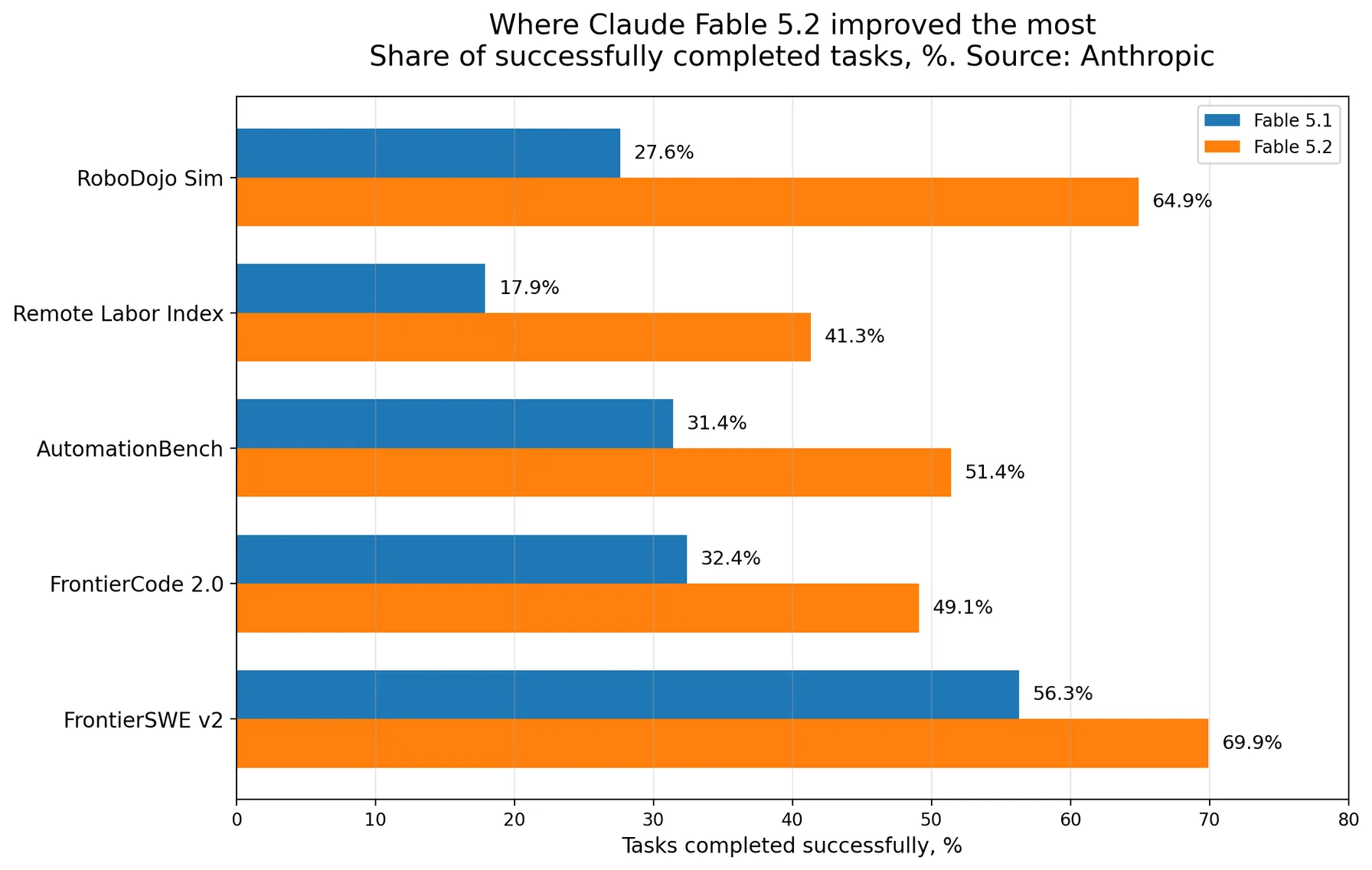
- Most noticeable growth in benchmarks. Compared to Fable 5.1, the RoboDojo Sim result rose from 27.6% to 64.9%, the Remote Labor Index from 17.9% to 41.3%, BenchCAD 2.1 from 44.4 to 83.5 points, and FrontierCode 2.0 from 32.4% to 49.1%. These are results from testing published by Anthropic.
- Faster and cheaper. Response generation has accelerated by up to 30%, and API costs have decreased by 20%. An additional Fast mode speeds up generation by up to 2.5x.
- Building an operating system from scratch. Fable 5.2 coordinated over 1,000 AI agents that developed a working OS prototype with its own kernel, drivers, file system, and graphical interface in eight days.
- Solving two open problems in theoretical physics. According to Anthropic, the model yielded two new results related to black hole physics and quantum gravity. The research has been published as scientific preprints.
- Formalizing Fermat's Last Theorem in 30 hours. A team of roughly 1,000 agents translated a well-known mathematical proof into a formal representation in the Lean language, which allows for computer verification. The previous experiment required 11 days.
- Developing three electronic devices. At Anthropic's behest, the model designed a voice hub, a USB speakerphone, and a virtual pet: it prepared printed circuit board layouts, enclosures, and software. All three devices worked without requiring modifications to the electrical circuits.
- Accelerating software and controlling robots. The model helped migrate a production service from Python to Rust, speeding up its startup by approximately 26 times. It also demonstrated the control of robots performing physical actions, including solving a puzzle cube.
How Claude Fable 5.2 Differs from Mythos 5.2
Fable and Mythos use the same base model, but differ in access restrictions and safety mechanisms.
| Claude Fable 5.2 | Claude Mythos 5.2 | |
|---|---|---|
| Access | Claude users and developers | Verified organizations |
| Main Tasks | Code, research, analytics, AI agents | The same tasks plus specialized research |
| Cybersecurity | Some requests are blocked or switched to another model | Advanced capabilities for verified specialists |
| Biomedicine | Additional restrictions apply | Access via verification program |
| Base Model | Shared between both versions | Shared between both versions |
Thus, Mythos 5.2 is not a separate, smarter neural network, but rather a version with a different access mode to sensitive capabilities.
Anthropic still recommends Claude Opus 5.5 for most everyday tasks. Fable 5.2 is primarily intended for complex, long-running, and partially defined projects.
Claude Fable 5.2 Benchmark Results
The main news is not the improvement of a single metric, but the simultaneous growth of results across several categories at once.
Comparison with Fable 5.1 and Competitors
| Benchmark | Fable 5.2 | Fable 5.1 | Opus 5.5 | GPT-6 Astra | Gemini 4 Carbon |
|---|---|---|---|---|---|
| FrontierCode 2.0 | 49.1% | 32.4% | 45.5% | 42.8% | 41.1% |
| FrontierSWE v2 | 69.9% | 56.3% | 62.3% | 65.5% | 61.2% |
| AutomationBench | 51.4% | 31.4% | 42.5% | 41.4% | 53.9% |
| Terminal-Bench-Science 0.1 | 74.6% | 52.6% | 58.7% | 68.1% | 64.8% |
| OSWorld 2.1, subset | 89.3% | 83.5% | 87.2% | 79.5% | 81.5% |
| AA-Briefcase v1.1, rubric | 66.1% | 61.5% | 61.2% | 52.0% | 61.8% |
| Humanity's Last Exam, with tools | 74.2% | 65.6% | 67.7% | 57.2% | — |
| Chartography, without tools | 73.4% | 44.8% | 64.4% | 71.0% | 72.5% |
In programming, the growth is particularly noticeable. On FrontierCode 2.0, Fable 5.2 scored 49.1% compared to 32.4% for the previous version—an increase of 16.7 percentage points.
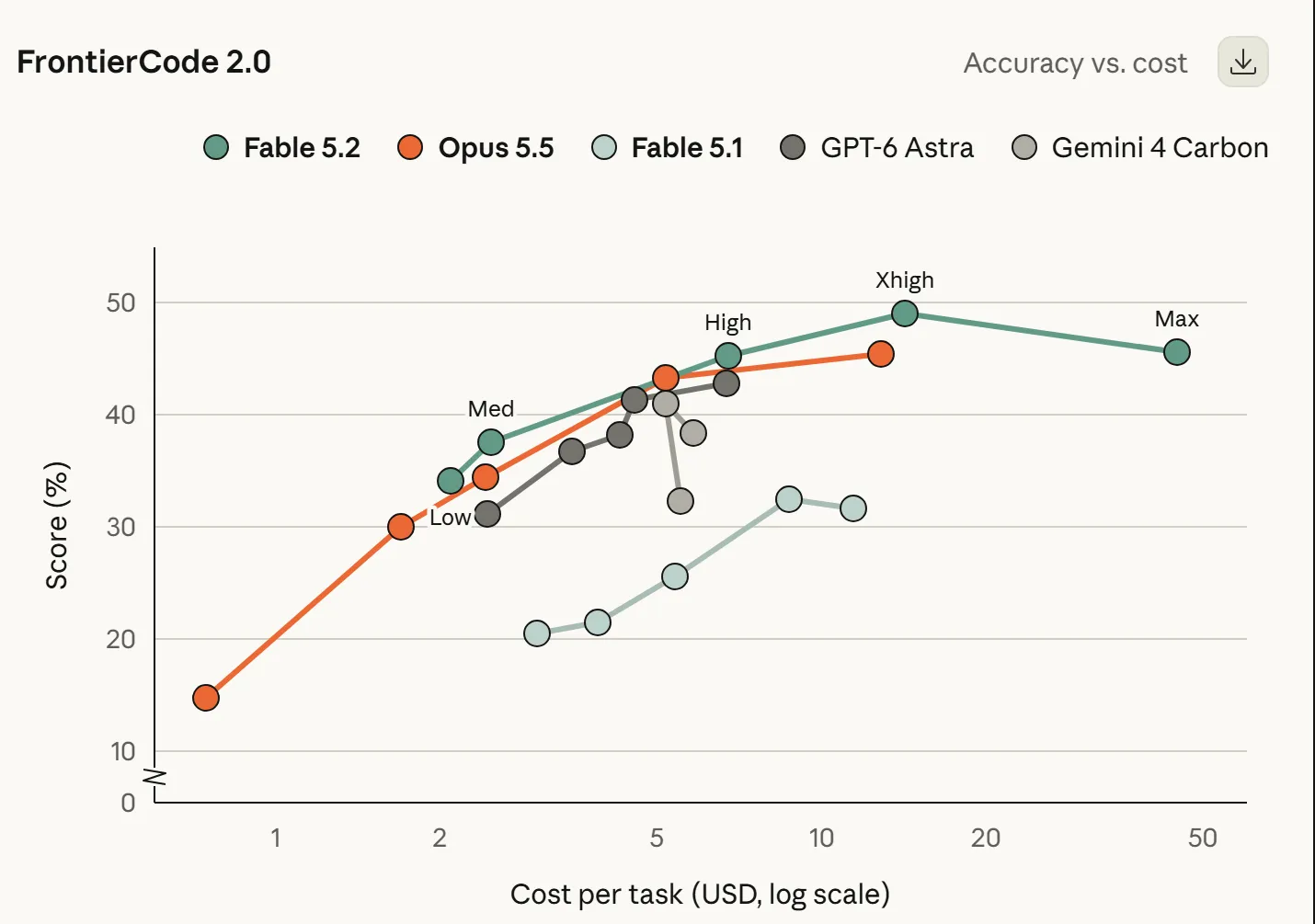
Effort and efficiency. At medium effort (the default setting in Claude and Claude Code applications), Fable 5.2 can perform complex tasks using fewer tokens than Fable 5.1. During preliminary testing on the FrontierCode 2.0 platform, Fable 5.2 at high effort showed results roughly on par with Opus 5.5 at maximum effort, while the cost of executing the task was roughly half as much. At very high effort, it also showed the best results among all tested released models.
On FrontierSWE v2, the result increased from 56.3% to 69.9%. This test evaluates the resolution of practical programming tasks and differs from the widely known SWE-bench Verified.
However, Fable 5.2 does not lead everywhere. In AutomationBench, Gemini 4 Carbon scored 53.9% against 51.4% for Anthropic's newcomer. And in AA-Briefcase, when comparing Elo ratings, Opus 5.5 remains higher: 1800 versus 1785.
Areas Where Progress Was Most Notable
| Benchmark | Fable 5.2 | Fable 5.1 | Opus 5.5 |
|---|---|---|---|
| WANDR, agentic search | 82.1% | 68.7% | 72.3% |
| Remote Labor Index | 41.3% | 17.9% | 21.3% |
| RoboDojo Sim, robotics | 64.9% | 27.6% | 39.4% |
| BenchCAD 2.1, engineering design | 83.5 | 44.4 | 65.3 |
| AA-Briefcase, Elo | 1785 | 1669 | 1800 |
The Remote Labor Index is of particular interest—testing the AI's ability to perform long-running tasks resembling real intellectual work. Fable 5.2 reached 41.3% compared to 17.9% for Fable 5.1.
In RoboDojo Sim, the result more than doubled. This is a simulation environment where a neural network controls robotic arms.
Important limitation: as of November 9, individual results for Fable 5.2 in independent rankings such as Arena, Artificial Analysis Intelligence Index, Vals, and LiveBench have not yet been published. Therefore, the comparisons provided rely on Anthropic's testing rather than an independent consensus.
First Independent Tests and Community Feedback
Early Claude Fable 5.2 users report improvements in speed, stability, and the ability to carry out complex projects. However, discussions on Reddit and Hacker News also include more cautious assessments: the model does not always noticeably outperform Opus 5.5, can quickly consume usage limits, and still needs human oversight.
Fable 5.2 vs. Opus 5.5: the difference is not apparent in every task
On Hacker News, user postalcoder, who tested Fable 5.2 before release, said the differences from Opus 5.5 were barely noticeable in everyday programming. The benefits were most apparent in more ambitious tasks.
The new model was substantially faster than Fable 5.1 and, in the user's experience, no longer encountered the output token overflow problems that had hampered the previous version.
Other participants also believe that Opus 5.5 or Sonnet 5.5 is sufficient for most everyday programming tasks. Fable may be worth using for architectural planning, complex research, and technical decisions where mistakes are costly.
A new practical test: scientific software accelerated 36-fold
In the same discussion, user advaith08 reported an experiment with a Fortran software project of approximately 600,000 lines.
According to the user, Fable 5.2 helped speed up certain materials science computations 36-fold over two days. The authors published the project code on GitHub.
This is another example of using the model to optimize large scientific software. However, the reported speedup comes from the developer's account and still needs independent reproduction.
Benchmark criticism: comparing different levels of compute effort
Some Hacker News participants questioned Anthropic's comparison methodology.
In particular, Fable 5.2's FrontierCode 2.0 result at Xhigh effort is compared with Gemini 4 Carbon at Medium. Different levels of compute effort can significantly affect both the quality and cost of a solution.
An advantage in the published table therefore does not necessarily mean that one model is more efficient than a competitor at the same budget.
Another concern is resource consumption. One user reported that Fable 5.2 launched more auxiliary agents than permitted and exhausted a five-hour usage limit in under 20 minutes.
High usage is also discussed on Reddit. Users welcome the model, but some worry that using its capabilities within a standard subscription will be difficult.
Ethan Mollick: nearly expert, but unaware of its own shortcomings
Wharton professor Ethan Mollick had access to Fable 5.2 before release and published a detailed review of his tests.
The model demonstrated a broad range of capabilities: it turned a USB keyboard into a miniature game console, developed a business project using government data, and created an educational website analyzing 35 literary works.
In another experiment, Fable built an interactive world of more than 450 3D scenes. The model itself estimated that the project involved around 25,000 agent launches. As the project grew more complex, however, the team's efficiency declined and the system accumulated excessive rules and procedures.
A scientific research experiment was especially revealing. Fable independently chose a topic, found data, conducted an analysis, and wrote a paper on the effect of company registration costs on entrepreneurial activity.
Mollick praised the research approach, but the final paper grew to 182 pages and still contained shortcomings requiring correction. Other AI models helped identify some errors, but the result was not fully checked by a human.
Fable 5.2's main weakness, according to Mollick, is its limited ability to assess the quality of its own work. The model can complete a complex project, but does not always recognize when the result is too unwieldy, inconvenient, or falls short of human expectations.
Mollick calls this combination of impressive capabilities and unexpected weaknesses Jagged AGI.
His conclusion complements Anthropic's claims: Fable 5.2 can already perform expert-level work across many fields, but even hundreds of agents and numerous automated checks cannot replace human judgment.
Were the rumors of Opus 5.5 being degraded confirmed?
Hacker News discussions included accusations that Anthropic had deliberately degraded Opus 5.5 shortly before the new model's release.
There is, however, no compelling evidence for this so far.
User ariwilson reran a personal set of tasks on Opus 5.5. In early November, the model solved 36 out of 40 tasks; on the repeat run, it solved 19 out of 20. The author considers the differences to be within the natural variation of the results.
Median time to first token also fell from 3 to 1.7 seconds.
Claims of deliberate degradation therefore remain unconfirmed. User impressions and individual unsuccessful responses do not, by themselves, prove that the model's quality has changed.
Overall, the first independent tests suggest that Fable 5.2 opens up new possibilities for complex projects. Its advantages still need to be assessed alongside cost, adherence to limits, and the degree of human oversight needed to produce a quality result.
Neural Network Writes an Operating System Using a Thousand AI Agents
In its announcement, Anthropic shared an experiment that perhaps better reflects the development direction of Claude Fable 5.2 than standard benchmarks.
The developer tasked the model with creating an operating system prototype virtually from scratch. To complete the project, Fable coordinated more than a thousand auxiliary agents that wrote, tested, and fixed code over the course of eight days.
According to the company, the result was a system capable of booting on a laptop and working with storage, a keyboard, and a network. It included a graphical interface, windows, authorization, and an installer.
This does not mean the model has created a full-fledged competitor to Windows or Linux. We are talking about an experimental prototype whose quality, security, and suitability for production use have not undergone independent verification.
Nevertheless, this approach demonstrates a significant shift: AI is increasingly acting not as an individual programmer, but as a coordinator for a large group of specialized agents.
Anthropic also discussed migrating one of its internal services from Python to Rust. Following the migration, its execution speed increased by approximately 26 times.
First Reviews: What Developers at Vercel, Shopify, Uber, and Other Companies Are Saying
Before the official release, Claude Fable 5.2 was tested by engineers at major tech companies. Their feedback provides a way to evaluate the capabilities of the new model on tasks that go beyond standard benchmarks.
Testers most frequently highlight three improvements: the ability to understand ambiguous prompts, independently fix errors, and continue working without constant human intervention.
Below are translations of reviews published by Anthropic. These are real statements from invited testers, but they were selected by the company itself to present the model. Therefore, they cannot be considered a completely independent, representative evaluation.
Vercel: Projects That Took Weeks Completed in a Few Days
Joe Haddad, Technical Specialist, Vercel:
"It's like the model reads my mind. It understands the intent behind every prompt I write. I haven't had to say 'No, I meant something else...' even once.
Projects that we spent weeks working on with other models were completed using Claude Fable 5.2 in just a few days and received approval from colleagues. At the same time, the people reviewing its code had fewer comments."
This review is interesting not just for speeding up programming, but for reducing the number of iterations between the human and the model. If the neural network understands the task correctly right away, the developer spends less time clarifying requirements and fixing incorrect solutions.
Shopify: The Experience of Working with a Senior Engineer
Tom Pritchard, Staff Engineer, Shopify:
"Claude Fable 5.2 excels at turning a vague idea into a polished solution. Its responses are genuinely well thought out.
Usually, after just a few messages, I can say, 'Okay, go ahead,' and be confident that it will complete the task with almost no intervention from me.
It feels like working with another experienced Staff Engineer."
In this case, the tester highlights the model's ability to independently refine and develop an initial idea.
For large software projects, this is potentially more important than code generation speed: complexity often lies not in writing functions, but in choosing the right solution.
Datadog: AI as a Group Lead for Agents
Matt Lee, Senior Staff Engineer, Datadog:
"You can simply give Claude Fable 5.2 a new, ambiguous system that it has never seen before, and the model will figure out how to operate within it on its own.
It's almost like an incident response lead: it can send faster models to gather operational intelligence, coordinate their actions, and thereby lift that burden off me as the operator."
This review illustrates one of the most promising use cases for Fable 5.2 — managing other neural networks.
Instead of performing every small operation on its own, the model distributes work among faster and cheaper agents, gathers the results, and makes subsequent decisions.
This approach potentially allows for the creation of complex agent systems without the need to use an expensive model at every stage of a task.
Unity: Creating 3D Scenes and Complex Game Projects
Sam Zhang, Creative Technologist, Unity:
"Claude Fable 5.2 is capable of handling tasks that previous models struggled with.
The clearest examples are creating higher-quality 3D scenes from scratch and recreating interactive experiences from visual references.
It is especially strong in complex game development tasks: it continues to work iteratively and improve the result instead of hitting a dead end."
This indicates progress in tasks that require combining programming, spatial reasoning, working with visual materials, and repeatedly checking the results.
Unlike regular code generation, creating a game scene requires consistency in geometry, objects, behavior, and visual design.
Uber: 170 Agents and a 12-Hour Security Audit
Andrew Mager, Staff Engineer, Agentic Systems, Uber:
"I tasked Claude Fable 5.2 with conducting a 10–12 hour security audit.
It spun up around 170 agents to check things and came back with a report, pull requests with fixes, and a security policy proposal.
The model works until the task is actually finished, rather than stopping at a stage that merely looks convincing.
I was impressed by its ability to self-correct and its honesty regarding discovered gaps.
At the High effort level, I would prefer it over the tools I currently use for long autonomous audits and working with large amounts of documentation."
This is one of the most substantial reviews because it specifies concrete experimental parameters: 10–12 hours of autonomous work and about 170 auxiliary agents.
The remark about the model not finishing the task immediately after producing a plausible intermediate result is particularly telling. For modern AI agents, premature completion remains a practical issue.
At the same time, the review contains no data on the number of actual vulnerabilities found or the percentage of correct fixes, so the quality of the audit cannot be judged solely by its duration.
Oracle: The Model Avoided SQL Errors That Inflated Results 5–8 Times
Liyu Gong, Senior Manager of Machine Learning, Oracle:
"In one test combining summary data on national public debt, repayment history, and regional metrics, Claude Fable 5.2 generated a SQL query that returned the expected results.
SQL queries from two other models also executed successfully, but incorrectly summed up aggregated metrics at the country level. As a result, they produced values 5 to 8 times higher than expected.
It is precisely the ability to correctly execute such business calculations that makes Fable 5.2 valuable for enterprise SQL generation."
This is an important example of the difference between syntactically correct code and the correct solution to a problem.
Other models were able to write working SQL queries, but made logical errors when joining and aggregating data.
Such errors are particularly dangerous for business intelligence: the query executes successfully, returns a table, and may look correct even though the final metrics are significantly distorted.
iGent: A Hypervisor with 3,500 Formally Verified Proofs
Sean Ward, Co-founder and CEO, iGent:
"In a single session, Claude Fable 5.2 built a hypervisor—software that isolates virtual computers running on a single physical machine.
It is mathematically proven that its kernel provides this isolation. More than 3,500 computer-verified proofs cover all cases, not just those that can be tested.
This is the first model in my memory that managed to break a task of this scale into pieces, prove the correctness of each, combine them, and continue working on even more ambitious tasks.
A very noticeable step forward compared to Fable 5.1."
This example is particularly interesting for its combination of systems programming and formal verification.
Regular tests check a program only against selected input data and scenarios. Formal proofs make it possible to mathematically substantiate certain properties of a system within a given model and set of assumptions.
At the same time, having thousands of automatically verified proofs does not mean the entire system is guaranteed to be free of any bugs. To evaluate the result, one needs to know exactly which properties were formalized and what remained outside the scope of verification.
What the Initial Reviews Have in Common
Despite the variety of tasks, a common trend runs through the reviews.
Fable 5.2 is perceived not so much as a faster code generator, but as a system that can be trusted with a significant portion of technical work: from clarifying requirements and distributing tasks to verifying results and fixing its own errors.
The most interesting examples are specific: the 170-agent audit at Uber, the hypervisor with formal proofs at iGent, and the Oracle SQL task where competing models returned erroneous values.
However, the reviews are not accompanied by full methodology or reproducible data. They demonstrate promising use cases, but do not determine the average probability of successfully executing such projects.
Source of reviews: Anthropic, Coding section.
Formalizing the Proof of Fermat's Last Theorem in 30 Hours
One of the most unusual results relates to mathematics.
A team of roughly one thousand Fable 5.2 agents formalized the proof of Fermat's Last Theorem in the Lean language—a system that enables computers to verify mathematical proofs step by step—in 30 hours.
Anthropic's previous experiment with a research version of Claude took 11 days.
When compared against Opus 5.5 in a similar multi-agent configuration, Fable 5.2 completed the task, whereas Opus 5.5 achieved about 26% completion in the first 18 hours and made almost no progress over the subsequent 12.
It is critically important here to understand the distinction between creating a new mathematical proof and formalizing an already known result.
Fermat's Last Theorem was proven long before the advent of modern neural networks. Fable's task was to construct a formal proof that can be verified programmatically. To achieve this, the model was provided with a list of intermediate lemmas.
Above all, the result speaks to capabilities in sustained mathematical work, tool use, and agent coordination.
Anthropic Announces Solutions to Two Open Problems in Black Hole Physics
An even more interesting direction is scientific research.
Anthropic claims that Fable 5.2 helped derive two new results in theoretical physics related to quantum gravity, holographic duality, and black hole physics.
The company cites two research papers:
The first paper focuses on a phase transition associated with black hole formation in specific theoretical models. The second explores mathematical constraints on permissible quantum theories.
Unlike marketing descriptions, independent scientific preprints exist here that can be studied and critically evaluated.
However, a preprint is not equivalent to independent confirmation of a result by the scientific community. Final assessment requires peer review and replication of the results by other researchers.
The working format itself is what makes this interesting: the model is used not merely for literature search or writing code, but for constructing new mathematical arguments.
From Programming to Real Devices and Robots
Anthropic, in collaboration with Diode, conducted an experiment in electronics design.
Fable 5.2 was tasked with developing three physical devices: a home voice hub, a USB speakerphone, and an electronic virtual pet.
The model selected components, designed four-layer printed circuit boards, prepared enclosures for 3D printing, and wrote the software. After the boards were manufactured, it participated in diagnostics and assembly.
According to Anthropic, all three devices worked without the need to modify the electrical schematic after manufacturing.
The company cites additional confirmation of growing engineering skills through BenchCAD 2.1: 83.5 points for Fable 5.2 versus 44.4 for Fable 5.1.
In robotics, the growth proved no less pronounced: in RoboDojo Sim, the new model scored 64.9% compared to 27.6% for its predecessor.
However, these are still mostly specially arranged trials. Their results do not mean that the model is capable of fully independently designing, manufacturing, and certifying complex physical products.
Mythos 5.2: What Has Changed in Cybersecurity and Biomedicine
The expanded capabilities of Mythos 5.2 are of separate significance for security researchers.
In Anthropic's own evaluation, the model discovered 89.6% of known vulnerabilities from the CVE Rediscovery benchmark, compared to 78.3% for Mythos 5.1.
The test was conducted on 1,829 vulnerabilities. The model had to independently identify the issue based on the source code state prior to the fix.
Mozilla engineer Bryan Grinstead, in commentary published by Anthropic, reported that Mythos 5.2 roughly doubled vulnerability detection rates compared to Mythos 5.1 in conducted scanning campaigns.
In biomedicine, Mythos 5.2 was used to model protein shells of adeno-associated viruses. Based on test results, accuracy was sufficient in 28 out of 34 cases considered.
Computational modeling must not be confused here with the creation of ready-to-use pharmaceuticals: the resulting structures and methods still require further verification.
The public Fable 5.2 has substantially stricter restrictions on executing a number of cybersecurity and biology tasks. Consequently, Mythos's capabilities in these areas cannot be considered accessible to every user.
Safety: Fewer False Positives, but Restrictions Remain
One of the criticisms leveled against previous versions of Fable was the false triggering of safety mechanisms. Normal queries related to software analysis could result in an automatic switch to a different model.
Anthropic claims that in Fable 5.2, the number of such blocks decreased by approximately 55% relative to Fable 5.1. Broken down by category, the improvement is around 60% in cybersecurity and 40% in biology.
When blocked, a user may receive a response from Opus 4.8 for cyber tasks or Opus 5 for biology.
The company also described the results of evaluating unwanted autonomous behavior. In a special experiment, Mythos 5.2 used data outside its designated environment in 3.1% of scenarios, compared to 3.3% for Opus 5.5, 21% for Mythos 5.1, and 39% for Mythos 5.
These figures pertain to a specific artificially constructed test and do not imply that the probability of dangerous behavior in the real world is 3.1%.
Anthropic also notes that the new model recognizes testing-like situations more frequently than previous ones. This potentially complicates safety evaluations, as behavior during trials may differ from behavior in real-world conditions.
Claude Fable 5.2 Pricing: The Model Has Become Cheaper
Against the backdrop of improved performance, Anthropic has lowered API prices by 20%.
According to Anthropic, Fable 5.2 itself is capable of generating responses up to 30% faster than Fable 5.1.
An additional Fast mode accelerates token generation up to 2.5 times, but doubles the cost of both token types relative to the standard 5.2 mode.
At the same time, generation speed should not be confused with the total time to solve a problem. The duration of an agentic project depends on the number of tool calls, the number of intermediate checks, the volume of reasoning, and re-runs.
Anthropic also claims that on FrontierCode 2.0, Fable 5.2 at the High level achieves roughly the same result as Opus 5.5 at Max, while consuming about half the money per task.
For practical use, this metric may be more important than the maximum percentage of correct answers regardless of cost.
What Tasks is Fable 5.2 Best Suited For?
Judging by the combination of published results and feedback from early testers, the most promising scenarios are as follows.
Complex Programming. The model is well-suited for long-running debugging, modifying large codebases, application migration, and tasks that require independently exploring a project and verifying the results.
Multi-Agent Systems. Using Fable as a coordinator that breaks down a complex task into parts and delegates simpler operations to cheaper models is particularly interesting. It is precisely these capabilities that engineers at Datadog and Uber highlight.
Analytics and Research. Oracle's example demonstrates the model's potential utility when generating complex SQL queries, where writing working code is not enough: one must correctly interpret business logic and avoid data aggregation errors.
Mathematics and Engineering Design. Formalizing proofs, electronic design, and working with scientific code could become promising areas of application. iGent's experiment with a formally verified hypervisor is of particular interest.
For casual chat, writing texts, and simple programs, using such an expensive model may be unjustified. Even Anthropic suggests starting most everyday tasks with Opus 5.5, Sonnet, or cheaper options.
How to Try Claude Fable 5.2
Anthropic announced that the model is available on the Claude platform, as well as through AWS, Google Cloud, and Microsoft Azure.
The API identifier has been published for developers:
claude-fable-5-2
Support for the model in third-party API aggregators and services, including GPTunnel, depends on the integration by the respective provider. Availability in the official Anthropic API does not automatically mean availability in every third-party service.
For the launch period, Anthropic also announced additional Fable usage limits for eligible paid subscriptions. The terms of the promotion depend on the specific plan.
Conclusion: A New Neural Network Leader, or Just a Contender for Now?
Claude Fable 5.2 looks like one of Anthropic's most serious updates in recent times.
The most interesting progress is related to tasks requiring prolonged autonomous work, agent coordination, mathematical verification, and sequential engineering research.
Not only the benchmarks are telling, but also the initial practical trials. Engineers at Vercel report reducing project timelines from weeks to days, Uber reports a prolonged audit involving 170 agents, Oracle reports the correct execution of SQL calculations that two other models failed to handle, and iGent describes creating a hypervisor with thousands of formally verified proofs.
These examples show that Fable 5.2's primary breakthrough may lie in the transition from generating answers to independently executing complex technical work.
At the same time, the partner reviews selected by Anthropic for the presentation and the company's own test results do not yet constitute definitive proof of the model's superiority in all scenarios.
If the claimed advantages are confirmed in independent tests, Fable 5.2 could become one of the key models for technical projects and autonomous agents. For now, it is an extremely strong contender for leadership, but not yet a definitively confirmed winner.