
Anthropic has introduced Claude Meetings, an AI collaborator that dials directly into video calls as an autonomous participant. Rather than simply transcribing remarks after the fact, Claude answers technical questions, drafts project documents, and carries out research tasks live during discussions. The beta preview launched on November 12, 2026, for corporate Claude accounts.
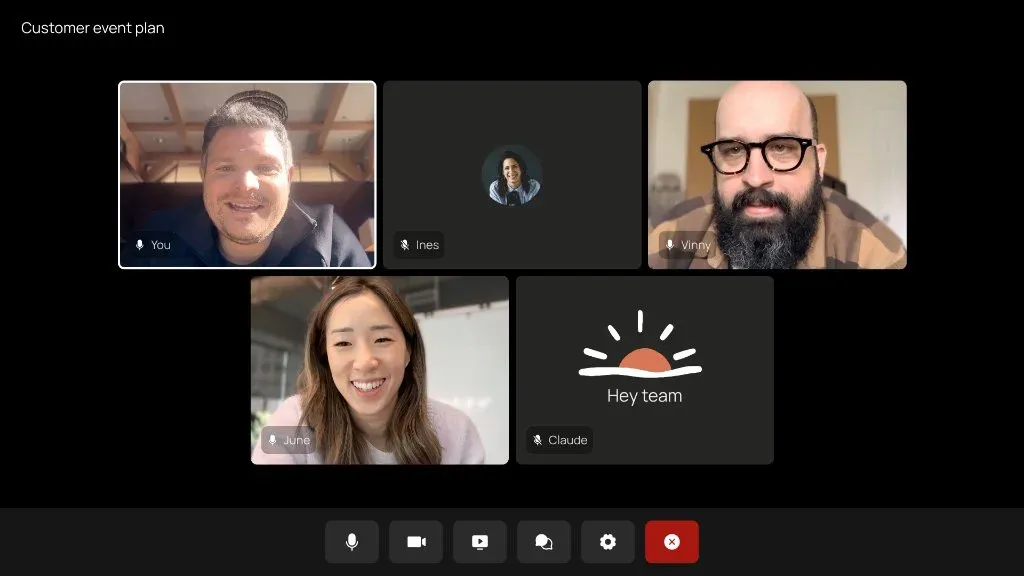
How Claude Operates During Live Calls
In traditional meeting workflows, AI tools typically process an audio recording only after a call concludes. Claude Meetings fundamentally alters that dynamic: the assistant joins Google Meet sessions as a visible attendee, follows the conversation in real time, maintains running minutes, and responds to verbal questions or text prompts.
For example, during a project kickoff session, attendees can ask Claude to outline a detailed event roadmap. The assistant begins drafting the document in the background as the discussion progresses, allowing team members to edit text collaboratively in real time. When the conversation turns to financial estimates, Claude can query integrated corporate knowledge bases, pull past vendor receipts, and cross-reference them against proposed budgets.
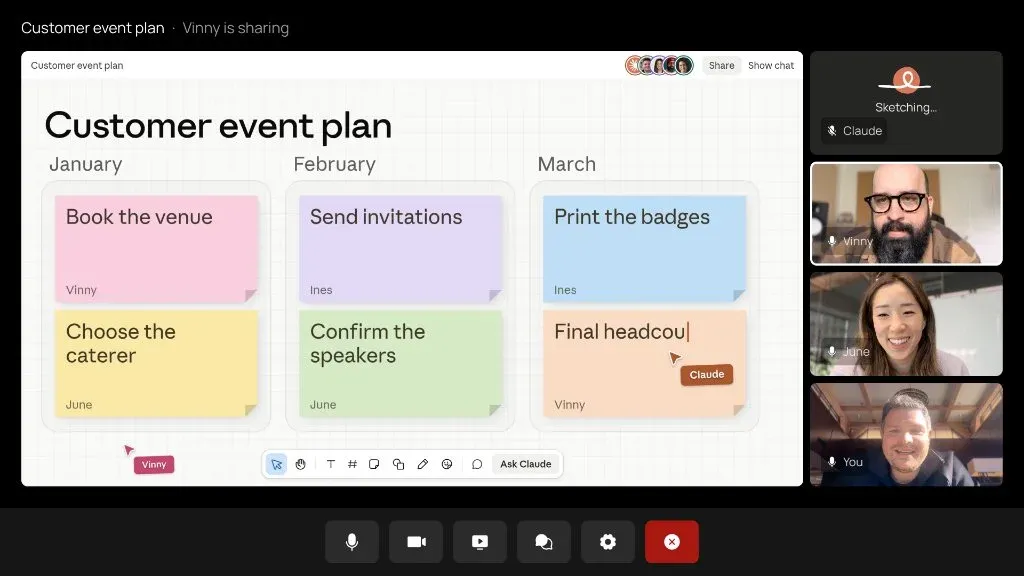
Supported capabilities include:
- Creating structured documents, slide presentations, and interactive Claude Whiteboards.
- Answering factual and analytical questions while grounding answers in the live conversation context.
- Retrieving records from connected enterprise databases and cloud workspaces.
- Executing authorized third-party actions, such as posting status updates to Slack channels.
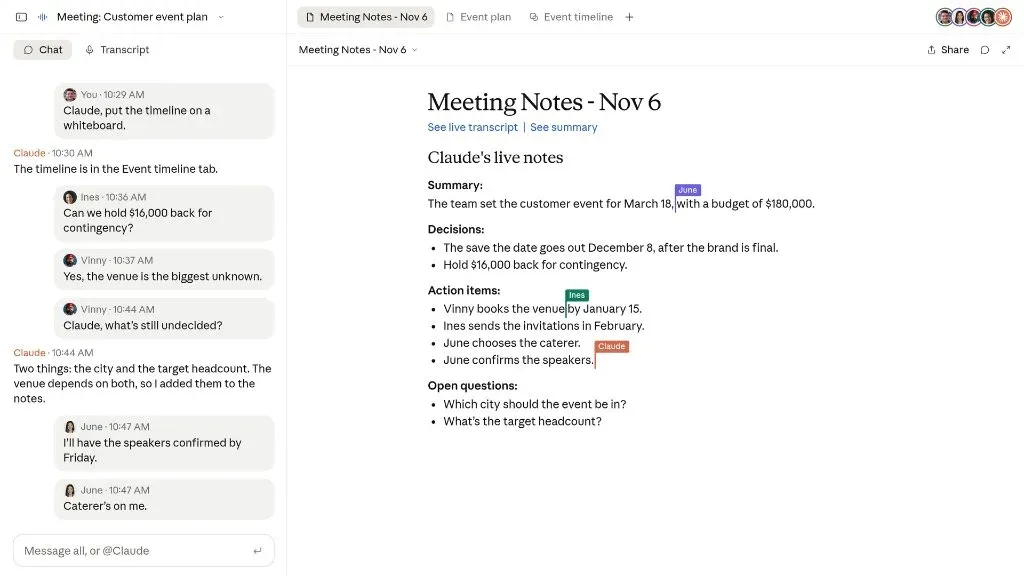
- Automatically generating comprehensive meeting minutes, executive summaries, and action items assigned to specific owners.
By default, Claude posts textual responses directly into the Google Meet chat stream. When requested to invoke external integrations or tools, it asks the user for explicit confirmation. For voice-activated prompts, the platform can enforce speaker identity verification before executing sensitive commands.
Once the call ends, all generated artifacts and transcripts are indexed under a dedicated project tab within claude.ai. Participants can review clean transcriptions, edit generated spreadsheets, and continue brainstorming with the model asynchronously.
Moving Beyond Passive AI Notetakers
Transcription services like Otter.ai, Fireflies.ai, and Granola have recorded calls and extracted action items for years.
Claude Meetings expands on that foundation: the model can author substantive deliverables and manipulate live application states while the meeting is still happening. Instead of waiting for post-call summaries, teams leave the conference with completed deliverables produced during the call itself.
This launch reinforces Anthropic's overarching strategy to evolve Claude into an end-to-end enterprise operating workspace. On November 10, the company unveiled Claude Sheets, Whiteboards, and Data analysis tools, alongside expanded interactive tool capabilities via the open Model Context Protocol (MCP).
Together, these offerings enable teams to use a unified interface to brainstorm concepts, generate documentation, query datasets, and execute operational workflows.
User Reactions and Operational Concerns
The announcement prompted active debates across professional forums and the r/ClaudeAI community. Users drew comparisons between Claude Meetings, established notetaking tools, and Microsoft Copilot.
While many observers praised the shift toward active in-meeting collaboration, some expressed hesitation regarding vendor lock-in and dependency on a single model ecosystem.
Accuracy in automated meeting minutes remains another frequently raised concern. Practitioners who already use AI note-taking tools recount instances where models misattributed action items or glossed over subtle technical nuances. For legally binding decisions or fiscal commitments, human verification remains indispensable.
Platform exclusivity has also attracted debate: Claude Meetings currently supports only Google Meet, whereas enterprise organizations frequently rely on Microsoft Teams or Zoom for daily operations.
Rollout, Security, and Pricing Terms
Claude Meetings is rolling out gradually to Claude Team and Enterprise subscription tiers. Support for additional video conferencing platforms is planned for future updates, though specific release windows have not been confirmed.
Anthropic has introduced several enterprise privacy safeguards:
- Claude joins calls visibly and explicitly announces its presence to all attendees.
- The service retains text transcripts, summary notes, and contextual screen descriptions, but deletes raw meeting audio recordings.
- Participation in meetings involving external attendees is governed by organization-level administrative policies.
- Specialized enterprise environments requiring custom customer-managed encryption keys are currently excluded from the preview.
Throughout the beta period, basic transcript generation and meeting summarization are included at no additional cost for eligible enterprise plans. Free creation of associated artifacts is guaranteed through February 10, 2027. Heavy usage of external tool calls and integrations will draw against standard subscription quota limits.
Conclusion: Corporate AI assistants are transforming from passive audio transcribers into active teammates. Their long-term utility will hinge on the reliability of live document generation, deep tool integrations, and their ability to accurately interpret complex human discussions.
Sources: