

CodeRabbit announced that its agentic security analysis system uncovered 1,215 potentially severe vulnerabilities across 1,125 public software repositories. The automated audit campaign took under two weeks to complete, though only 75 findings had been resolved by the time of publication. These findings highlight both the rapid evolution of automated vulnerability detection and the widening gap between discovering software flaws and remediating them.
On November 13, 2026, CodeRabbit shared the findings of its large-scale open-source scanning initiative powered by CodeRabbit Secure Deep Scan.
The scanning initiative ran from October 23 through November 3.
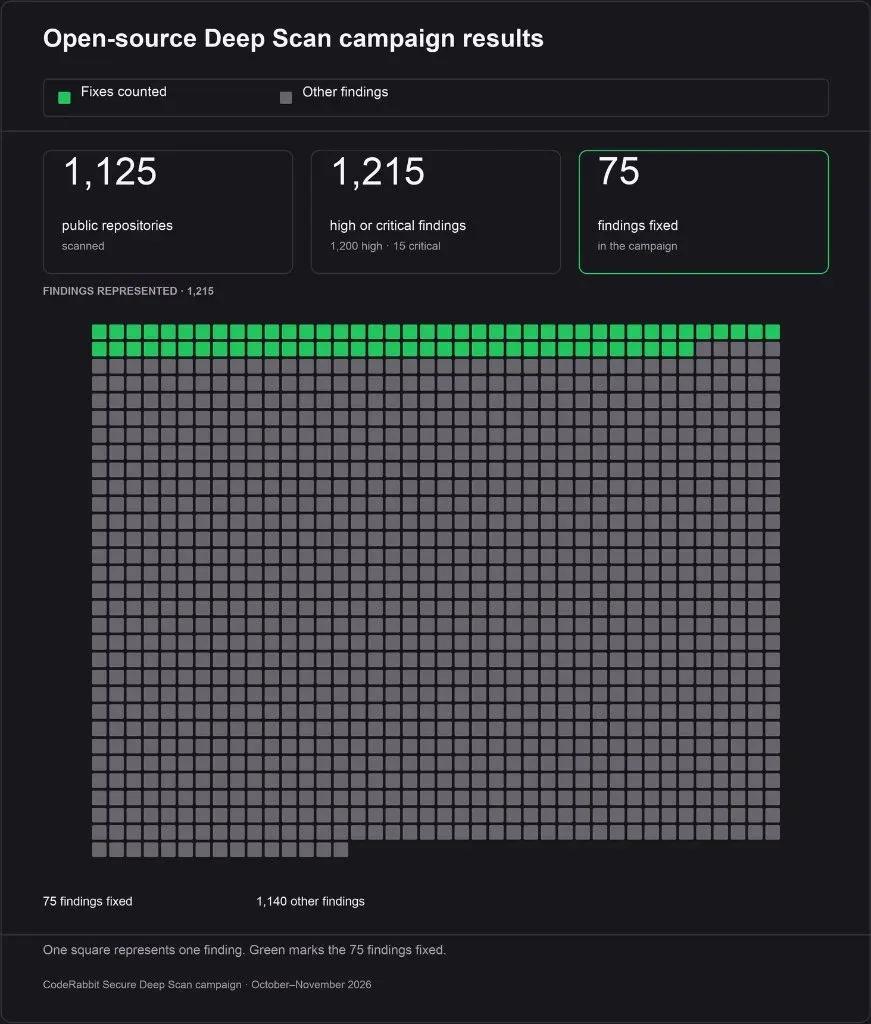
According to figures published by the company, the tool identified:
| Metric | Result |
|---|---|
| Public repositories audited | 1,125 |
| High and critical severity findings | 1,215 |
| Critical severity findings | 15 |
| High severity findings | 1,200 |
| Confirmed fixes at publication | At least 75 |
All statistics were self-reported by the tool's developers. CodeRabbit did not provide independent third-party verification for the full dataset.
How the AI Detects Security Flaws
Conventional static application security testing (SAST) tools inspect source files without executing the application. They are designed to flag dangerous function calls, untrusted data flows, and direct rule violations.
CodeRabbit Secure Deep Scan relies on an agentic architecture designed to trace contextual relationships across multiple application components and microservices.
The company outlines a four-stage process:
- Map. The system analyzes project structure, endpoints, authentication layers, and the broader attack surface.
- Hunt. Agents trace suspicious control flows and attempt to construct viable conditions for exploiting potential weaknesses.
- Verify. A dedicated validation agent evaluates evidence, code reachability, and existing perimeter defenses to filter out false positives.
- Fix. For validated findings, the system can draft a proposed patch for human maintainers to review and merge.
For instance, a web service might properly verify that an incoming user session is valid, yet omit a check ensuring the user has permissions to access a specific tenant document.
Because baseline authentication is present, simple syntactic checks frequently miss the omission. Catching such a broken object-level authorization flaw requires analyzing how request routes, domain business logic, and database queries interact.
CodeRabbit positions these multi-layered application logic bugs as the primary target for its agentic audit pipeline.
Most Frequent Vulnerability Categories
According to CodeRabbit, the most frequent categories identified during the scan included:
- Missing authorization checks on specific database objects (BOLA / IDOR).
- Cross-site scripting (XSS) risks stemming from improper handling of user input.
- Insufficient validation of authentication tokens, request signatures, and caller identities.
- Path traversal vulnerabilities allowing unauthorized directory access.
- Incomplete session termination and improper token revocation mechanisms.
- Sensitive data leaks through uncaught errors, API responses, and shared storage layers.
The company emphasizes that agentic analysis is intended to complement traditional static scanners and software composition analysis rather than replace them entirely.
Why Few Vulnerabilities Have Been Patched
At the time of disclosure, CodeRabbit confirmed that maintainers had patched at least 75 of the 1,215 reported findings.
That represents roughly 6% of all identified issues. However, this figure cannot be interpreted as a definitive resolution rate: numerous vulnerability reports remain in maintainer triage queues, and data regarding subsequent patches has not yet been compiled.
Furthermore, identifying a suspicious code pattern does not inherently guarantee that an exploitable vulnerability exists in a production environment.
Accurately evaluating the real-world impact requires broader data on false-positive rates, distribution across affected repositories, and independent review. The developer has not yet published comprehensive statistics covering these questions.
Developer and Community Reaction
Herrington Darkholme, author of the structural code search tool ast-grep, reported testing Deep Scan on his own codebase.
In his evaluation, the system's primary advantage is its built-in verification pass, which examines whether a flaw is reachable before generating an issue report. This extra scrutiny makes the resulting notifications far more actionable for maintainers.
This feedback represents the perspective of a pilot participant published by CodeRabbit, rather than an independent comparative benchmark.
AI vs. AI: The Cybersecurity Arms Race
The deployment of automated scanning systems reflects a broader shift across the security industry.
Attackers can already use generative models to accelerate code analysis, discover edge cases, and probe software attack surfaces. Defensive tooling providers are countering with their own agentic pipelines.
OpenAI is pursuing a similar trajectory. Its experimental Aardvark agent unveiled in 2025 evolved into Codex Security, which analyzes codebases and assists teams in finding vulnerabilities.
Google DeepMind is likewise developing systems for formal verification, including AlphaProof Code.
As vulnerability discovery becomes increasingly automated, the human role is shifting from initial identification toward verifying findings, evaluating operational risk, and shipping patches.
Conclusion: CodeRabbit's campaign illustrates the potential of agentic security scanning across open-source ecosystems. However, the definitive measure of success remains the number of verified, reproducible vulnerabilities that maintainers successfully resolve. The speed of AI-driven scanning is growing faster than the capacity of open-source projects to remediate issues.
Sources: