
AI face swap for photos
Swapping faces in photos with AI has become a popular tool in today's world. Face-swap solutions let you create portraits, avatars, or even change faces in a group photo with high accuracy and realism. But as face-swapping technology advances, questions about ethics and privacy arise.
For example, creating deepfakes can be misused for disinformation or cyberbullying. This calls for a closer look at the tools, the ethical questions, and the regulations that help prevent abuse and protect people from harm.
In this article we'll look at how face swapping in photos works, what advantages it offers, and which online tools and apps are available for it.
How face-swap neural networks work
These technologies rely on complex machine-learning algorithms, such as generative adversarial networks (GANs). These algorithms are trained on large datasets to recognize and reproduce faces with high precision. The process includes several stages:
- Analyzing the source image: The system analyzes the photo where the face needs to be swapped, identifying key points such as the eyes, nose, and mouth, skin tone, and expression. This step is crucial for accurately determining the face's boundaries and position.
For the best results, it's recommended to upload photos of at least 1024 pixels so the neural network can work with high resolution.
- Choosing the target face: The user uploads their own photo with the face they want to place into the image. Choosing a high-quality source image is critical for a realistic result. Some online apps allow uploading photos up to 5 MB, which ensures high processing quality.
- Swapping the faces: The tool overlays the target face onto the source image, taking lighting, angles, and proportions into account. At this stage it's important that both faces have similar angles and lighting to achieve maximum realism. The tool adapts the new face to the existing lighting and shadow conditions to avoid visible artifacts.
- Processing and optimization: The final stage involves fine-tuning small details for maximum realism. This can include adjusting the color palette, removing artifacts, and improving the overall quality of the image or video. The neural network performs numerous micro-corrections to smooth transitions and make the result as natural as possible.
Benefits of using AI for face swapping in video and photos
Using neural networks for face swapping offers many advantages:
- High accuracy: Modern neural networks can create realistic images with minimal artifacts. This is achieved through complex algorithms and large volumes of training data. Neural networks can reproduce the finest details, such as skin texture and natural shadows.
- Speed: The process of swapping a face in a video or photo takes only minutes, making it accessible to a wide range of users. Thanks to powerful computing resources, neural networks can process photos and videos in real time. This is especially important for projects that require fast processing of large amounts of data.
- Accessibility: Many face-swap services are available without installing any additional software. This is especially convenient for users who prefer working online without downloading apps.
Online platforms often offer intuitive interfaces, which makes them simple and convenient to use. Below we take a closer look at GPTunneL's solution, which delivers excellent results for face swapping in photos.
- Versatility: Neural networks can work not only with different photo styles and formats but also with video, which expands their range of use. This allows for creating dynamic and interactive projects, including face swapping in videos, with different styles, angles, and scenes. Neural networks adapt to various formats and resolutions, ensuring high-quality results.
- Creative possibilities: Swapping faces in photos and videos opens up new horizons for creativity. Users can create unique looks, experiment with different styles, and even bring fantastical ideas to life.
The technology lets you swap faces not just in single portraits but also in group photos, which is especially useful for creative projects involving several people.
The best online tool for face swapping in photos
There are many tools that let you quickly and easily swap faces in photos and videos. Here's the best one:
FaceSwap on GPTunneL
This is an AI service that lets you quickly and easily place a face onto a photo. Upload two images: the source photo and the one you want to take the face from. You can also enhance the overall generation quality. The tool works worldwide, with no VPN needed and support for local payment methods.
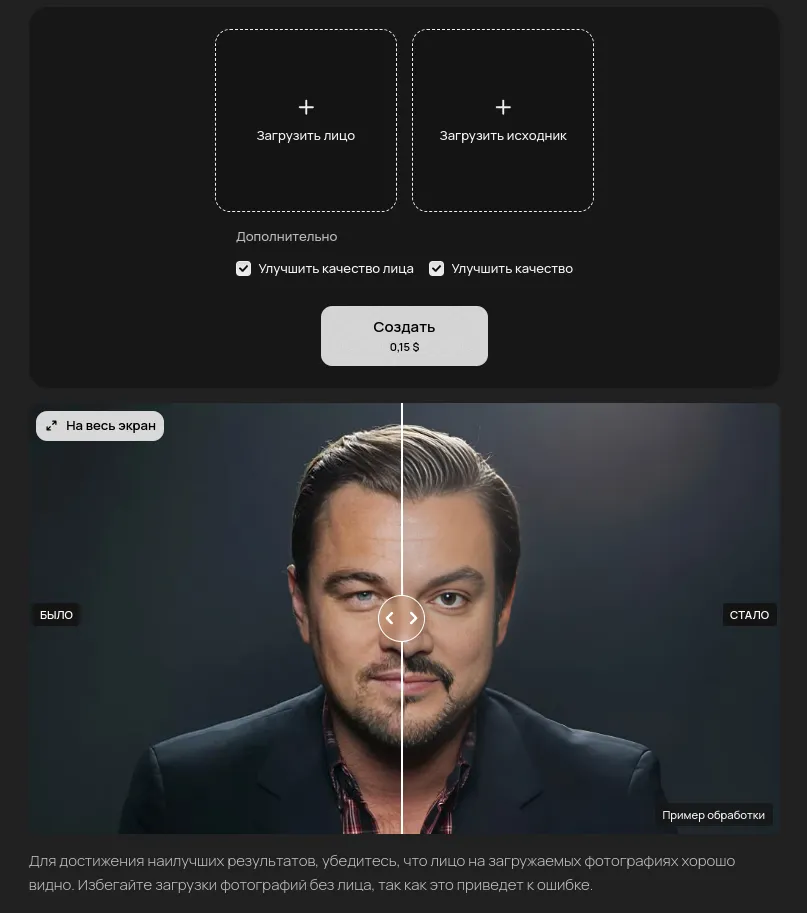
After generation, you can customize the photo even further. For example, send the image to the Minimax neural network to "bring it to life" by turning it into a video. This level of customization is possible on GPTunneL thanks to a convenient, unified platform that brings together all the major language models, image generators, and AI tools. Try it now!
Ethics and legal considerations of AI face swapping
Despite all its benefits, AI-based face swapping raises ethical and legal questions. Keep the following in mind:
- Consent: Using someone else's photos without permission can violate privacy and copyright. Always get consent from the people whose images you plan to use. This is especially important when working with public figures or well-known individuals if you plan to use the results commercially.
- Ethics: Creating deepfakes can be misused for disinformation or cyberbullying. It's important to use the technology responsibly and avoid causing harm to others. Ethical standards require respecting every person's identity and rights.
- Legal aspects: Various countries have laws regulating the use of this technology. Breaking these laws can lead to serious legal consequences. Users should be aware of legal restrictions and always act within the law.
We'll add that, per clause 8.2.6 of the GPTunneL terms of service, all materials you generate using the services belong solely to you.
- Privacy: Such modifications can violate privacy, especially when images are used without consent. This can lead to legal and ethical consequences, including lawsuits and loss of trust.
- Psychological aspect: Misuse of the technology can cause psychological discomfort for people whose images and videos were altered without their knowledge. This can lead to stress, anxiety, and other negative emotional reactions.
Potential risks and limitations of the technology
Despite its impressive capabilities, face-swap technology has its limitations:
- Quality of the source data: Low quality can lead to unsatisfactory results. For the best results, it's recommended to use high-resolution images and videos. The quality of the source data directly affects the final result.
- Algorithm limitations: Neural networks don't always handle complex angles or lighting correctly. This can lead to artifacts and unrealistic results. Algorithms keep improving, but errors can't be fully avoided yet.
- Ethical risks: Misuse of the technology can lead to serious consequences. It's important to keep ethical standards and legal aspects in mind when working with face swapping in photos and videos. Many modern services have clear rules about what's allowed and what isn't. For example, in FaceSwap by GPTunneL you cannot work with NSFW images.
Conclusion: the future of AI face-swap technology
AI for changing faces in images and videos continues to evolve, offering increasingly refined and realistic results. In the future, we can expect improvements in quality, speed, and accessibility. However, it's important to keep ethical and legal aspects in mind in order to use these tools responsibly and safely.
Swapping faces in photos and videos is becoming more accessible and popular thanks to advances in neural networks. These technologies open up new opportunities for creative self-expression and entertainment, but they also call for a responsible approach to their use.
Ahead of us lie many innovations and improvements that will make face swapping even more realistic and accessible to a wide audience. Over time, more and more users will be able to easily upload their own photos and videos, experimenting with different looks and styles without leaving home.