
Google announced a major architectural upgrade to its generative search engine, shifting its underlying foundation to Gemini 4 Hydrogen. The new model handles intricate multi-part questions, conducts parallel research across diverse query branches, and compiles structured responses complete with comparative tables, images, and verified citation links. The shift is particularly significant for website operators, as it redefines how algorithms select and surface publisher pages within AI responses.
On November 12, 2026, Robby Stein, Vice President of Product for Google Search, introduced the update, characterizing the integration of Gemini 4 Hydrogen as the most significant model upgrade in Google Search history.
The rollout is launching globally. According to Google, Hydrogen capabilities are accessible to users across standard Google Search without requiring an active paid subscription.
What Changes in Search Experience and Latency
The primary enhancement centers on parsing complex, compound queries that users previously had to break down into several distinct searches.
For example, a user might ask Google to recommend a portable laptop suited for 4K video editing, specifying 32GB of RAM, extensive battery endurance, lightweight construction, and a strict budget threshold.
Rather than returning disjointed blue links, the new model evaluates all constraints simultaneously, crawls technical specifications across independent domains, compares tradeoffs, and compiles a structured recommendation table.
Google emphasizes four key areas of improvement:
- Nuanced Intent Understanding: The model interprets long-tail questions, conditional requirements, and conversational typos with greater accuracy.
- Parallel Source Discovery: The system automatically executes multiple interlocking background searches to investigate different facets of a user's request.
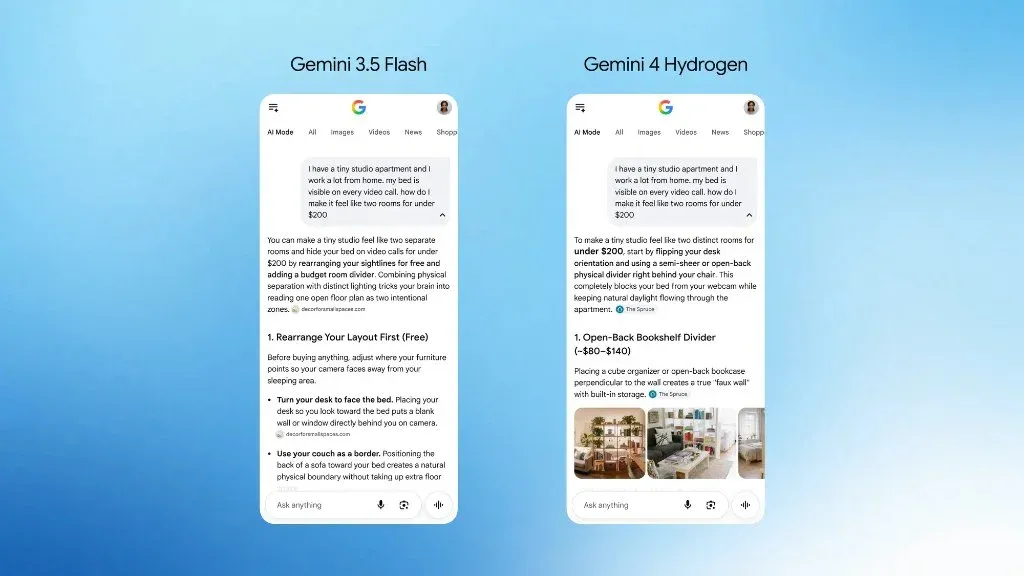
- Rich Multimodal Formatting: AI-generated answers incorporate side-by-side comparison tables, relevant image crops, and interactive filtering toggles.
- Multilingual Parity: Performance improvements extend across all global languages supported by Google's AI search modes.
According to Google, Hydrogen is designed specifically for high-speed agentic execution. Unlike Gemini 4 Carbon or Argon—which are engineered for heavy reasoning traces and deep deliberative workflows—Hydrogen is optimized for high-throughput, low-latency applications.
Google also claims the model executes tasks 2.5 times faster than Gemini 3.8 Flash. However, that figure reflects raw model execution speed rather than an absolute 2.5x speedup for every end-to-end web search response.
Query Fan-Out: How Google Selects Publisher Citations
A central technical pillar of the upgrade is an enhanced query fan-out architecture.
When confronted with a multi-layered question, Google Search splits the prompt into sub-queries and executes several parallel web searches across distinct information verticals.
For instance, an inquiry regarding which neural network to choose for automated software testing might trigger concurrent searches across benchmark leaderboards, API pricing sheets, generation latencies, and language support pages.
The engine synthesizes findings from these separate passes into a unified overview, linking directly to the most relevant external pages.
While query fan-out existed in earlier iterations of AI Mode, Google asserts that Gemini 4 Hydrogen substantially improves query decomposition and discovers a broader, more diverse pool of publisher websites.
For site publishers and webmasters, this is a pivotal development. A deeply technical article or niche case study can now be cited to answer a specific facet of a complex user query, even if the user never typed a keyword-matched query directly.
However, Google has yet to publish third-party empirical studies documenting how outbound referral traffic and link distributions have changed post-rollout.
Strategic Implications for SEO and Generative Engine Optimization (GEO)
The maturation of AI Mode is fundamentally altering how digital marketers assess organic visibility.
In traditional search engine optimization (SEO), visibility is measured by static rank positions for targeted keywords. In generative search environments, the primary metric shifts toward whether generative agents select and cite your content when constructing synthesized answers.
Barry Schwartz, contributing editor at Search Engine Land, observed that the Hydrogen rollout could reshape publisher prominence across both AI Mode and standard AI Overviews.
Pages that offer proprietary empirical data, original benchmarks, rigorous comparative testing, and transparent methodologies stand to gain the highest citation frequency.
At the same time, Google's official documentation notes that foundational SEO principles remain unchanged. Gaining visibility in AI-generated answers does not require specialized markup, proprietary protocols, or dedicated crawler directives. Content must simply be crawlable, indexable, and compliant with standard snippet display guidelines.
Compliance alone, however, does not guarantee that AI agents will cite a given domain.
The Broader Transition from Blue Links to Action Interfaces
Modern search engines are steadily migrating from lists of links toward conversational interfaces capable of resolving tasks in place.
Google is expanding AI Mode into an agentic assistant. OpenAI is transforming ChatGPT into an active discovery and shopping agent. Other search engines are likewise combining web indexing with live workflow execution.
This paradigm creates a dual reality for content publishers:
On one hand, AI discovery engines can surface specialized, authoritative content to users who might never have discovered the domain through manual queries. On the other hand, many informational queries are now fully answered directly within the search results page, rendering click-throughs unnecessary.
Consequently, marketing teams must analyze search impressions, citation frequencies, and referral traffic independently.
Conclusion: Gemini 4 Hydrogen cements the shift toward multi-step search synthesis and multi-source attribution. Google promises higher relevance and richer answers. Exactly how this rebalances traffic across digital publishers will become clearer as industry benchmarks and longitudinal analytics emerge.
Sources: