
On September 22, OpenAI released two GPT-6 generation models, Sol and Luna. The main story is not a jump in intelligence but the economics: both were trained with the same methods as the flagship GPT-6 Astra, and both cost half as much as their GPT-5.6 predecessors. The release landed about an hour and a half after Claude Opus 5.5, so the choice of model for a task changed twice in one day.
If your product or pipeline runs on GPT-5.6 Sol, the question is no longer whether to switch but what to do with the freed-up budget: save it, or hand some steps to a stronger model.
What shipped
- GPT-6 Sol is the mid model of the generation,
gpt-6-solin the API. OpenAI positions it for demanding work and agentic coding with more headroom on limits and cost. - GPT-6 Luna is the lightest and cheapest model in the family,
gpt-6-lunain the API. - GPT-6 Astra, released on September 3, remains OpenAI's best model "across the board" — the company's own wording.
In ChatGPT both models roll out through the day in ChatGPT Work and Codex for Plus, Pro, Business, Enterprise and Edu. Free and Go users get Luna, but only in the desktop app; the regular ChatGPT chat doesn't have them yet. In GitHub Copilot Sol starts at the Pro+ plan and Luna at Pro. On GPTunneL both models are already in the catalog and answer through the API.
Pricing
| Model | Input, $ per 1M | Output, $ per 1M | On GPTunneL per 1K, input / output |
|---|---|---|---|
| GPT-5.6 Sol | $4 | $20 | $0.01 / $0.06 |
| GPT-6 Sol | $2 | $10 | $0.005 / $0.03 at 50% off, $0.01 / $0.06 without it |
| GPT-5.6 Luna | $0.20 | $1.20 | $0.0004 / $0.0024 |
| GPT-6 Luna | $0.10 | $0.50 | $0.0002 / $0.0012 at 50% off, $0.0004 / $0.0024 without it |
OpenAI credits the cut to improvements in caching and inference. For agents the cache matters more than the price list: GPT-6 has higher hit rates by default, cached reads get a 90% discount, and changing reasoning effort or the tool set mid-conversation no longer breaks the cache. There are also explicit breakpoints, so you decide where the cached prefix ends. GPTunneL prices are from our catalog on release day; current ones are always on the pricing page.
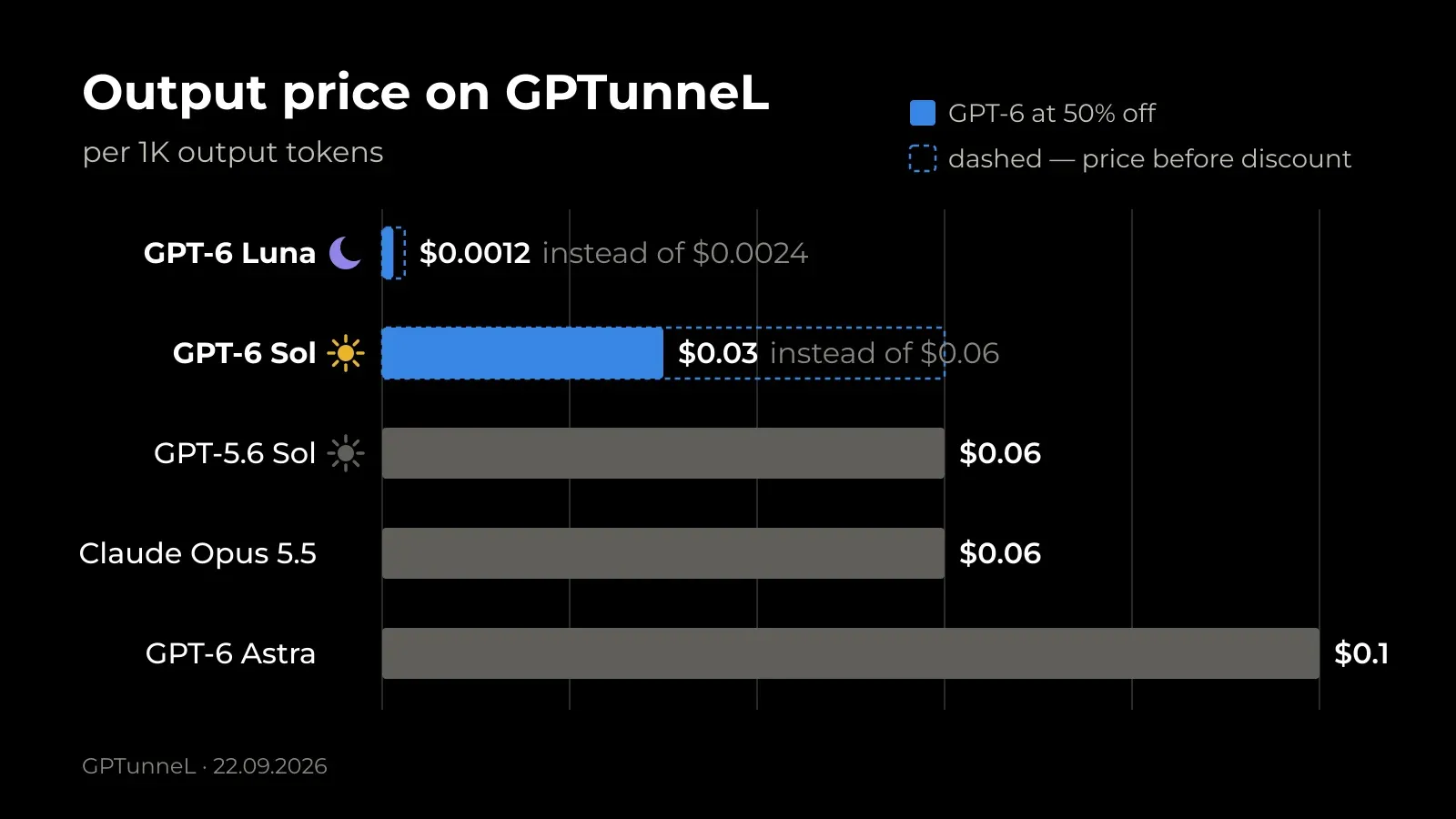
On GPTunneL both models currently come with a 50% launch discount. With it, Sol's output tokens cost half as much as GPT-5.6 Sol and Claude Opus 5.5 and over three times less than Astra, and Luna costs half as much as GPT-5.6 Luna. While the discount runs, the gap between the mid and the top model is wider than usual, and that changes the math on which steps deserve the expensive model.
Quality
Everything below comes from OpenAI's announcement; there are no independent measurements on release day. Effort levels differ across comparisons: the new models usually run at xhigh or max, competitors often at medium.
| Benchmark | GPT-6 Sol | For comparison |
|---|---|---|
| AutomationBench 1.0.6 (business workflows, 47 tools) | 33.2% at xhigh, $0.27 per task | Astra at low: 30.3% at 3.9× the cost; Claude Opus 5 at max: 26.9% at 11.1× the cost |
| Agents' Last Exam | 56.4% at max | above Claude Opus 5's best score at 60% lower cost per task |
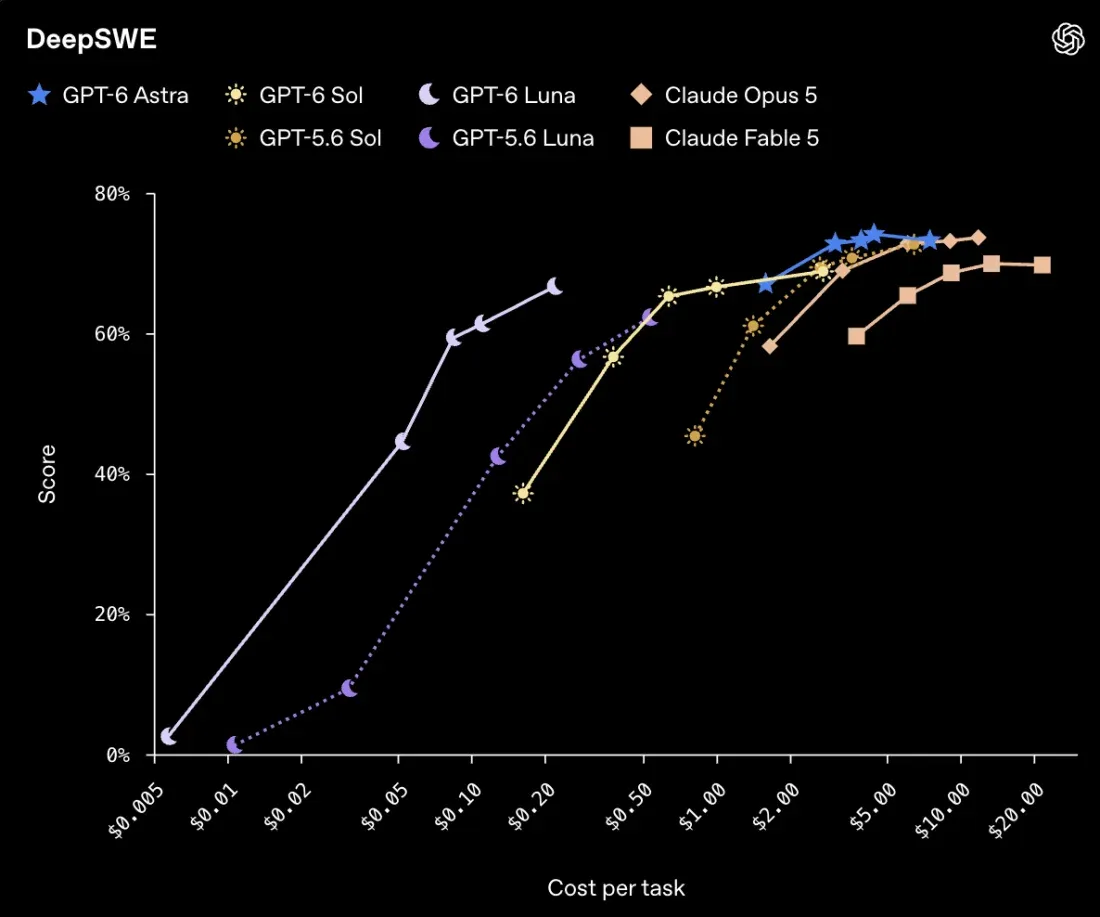
| DeepSWE 1.1 (code in real repositories) | 68.8% at max | Claude Fable 5 at xhigh: 69.9% at roughly 80% higher cost per task |
| OSWorld 2.0 (computer use) | 60.5% at xhigh | Claude Opus 5 at medium: 60.3% at roughly 80% higher cost per task |
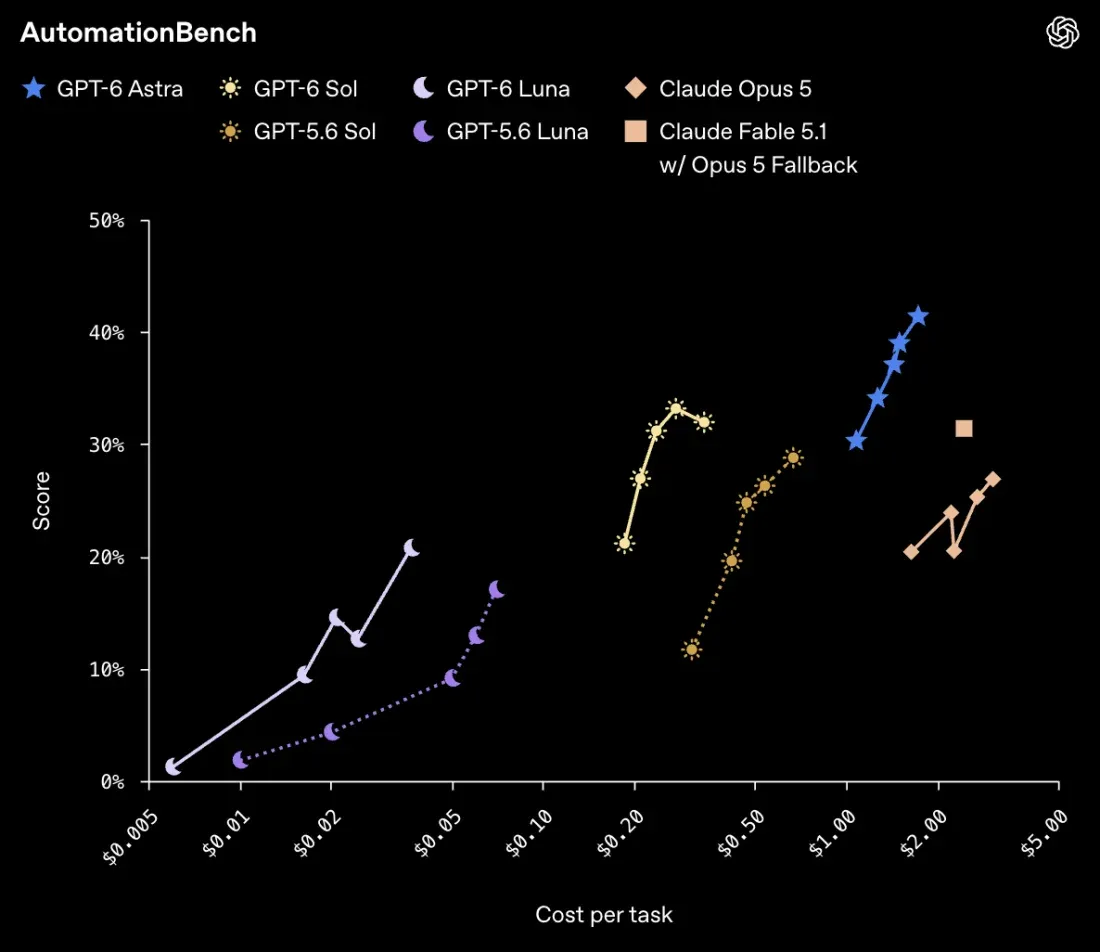
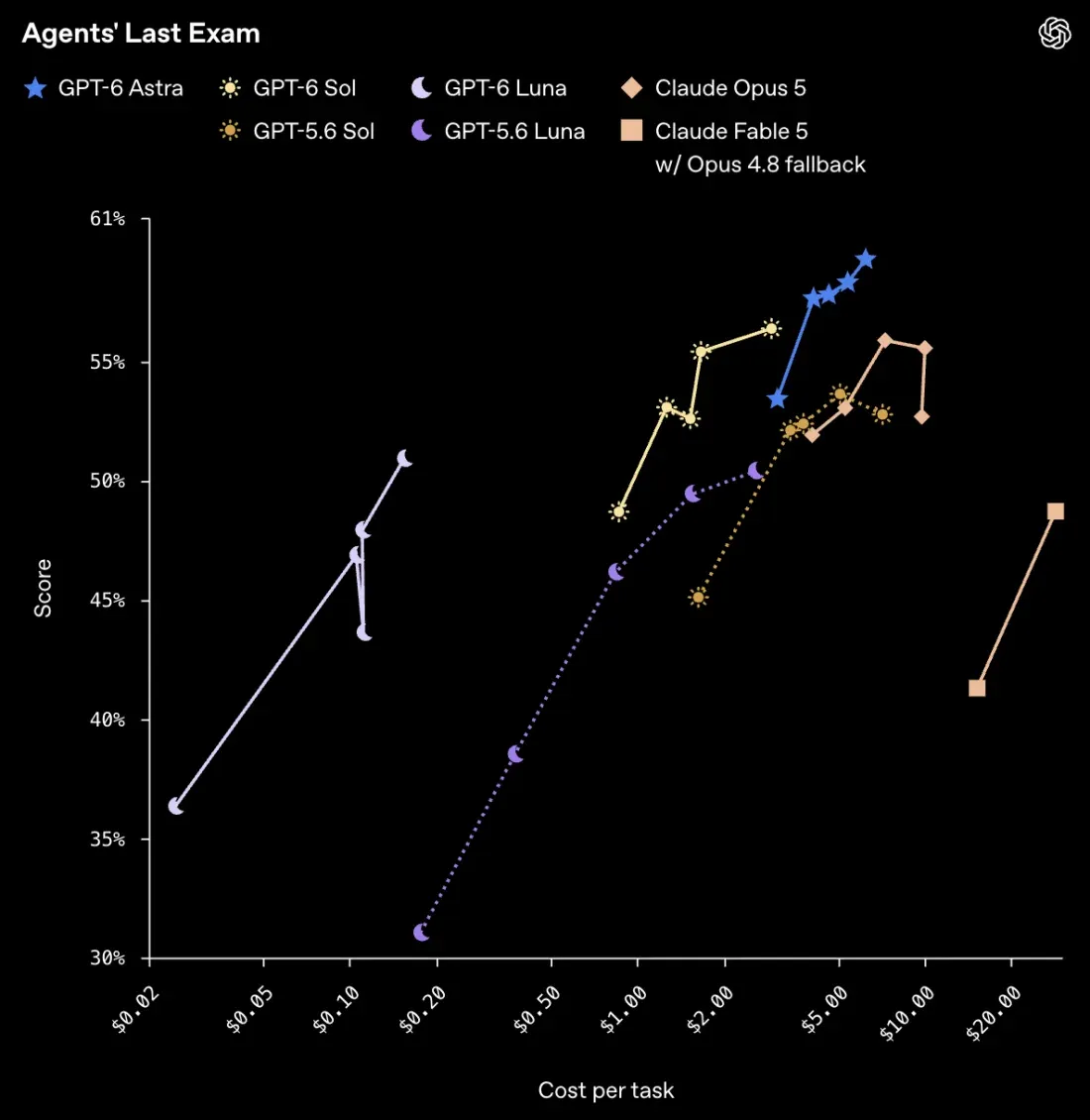
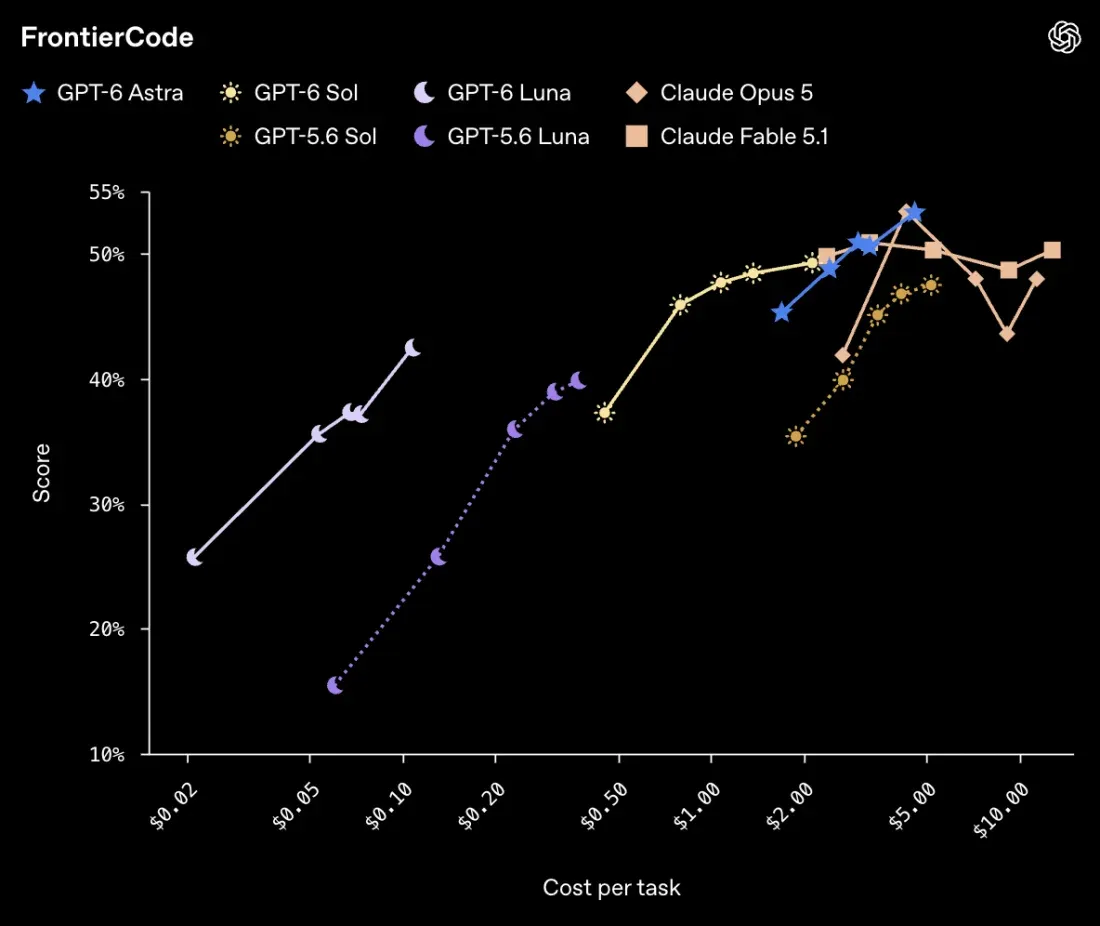
On FrontierCode, which also grades code on whether it is ready to merge, OpenAI says Sol matches Claude Fable 5.1 at xhigh at much lower cost, but shows the exact numbers only on the chart.
Three things here matter more than individual percentages.
Luna comes close to Sol on code. On DeepSWE Luna scores 66.6% against Sol's 68.8% — the level of Claude Opus 5 and Fable 5 at medium effort, at 93% lower cost per task than Opus 5. On OSWorld, Luna at max beats GPT-5.6 Sol at medium for a tenth of the price. The benchmark measures isolated tasks, not long work in someone else's codebase, so replacing Sol with Luna everywhere is a bad idea. But on many pipeline steps the quality gap is smaller than the price gap — and that one is 20–25×.
Sol makes half the mistakes. On an internal factuality evaluation built from real conversations where users flagged an error, Sol makes about half as many mistakes as GPT-5.6 Sol and approaches Astra. Luna at high effort holds GPT-5.6 Sol's level at roughly a hundredth of the cost. OpenAI's caveat: these are deliberately hard conversations, and everyday work has fewer errors.
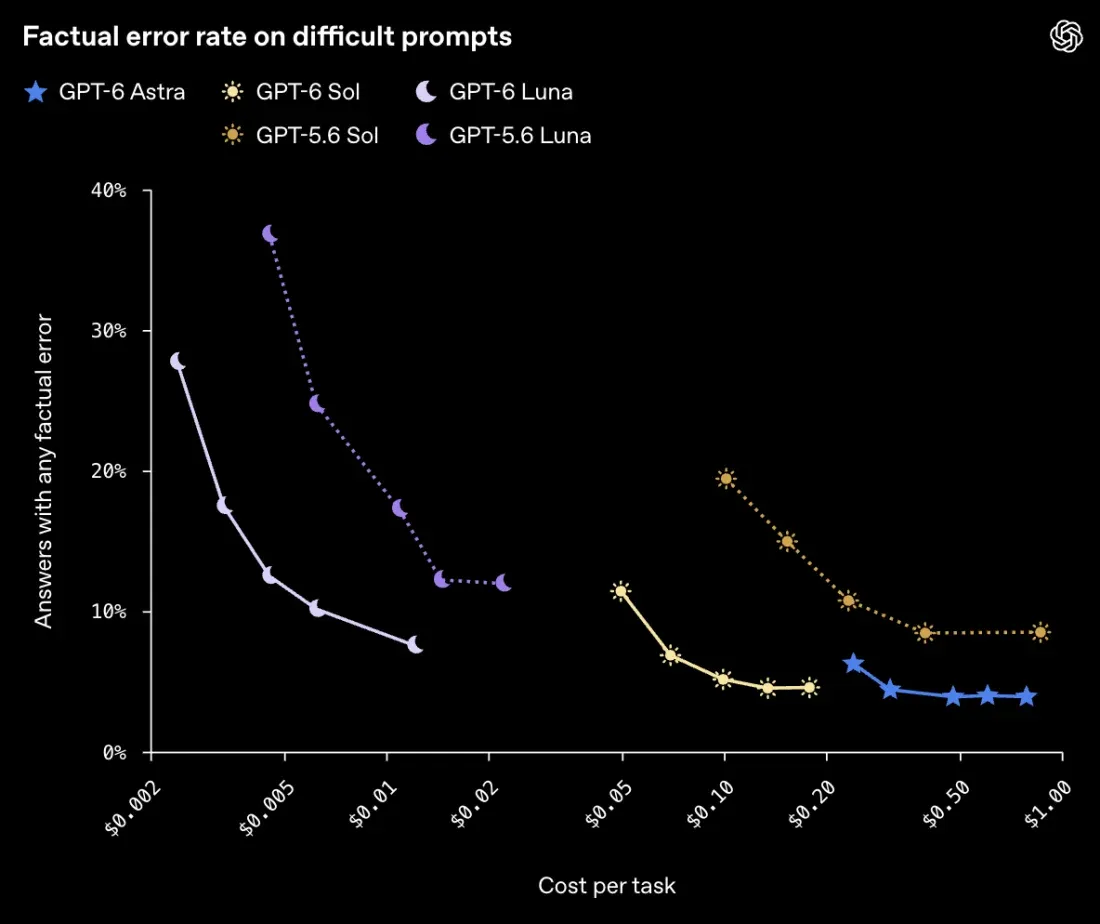
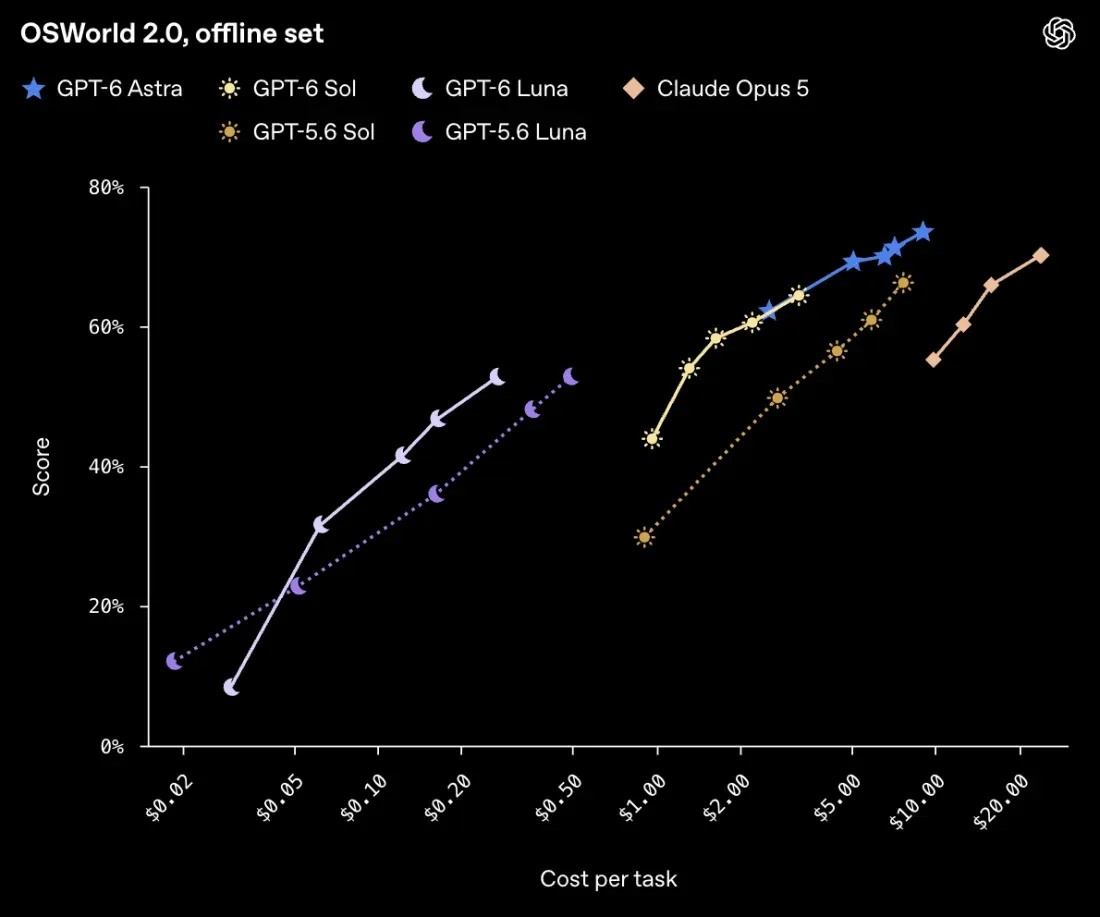
The charts are from OpenAI's announcement: the horizontal axis is cost per task on a log scale, and the points on each line are different effort levels.
The models are more honest about their own work. On alignment evaluations both make misleading claims about their code less often than the 5.6 versions. For an agent that matters more than speed: an agent that hides a broken tool costs more than one that stops honestly. The tests are deliberately adversarial and don't reflect error rates in typical use.
OpenAI also brought Astra's answer style to Sol and Luna: less jargon, fewer low-value details, slightly shorter answers. Over long sessions that saves output tokens too.
There is no direct comparison with Opus 5.5 in the announcement: it shipped the same day, and OpenAI compares against Opus 5 and Fable 5.1. Anthropic reports 81.8% for Opus 5.5 on OSWorld 2.0, but comparing that with Sol's 60.5% across two different announcements isn't valid. The only reliable method is to run your own tasks on both.
Where Luna is enough and where you need Sol
My recommendation: don't pick one model for everything, split the work by step.
| Task | Model | Why |
|---|---|---|
| Classification, field extraction, request routing | Luna | short, verifiable output; price decides |
| Agent subtasks: file search, summarizing tool output | Luna | many calls, each one simple |
| Interactive coding, review, agents running dozens of steps | Sol | reliability of the whole chain matters, not the price of one call |
| Replies to customers or text going into a document | Sol | half the factual errors of GPT-5.6 Sol |
| Long autonomous tasks, large context, computer use | Astra or Opus 5.5 | Sol is weaker there, and the extra cost pays off |
Code is the borderline case. If your pipeline has lots of short edits from a clear description, run them on Luna first and move only the ones Luna gets wrong to Sol. The price difference leaves room in the budget for that check.
Limitations
- The benchmarks are OpenAI's. Effort levels differ across comparisons, competitor results come from their public reports, and for Fable some numbers are Fable 5 because 5.1 data wasn't available.
- Astra is still stronger. Sol is a cheap way to get near-Astra reliability on typical tasks, not a replacement for it on the hardest ones.
- Migrating isn't a one-liner. Prompts tuned for GPT-5.6 are worth rechecking: the models write shorter and report problems more honestly, so parsers and flows tied to the old answer format may behave differently.
FAQ
Are GPT-6 Sol and GPT-6 Luna out? Yes, since September 22, 2026. In the API immediately; in ChatGPT Work and Codex gradually through the day.
How much do they cost? At OpenAI, Sol is $2 per million input tokens and $10 per million output tokens; Luna is $0.10 and $0.50. On GPTunneL there is a 50% launch discount right now: Sol is $0.005 per 1K input and $0.03 per 1K output tokens; Luna is $0.0002 and $0.0012. Without the discount: $0.01 / $0.06 and $0.0004 / $0.0024.
How is Sol different from Astra? Astra is the flagship for the hardest and longest tasks; on OpenAI's price list Sol is five times cheaper. On typical tasks the quality gap is small: on AutomationBench, Sol at xhigh even beats Astra at low.
Can I use them for free? GPTunneL has no permanent free access: you pay for the tokens you use, with no subscription. On Luna a short request costs a tiny fraction of a cent.
Do I need a VPN? No. GPTunneL works without a VPN and accepts local payment methods.
What to check on your side
If you run GPT-5.6 Sol today, the cheapest experiment is to replay the same request set on GPT-6 Sol and GPT-6 Luna and see which steps Luna covers without losing quality. On GPTunneL both models, Astra and Claude Opus 5.5 share one balance, so you can compare them in one chat or with one API key.