
On October 19, 2026, MiniMax released M3.1 Flash, a model for agentic tasks with a 1M-token context. On Automation-Bench it scored 62.8, ahead of Claude Opus 5 (50.3) and GPT-5.6 Sol (45.8), and one task costs less than $0.05. MiniMax says agentic tasks cost 70% less on it than on the previous model. The company promises to publish the weights later.
For context: by MiniMax’s own tests, M3.1 Flash trails the recent DeepSeek V4.1 Flash 1017 update, which we covered on October 18, in most shared tests. There are six. It wins one: Automation-Bench, 62.8 against 60.5 (+2.3). It loses five: NL2Repo-Bench by 7.0 points, Terminal Bench 4.0 by 4.2, DeepSWE v1.1 by 3.3, BabyVision by 1.5 and HLE by 0.6.
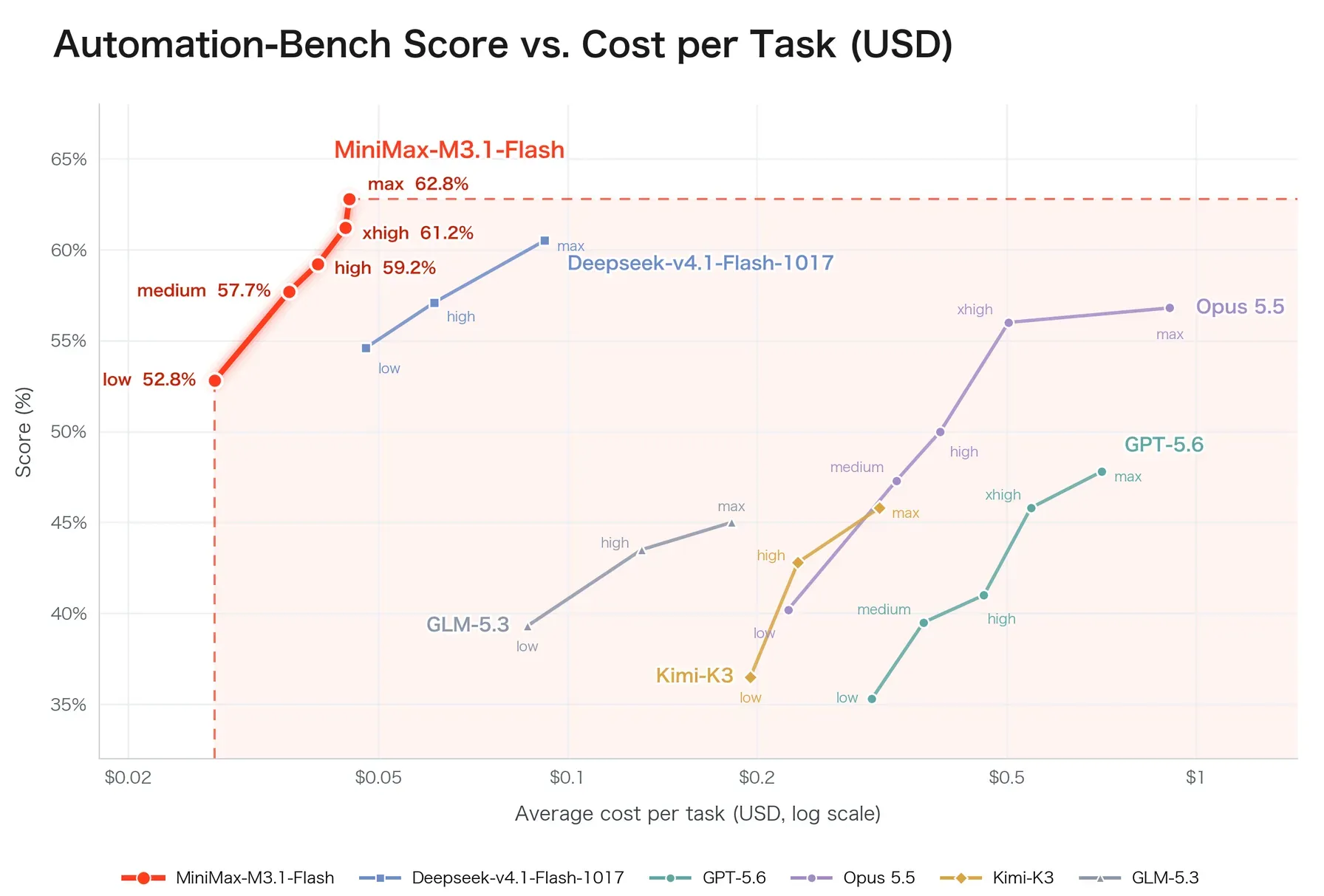
Automation-Bench: score and average cost per task at five effort levels, logarithmic cost scale. Chart from the MiniMax announcement.
What we know about the model
M3.1 Flash is the successor to MiniMax M3. Before release it was tested anonymously under the name Space Bunny: according to MiniMax, that build processed more than 200 trillion tokens. The API documentation describes the model as a "frontier multimodal coding model" with a 1M-token context and tunable thinking depth.
MiniMax does not give the model size in the announcement. MarkTechPost, citing the product page, reports 428B parameters with about 23B active (a Mixture-of-Experts architecture) and text, image and video input. That matches M3, and there is no technical report on what changed.
The model is available through the API as MiniMax-M3.1-Flash, the M Plan subscription and the MiniMax Code app. Reasoning is always on: according to MarkTechPost, there are five effort levels from low to max, MiniMax recommends max, and a request with thinking disabled returns an error.
Cost and speed
| Parameter | M3.1 Flash |
|---|---|
| Context | 1M tokens |
| Surcharge for long context | none, a single rate across the full 1M |
| Speed | up to 200+ tokens/s, median 170+ |
| Cost of agentic tasks | 70% lower than the previous model |
All figures in the table are MiniMax's claims. According to MiniMax, online inference is almost three times faster than before. The product page, per MarkTechPost, lists about 150 tokens per second.
What the benchmarks show
Below is the table from the MiniMax announcement. All results in it were published by the company itself, and run conditions differ: for each test the vendor names its own agent harness and context limit. An independent measurement from Arena is in the next section.
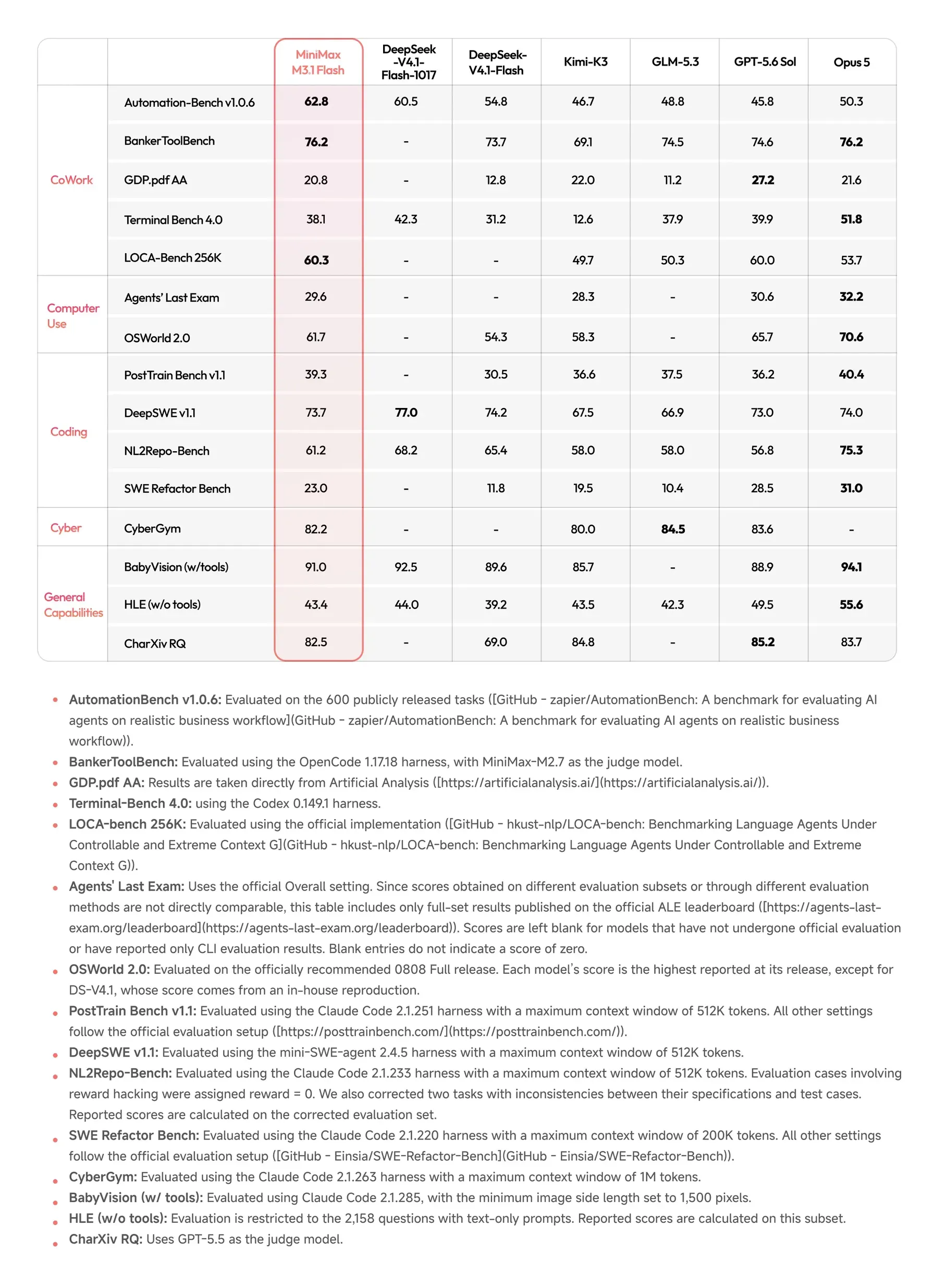
Table from the MiniMax announcement. A dash means the vendor did not report a result for that model.
A digest of the tests where the other models are compared:
| Test | M3.1 Flash | DeepSeek V4.1 Flash 1017 | Kimi K3 | GLM-5.3 | GPT-5.6 Sol | Opus 5 |
|---|---|---|---|---|---|---|
| Automation-Bench v1.0.6 | 62.8 | 60.5 | 46.7 | 48.8 | 45.8 | 50.3 |
| BankerToolBench | 76.2 | - | 69.1 | 74.5 | 74.6 | 76.2 |
| LOCA-Bench 256K | 60.3 | - | 49.7 | 50.3 | 60.0 | 53.7 |
| DeepSWE v1.1 | 73.7 | 77.0 | 67.5 | 66.9 | 73.0 | 74.0 |
| Terminal Bench 4.0 | 38.1 | 42.3 | 12.6 | 37.9 | 39.9 | 51.8 |
| NL2Repo-Bench | 61.2 | 68.2 | 58.0 | 58.0 | 56.8 | 75.3 |
| OSWorld 2.0 | 61.7 | - | 58.3 | - | 65.7 | 70.6 |
| HLE without tools | 43.4 | 44.0 | 43.5 | 42.3 | 49.5 | 55.6 |
The picture is this: the model leads in office and agentic tasks (Automation-Bench, BankerToolBench, LOCA-Bench), holds level with GPT-5.6 Sol and Opus 5 on DeepSWE, but is clearly behind Opus 5 in terminal tasks, repository work and general knowledge. MiniMax calls it the best Chinese model on OSWorld 2.0 and Agents' Last Exam.
What the independent ranking shows
Arena added M3.1 Flash to Code Arena: WebDev, a ranking where models build web interfaces and users judge the results in blind comparisons. The model scored 1588 points: 12th among open models and 32nd overall, and MiniMax as a lab moved up to 12th place. Arena classes the model as open, although MiniMax has not yet published the weights. Its predecessor M3 had 1482 points, 19th among open models and 66th overall, so the gain is 106 points.
The score is preliminary: in the Arena table on October 19 the model carries a Preliminary tag, 1787 votes and a margin of ±14 points. In the overall ranking, with open and closed models together, its closest neighbors are Gemini 3.7 Flash (1590), Claude Haiku 5.5 and Gemini 3.8 Flash (1586 each) and DeepSeek-V4-Flash (1582). The table lists the license as MiniMax Community License; the MiniMax announcement does not mention a license.
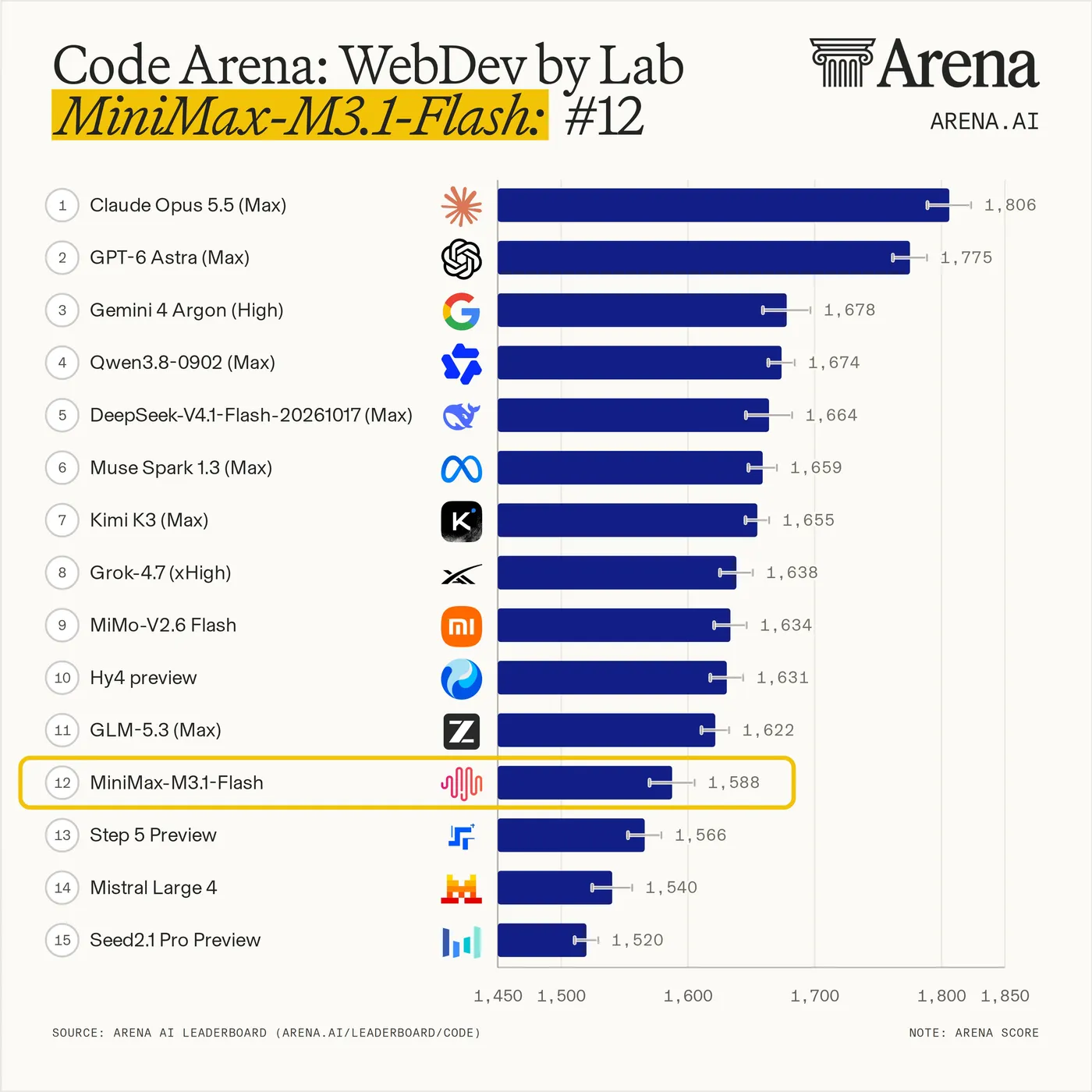
Code Arena: WebDev, lab ranking. Source: Arena (arena.ai/leaderboard/code).
Next to its competitors the result is more modest than in MiniMax's agentic tables: DeepSeek V4.1 Flash 1017 scored 1664, Kimi K3 1655, GLM-5.3 1622, and Claude Opus 5.5 leads with 1806. According to Arena, the model moved up in every category compared with M3, with the biggest gains in gaming (+179 points, from 21st to 9th) and reference-based design (+155, from 20th to 7th).
This is one ranking for one type of task, and it measures web development, not the office scenarios MiniMax builds its announcement around.
What a task costs
MiniMax builds its comparison around the price of a task, not a token. The values below are read off the vendor's charts (the first is at the top of the article) and are approximate.
- Automation-Bench. M3.1 Flash scores 52.8 at low effort and 62.8 at max, and at all five levels a task costs under $0.05. On the chart Claude Opus 5.5 scores about 56.8 at roughly $0.9 per task, GPT-5.6 about 47.8 at roughly $0.7.
- DeepSWE v1.1. At 73.7%, M3.1 Flash spends about $0.28 per task. Claude Opus 5 at maximum effort shows a close result at roughly $12 per task.
- Agents' Last Exam. A full run of 152 tasks cost about $111 at 29.6%. Claude Opus 5.5 scores about 38% at a cost on the order of $1,300.
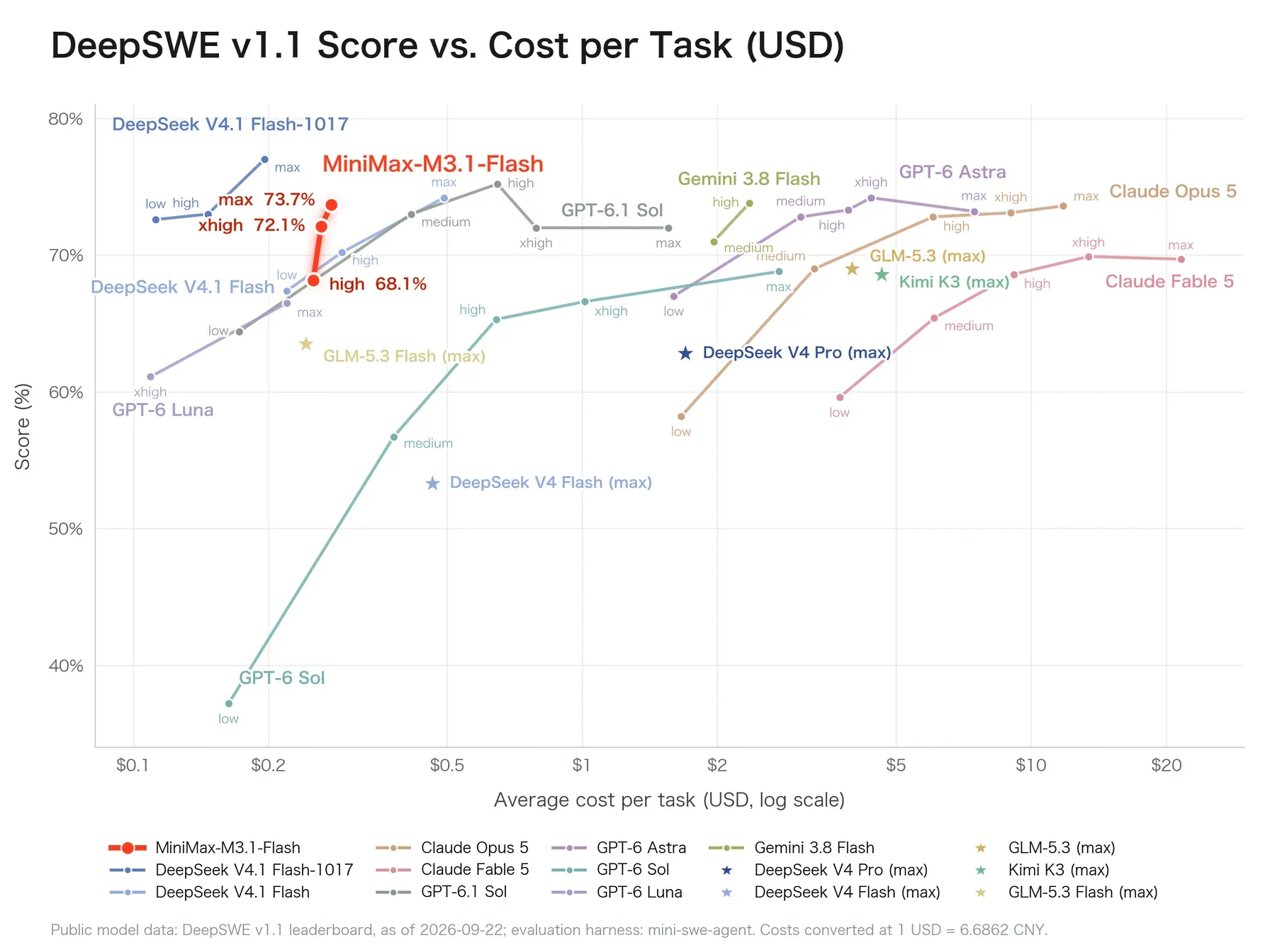
DeepSWE v1.1: DeepSeek V4.1 Flash 1017 is higher and cheaper on the chart. Leaderboard results as of 22.09.2026, mini-SWE-agent harness.
What remains unclear
- Few independent checks. MiniMax published the agentic tests in the announcement itself, and the comparison with other models depends on run conditions. So far only Arena has evaluated the model independently, and only on web development. MarkTechPost notes that Kimi K3's own card reports 30.8 on Automation-Bench on a public set of 600 tasks, while MiniMax lists 46.7 for it.
- DeepSeek V4.1 Flash 1017 is stronger at code. On DeepSWE it scores 77.0 against 73.7 and is cheaper on the chart. More about that model in our review.
- Reasoning cannot be turned off. For simple requests this sets a floor on tokens and latency, and old code that expected
<think>tags as with M3 will need rewriting: per MarkTechPost, reasoning arrives in a separatereasoning_contentfield. - Weights, license, size. The announcement only says the weights will come later. MarkTechPost gives the date October 23, but it is not on the MiniMax page; the announcement names no license, while Arena's table lists MiniMax Community License. The larger M3.1 Pro, according to MiniMax, will come later.
What this means for you
If you just chat with AI, the new model changes nothing for you: M3.1 Flash is built for agents that run long multi-step tasks with tools. If you run such tasks through an API, compare models by the cost of a completed task on your own material, not by the price of a token: that is what MiniMax's charts are built on, and that is where M3.1 Flash shows its biggest gap.
Until the weights are out and there are independent measurements on agentic tasks, treat the figures from the announcement as a guide.
Where to try
M3.1 Flash is not yet in the GPTunneL catalog. Its predecessor MiniMax M3, DeepSeek V4.1 Flash and Kimi K3 are available in one chat: you can test your task on them until the new model appears on the platform.
Sources
- MiniMax-M3.1-Flash, MiniMax blog, 19.10.2026 - announcement, speed, benchmarks, cost-per-task charts, statement about the weights.
- MiniMax model documentation - model description, 1M context.
- Arena (X), post on the launch of MiniMax-M3.1-Flash in Code Arena: WebDev - rank, scores, gain over M3 and by category; ranking at arena.ai/leaderboard/code.
- MiniMax Just Launched M3.1 Flash, MarkTechPost, 19.10.2026 - parameters, effort levels, weights date, cross-check with the Kimi K3 card.