
Today, neural networks can generate a melody, arrangement, and even vocals from a text description in minutes. Artificial intelligence is moving into creative fields, and music creation is one of the most exciting areas of its application. The technology is developing rapidly, offering musicians and everyone else new tools for self-expression.
These smart systems, such as Suno or Mureka, no longer just imitate existing styles — they offer original compositions, help overcome creative block, and can even build a song from scratch. How do they do it, what possibilities do they open up, and what challenges do developers and users face?
Let's explore how neural networks are changing the world of music and what awaits us in the future. This is a journey into a world of algorithmic creativity available to everyone.
What is a neural network for music creation?
A neural network for music creation is a specialized type of artificial intelligence — a program trained on huge volumes of musical data. Imagine a student who has listened to millions of hours of music across every genre and style, studied harmony, rhythm, and compositional structure, and can now create something similar or even entirely new.
Put simply, such a neural network works like this:
- It analyzes patterns in the training data;
- Then it uses them to generate original musical fragments or full tracks.
At the core of these systems are complex mathematical models that mimic the workings of the human brain. They can pick up on nuances of mood, style, tempo, and instrumentation.
The goal of the neural network is not simply to copy, but to generate new music that matches given parameters or continues a melody that has already begun. The process of creating music with these tools is becoming more accessible, opening the door to creativity even for those without a musical education.
It's a powerful tool both for professionals seeking inspiration and for hobbyists who want to experiment with sound. The neural network analyzes and reproduces complex structures.
How do neural networks generate music?
The music generation process starts with training. Developers "feed" the algorithm enormous music libraries — from classical to contemporary hip-hop — often in MIDI format (containing information about notes, their duration, and volume) or directly as audio files.
The neural network then analyzes this data, identifying statistical patterns:
- Typical chord progressions for a particular genre.
- Characteristic rhythmic patterns;
- Instrument combinations;
- Song structure.
Once the neural network is trained and released to the public, users can set parameters for generation. These tools often offer several generation modes. That can be a free-form text prompt (for example, "a song about a lonely robot finding a friend" or "upbeat electronic track for workout"), or choosing a mood and genre, specifying tempo, instruments, or even humming a melody.
Based on this input, the neural network begins the generation process. Using the patterns it has learned, it predicts the next note, chord, or musical fragment, gradually building the entire composition. Some neural networks can generate not only instrumental tracks but also songs with vocals, sometimes based on lyrics written by the user.
Models such as transformers or recurrent neural networks are especially good at capturing long-term dependencies in music, which is important for creating logically structured tracks. Generation quality depends on the volume and diversity of the training data, as well as the complexity of the model itself.
Advantages and limitations
Using neural networks to create music opens up a wealth of possibilities, but it also comes with certain challenges.
Advantages:
- Speed and accessibility: You can create a basic track or sketch in minutes, with no special skills required. This democratizes music creation.
- Source of inspiration: A neural network can spark an unexpected idea, melody, or harmony, helping you get past creative block.
- Background music generation: It's easy to create royalty-free music for videos, podcasts, games, or presentations without worrying about copyright infringement. Generating such tracks is a popular use case.
- Customization: Many services let you specify the genre, mood, instruments, and other parameters of the future track.
- Learning: Interacting with a neural network can help beginners understand the basics of composition and arrangement.
Limitations:
- Lack of deep meaning and emotion: Neural networks are not yet able to infuse music with genuine feeling or the complex intent characteristic of human creativity. Compositions can sound technically correct but soulless — although recent solutions like Suno or Mureka show impressive results.
- Formulaic and predictable output: Despite generating new content, a neural network often relies on averaged patterns, which can lead to a certain sameness in generated tracks, especially with simplified prompts.
- Quality and artifacts: Generation sometimes suffers from technical imperfections, strange sounds, or illogical transitions. This is especially true for vocal generation.
- Ethical and legal questions: Who owns the rights to music created by a neural network? Can a neural network be trained on copyrighted music? These questions don't yet have clear answers.
- Need for refinement: Generated tracks often require further human processing: editing, mixing, mastering. A neural network is great for generating sketches, but the final product often requires human intervention.
The 2 best neural networks for music creation
The market for AI music creation tools is growing, and there are already several notable players. Here are a couple of them:
Suno AI
We recommend: the GPTunneL prompting guide — how to write prompts for Suno.
Perhaps one of the most talked-about neural networks for music generation, available with no restrictions and no VPN required on GPTunneL. Suno can create full songs from a text prompt, especially in genres like Lofi, Jazz, or Synthwave. The user enters a song description, chooses whether they want vocals or an instrumental, and Suno generates two track variants so you can compare them.
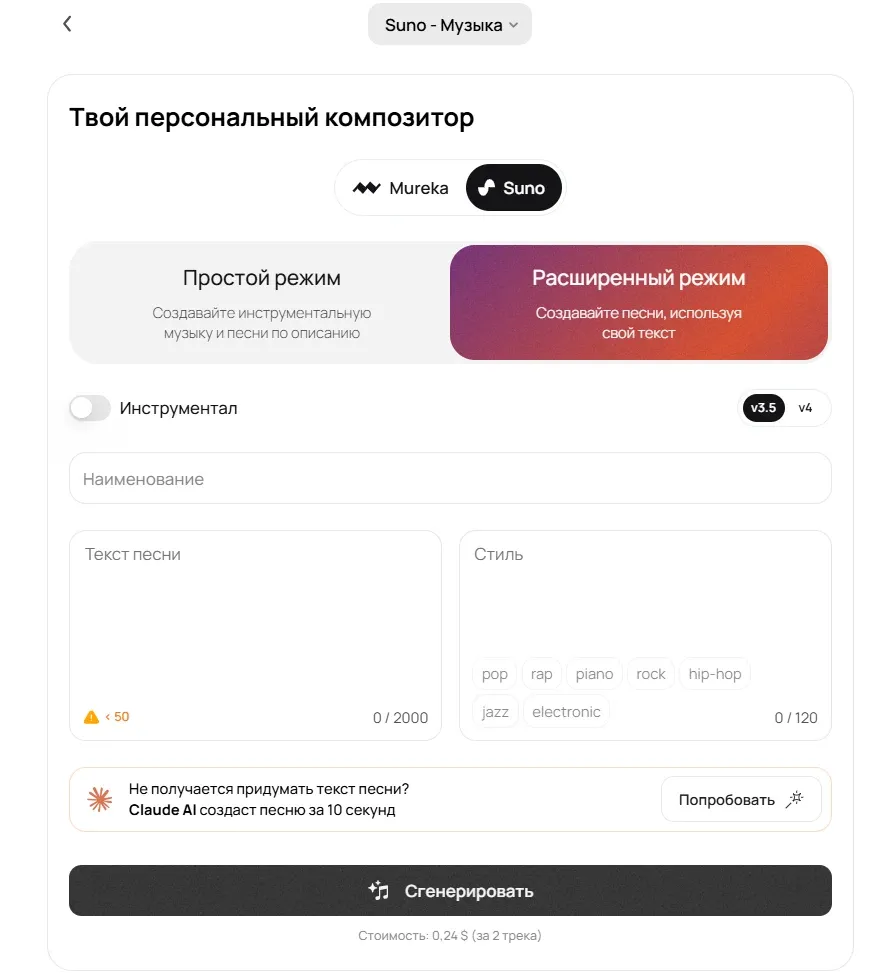
The quality of Suno's vocal and music generation is impressive. You can check the cost of generating songs on GPTunneL on our pricing pages. You can download every song you generate and use it in your own projects — under our terms of service, you are the sole owner of the materials generated on our platform.
Suno also lets you write a lyrics prompt with AI assistance or use your own. You can customize it with special tags that control timing, rhythm, pauses, and other parameters.
That said, you don't have to spend hours studying guides — you can use our AI songwriting assistant built on Claude 3.5 Sonnet, which works for both Suno and the other music model on GPTunneL, Mureka.
Mureka
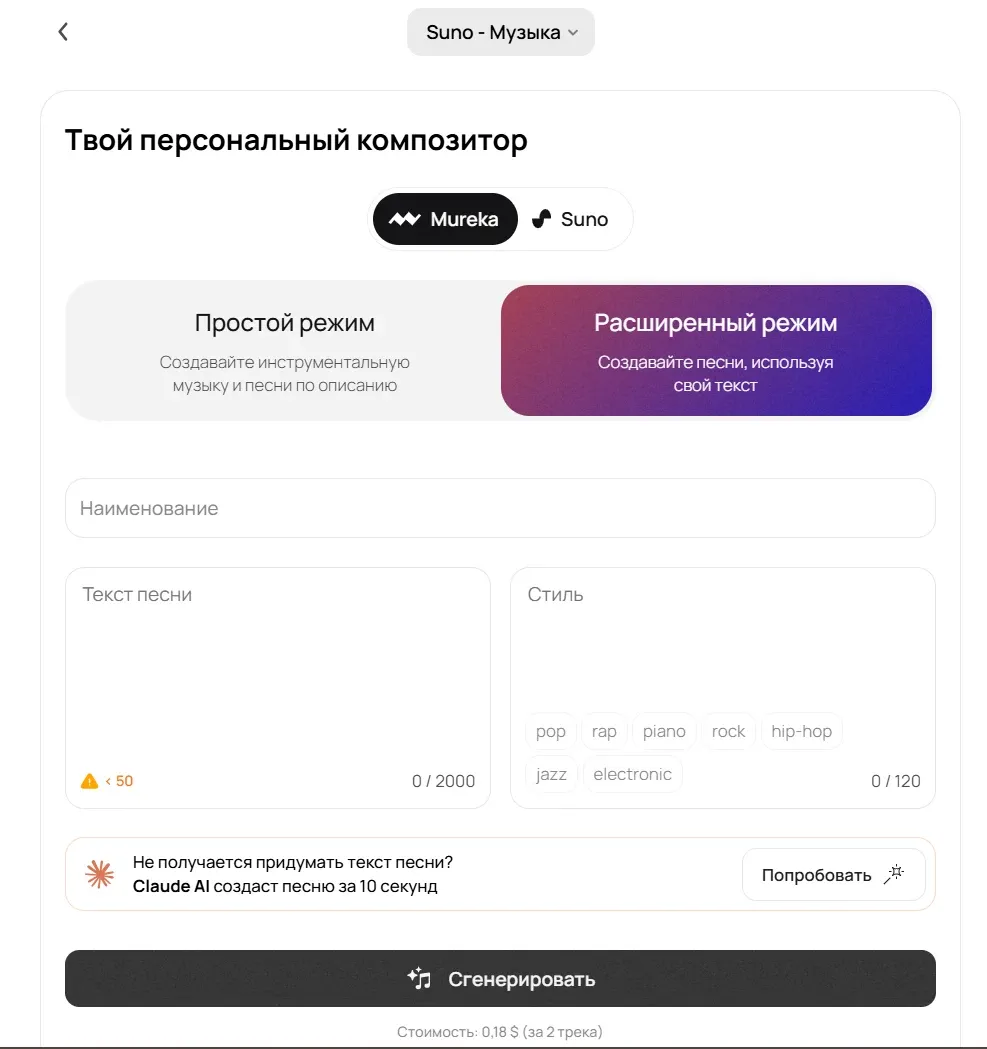
Mureka is another cutting-edge neural network for music generation, available directly on GPTunneL. This AI tool lets everyone, from beginners to experienced musicians, create unique music. Using its own AI model, Mureka generates tracks across various genres, including pop, rap, piano, rock, and more.
- Melody generation from a text description in simple mode.
- Flexible control over style, mood, lyrics, and instruments in advanced mode.
- Choice of vocalist gender and timbre via prompts.
- An interface closely modeled on Suno's for ease of use.
Mureka is geared toward producing professional-quality tracks suited for a variety of uses, including commercial and personal projects. That makes it useful both for content creators and for musicians looking for quick demos or a source of inspiration for their own work.
What to keep in mind when choosing a music-generation neural network?
Keep in mind that features and generation quality vary a lot between different neural networks. Getting a good result often takes several attempts and experimenting with prompts. Some services handle instrumental music better, others are stronger at creating songs with vocals.
If you want to use a track in a project, customize your prompt — you'll get a much better result. For example, a song created with a basic Suno prompt (no tags, no vocal settings, with simple instructions) isn't suitable for commercial use. You can play it in the background, but if you listen closely, you'll notice artifacts and oddities.
Remember, writing a prompt like "a song about love" is easy, but for a unique track it's better to try a more detailed description built using the tips from our Suno prompting guide. Creating a song with a neural network is an engaging process. And don't forget — the lyrics and prompt can be written by you or generated.
The future of neural networks in the music industry
The prospects for artificial intelligence in music creation look exciting, though they spark plenty of debate. We can expect neural networks to keep getting more advanced. Music generation quality will improve, especially when it comes to vocals and conveying complex emotions and moods.
Algorithms will get better at understanding the nuances of text prompts and creating music that more precisely matches the user's vision. We'll likely see tighter integration of AI tools into professional music editors (DAWs), enabling hybrid workflows where humans and neural networks work in tandem.
AI could become an indispensable assistant for composers and arrangers, suggesting harmonies, rhythms, or entire track sections. This could speed up music creation and make it even more accessible.
We may see personalized music services emerge, where a neural network generates tracks in real time, adapting to the listener's mood or activity. Song lyrics will also be generated with greater meaning and coherence.
However, the rise of AI raises serious questions too:
- How will this affect the value of human creativity and musicians' earnings?
- How should the use of neural networks trained on other people's music be regulated?
- Could the mass creation of AI music lead to devaluation and sameness?
Finding answers to these questions will be a key task for the industry in the coming years. The future most likely belongs to collaboration between humans and machines, where AI serves as a powerful tool that expands creative horizons rather than fully replacing the artist.
We'll need to find the fine line between advancing technology and preserving what matters most — the unique human perspective in art. Music written by artificial intelligence will exist alongside music created by people.
In summary
Neural networks trained to create music are no longer science fiction — they're a real, rapidly evolving tool finding applications across many fields. Tools like Suno, Mureka, Udio, AIVA, and others are making music creation more accessible, helping people overcome barriers, and offering new sources of inspiration.
Of course, the technology has its limitations: generated tracks aren't always perfect, they can lack emotional depth, and questions of copyright and ethics remain open. But the potential is enormous.
In the future, neural networks will likely become an integral part of the music industry, acting as co-authors and assistants for musicians while letting anyone who wants to try their hand at creating their own compositions. The key thing to remember is that true creativity still requires human involvement, taste, and soul.