

Digital products increasingly require voiceover: video reviews, training modules, podcasts, virtual assistants. To turn text into speech online, you no longer need to search for professional voice actors. It's enough to use TTS services and voice neural networks that generate speech synthesis in seconds.
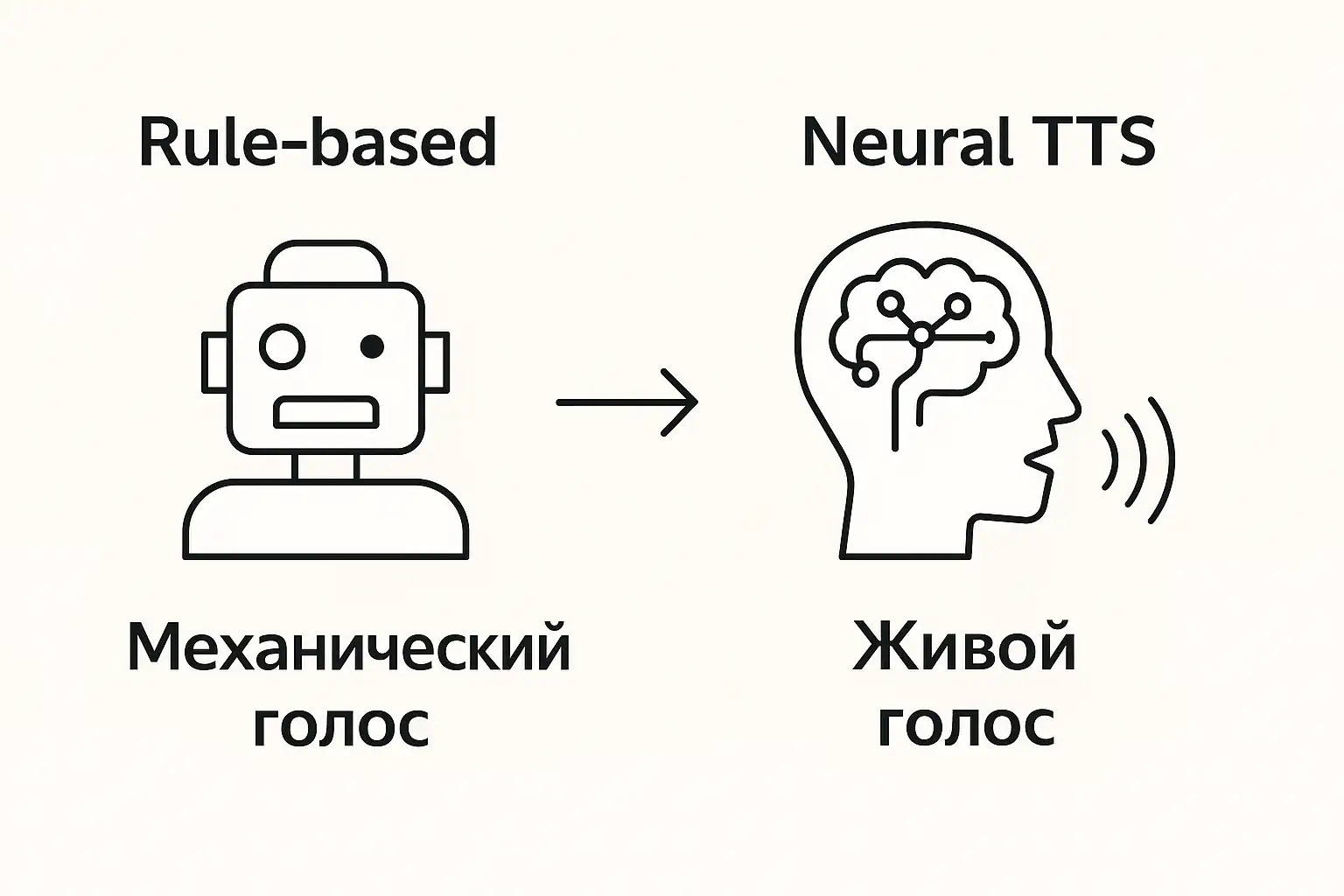
Before neural networks appeared, speech synthesis lacked nuance: the voice sounded mechanical, the intonation monotonous. Now speech synthesis neural networks convey emotions, individual characteristics, and accents, and handle a wide range of tasks — from deepfake voice to AI audiobook generation.
What speech synthesis is and why it matters
Today people consume content on the go, and text-to-speech technologies are becoming more important than ever. With speech synthesis, companies make content accessible to their audience, boost engagement, and cut production costs.
Text-to-speech with neural networks simplifies creating audio versions of articles, books, instructions, or presentations. Businesses use TTS services to automate call handling and customer support, while educational services use them to explain complex topics out loud.
Today, AI speech synthesis services cover tasks such as:
- Voicing videos and training materials,
- AI audiobook generation,
- Creating podcasts without a host,
- AI presentation voiceover,
- Integrating voice avatars and bots,
- Automated response systems and interfaces.
As a result, speech synthesis has become part of everyday digital interaction for business, education, and media.
How speech synthesis works in neural networks
Unlike rule-based systems, neural TTS services like ElevenLabs can turn text into lifelike speech with intonation and emotion. It all starts with natural language processing, through which the system "understands" not just the words but their meaning, context, and sentence structure — which is what makes the voice sound natural.
Next, the model builds a detailed "map" of the future speech — a spectrogram encoding timbre, pauses, pace, and even mood. This is where it's decided whether the voice will sound joyful, serious, or neutral, with pauses and emphasis that come across as human as possible.
The final stage is audio signal generation, handled by vocoder modules that give the voice depth and naturalness. The result is synthesized speech indistinguishable from a live voice actor, suitable for voicing videos, podcasts, and presentations.
The most advanced voice neural networks allow you to:
- Clone a voice with AI (from a short sample),
- Customize timbre for a specific task through prompt engineering,
- Switch between languages and accents on the fly.
In prompt engineering, developers use useful ChatGPT prompts to precisely control style, pace, and emotion when generating speech.
Best TTS services and voice neural networks in 2025, available on GPTunneL
In 2025, the best TTS services offer dozens of voices in multiple languages, flexible APIs, and control over pace and emotion. Nearly all these systems support voicing content in multiple languages, including English.
ElevenLabs
For example, ElevenLabs is the benchmark for natural-sounding speech synthesis:
- Streaming voice generation in 90+ languages
- Great for use cases like fast video voiceover with a neural network
- Support for custom voice profiles
- Fine-tuned control
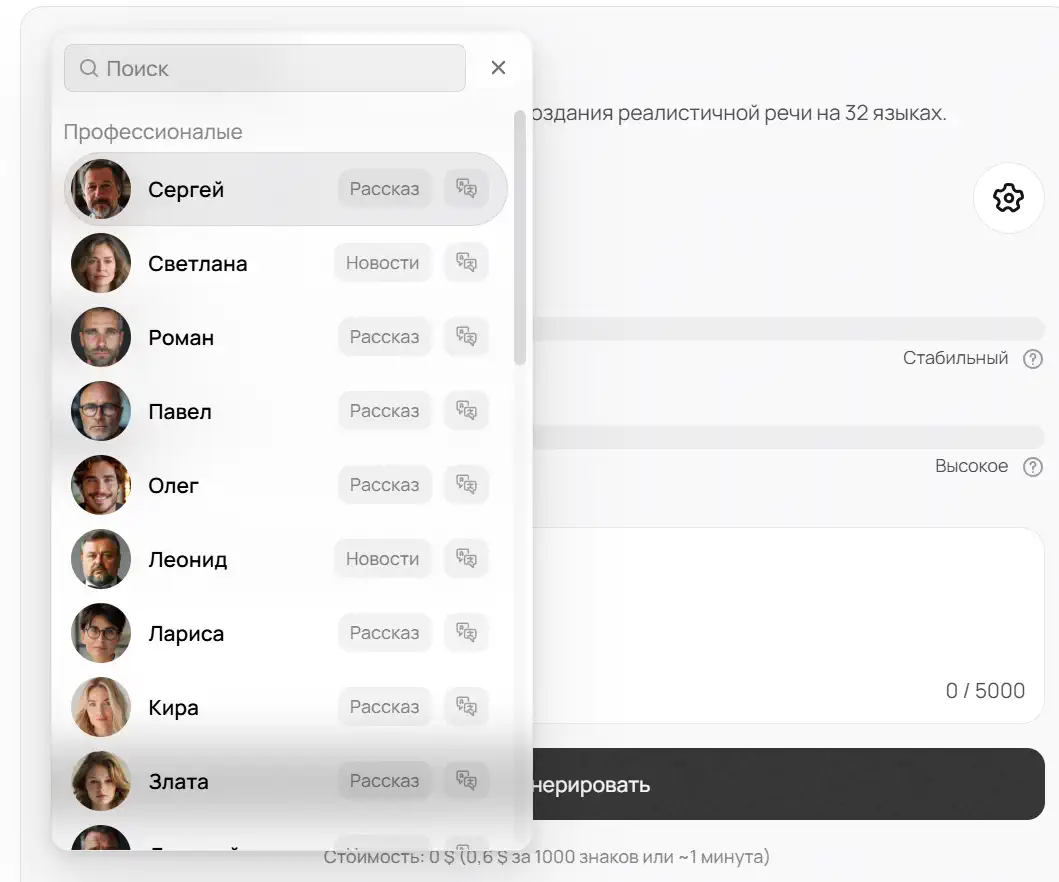
GPTunneL offers Announcer 2.0, built on ElevenLabs, which lets you synthesize any text into speech using more than 20 pre-built voices.
Veo 3 and Veo 3 Fast
VEO 3 belongs among the leading TTS services thanks to its ability to generate videos up to 8 seconds long with audio tracks and any character voices.
- The model can work with male and female voices, accents, and multiple languages
- It handles video generation well — you can give it any prompt, and the model will execute it
- You can fully control the output, including the footage, character voices, or audio effects, through your prompts. Read our Veo 3 prompt engineering guide to learn more.
The neural network is available in GPTunneL's Creative Lab in two versions: Veo 3 for maximum quality, and the lighter Veo 3 Fast, which generates video faster.
Suno
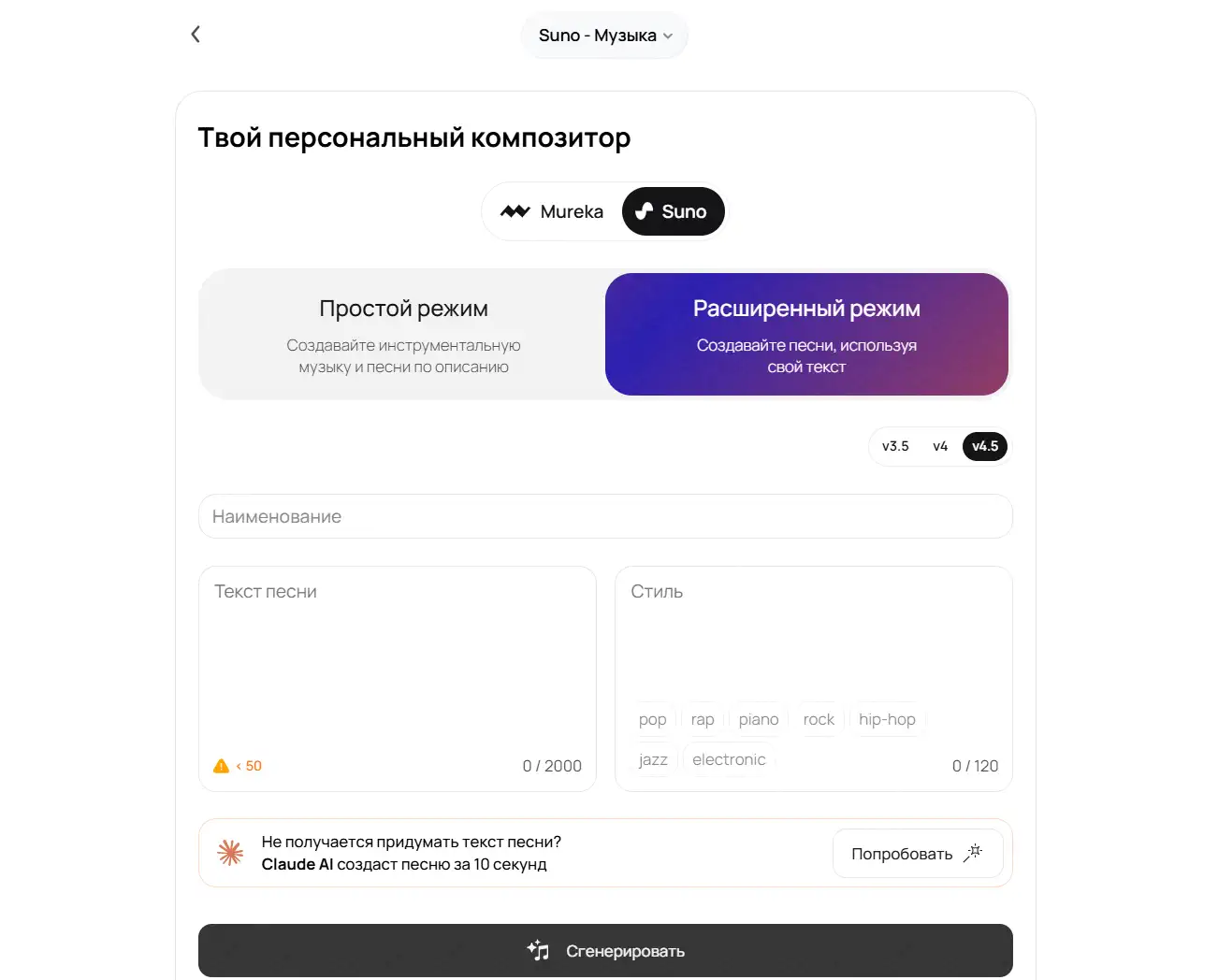
Suno is a neural network that can generate an entire song with vocals from your text. It's a real find for creative projects.
- There are two modes: a regular one for generating melodies, and an advanced mode suited for creating songs with vocals.
- Suno's strength is control over style and timbre: you can choose the genre and mood, and the result always sounds fresh and natural.
- You can also use special tags to fine-tune stress, pauses, and other elements of your song.
The neural network is used for creating music videos, jingles, audio ads, and even voicing dialogue with music. GPTunneL offers Suno in three versions: v3.5, v4, v4.5. If you don't know how to write prompts for Suno — no problem: we also have a songwriter assistant built on Claude 3.5 Sonnet.
Mureka
Mureka is a versatile voice synthesizer built for generating songs. It makes switching between styles easy — from rock to lyrical ballads.
- Mureka is especially valued for its clean sound, fast response time, and support for many languages.
- Thanks to flexible emotion and accent settings, the voice always fits the context.
- On GPTunneL, the neural network offers a settings menu similar to Suno's, along with lower track generation costs. You can create melodies and songs with vocals.
While it falls slightly short of Suno in quality, the neural network is highly responsive to your prompts, produces clean sound, and offers a rich variety of styles and genres. Try experimenting with Mureka and compare it to its competitor.
What to use TTS and AI voiceover for
Use cases for TTS services vary widely — from basic automation to complex media projects.
- Voicing text and articles — quickly make content accessible to listeners with visual impairments or those who prefer audio format.
- Video content — automatic video voiceover with a neural network is used for localization, creating subtitles, and clips.
- Presentations and training — AI presentation voiceover lets you personalize delivery and speeds up course production.
- Audiobooks — AI audiobook generation expands the audience for text-based materials.
- Podcasts and storytelling — neural networks for podcasts cut costs and let creators experiment with styles without a host.
- Voice avatars and bots — used in voice interfaces, customer support, and mobile apps.
These capabilities speed up time-to-market, reduce costs, and let you test new formats without hiring voice actors.
How to choose a TTS service for your task
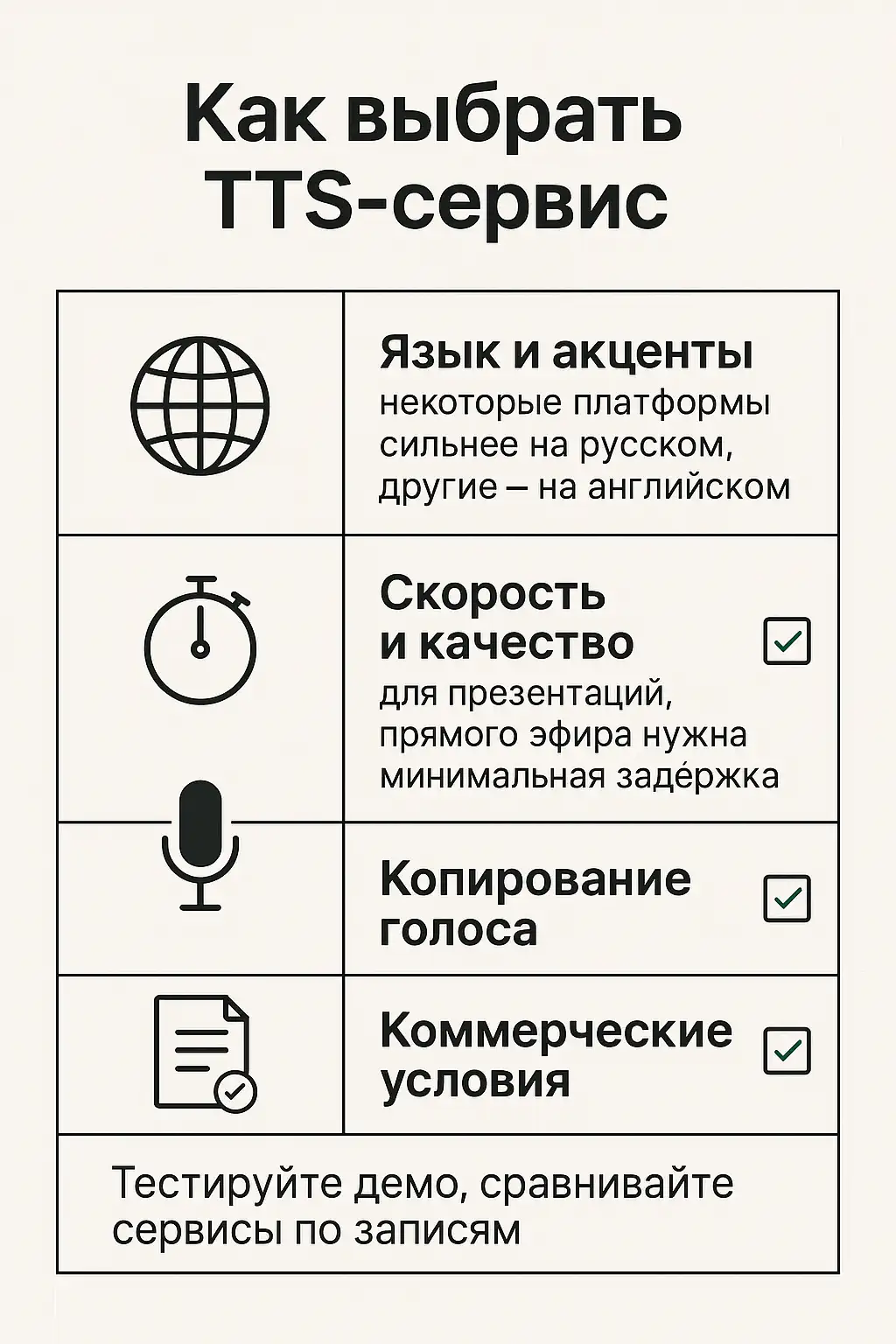
When choosing a TTS service, it's important to consider:
- Language and accents: some platforms are stronger in one language, others in another. Announcer on GPTunneL offers a wide range of voices: neutral, irritated, enthusiastic, and more.
- Generation speed and quality: presentations and live broadcasts require minimal latency.
- Voice cloning capability with AI for custom projects.
- Commercial terms: license for commercial use, cost of voiceover. On GPTunneL, all the materials you generate belong to you.
Compare services or text-to-speech voices using real recordings, test demo versions, and check support for the formats and integrations you need.
Use cases and examples
Companies and creators regularly integrate speech synthesis neural networks into digital products:
- Voicing YouTube video reviews — adapting for different locales without re-recording,
- Podcasts without a host — neural networks for podcasts instantly replace the voice,
- Voicing presentations for clients — reducing production costs,
- Automated response systems with AI voice — personalizing support,
- Integrating TTS into mobile apps — voice assistants, accessibility for visually impaired users. GPTunneL offers an API system, so you can seamlessly integrate our platform's neural networks into your projects.
For these tasks, it's important to choose the right tool for the scenario and not ignore the legal aspects of voice use (especially with deepfake voice and personal data cloning).
In summary
TTS services and voice neural networks now deliver voiceover that's nearly indistinguishable from a human voice. Thanks to customization, high generation speed, and a wide range of settings, speech synthesis neural networks have moved from being an auxiliary technology to a core tool for digital business and education.
The choice of TTS service depends on the specific task, scale, and quality requirements. New platforms appearing on GPTunneL, the integration of prompt engineering, and the development of custom voice avatars are opening up new use cases for businesses, startups, and independent creators. A reliable choice supports growth in efficiency, accessibility, and content diversity across platforms.
FAQ
Which neural networks voice text best?
ElevenLabs, Veo 3, Suno, and Mureka lead the pack. They demonstrate high naturalness, a wide range of styles, and flexibility, supporting voiceover in multiple languages.
Which TTS service is best for generating audiobooks?
ElevenLabs is an excellent choice for this task. Look for services with controllable emotion and support for long-form content.
Is AI voiceover suitable for commercial use?
Yes, as long as the service's own license permits commercial use. Before launching, make sure the use of voices is legitimate and check the intellectual property terms. All materials you generate on GPTunneL belong to you alone.