
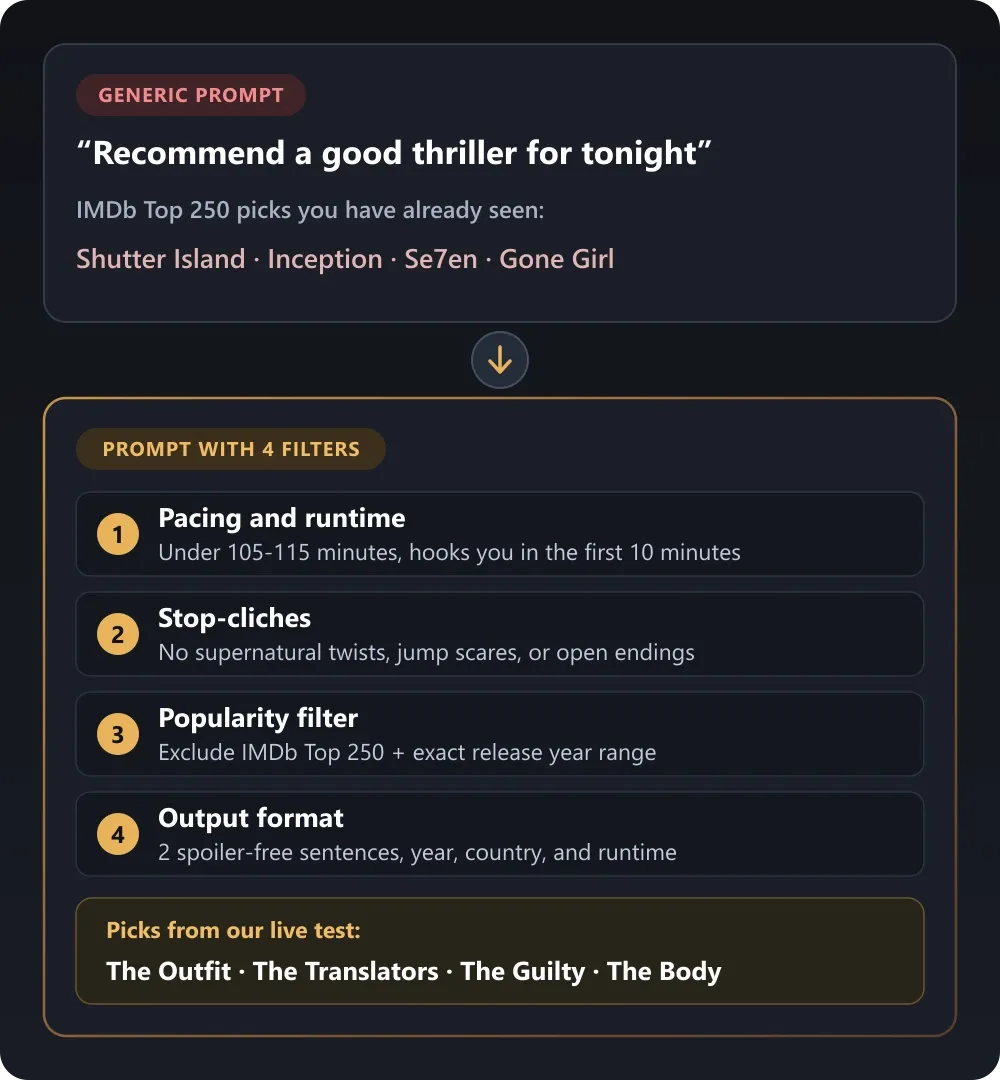
If you open an AI chat and type "recommend a good thriller for tonight", you will almost certainly get Shutter Island, Inception, Se7en, and Gone Girl. Great movies, sure, but by 2026 almost everyone has seen them, and you still end up scrolling through streaming apps for half an hour until you give up on watching anything at all.
The issue is not that language models lack film knowledge. They know tens of thousands of titles, including sharp European chamber mysteries and overlooked festival gems. The issue is that a vague prompt pulls the highest-frequency titles from training data - which is basically the exact same IMDb Top 250 list you already scrolled past.
I put together 7 practical prompts for different evening scenarios - the ones I actually use myself when I am tired of browsing catalogs, from "exhausted after work, need something light under 105 minutes" to "two people with completely different tastes on one couch". At the end, I will show a live test: I sent one of the strictest prompts to four models - DeepSeek V4.1 Flash, Gemini 4 Carbon, GPT-6.2 Astra, and Claude Opus 5.5 - to see which one respects constraints best without falling back on cliches.
Why a short prompt almost always fails
When you ask for "a good comedy", the model is missing four details that actually decide whether your evening works:
- Pacing and mental load. After a ten-hour workday, a slow three-hour arthouse parable and a tight dialogue-driven mystery land completely differently.
- Anti-references (stop-cliches). It is much easier to rule out what annoys you (jump scares, love triangles, open endings, slapstick humor) than to describe your "ideal taste".
- Popularity filter. Unless you explicitly ban obvious hits, the model plays it safe with mainstream classics.
- Output format. Without "spoiler-free and 2 sentences max", AI chats love summarizing half the plot including the main twist.
The fix is simple: all four levers fit into one short template. Copy the scenario that matches your evening below, swap the [bracketed] details for your own, and paste it into the chat.
7 prompts to find the right movie for any situation
1. "Anti-Top-250" - when you feel like you have seen everything
This prompt pushes the model off rehearsed lists and forces it to dig deeper into European, Asian, and independent cinema that rarely surfaces on streaming homepages.
Recommend 4 movies in the [thriller / drama / sci-fi] genre.

Strict requirements:
1. No obvious hits from the IMDb Top 250.
2. Focus on underrated films or strong non-English cinema released between [2005-2025].
3. Must have a clear, closed ending.
4. For each film, list: title, year, country, runtime, and 2 spoiler-free sentences explaining what makes it stand out.
Why it works: banning the Top 250 alongside a year window and international focus immediately clears out the usual Nolan and Fincher shortlist.
2. "After a long workday" - light on the brain, not mindless
The most common weeknight need: you do not want a heavy tragedy or a dumb slapstick comedy, just something smart, warm, or brisk under two hours.
I am tired after work and want a movie that helps me unwind, without cheap slapstick humor or overly sappy melodrama.

Constraints:
- Runtime strictly under [105] minutes.
- Brisk opening: hooks you within the first 10 minutes.
- No bleak themes, dying pets, or depressing endings.
- Mood references I love: [The Secret Life of Walter Mitty, The Intouchables, Chef].

Give me 3 picks: title, year, runtime, and one sentence on the feeling it leaves you with.
Why it works: the runtime cap and "brisk opening" filter out slow burns, while asking about the aftertaste tunes the model to the exact tone you want.
3. "Like movie X, but without Y" - surgical reference
Use this when you loved the core mechanics of a movie, but want to shift its tone. For example, taking the locked-room mystery structure of Knives Out, stripping away the playful irony, and moving closer to the dark tension of Se7en.
Recommend 3 movies in the spirit of [Knives Out], but [darker and more serious - no comedic irony, with tension closer to Se7en]: tight chamber mystery, sharp dialogue, and a surprising payoff.

Strict exclusions:
- No supernatural elements, jump scares, or open endings.
- No obvious hits like [Shutter Island, Prisoners, Gone Girl].
- Runtime under [115] minutes, released between [2005-2025].

For each film, provide: title, year, country, director, exact runtime, and 2 spoiler-free sentences explaining why it fits.
Why it works: two contrasting reference points define a clear corridor (from clever puzzle to dark tension), and the exclusion list stops repeats. This exact pairing with strict filters is what I tested across 4 models below.
4. Two people, two completely different tastes
Classic Friday night standoff: one person wants a tense thriller or sci-fi, the other wants a witty dramedy or a visually gorgeous character story. Let the model find the overlap.
We are picking a movie for two people with very different tastes.
- Viewer 1 loves: [tense thrillers, smart sci-fi, plot twists - for example, Arrival and Tenet].
- Viewer 2 loves: [witty dramedies, snappy dialogue, great visuals - for example, The Grand Budapest Hotel and The Gentlemen].

Find 3 movies at the intersection of these tastes so neither of us gets bored. For each pick, explain in one line what Viewer 1 will enjoy and what Viewer 2 will enjoy. No spoilers.
Why it works: asking for separate reasons for Viewer 1 and Viewer 2 prevents the model from sneaking in a movie that only satisfies one side.
5. Stop-cliche filter
Sometimes you have no idea what genre you want, but you know exactly what will make you turn a movie off in fifteen minutes. Work backwards from your dealbreakers.
Recommend 4 strong movies of any genre except [horror and musicals], released after [2010].

Strict stop-cliche list (if a movie has even one of these, skip it):
1. [Love triangles used as cheap drama.]
2. [Saving the world with a huge CGI final battle.]
3. [Characters acting stupid just to move the plot forward.]
4. [An ambiguous, open ending.]

Include title, year, genre, runtime, and a short spoiler-free premise.
Why it works: language models follow numbered negative constraints very well. The sharper your stop-list, the cleaner the recommendations.
6. Interviewer mode - when you do not know what you want
Some evenings you just do not have the energy to write a brief. Flip the script and let the model pull your mood out in 30 seconds.
Help me pick a movie for tonight, but do not recommend anything yet.
Ask me exactly 4 short multiple-choice questions (A, B, C, D) to figure out my mood, energy level, preferred pacing, and tone.
After I reply, suggest 3 spot-on movies (outside the obvious Top 50) with runtime and a 2-sentence spoiler-free pitch.
Why it works: replying "1A, 2C, 3B, 4A" takes five seconds, and the final shortlist is far more accurate than a cold first guess.
7. Niche subgenre, era, or setting
When you crave a very specific vibe: a locked-room mystery in one location, a train in the snow, cozy 1990s autumn New York, or grounded sci-fi without aliens.
Recommend 4 movies with a very specific atmosphere: [a chamber story set in one confined space - a hotel, train, bunker, or single room - where tension comes purely from dialogue and suspicion].

Conditions:
- Release years: [2000-2025].
- No superhero films or cheap slashers.
- For each pick, explain where the story takes place and what drives the tension (no spoilers).
Why it works: anchoring the request to a physical setting and a tension mechanism ("dialogue and suspicion") stops the model from throwing unrelated genres together.
If you want to sharpen your prompts for everyday tasks beyond movies, check out our guide on how to write effective AI prompts.
Bonus test: how 4 different AI models handle the exact same prompt
To see how much the model itself changes the recommendations, I took prompt #3 (tight chamber mystery between Knives Out and Se7en, no Top 250 hits, strictly under 115 minutes, 2005-2025, no supernatural twists, jump scares, or open endings) and sent it word for word to four current models in the GPTunneL catalog:
Below are the real results from a single API run, ordered from the most affordable model to the flagship.
| Model | 3 movies recommended | Followed all filters? | Speed and relative cost | Style of picks |
|---|---|---|---|---|
| DeepSeek V4.1 Flash | Sleuth (2007, 88 min), The Disappearance of Alice Creed (2009, 93 min), Exam (2009, 101 min) | Yes, all three are real films within every constraint | 18.3 s · ~$0.01 (low reasoning) | Best budget option: dug up sharp British chamber thrillers for about a cent |
| Gemini 4 Carbon | An Inspector Calls (2015, 87 min), The Body (2012, 108 min), Crooked House (2017, 115 min) | Almost 100% (An Inspector Calls has a faint allegorical twist; the other two are spot-on) | 14.0 s · ~$0.02 (low reasoning) | Fastest response in the test: atmospheric European mysteries and a standout Spanish thriller |
| GPT-6.2 Astra | The Translators (2019, 105 min), The Outfit (2022, 105 min), Fermat's Room (2007, 89 min) | Yes, 100% strict compliance | 26.3 s · ~$0.06 | Most consistent trio: lively pitches, zero mainstream repeats, strict filter discipline |
| Claude Opus 5.5 | Sleuth (2007, 88 min), The Guilty (2018, 85 min), The Oxford Murders (2008, 108 min) | Yes, 100% + added its own note about theatrical runtime variations | 22.2 s · ~$0.13 | European and intellectual lean, with the cleanest, most expressive explanations |
What this test showed:
- Every model has its own taste. From the exact same prompt, four models produced 11 distinct movies out of 12 slots - only Sleuth overlapped between
DeepSeek V4.1 FlashandClaude Opus 5.5. If the first list does not click, switching models is often faster than rewriting your prompt. - You do not need an expensive flagship for movie night - just keep reasoning depth in check. In default deep-reasoning mode, both
DeepSeek V4.1 FlashandGemini 4 Carbonspent too long double-checking runtimes and constraints. Lowering reasoning effort made both deliver strong, non-obvious lists in 14-18 seconds for roughly one to two cents. If you want strict first-try compliance without touching settings, GPT-6.2 Astra or Claude Opus 5.5 handles it effortlessly. For a broader look at speed and pricing across harder tasks, I already broke down the numbers in our 2026 smartest AI models ranking.
Quick safeguard: how to avoid spoilers and made-up titles
Even strong models occasionally miss a release year by a couple of years, get a runtime off by 3-5 minutes, or accidentally spoil a twist in the synopsis. Add these two lines to the end of any prompt:
Important: do not spoil plot twists or the ending. If you are not 100% sure a movie exists and fits every constraint, leave it off the list.Before hitting play, take two seconds to verify the title and year in search or your streaming app.
Bottom line: where to start tonight
You do not need to memorize all seven templates - just save 1-2 that match your usual evenings (for example, "After a long workday" and "Two people, two tastes"). If you want two or three fresh angles on the same request in under a minute, GPTunneL Chat makes it simple: paste your prompt once and switch models in the same window - start with fast DeepSeek V4.1 Flash or GPT-6.2 Astra, and flip to Claude Opus 5.5 if you want a sharper European selection. You can explore all available models in the text AI catalog.