

Qwen 3 is a series of language models from Alibaba Cloud, released in April 2025. The lineup includes models with different parameter counts — from 0.6 to 235 billion — making them suitable for both large-scale projects and small businesses.
Qwen 3 models deliver strong results in tasks related to coding, mathematics, and multilingual text processing. They support 119 languages, including English and Chinese.
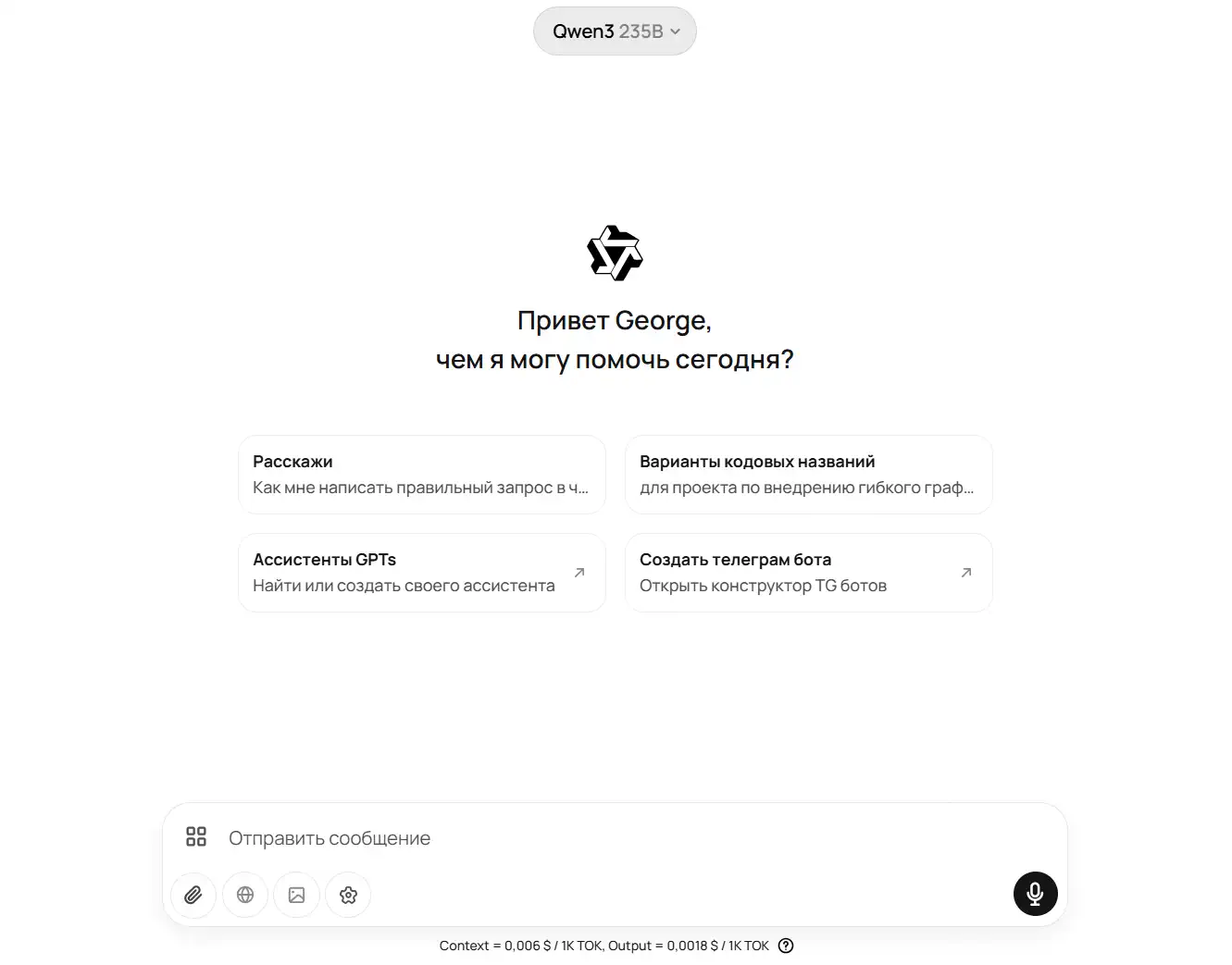
In this article, we'll look at the key features of Qwen 3, its performance on standard benchmarks, compare it with other popular models such as GPT-4o and Claude 3.7 Sonnet, and give examples of practical use.
Key features of Qwen 3
The models were trained on a dataset of 36 trillion tokens — twice the size of the previous Qwen2.5 generation. This massive corpus includes thousands of pages of text from web pages, PDF documents, and synthetic data covering mathematics, programming, and other fields. The lineup consists of eight models:
- Two mixture-of-experts (MoE) models: Qwen3-235B-A22B (235 billion parameters, of which 22 billion are active) and Qwen3-30B-A3B (30 billion parameters, 3 billion active).
- Six dense models ranging from 0.6 to 32 billion parameters.
Qwen 3 has several features that make it competitive among other language models:
- Size and parameters: models range from 0.6 to 235 billion parameters. The lineup includes mixture-of-experts (MoE) architectures that activate only part of the parameters, improving efficiency.
- Generation speed: the MoE architecture activates only a portion of the parameters, making these models more computationally economical compared to dense counterparts.
- Language support: the models support 119 languages, including English. They are adapted to the grammatical and cultural nuances of different languages.
- Working with structured data: Qwen 3 is optimized for analyzing PDF documents, Excel spreadsheets, and JSON, which is useful for business tasks.
- Safety: the models have built-in mechanisms that prevent generating unwanted content, in line with ethical AI usage standards.
Benchmark performance
Qwen 3 shows strong results on standard benchmarks, especially in tasks related to coding, mathematics, and general understanding. Below are the scores for the main models:
| Benchmark | Qwen3-235B-A2 2B | Qwen3-30 B-A3B | Qwen3-4 B | GPT-4o | Gemini 2.5 Pro |
|---|---|---|---|---|---|
| ArenaHard | 95.6 | 91.0 | 76.6 | 85.3 | 96.4 |
| AIME'25 | 81.5 | 70.9 | 65.6 | 7.6 | 86.7 |
| LiveCodeBench | 70.7 | 62.6 | 54.2 | 32.7 | 70.4 |
| CodeForces (Elo) | 2056 | 1974 | 1671 | 864 | 2001 |
| GPQA | 68.21 | 65.8 | 55.9 | 46.0 | 42.4 |
| LiveBench | 77.1 | 74.3 | 63.6 | 52.2 | 82.4 |
| BFCL | 70.8 | 69.1 | 65.9 | 72.5 | 62.9 |
| MultiIF | 71.9 | 72.2 | 66.3 | 65.6 | 77.8 |
Source: Qwen 3 announcement
This data comes from Alibaba's official benchmarks. It shows the percentage of tasks completed successfully in each benchmark. For example, in LiveCodeBench, which tests a model's ability to write code for real-world tasks, Qwen 3 235B achieved a 70.7% success rate. In the GPQA benchmark, the model scored 68.2%. GPQA consists of more than 4,000 graduate-level questions across scientific fields such as biology, physics, chemistry, and others.
Qwen3-235B-A22B delivers results comparable to models like Gemini 2.5 Pro, especially in coding tasks (CodeForces Elo: 2056) and mathematics (AIME'25: 81.5). Smaller models, such as Qwen3-4B, also show strong results, outperforming the much larger GPT-4o.
Comparison with other models
To assess where Qwen 3 stands in the market, let's compare it with popular models such as OpenAI's GPT-4o and Anthropic's Claude 3.7 Sonnet:
Performance according to benchmarks run by Artificial Analysis:
- MMLU-Pro (Massive Multitask Language Understanding) tests general knowledge and reasoning across a wide range of subject areas (history, science, mathematics, etc.). Qwen3-235B-A22B scores 84% (GPT-4o — 87%, Claude 3.7 Sonnet — 80.3%).
- HumanEval evaluates the ability to write correct code from a text description (Python functions). Here, Qwen3-235B-A22B scores 95%, while GPT-4o and Gemini 2.5 Pro both score 99% (Claude 3.7 Sonnet data isn't listed in the report).
Cost efficiency:
- Thanks to its MoE architecture, Qwen 3 can be more cost-efficient to run. The cost of generating 1,000 tokens on GPTunneL with Qwen3-235B-A22B is ₽0.18, which is lower than GPT-4o (₽2.7) and Claude 3.7 (₽4.5). You can check current generation pricing on the pricing page.
Generative tasks: where Qwen 3 shines
Qwen 3 particularly excels at generative tasks — from code to creative writing. Below are five key scenarios with examples and ready-to-use prompts.
1. Code generation
Qwen 3 delivers strong results in programming. It can generate code in Python, JavaScript, SQL, and other languages with high accuracy.
- Example: A developer gets a ready-made Python REST API with only minor tweaks needed.
- Try this prompt with Qwen 3: "Build a Python (Flask) server that handles CSV file uploads with user data, saves them to SQLite, and returns an API response with the row count and the last user's field. Add validation for the input file."
- Benefit: Speeds up development by automating routine tasks and assisting with debugging.
2. Creating multilingual content
Support for 119 languages lets Qwen 3 generate marketing and technical copy adapted to cultural nuances.
- Example: An international company gets ready-to-publish ad copy in English, Chinese, and French.
- Try this prompt with Qwen 3: "Write an ad block for an international airline website: 2 sentences each in English, French, and Arabic, in an 'invitation to adventure' style, avoiding clichés. Take cultural nuances and local metaphors into account."
- Benefit: Saves time and resources on translation and localization while ensuring high quality.
3. Generating educational materials
Qwen 3 can create exercises, tests, and step-by-step solutions, especially in mathematics and programming.
- Example: An education platform automatically generates an algebra problem with a step-by-step explanation.
- Try this prompt with Qwen 3: "Create a non-standard 9th-grade algebra problem: a system of two equations where one coefficient is given as a parameter. Provide a step-by-step explanation of the solution and a hint for students with low motivation."
- Benefit: Personalizes learning, helping students grasp material faster.
4. Generating creative text
Qwen 3 can create scripts, stories, and dialogue for games, films, or marketing campaigns.
- Example: A game studio gets fantasy-style character dialogue that maintains logical consistency.
- Try this prompt with Qwen 3: "Write a dialogue between an android artist and a robot archivist discussing the disappearance of humanity. Tone — philosophical, with hints of irony. Each line should reveal cultural references to the 2000s era."
- Benefit: Speeds up content creation and reduces the cost of hiring writers.
5. Translation and localization
The model doesn't just translate text — it also adapts it to the cultural context of the target audience.
- Example: Qwen 3 translates technical documentation from English into another language, adding local terminology and explanations.
- Try this prompt with Qwen 3: "Translate this technical text, keeping the documentation style but adapting the phrasing for a general audience: 'Deploy the containerized backend via Kubernetes with persistent volumes and load balancing.' Explain the terms in brackets."
- Benefit: Improves the accuracy and accessibility of content for different audiences.
How to use Qwen 3 through GPTunneL
The GPTunneL platform makes it easy to work with Qwen 3 models. The following models are available:
The free version of Qwen3-4B lets you try the model at no cost. This is convenient for students, developers, and small businesses.
To get started:
- Sign up on the GPTunneL website.
- Top up your balance — even a small amount is enough for generation.
- Go to the models section and select Qwen.
- Choose the model you need.
- Enter your prompts and work with the model through the interface.
The platform also offers guides and support for users.
Conclusion
Qwen 3 combines strong performance, cost efficiency, and accessibility. It's suitable for a wide range of tasks, from programming to content creation, and can be useful for businesses, developers, and educational institutions alike.
Through the GPTunneL platform, you can easily try out Qwen 3 models, including the free Qwen3-4B version. Qwen 3 shows that open models can be competitive and innovative, opening up new possibilities for AI use.