
Research as of November 9, 2026
On November 4, Tencent introduced HY4, a new flagship model in the Hunyuan family. Its developers claim substantial progress in coding, multimodal analysis, computer use and autonomous completion of complex tasks.
Early independent tests are impressive: HY4 beats DeepSeek V4.1 in several rankings, places third on Mercor APEX-Agents and even surpasses Claude Opus 5.5 in some professional scenarios.
Other studies paint a different picture. Vals AI ranks DeepSeek above Tencent's new model, and HY4 often costs several times more per task than its competitors.
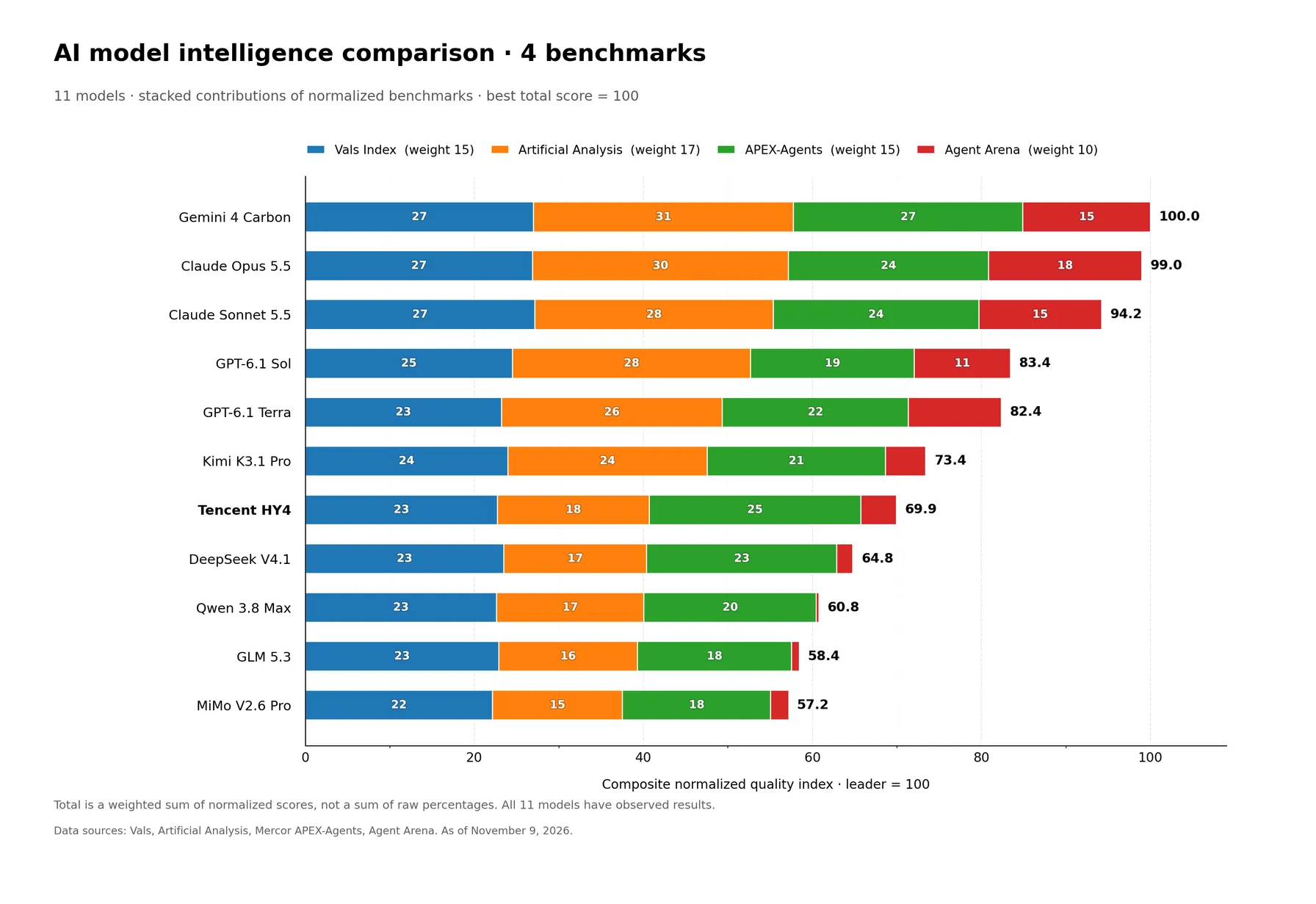
We compared 11 models across five independent rankings - Vals AI, Artificial Analysis, Mercor APEX-Agents, Agent Arena and WebDev Arena - and also examined LiveBench results, a Plotly study and developer feedback. To assess both quality and cost efficiency, we normalized intelligence scores and task costs and plotted the Pareto frontier.
The central question: is HY4 worth switching to, or do other models offer comparable intelligence for less?
In brief: HY4 is among the strongest models for complex agent tasks, but it is not the universal leader in intelligence or cost. Its composite score across four benchmarks is about 8% above DeepSeek V4.1's, at 2.6 times the relative cost. Its strength is autonomous tool use and multistep professional work: it scores 77.6% on APEX-Agents versus DeepSeek's 69.8%, and ranks 14th versus DeepSeek's 20th on Agent Arena. It is also stronger at terminal tasks and solved 42 of 43 Plotly analytics tasks for $2.11, less than other participants with comparable results. HY4 is promising for complex agents, professional automation and analytics where quality matters more than speed. It trails Kimi K3.1 Pro, GPT-6.1 Terra and leading Claude and Gemini models on the composite index, while its cost and lengthy reasoning make it less attractive for mass requests, ordinary chat and low-cost development. DeepSeek remains a more economical general choice; HY4 is an alternative when its extra capabilities justify the expense.
What is Tencent HY4?
HY4 is a multimodal model developed by Tencent Hunyuan for agents, coding and professional workflows. Compared with HY4 Preview, released in August 2026, it has several substantial improvements.
Tencent developed its ability to carry out long sequences autonomously: investigate information, use tools, write and run code, find errors and check results. It also improved image and interface interaction, including work with Blender, CAD systems and game engines. Its context window reaches approximately one million tokens, allowing it to process large documents, codebases and long conversations.
HY4 Preview used a Mixture-of-Experts architecture with 770 billion parameters, about 49 billion active per token. These figures apply to Preview and are not confirmed specifications for the final model. Preview weights have been released; at the time of the announcement Tencent had only promised to release full HY4 weights.
Where Tencent says HY4 is particularly strong
Tencent positions HY4 primarily as a model for complex professional tasks (real-world productivity), rather than simply a general-purpose chatbot. The developer emphasizes autonomous AI agents that can use tools, interact with applications and carry out long workflows with minimal human involvement.
In its official HY4 overview, the company highlights these areas:
| Area | Claimed HY4 capabilities |
|---|---|
| Autonomous AI agents | Planning multistep actions, calling tools, checking results and correcting errors |
| Computer use | Working with command lines and graphical interfaces, including Blender and CAD systems |
| Office work | Analyzing documents, spreadsheets, email and calendars; coordinating projects and collaborative editing |
| Financial analysis | Investment fund research, securities analysis, quantitative strategies and financial research |
| Programming and game development | Building interfaces, implementing complex business logic and working with Unity, Unreal Engine and Godot |
| Scientific research | Mathematical and physical modeling, scientific programming and automation of research workflows |
Independent studies partially support these claims: HY4 performs strongly on APEX-Agents and Terminal-Bench and shows high data analysis accuracy in Plotly's test. Its advantage over competitors in ordinary programming, legal and tax tasks is less clear-cut.
Source: Tencent's official HY4 release.
Overall intelligence comparison: HY4 against 10 rivals
One ranking cannot capture model quality. Benchmarks measure different abilities, from reasoning and coding to financial analysis and autonomous tool use. We combined five independent sources.
Model quality comparison
| Model | Vals Index | Artificial Analysis | APEX-Agents | Agent Arena | WebDev Arena |
|---|---|---|---|---|---|
| Gemini 4 Carbon | 70.45% | 60 | 84.2% | +16.63% | 1768 |
| Claude Opus 5.5 | 70.18% | 59 | 73.5% | +19.96% | 1818 |
| Claude Sonnet 5.5 | 70.85% | 55 | 75.5% | +15.99% | 1773 |
| GPT-6.1 Sol | 63.94% | 55 | 60.0% | +12.53% | 1743 |
| Kimi K3.1 Pro | 62.52% | 46 | 65.5% | +5.24% | 1687 |
| DeepSeek V4.1 Flash | 61.26% | 33 | 69.8% | +2.07% | 1664 |
| GPT-6.1 Terra | 60.54% | 51 | 68.3% | +12.10% | 1678 |
| GLM 5.3 | 59.73% | 32 | 56.6% | +0.99% | 1622 |
| Tencent HY4 | 59.35% | 35 | 77.6% | +4.66% | No data |
| Qwen 3.8 Max | 59.05% | 34 | 63.3% | +0.33% | 1677 |
| Xiaomi MiMo V2.6 Pro | 57.81% | 30 | 54.4% | +2.33% | 1624 |
Sources: Vals AI, Artificial Analysis, Mercor, Agent Arena, WebDev Arena.
What the metrics measure: Vals Index measures success on professional tasks; Artificial Analysis reports a composite intelligence index; APEX-Agents measures performance on long professional workflows; Agent Arena compares agent usefulness in user sessions; WebDev Arena ranks web development results by user preference.
Final HY4 has no WebDev Arena score yet. HY4 Preview scored 1,632 and ranked 24th, but this is not a valid substitute for the new version.
What the five rankings show
HY4 beats DeepSeek on some measures: Artificial Analysis, APEX-Agents and Agent Arena. The largest gap is in APEX: 77.6% versus 69.8%. DeepSeek leads on Vals, and the final versions cannot yet be compared on WebDev.
Kimi K3.1 Pro looks stronger overall, leading HY4 on Vals, Artificial Analysis and Agent Arena, although Tencent does substantially better on APEX-Agents. Claude and Gemini lead broad intelligence measures, especially Artificial Analysis and WebDev, although HY4 can compete with Claude on some complex professional tasks.
There is no single objective intelligence ranking: model performance depends on the task and test conditions.
What tasks cost: four sources compared
The price of a million tokens does not always reflect actual spending. A model may repeatedly call tools, generate thousands of reasoning tokens or need a retry. Comparing the cost of a completed task, rather than API rates alone, is more practical.
Task costs
Costs are in US dollars.
| Model | Vals $/test | AA $/task | Agent Arena $/task | WebDev $/task |
|---|---|---|---|---|
| Gemini 4 Carbon | $10.51 | $7.76 | $1.53 | $1.62 |
| Claude Opus 5.5 | $24.77 | $10.04 | $6.51 | $9.09 |
| Claude Sonnet 5.5 | $16.18 | $10.02 | $3.39 | $3.00 |
| GPT-6.1 Sol | $3.61 | $1.27 | $0.98 | $1.61 |
| Kimi K3.1 Pro | $6.44 | $3.68 | $1.29 | $1.27 |
| DeepSeek V4.1 | $0.66 | $0.60 | $0.15 | $0.12 |
| GPT-6.1 Terra | $2.94 | $0.96 | $0.80 | $0.63 |
| GLM 5.3 | $8.52 | $5.01 | $1.08 | - |
| Tencent HY4 | $1.72 | $1.03 | $0.60 | No data |
| Qwen 3.8 Max | $8.73 | $10.02 | $1.22 | - |
| MiMo V2.6 Pro | $0.43 | $0.26 | $0.17 | - |
Sources: Vals, Artificial Analysis, Agent Arena Pareto, WebDev Arena Pareto. Vals and AA publish mean test costs; Arena publishes median user-task costs. Columns should not be compared directly.
DeepSeek is among the most economical models in several studies. A Vals task costs $0.66 versus $1.72 for HY4; Artificial Analysis reports $0.60 versus $1.03; Agent Arena reports $0.15 versus $0.60. Their intelligence scores are relatively close. But whether DeepSeek is more economical than every rival depends on both quality and cost.
Normalized intelligence and cost: which models offer better value?
We scaled benchmark results to a comparable range, following the approach used in our research on the smartest AI models.
Method: each intelligence benchmark is normalized to its leader and combined using a weighted average. Costs are normalized to Claude Opus 5.5 in each source and combined using a geometric mean. The main index uses Artificial Analysis (weight 17), Vals (15), APEX (15) and Agent Arena (10), plus three cost sources. The highest composite intelligence score is set to 100 and Claude Opus's relative cost to 1.00. This is a comparative index for the selected tests, not a measurement of absolute IQ.
Overall ranking: intelligence and relative cost
| Model | Intelligence index | Relative cost | Pareto |
|---|---|---|---|
| Gemini 4 Carbon | 100.0 | 0.426 | ✓ |
| Claude Opus 5.5 | 99.0 | 1.000 | - |
| Claude Sonnet 5.5 | 94.2 | 0.698 | - |
| GPT-6.1 Sol | 83.4 | 0.141 | ✓ |
| GPT-6.1 Terra | 82.4 | 0.112 | ✓ |
| Kimi K3.1 Pro | 73.4 | 0.266 | - |
| Tencent HY4 | 69.9 | 0.087 | ✓ |
| DeepSeek V4.1 | 64.8 | 0.033 | ✓ |
| Qwen 3.8 Max | 60.8 | 0.404 | - |
| GLM 5.3 | 58.4 | 0.305 | - |
| MiMo V2.6 Pro | 57.2 | 0.023 | ✓ |
Higher intelligence is better; lower relative cost is cheaper. Values use benchmarks published as of November 9, 2026. Relative cost units are not dollars.
Pareto chart: intelligence versus cost
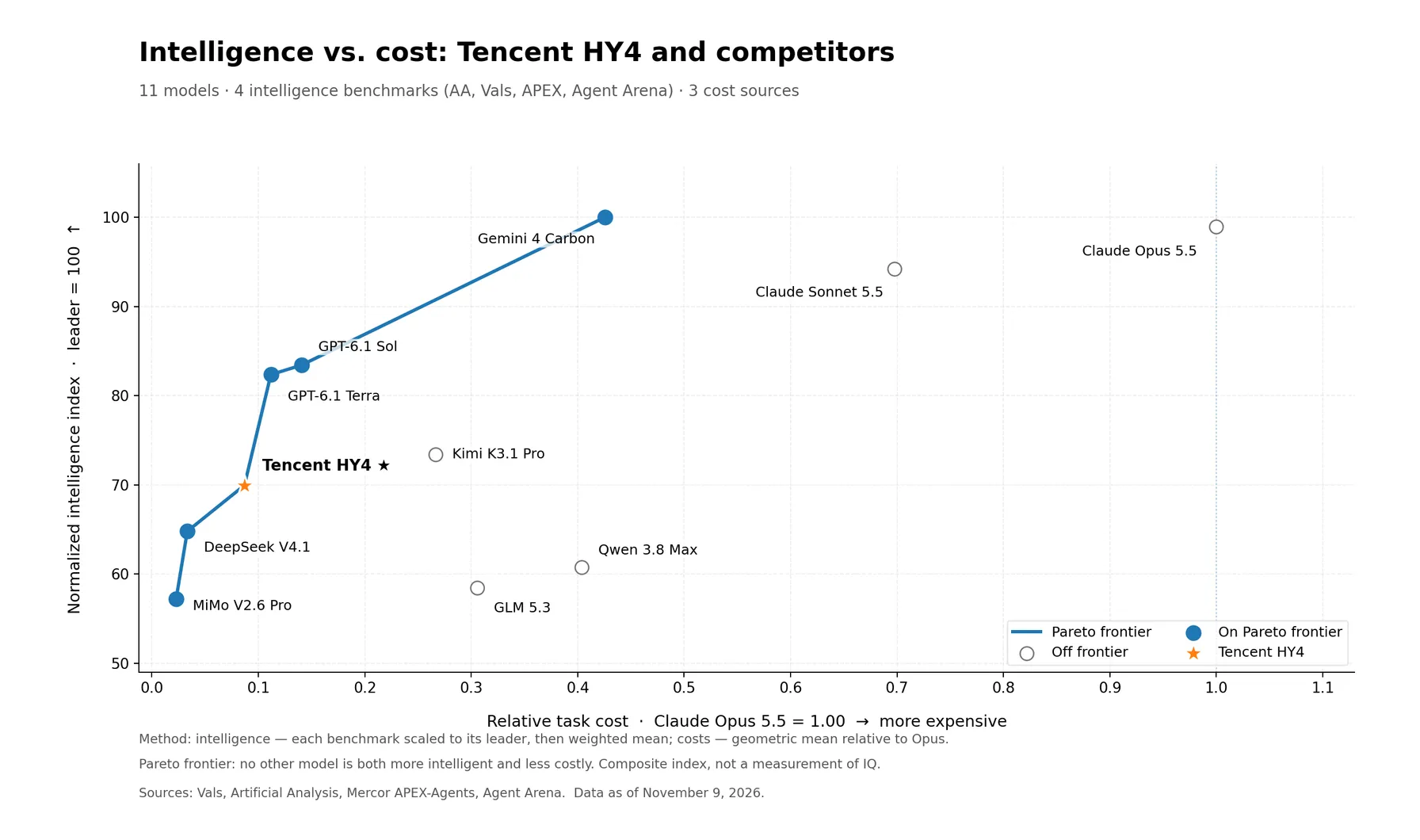
Pareto frontier for 11 models across four intelligence tests and three cost sources. The blue line connects models for which no alternative in the sample is both smarter and cheaper.
Tencent HY4 lies on the Pareto frontier: no other model in this comparison has both a higher calculated intelligence score and a lower cost. This does not mean it is optimal for every task.
HY4 versus DeepSeek: 69.9 versus 64.8 on the composite, an advantage of about 8%, but at 2.6 times the relative cost. HY4 versus GPT-6.1 Terra: Terra scores 82.4 versus 69.9 while relative cost rises from 0.087 to 0.112, about 29%, an interesting quality-cost compromise.
Kimi K3.1 Pro is off the frontier: by this method, GPT-6.1 Terra and Sol are both stronger and cheaper overall, though Kimi can perform differently on particular professional tests. Gemini 4 Carbon dominates Claude Opus 5.5 in the main index, scoring slightly higher at substantially lower relative cost. This changes when WebDev is added.
How Arena WebDev changes the ranking
To test robustness we added WebDev Arena as a fifth intelligence test and fourth cost source.
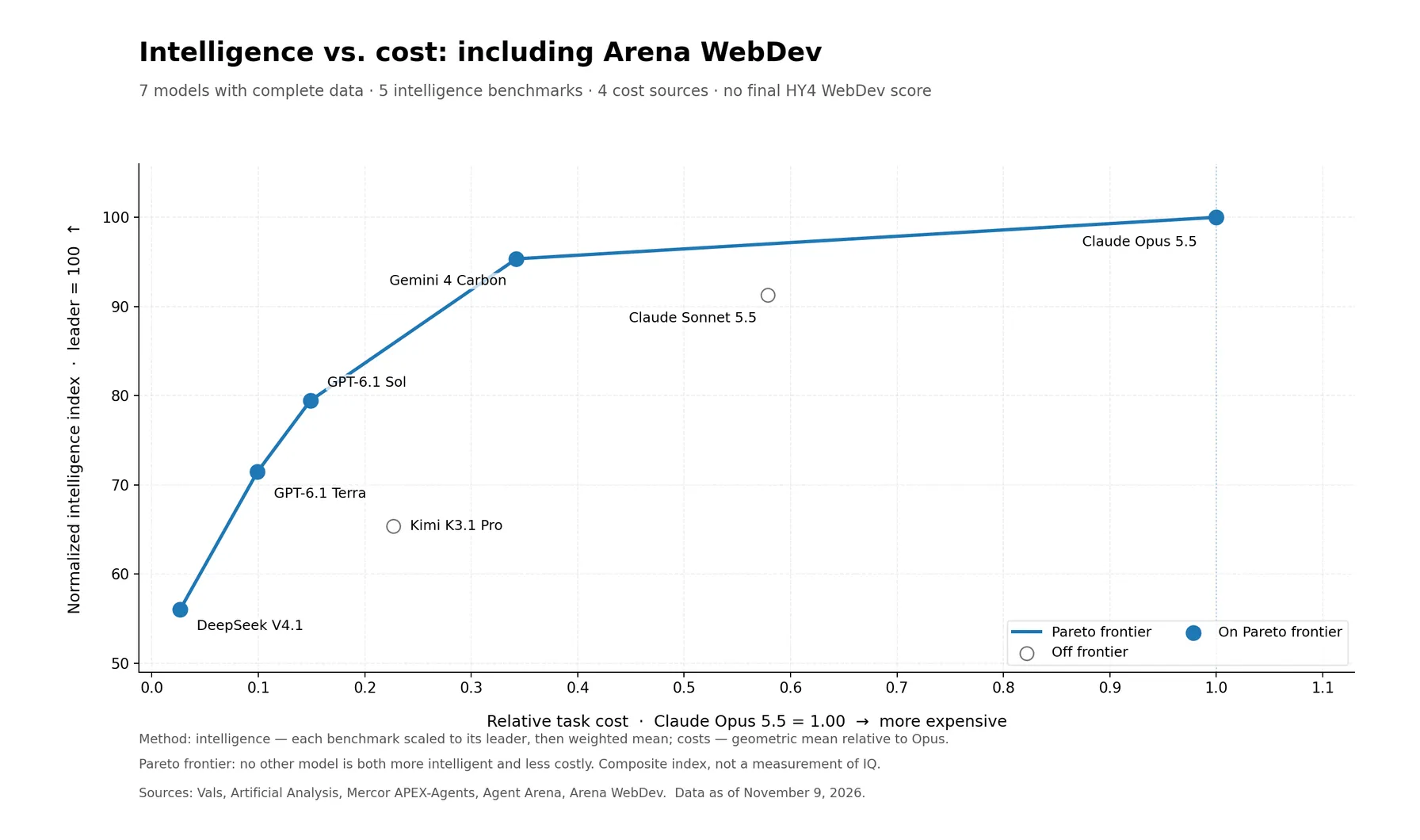
Only seven models with complete published data are included. Final HY4 is excluded because WebDev data are unavailable. The WebDev rating uses min-max normalization.
With WebDev included, Claude Opus 5.5 returns to the Pareto frontier: its web development result lifts its composite score to 100, although Gemini 4 Carbon remains considerably cheaper. GPT-6.1 Sol and Terra remain strong value choices, while DeepSeek is the cheapest of the seven models with complete data.
The test selection clearly affects rankings. Read the main chart with HY4 alongside the additional WebDev chart, but do not compare their scores directly: their model and benchmark sets differ.
Where HY4 beats DeepSeek: coding and professional tasks
Overall indices hide differences between disciplines. These are specialized Vals results for HY4 and DeepSeek V4.1 Flash 1017:
| Test | HY4 | DeepSeek |
|---|---|---|
| Terminal-Bench 4.0 | 39.39% | 31.82% |
| Vibe Code Bench | 81.01% | 87.73% |
| Finance Agent v2.1 | 64.70% | 62.93% |
| Tax Agent Bench | 34.40% | 44.35% |
| Legal Research Bench | 41.35% | 45.19% |
| Excel Modeling Bench | 66.18% | 69.17% |
| Harvey Legal Agent Bench | 12.50% | 14.17% |
Terminal-Bench requires autonomous technical work in a terminal: files, commands, dependencies and debugging. HY4 leads 39.39% to 31.82%. DeepSeek leads Vibe Code Bench, which tests application development, 87.73% to 81.01%. HY4 is slightly ahead on finance agent tasks, but DeepSeek leads on tax, legal research and spreadsheets.
Creating code and using tools autonomously are different skills. HY4 is particularly interesting for multistep technical workflows, but is not the unconditional coding leader.
Blender and CAD: a distinct specialization of Tencent HY4
One unusual feature of HY4 is its specialized training for professional 3D modeling and design software. Tencent trained the model to interact with Blender and CAD systems using computer-use capabilities: it can analyze graphical interfaces, control applications, execute commands and check its results.
Unlike conventional text-to-3D generators, HY4 is designed to perform sequences of operations directly in professional software, from creating and modifying objects to preparing a scene and checking the result.
Tencent reported the following results on the specialized 3DArena-Modeling benchmark:
| Model | Score |
|---|---|
| Claude Opus 5.5 | 43.4 |
| GPT-6.1 Sol | 41.8 |
| Tencent HY4 | 37.1 |
| Kimi K3.1 Pro | 36.1 |
| DeepSeek V4.1 | 32.3 |
| HY4 Preview | 23.4 |
| GLM 5.3 | 23.0 |
Source: Tencent's 3DArena-Modeling results. This is the developer's internal benchmark and has not yet been independently verified.
The new HY4 substantially improves on Preview and outperforms DeepSeek V4.1 and Kimi K3.1 Pro, although it trails GPT-6.1 Sol and Claude Opus 5.5.
This makes the model promising for automating 3D scene creation, preparing visualizations and working with professional graphics tools. However, successful 3D modeling is not equivalent to reliable engineering CAD design. Independent evidence on dimensional accuracy, tolerances and the correctness of complex engineering models remains insufficient. HY4's CAD capabilities should therefore be seen as a promising direction, not a proven replacement for specialized engineering tools.
Mercor APEX-Agents: HY4 unexpectedly beats Claude
HY4's third place on Mercor's independent APEX-Agents test is striking. It contains 240 professional tasks across 31 workflows for investment analysts, management consultants and corporate lawyers. Models must study documents, use multiple applications, find information and complete sequences of actions.
APEX-Agents results
| Model | Pass@1 |
|---|---|
| Gemini 4 Carbon High | 84.2% |
| Gemini 4 Argon High | 82.4% |
| Tencent HY4 High | 77.6% |
| Claude Sonnet 5.5 Max | 75.5% |
| Claude Opus 5.5 Max | 73.5% |
| DeepSeek V4.1 Flash | 69.8% |
| Kimi K3.1 Pro | 65.5% |
| Qwen 3.8 Max | 63.3% |
Source: Mercor APEX-Agents.
HY4 leads DeepSeek by 7.8 percentage points and scores above Claude Opus 5.5. However, uncertainty intervals for several adjacent models overlap, so a statistically reliable advantage over Claude cannot be asserted. The results nevertheless point to HY4's strength in long professional tasks using tools. They also help explain the difference from Vals: the platforms test different tasks.
WebDev Arena: building websites
WebDev Arena evaluates websites and web apps using comparative user preferences, including interface quality as well as code. As of November 8, 2026, it contained 154 models and almost 986,000 votes.
Claude Opus 5.5 leads with 1,818, followed by Claude Sonnet 5.5 (1,773) and Gemini 4 Carbon (1,768). DeepSeek V4.1 ranks 16th at 1,664, with an exceptionally low median web-task cost of $0.12. GPT-6.1 Terra scores 1,678 at $0.63, and Kimi K3.1 Pro 1,687 at $1.27. Claude Opus 5.5 costs $9.09 per median web task, roughly 76 times DeepSeek.
Quality may justify the price in complex commercial projects, but DeepSeek is competitive for mass production of prototypes, small websites and interfaces. Final HY4 has no WebDev result, so this ranking cannot establish whether it is ahead or behind in web development.
Source: Arena WebDev.
Plotly: when HY4 is among the best-value models
DeepSeek is cheaper in most tests above, but Plotly's study provides an exception. Its DataAnalyticsBench contains 43 analytics tasks involving SQL, charts and sequential tool calls. Models analyzed a warehouse of about 20 million rows, found patterns, checked calculations and avoided statistical mistakes. HY4 solved 42 of 43 tasks.
| Model | Solved | Full test cost |
|---|---|---|
| GPT-6.1 Sol | 43/43 | $2.61 |
| Tencent HY4 | 42/43 | $2.11 |
| Grok 4.7 | 42/43 | $7.85 |
| Kimi K3.1 Pro | 42/43 | $13.47 |
Source: Plotly - Tencent HY4 Benchmark Results. DeepSeek V4.1 did not participate.
HY4 was the cheapest tested model to solve at least 42 tasks. Its median response time was 117 seconds, however, compared with 18 for GPT-6.1 Sol. Researchers found that HY4 repeatedly checked results and performed many queries and chart operations. This thoroughness helped avoid mistakes but substantially increased execution time. It can help complex analytics where quality matters more than speed, but is a disadvantage in interactive chat.
LiveBench: insufficient data for direct comparison
LiveBench regularly updates tasks to reduce the risk of test questions appearing in training data. It evaluates coding, reasoning, information analysis, browser use and other abilities. DeepSeek V4.1 Flash 1017 has published LiveBench 2.0 results, but a complete comparable set for final HY4 could not be confirmed as of the study date. We therefore excluded LiveBench from the normalized ranking and did not substitute Preview scores.
Source: LiveBench.
Developer discussions on Reddit, Hacker News and X
Community reaction was mixed. On r/LocalLLaMA, users discuss 3D, graphics tools and game engines alongside API cost, local deployment and weight release timing. On Hacker News, participants focused on agent economics and HY4's thoroughness. A Plotly representative confirmed strong analytical accuracy but said excessive checks often slow it down. On X, Mercor APEX-Agents results attracted interest because HY4 ranked highly among models whose weights were announced for release.
There are still few comprehensive user A/B tests of final HY4; feedback on Preview cannot automatically be applied to the new version.
Why benchmarks disagree
DeepSeek leads on Vals; HY4 has a small advantage on Artificial Analysis, a larger one on Mercor, and better Agent Arena user signals at a higher cost. The studies measure different abilities. Coding success is not the same as computer use; reasoning does not guarantee agent performance; a higher success rate does not necessarily mean lower cost. Reasoning settings, tools, time limits, agent infrastructure and statistical uncertainty also matter. A small score difference does not always establish a stable lead. That is why our composite is accompanied by individual benchmark and cost analysis.
Which model to choose
| Scenario | Models to consider | Why |
|---|---|---|
| General requests and API | DeepSeek V4.1, GPT-6.1 Terra | Strong quality-to-cost ratio |
| Maximum general intelligence | Gemini 4 Carbon, Claude Opus 5.5 | Lead broad measures |
| Websites and interfaces | Claude Opus 5.5, Gemini 4 Carbon | High WebDev rankings |
| Low-cost web development | DeepSeek V4.1 | 1,664 rating at $0.12 per task |
| Terminal work | HY4 | Leads DeepSeek on Terminal-Bench |
| Professional agents | HY4, Gemini 4 Carbon | Strong APEX-Agents results |
| Complex data analysis | HY4, GPT-6.1 Sol | Strong Plotly results |
| Low-cost automation at scale | DeepSeek V4.1, MiMo V2.6 Pro | Low task costs |
These are candidates to test, not guaranteed winners for every task in each category.
Conclusion: HY4 reaches the Pareto frontier, while DeepSeek remains much cheaper
Tencent HY4 is a serious competitor, especially for autonomous agents, tool-based coding and data analysis. Its APEX-Agents and Terminal-Bench results are strong, and it can compete with Claude on some professional tasks. It is too early to call it a universal leader: DeepSeek, Kimi and GLM lead on Vals, and the strongest commercial models lead broader intelligence rankings.
The normalized four-test comparison gives HY4 69.9 versus DeepSeek's 64.8, at 2.6 times the relative cost. Both are on different parts of the Pareto frontier: DeepSeek emphasizes economy; HY4 offers a higher composite score for more money. GPT-6.1 Terra scores 82.4 at only 29% more than HY4 under this method.
Adding WebDev changes positions: Claude Opus 5.5 returns to the frontier. Final HY4 has no WebDev score, so its position in the five-component comparison is unknown. Specialization also matters: although HY4 costs more than DeepSeek in most general agent tests, Plotly shows Tencent can offer unusually good value for high-quality complex analytics.
Consider HY4 a strong alternative for complex agent tasks rather than a universal DeepSeek replacement. Evaluate models on benchmark intelligence, the cost of a successful task and time to result: together they determine practical value.
Research sources
- Tencent - official HY4 research release
- Vals AI - Vals Index
- Artificial Analysis - model leaderboard
- Mercor - APEX-Agents
- Agent Arena - leaderboard
- Agent Arena - Pareto frontier
- WebDev Arena - leaderboard
- WebDev Arena - Pareto frontier
- Plotly - HY4 data analytics results
- LiveBench - official leaderboard
- Reddit - HY4 discussion
- Hacker News - HY4 discussion