

AI-powered rewriting has become a standard approach for businesses, especially in recent years, as demands for unique text in business, education, and digital marketing have grown sharply. Today, an AI rewriting tool can rewrite content quickly, at scale, and while preserving meaning — without the routine manual work.
These platforms solve real problems for students, content managers, SEO specialists, and entrepreneurs. How do you choose an online AI rewriter that fits your tasks, keeps your style, and boosts uniqueness? We'll walk through practical examples and cover the best systems available.
What can AI rewriting tools do?
Adopting AI for rewriting isn't a passing trend — it answers a real need: refreshing old articles for SEO, creating platform-specific versions of a text, or quickly producing unique content for marketplaces. Quality online rewriting has long outgrown simple synonym swapping.
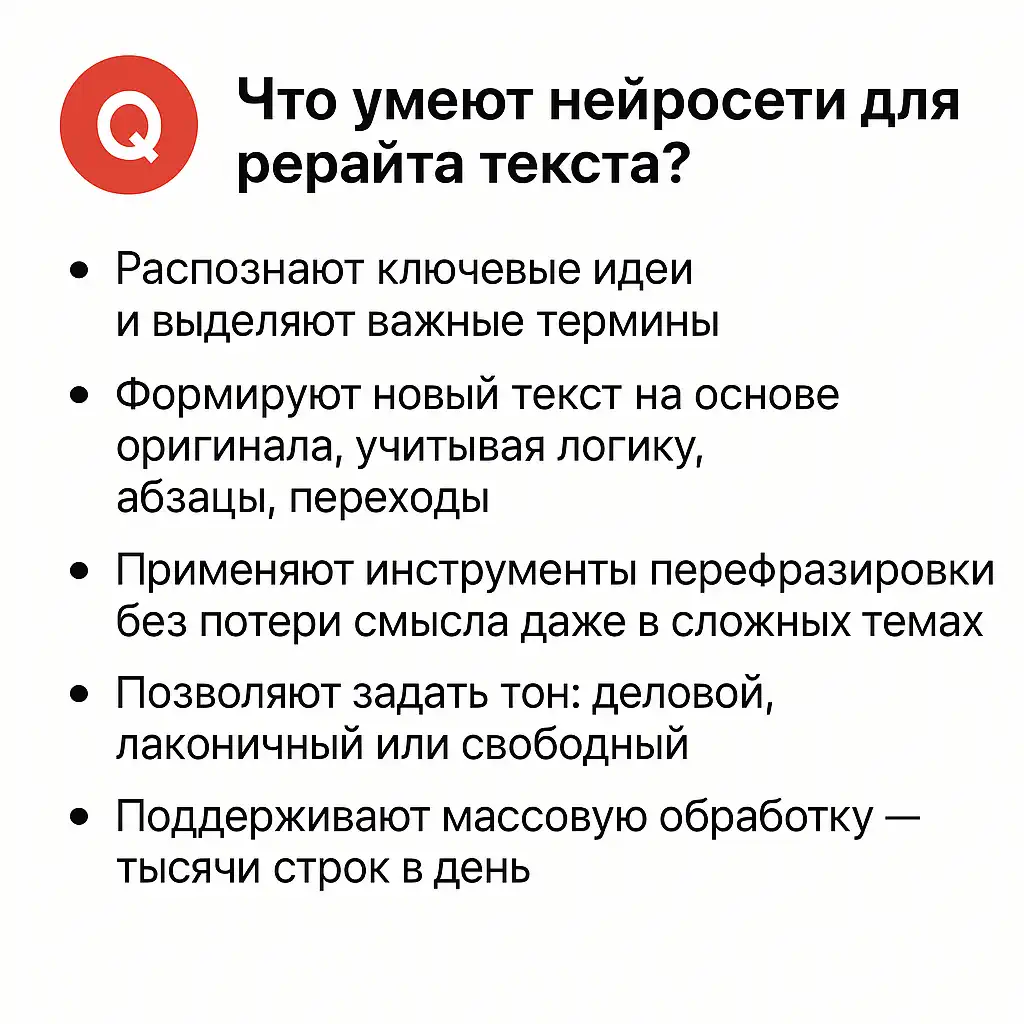
A modern AI rewriting tool analyzes not just the content, but the style, tone, and structure of the source material. Such systems:
- Recognize key ideas and highlight important terms
- Build new text based on the original, respecting logic, paragraphs, and transitions
- Apply paraphrasing tools that preserve meaning even in complex topics
- Let you set the tone: formal, concise, or casual
- Support bulk processing — thousands of lines per day
The key shift is that AI-powered text rewriting is now available right inside a spreadsheet, a corporate editor, or an API. This enables integration into business workflows and cuts down time spent on manual work.
Top 7 AI models for rewriting in 2025
Let's approach this from a different angle. Forget the polished wrapping of SaaS tools and look "under the hood" — at the engines actually doing the magic. In 2025, these AI models aren't just synonym generators — they're genuine collaborators, each with its own character. Here's my expert-but-human top 7 of foundational rewriting models.
1. Claude 4 (Opus & Sonnet)
What makes it special?
Claude 4 Opus doesn't just rewrite text — it understands mood, emotion, and meaning. Its strength lies in a deep grasp of tone, style, and subtle nuance. It doesn't just swap words; it rebuilds the text, whether that's a formal report or a friendly blog post.
Key use cases:
- Tone transformation: Turn a dry annual report into a compelling story for investors.
- Deep long-form rewriting: Rewrite an entire book chapter or research article while preserving all the connections of meaning and improving the narrative.
- Brand-voice adaptation: Feed it samples of your brand's writing and get a rewrite that sounds like it was written by your in-house copywriter.
2. GPT-4o
What makes it special?
If Claude is a specialist for creative text, GPT-4o is the reliable multitool that handles almost any situation. OpenAI has polished this model into the "gold standard" for most tasks. It understands complex requests well and can rewrite text by changing its structure, simplifying dense passages, or adding more detail where needed.
Key use cases:
- SEO rewriting: Carefully rewrite text while naturally weaving in keywords so it doesn't read as robotic.
- Structural rebuilding: Turn a wall of text into a clear structure with subheadings and lists, or the reverse.
- Everyday rewriting: Quickly make a news piece, social post, or product description unique when you just need something "good and fast."
3. Gemini 2.5 Pro
What makes it special?
This is the only model on the list that can not only read, but also "watch" and "listen." Gemini's biggest advantage is its enormous context window. You can hand it a transcript of an hour-long YouTube webinar and ask: "Turn this into a 5,000-character article in a business style." And it delivers.
Key use cases:
- Rewriting from video/audio: Turn an interview, lecture, or podcast transcript into a polished article or a series of posts.
- Summarizing and rewriting massive documents: Process a PDF report and rewrite the key findings for a presentation.
- On-the-fly rewriting: Retell an entire website's content in your own words from a single link.
4. DeepSeek-V3
What makes it special?
A model from the Chinese company DeepSeek AI. Its key advantage is performance comparable to GPT-4o, but at a significantly lower cost. DeepSeek V3 has proven that top-tier rewriting quality can be economically accessible.
Key use cases:
- Price-to-quality ratio: Offers advanced text generation and editing capabilities at a price that makes the technology accessible to a broad range of businesses.
- High performance: Delivers excellent results in tasks that require logic and creativity, which directly impacts rewriting quality.
- Efficiency: An optimized architecture allows for fast processing of large volumes of requests.
5. Qwen 3: A global competitor with serious power
What makes it special?
A flagship model from tech giant Alibaba. Qwen 3 is a direct answer to leading American models, matching or even surpassing them on many benchmarks. It's the choice for those who need maximum performance and scale.
Key use cases:
- Top-tier performance: Consistently ranks among the leaders in independent benchmarks, especially in language understanding and logic tasks.
- Scale: Handles very large volumes of information well, making it ideal for enterprise tasks.
- Strong multilingual capabilities: Delivers high-quality rewriting across many languages, including complex Asian languages.
6. Mistral Large
What makes it special?
French company Mistral AI builds models that match American giants in performance while being much "lighter" and more cost-efficient. It strikes a balance between power and cost. Mistral Large handles European languages exceptionally well, making it a great choice for rewriting content aimed at international audiences.
Key use cases:
- Bulk content rewriting: Process articles or product descriptions when budget matters.
- Multilingual projects: Adapt content for markets across Europe with high quality.
7. Grok 3: The internet's provocateur
What makes it special?
A model from Elon Musk's xAI, marketed as "terribly smart." Its unique edge is that it was trained on data from the social network X (formerly Twitter). Grok 3 can rewrite a news piece or article and enrich it with the freshest public reactions, current memes, or opinions from influencers. It has a "sense of humor" and a bolder personality.
Key use cases:
- Timely news rewriting: Rewrite the day's events, adding live context pulled from social media.
- Viral content creation: Generate text that speaks the same language as an online audience.
- Marketing rewriting: Create bold, provocative ad copy that's guaranteed to get noticed.
Sample rewriting prompts
Getting the most out of AI requires giving it clear tasks. Here are prompts for different goals:
- For an expert tone: "Act as a McKinsey analyst. Turn this set of bullet points into a paragraph for a white paper. Use a strict business style and include a compelling example from the fintech industry."
- For brevity and social media: "Repackage this long paragraph into a tweet for a technical audience. Make it short and bold, but be sure to keep the terms 'decentralization' and 'consensus.' Add a relevant hashtag."
- For simplification: "Imagine you're answering a customer's question. Rewrite this complex technical answer so it's simple, friendly, and concise. Remove all jargon while keeping the substance."
- For sales copy: "Turn this list of sneaker specs into a sales-driven description. Focus not on the materials, but on the feeling of comfort and speed. The goal is to spark a desire to buy."
- For a blog post from a video transcript: "Here's the transcript of a video review. Write an engaging blog post based on it. Capture the main idea and the speaker's energy, but make the text easier to read."
Prompts let you adapt tone, structure, and length. Thanks to them, online AI rewriting becomes a flexible tool for copywriting.
How to choose the right AI for the job?

Proven fact: a model asked to "reason out loud" or "think step by step" before giving a final answer handles logical and creative tasks significantly better. This shows that choosing the right tool is only half the battle. The other half is knowing how to hold a conversation with it.
The right AI for you isn't the most powerful one — it's the one whose "way of thinking" best fits the specific task at hand, whether that's a creative leap or rigorous analysis. Here are the key selection criteria:
- Quality of preserving meaning and terminology
- Support for long context processing
- Integration into your existing workflows
- Ability to customize style and length
Picture this task: making descriptions unique for five thousand product cards. Doing it manually would take months; doing it with one of these AI models, integrated through the GPTunneL API, takes a few hours. That's not just a huge resource saving — it also directly impacts SEO, since search engines value unique content.
For content or marketing agencies, this means instantly generating dozens of variations of a single ad creative for A/B testing, or adapting one news story into blog, social media, and press release formats. In these scenarios, choosing a model comes down not just to the quality of a single answer, but also to its speed, stability, and cost per thousand requests.
Bottom line
We've covered the main tools for working with text through AI. AI rewriting tools have moved well past being an "interesting toy" and become a full-fledged working tool. They solve real problems: they speed up content production, help maintain quality, and let you scale without hiring more writers.
There's no one-size-fits-all solution here, since each platform is built for its own scenarios. GPTunneL brings together all the key AI models and content tools — try out different options and put together your own personal toolkit for effective work.
Useful links and resources
- Prompt engineering guide
- Ready-made prompts for writing text with ChatGPT
- How to learn any language with AI?
FAQ
Which AI is best for rewriting text?
The best choice depends on volume, field, and integration requirements. ChatGPT is a versatile all-rounder, Claude excels at creative rewriting, and Gemini is best when you need to rewrite large volumes of content.
Can AI achieve high uniqueness?
Yes, but a quality result requires a precise task: write a prompt that explicitly asks for unique text based on the original, and adjust the rewriting parameters.
Is AI suitable for rewriting large texts?
Modern tools handle large volumes of data well. This is best implemented in Gemini 2.5 Pro thanks to its 1-million-token context window.