

Artificial intelligence for text translation is a tool that gets used more actively every year. People feed AI translators technical documentation, instructions, literary texts, journalism, business correspondence, and much more. What they want is a fast, accurate translation that doesn't distort the meaning of the original.
A modern neural network for text translation can:
- Account for terminology;
- Preserve style;
- Grasp context;
- Handle long files;
- Match the right tone of voice.
But translation quality varies noticeably depending on the model you choose. Some handle technical texts better, others excel at marketing content, and others aren't fazed by large volumes.
In this article, we tested 10 of the best AI translation tools across four language pairs — English, French, German, and Spanish, each paired with Russian. As our test bed, we used the GPTunneL neural network aggregator, which offers a rich arsenal of models for different tasks.
Testing Methodology
To keep the comparison objective, we picked several language pairs that reflect real-world usage scenarios. The most in-demand direction is Russian ↔ English. As additional pairs, we used:
- French → Russian;
- German → Russian;
- Spanish → Russian;
- And the reverse directions.
Texts for AI translation were selected from various categories:
- Technical documents;
- Business letters;
- A news fragment;
- Marketing copy;
- Everyday correspondence;
- A literary text;
- A long business text;
- A block of instructions.
When testing AI translation technologies, we paid attention to:
- Semantic accuracy;
- Natural-sounding phrasing;
- Correct terminology;
- Preservation of structure;
- Handling of large volumes.
For large language models, we used pre-prepared prompts. This let us evaluate the pure quality of the responses.
AI-Powered Translation: How 10 Neural Networks Performed
GPT-5.1: Technical Documentation RU→EN
Prompt
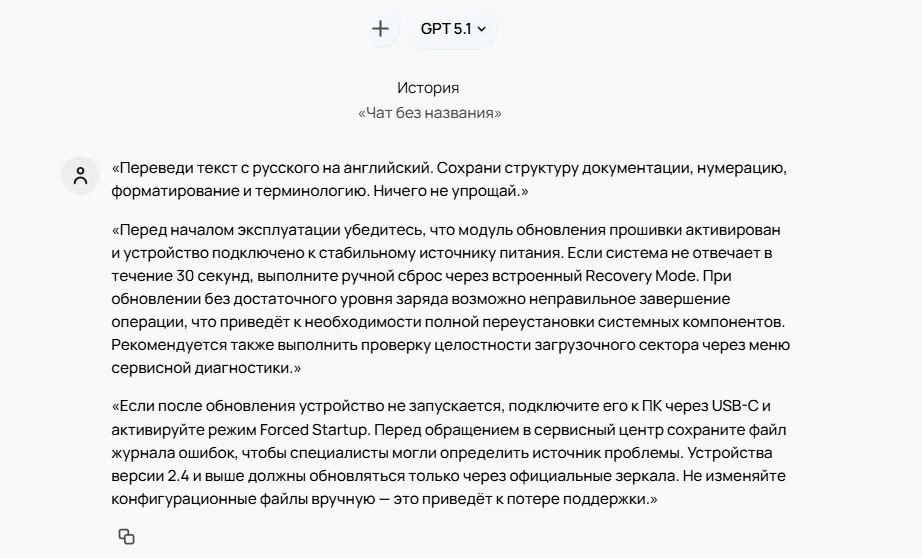
"Translate the text from Russian to English. Preserve the documentation structure, numbering, formatting, and terminology. Don't simplify anything."
Result:
- Semantic accuracy: GPT-5 meticulously conveyed the meaning, translating all conditions, warnings, and technical details. Nothing was lost, no "creative liberties" — the translation is semantically fully consistent with the original document;
- Natural phrasing: the resulting text reads like a typical English-language technical manual. Strict, formal, without unnecessary stylistic variation. All grammatical and stylistic norms are observed;
- Terminology: no errors in translating terms: Recovery Mode, Forced Startup, boot sector integrity check. GPT doesn't try to simplify technical vocabulary or make the text more conversational;
- Structure preservation: paragraphs, sequential logic, and formatting fully match the original. This is critical for technical texts;
- Ability to handle large volumes: two dense paragraphs were processed without any contextual loss. Sentence connections are preserved.
You can see the result in our dialogue with GPT-5.1.
Claude Sonnet-4.5: Business Letter EN→RU
Prompt
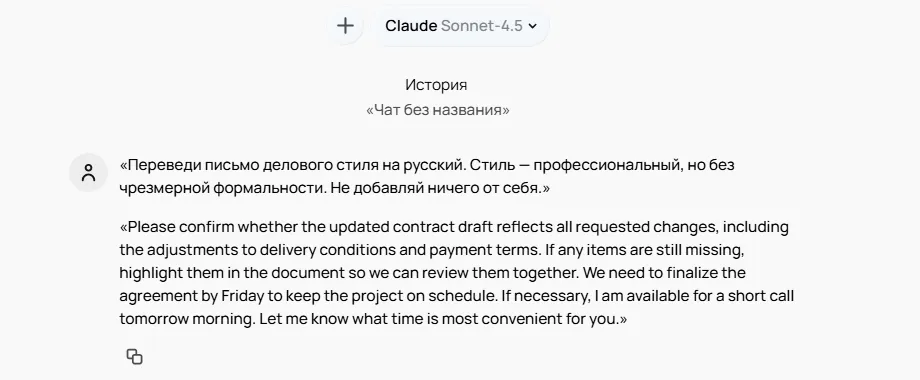
"Translate this business-style letter into Russian. Style — professional, but not overly formal. Don't add anything of your own."
Result:
- Accuracy: Claude conveyed the content of all five sentences without any semantic errors: the mention of contract changes, clarification of delivery and payment terms, the need to finalize an agreement by a certain date, and the offer to arrange a call;
- Natural phrasing: overall the style matches the original — neutral, businesslike. However, some spots sound like obvious calques. For example, the phrase "keeping the project on schedule" was rendered as a very literal transfer of the English idiom, whereas a more natural Russian equivalent would be closer to "so the project doesn't fall behind" or "to meet the deadlines." Another calque appeared in "I am available for a short call" — technically correct, but in Russian business communication something like "we can talk tomorrow morning" reads better;
- Terminology: all basic terms are translated correctly: "payment terms," "delivery terms," "updated draft contract";
- Structure preservation: a full match with the original — 5 separate sentences, the same logic and order of ideas;
- Handling volume: Claude processed the text quickly, without missing a single sentence.
You can see the result in our dialogue with Claude 4.5 Sonnet.
Gemini 3 Pro Preview: News Translation RU→EN
Prompt
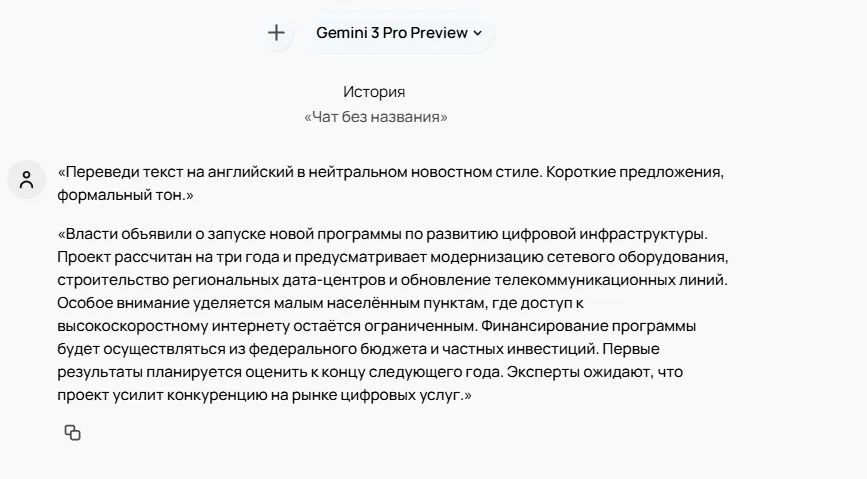
"Translate the text into English in a neutral news style. Short sentences, formal tone."
Result:
- Accuracy: Gemini conveyed the content of the news item without missing anything important. Key points — the implementation timeline, equipment modernization, the focus on small towns, funding sources, and expert expectations — are all reflected correctly. The translation followed the logic of the original, without any creative additions;
- Natural phrasing: the translation genuinely reads like a short English-language news piece. Short sentences, a neutral tone, the style of international news agencies;
- Terminology: network equipment, data centers, telecommunication lines, digital services market lexically match the original — no arbitrary simplifications or adaptations;
- Structure preservation: clarifications, enumerations, and cause-and-effect relationships are carried over carefully. The order of presentation from the original piece is preserved, while it doesn't read as linguistically foreign to an English-speaking reader;
- Ability to handle volume: the neural network didn't lose any content during translation and reflected all 6 sentences.
You can see the result in our dialogue with Gemini 3 Pro Preview.
DeepSeek-V3.2: Technical IT Translation RU→EN
Prompt
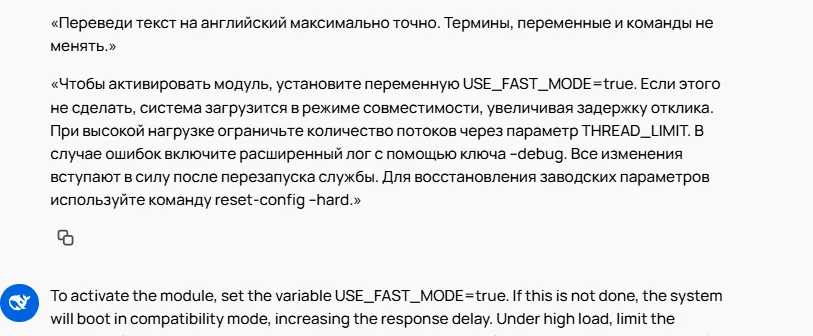
"Translate the text into English as precisely as possible. Don't change terms, variables, or commands."
Result:
- Accuracy: DeepSeek V3.2 conveyed the meaning of the technical document precisely, without changing or adding anything. Conditions, consequences, system behavior, and the sequence of actions match the original;
- Natural phrasing: the translation's style matches English-language IT documentation: a dry technical tone, standard constructions (In case of errors…, All changes take effect…). No overly literal, translated-sounding phrasing;
- Terms: the neural network left all variables and commands unchanged, exactly as required by the prompt. USE_FAST_MODE=true, THREAD_LIMIT, -debug, reset-config–hard;
- Structure preservation: sentence order and logic don't differ from the original;
- Volume: the model processed the entire text without omissions or compression.
You can see the result in our dialogue with DeepSeek V3.2.
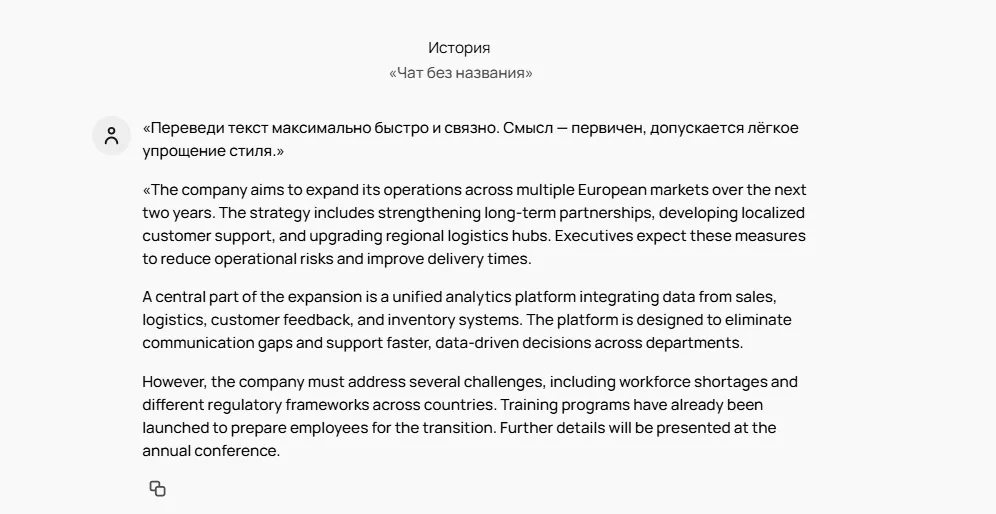
Qwen 3 30B: Business Text EN→RU
Prompt
"Translate the text as quickly and coherently as possible. Meaning comes first; slight stylistic simplification is acceptable."
Result:
- Accuracy: Qwen flawlessly carried over all key components of the original text into the translation: the expansion strategy, the analytics platform's objectives, staffing and regulatory challenges;
- Natural phrasing: the business tone is preserved, but the translation sounds simpler and shorter than the original — for example, a brief "details at the conference" instead of the more formal "will be presented at the annual conference." In other words, the neural network did exactly what we asked for in the prompt;
- Terminology: basic business concepts are translated correctly: "data analysis," "logistics centers," "long-term partnerships," "unified analytics platform";
- Structure preservation: all 3 paragraphs are presented in the correct order — with no mixing of topics. No logical inconsistencies either;
- Handling volume: Qwen didn't miss any key ideas, though it slightly shortened some phrases here and there — not because it ignored the original's volume, but because we allowed simplification.
You can see the result in our dialogue with Qwen 3 30B.
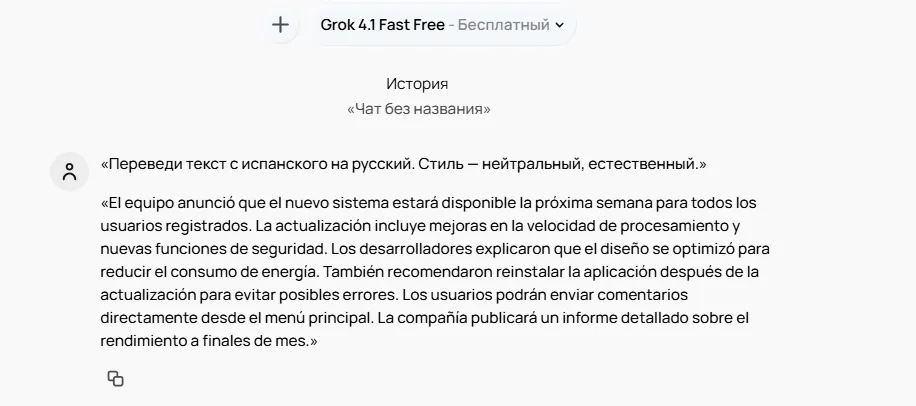
Grok 4.1 Fast Free: News-Technical Translation ES→RU
Prompt
"Translate the text from Spanish to Russian. Style — neutral, natural."
Result:
- Accuracy: Grok conveyed the factual meaning of the original without any distortion — availability timelines, performance improvements, developer recommendations, the ability to leave feedback, and the publication of the report;
- Natural phrasing: in terms of fluency and naturalness, this translation is one of the most transparent and native-sounding. Phrases about avoiding possible errors and a detailed performance report read easily, without any syntactic or lexical rough edges;
- Terminology: no conceptual distortions here either: "processing speed," "security features," "power consumption," "application," "reviews";
- Structure preservation: the translation reflects the 6 original sentences with intact logic and order of presentation;
- Handling volume: the neural network processed the fragment quickly, without missing a single phrase.
You can see the result in our dialogue with Grok 4.1 Fast Free.
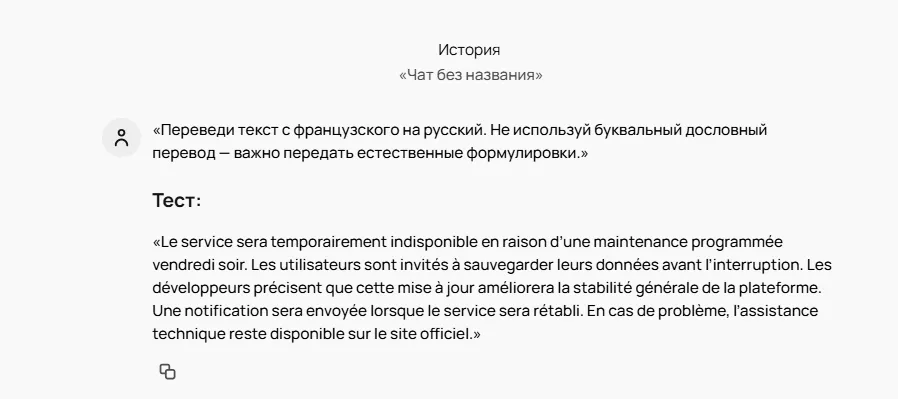
LLaMA 4 Scout: Technical-Business Translation FR→RU
Prompt
"Translate the text from French to Russian. Don't use a literal word-for-word translation — it's important to convey natural phrasing."
Result:
- Accuracy: LLaMA 4 Scout correctly conveyed the overall meaning of the text: scheduled maintenance, the recommendation to save data, improved platform stability, and the availability of technical support;
- Natural phrasing: some of the phrasing is a clear giveaway of machine translation — awkward literal renderings of time expressions and instructions that a native speaker would phrase more naturally, such as saving data ahead of time or being notified once the service is back up;
- Terminology: here the model did well: "technical maintenance," "platform stability," "technical support";
- Structure preservation: the translation carries over all 5 sentences with correct logic and order — from the warning to the instructions;
- Handling volume: while the fragment's size wasn't a challenge for LLaMA — the model handled it quickly — it apparently didn't have enough "time" to iron out the calques.
You can see the result in our dialogue with LLaMa 4 Scout.
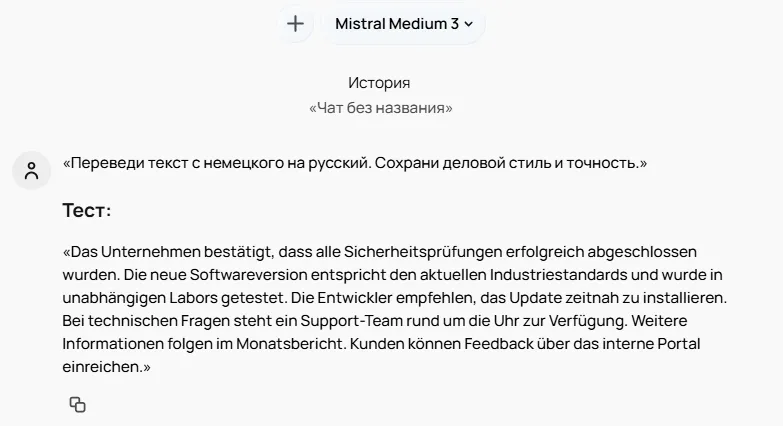
Mistral Medium 3: Official Translation DE→RU
Prompt
"Translate the text from German to Russian. Preserve the business style and accuracy."
Result:
- Accuracy: Mistral Medium 3 conveyed the meaning of the original document precisely. All facts, warnings, and recommendations are reflected without omissions or unauthorized creativity;
- Natural phrasing: a smooth, formal-business style, with vocabulary and syntax typical of Russian — no Germanisms;
- Terms: technical and business vocabulary is rendered correctly: "safety checks," "software," "current industry standards," "independent laboratories";
- Structure preservation: Mistral doesn't alter the document's composition, doesn't mix ideas, and doesn't shift the semantic emphasis;
- Handling volume: a fast translation of 6 sentences, with preserved context and smooth transitions.
You can see the result in our dialogue with Mistral Medium 3.
YaGPT 5.1 Pro: Conversational Translation RU→EN
Prompt
"Translate the text from Russian to English. Style — friendly, lively, conversational."
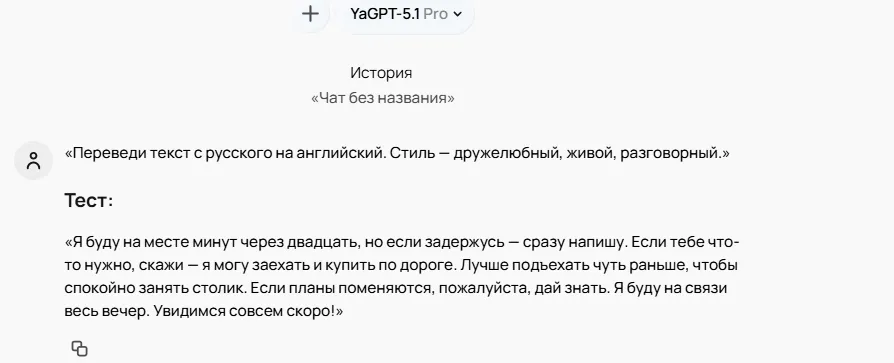
Result:
- Accuracy: YaGPT conveyed the general idea of the text only partially — it "swallowed" part of the phrases (the third, fourth, and fifth original sentences almost completely vanished), which naturally hurt accuracy;
- Natural phrasing: where the translation did come through, the English phrases sound natural: I'll text you right away, If you need anything, just let me know. But the missing context makes the overall style choppy;
- Terminology: there's no professional vocabulary here — the text is conversational, and all translated lexemes are chosen correctly;
- Structure preservation: only 3 out of 6 sentences can be found in the translation;
- Handling volume: it's clear the model struggled even with such a small fragment;
- And one more amusing fact: right before finalizing this review, we revisited the dialogue with YaGPT. Surprisingly, this time we found a fully translated text in the chat, matching the request exactly. But since we don't know for sure how long the neural network took to process the prompt (maybe 10 minutes, maybe an hour), we're keeping our original assessment. Speed suffered significantly either way, and along with it, other parameters — accuracy, structure, and so on.
You can see the result in our dialogue with YaGPT 5.1 Pro.
GigaChat 2 Max: Literary Translation RU→ES
Prompt
"Translate this literary text into Spanish. Preserve the imagery, mood, and rhythm."
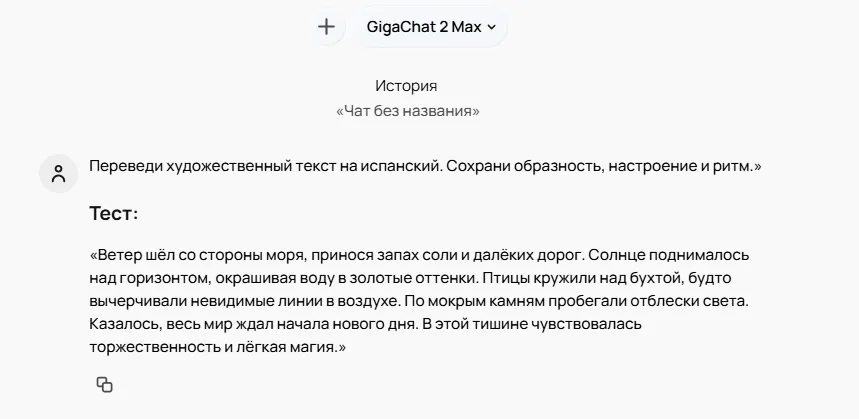
Result:
- Accuracy: GigaChat correctly conveyed the meaning of every sentence: the wind, the smell of salt, the dawn, the birds, the flickers of light, the feeling of anticipating a new day — no semantic omissions at all;
- Natural phrasing: the Spanish text flows smoothly while preserving the literary quality: tiñendo las aguas con tonos dorados, como si trazaran líneas invisibles, una ligera magia. The word choice is harmonious, and the sentence rhythm is close to literary prose;
- Terminology: solid literary vocabulary without bureaucratic dryness or excessive literalness. "Flickers of light" → destellos de luz — a good choice. "Solemnity" → solemnidad — also fitting;
- Structure preservation: the model didn't lose a single one of the 6 sentences, and also captured the syntactic rhythm of the original, with smooth transitions typical of literary text;
- Handling volume: GigaChat covered the whole fragment without any shift in tone and without cutting off phrases midway, and did the translation quite fast.
You can see the result in our dialogue with Gigachat 2 Max.
How to Choose the Best AI for Translation
For technical documentation, the optimal choices are GPT-5.1 and DeepSeek-V3.2. They're very precise with terminology, don't simplify phrasing, and strictly adhere to structure.
If you need to translate a large volume very quickly, with a bit of simplification, it's more convenient to use Qwen 30B.
For business correspondence and news content, Claude 4.5 and Gemini 3 Pro Preview work better, conveying the right style and tone excellently. Though with Claude, some minor lexical editing might be needed.
If you're working with literary text — say, translating from Russian into Spanish — GigaChat 2 Max will help. This neural network knows how to preserve imagery, rhythm, and find concise equivalents.
And for translations from Spanish, especially informational-technical messages, Grok 4.1 does an excellent job.
Conclusion
AI-powered translation is a new reality available to everyone. Today you can find plenty of models for tackling different translation tasks — from technical documentation to literary text.
The GPTunneL platform offers a wide range of neural networks: Claude 4.5 for business correspondence, GigaChat 2 Max and Grok for working with Spanish, DeepSeek and GPT for instructions and technical documents, and many others. A convenient interface, the ability to pay per request instead of a subscription, and high service speed will help you get a quality result fast: precise phrasing, natural-sounding language, and a clear structure.