
Google researcher Pietro Miotti deployed a coordinated swarm of 48 AI agents to search for lost Maya settlements in the Mexican jungle. The automated workflow successfully identified an archaeological site missing from national inventory databases. However, professional archaeologists quickly pointed out that the complex had already been documented in a peer-reviewed 2025 study. The incident has sparked a broader debate on AI's role in scientific discovery and the necessity of domain expertise.
In November 2026, The Verge detailed an unusual experiment conducted by a Google researcher who set out during his personal time to explore how modern neural networks could aid aerial archaeology.
How 48 AI Agents Scanned the Rainforest
The concept took shape on October 18 while Miotti was traveling through Peru. Wondering what tools modern explorers of ancient civilizations would deploy, he consulted leading conversational models including Gemini, ChatGPT, Claude, and Grok.
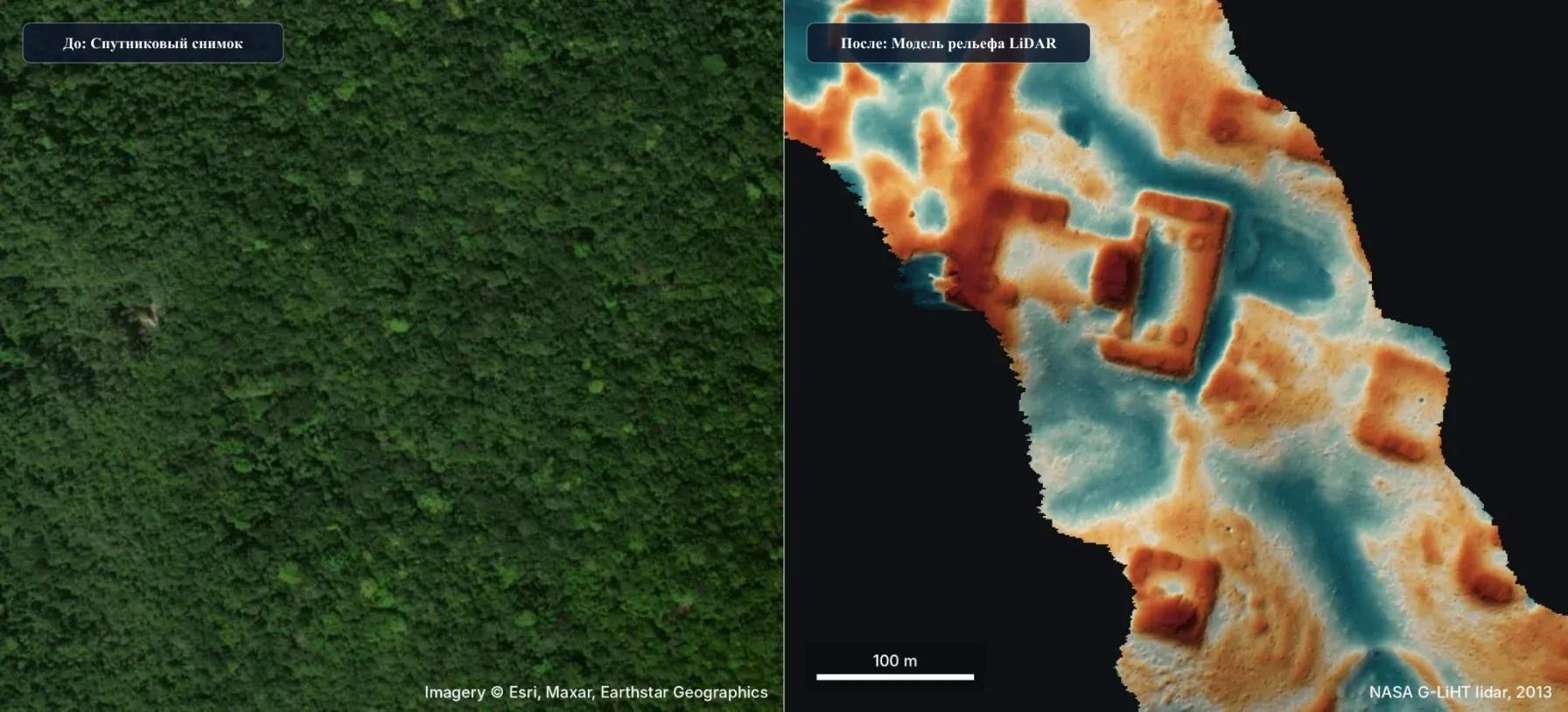
The models recommended analyzing LiDAR (Light Detection and Ranging) surveys—an established remote-sensing technology that maps ground topography beneath dense forest canopies.
Archaeologists have relied on airborne LiDAR for years to uncover sunken plazas, causeways, agricultural terraces, and buried stone structures.
Miotti selected an area of the ancient Maya civilization in southeastern Mexico covered by open-access NASA datasets originally collected for ecological monitoring.
He orchestrated a parallel pipeline of 48 AI agents. The workflow converted LiDAR point clouds spanning roughly 1,200 square kilometers into image tiles, which the agents inspected for geometric alignments and rectilinear mounds characteristic of human construction.
Notably, the experiment did not rely on specialized computer vision models trained specifically on archaeological features; the agents evaluated images by following plain-text descriptive prompts.
A Breakthrough That Proved to Be a Rediscovery
Among the candidates surfaced by the pipeline, one elevated clearing stood out: it featured distinct orthogonal terraces, an open plaza, and a suspected central pyramid standing approximately 8 to 12 meters tall.
Miotti instructed his agent team to cross-reference academic literature and official registries to determine whether the coordinates corresponded to a documented site.
The agents found no matching records.
Encouraged by the result, Miotti compiled a preliminary dossier and submitted it to Mexico's National Institute of Anthropology and History (INAH). On October 21, the agency confirmed that the specific coordinates were absent from its national archaeological atlas.
Interpreting the agency's response as confirmation of an unrecorded discovery, Miotti published a detailed write-up of his experiment online.
However, professional Mesoamerican scholars soon recognized the features. The entire complex had been documented and analyzed in a 2025 scientific paper authored by Marcello Canuto, Francisco Estrada-Belli, and colleagues.
On November 11, Miotti updated his post, acknowledging that his automated pipeline had effectively re-identified a site that field archaeologists already knew.
Why the Agents Missed Existing Literature
The breakdown occurred in verifying academic novelty.
A site's absence from an administrative government database does not mean it remains undiscovered by science. Crucial fieldwork is often published in academic monographs, field journals, or specialized conference proceedings long before national cadaster maps update.
Furthermore, archaeologists routinely omit exact GPS coordinates from public papers to safeguard fragile ruins from looting and unauthorized excavation.
As a consequence, performing simple keyword or coordinate searches across online repositories is insufficient. Establishing whether a site is known requires triangulating terrain contours, regional expedition surveys, and comparative site plans.
Miotti acknowledged that both he and his automated agents overlooked the relevant paper. In his view, human domain specialists remain indispensable for validating AI-generated findings.
At the same time, he framed the project as a successful proof-of-concept for how a small team can rapidly filter massive geospatial datasets.
How Archaeologists Responded
The wider archaeological community responded with measured criticism.
Sarah Parcak, an archaeologist and professor at the University of Alabama at Birmingham, emphasized the vital role of peer review and comprehensive literature reviews. She noted that an absence in a single state inventory cannot serve as evidence of a genuine discovery.
Elizabeth Graham, professor of Mesoamerican archaeology at University College London, pointed to a different reality: researchers already know of thousands of unmapped mounds throughout the region.
In her assessment, the primary bottleneck in contemporary archaeology is not spotting mounds from above, but securing funding for on-the-ground excavation, preservation, and community engagement.
Ivan Šprajc, an archaeologist at the Research Center of the Slovenian Academy of Sciences and Arts who co-authored the original 2025 study, also urged caution.
He noted that remote sensing has been an industry standard for decades. Spotting a geometric anomaly on an elevation map offers limited scientific value on its own.
Moreover, widespread announcements of unverified discoveries risk overwhelming underfunded heritage agencies and field researchers with false leads generated by enthusiastic hobbyists.
What This Means for AI in Scientific Discovery
Miotti's project illustrates both the efficiency and current limitations of autonomous agent workflows.
The AI proved capable of organizing data retrieval, processing raw LiDAR maps, isolating promising topographical candidates, and even drafting formal correspondence in a foreign language.
Yet verifying genuine scientific novelty proved far more challenging than pattern recognition.
Similar hurdles are surfacing in other disciplines: AI systems can formulate plausible hypotheses, detect statistical patterns in genomic data, or propose mathematical conjectures without accurately determining whether the insight is truly novel or already resolved.
Validating automated breakthroughs still depends on examining primary research, checking physical constraints, and relying on expert human judgment.
Conclusion: A team of 48 AI agents demonstrated that autonomous models can parse large-scale LiDAR datasets in record time. Yet they failed to prove the discovery was new. The episode confirms that while AI can dramatically accelerate exploratory scanning, interpreting findings and contextualizing knowledge still requires deep professional expertise.
Sources: