
How does artificial intelligence affect creativity, inventiveness, and the sense of authorship? Neural networks allow creating images, music, and texts in just minutes. But research reveals an unexpected effect: sometimes people are more satisfied with AI-generated results but feel less proud of them and less like their authors. Why does this happen, what do famous creative people think about it, and how can we use neural networks without losing the joy of the creative process itself?
Imagine you decided to paint a picture. You could spend several hours on composition, colors, and details. Or you could describe your idea to a neural network and get an image in a minute that looks even better than you could paint yourself.
In both cases, the final result might be equally attractive. But would you feel equally proud of it?
Now imagine another situation. You have long dreamed of writing a novel or creating a computer game but lacked the necessary skills. Thanks to a neural network, you finally managed to bring your idea to life. Would such a result be less valuable just because most of the technical work was done by AI?
These questions are becoming increasingly relevant as generative models take on not only routine tasks but also creative decisions.
Recent research shows that the quality of the result, the pleasure of the process, and the sense of authorship are different psychological experiences. Neural networks can enhance some of these while simultaneously weakening others.
Experiment: Designers preferred their own work over AI results
On November 8, 2026, the publication Bioengineer.org reported on a study about the impact of generative AI on designers’ work. The experiment itself was published earlier, on March 4, 2026, in the scientific journal Fashion and Textiles.
It involved 34 design students from South Korea. They created patterns for clothing and accessories in two ways: independently using Adobe Illustrator and with the help of built-in generative tools in Adobe Firefly.
Each student completed 20 designs, evenly split between the two methods. After finishing the tasks, participants rated the ease of work, the ability to express personal style, the quality of the result, and their own satisfaction.
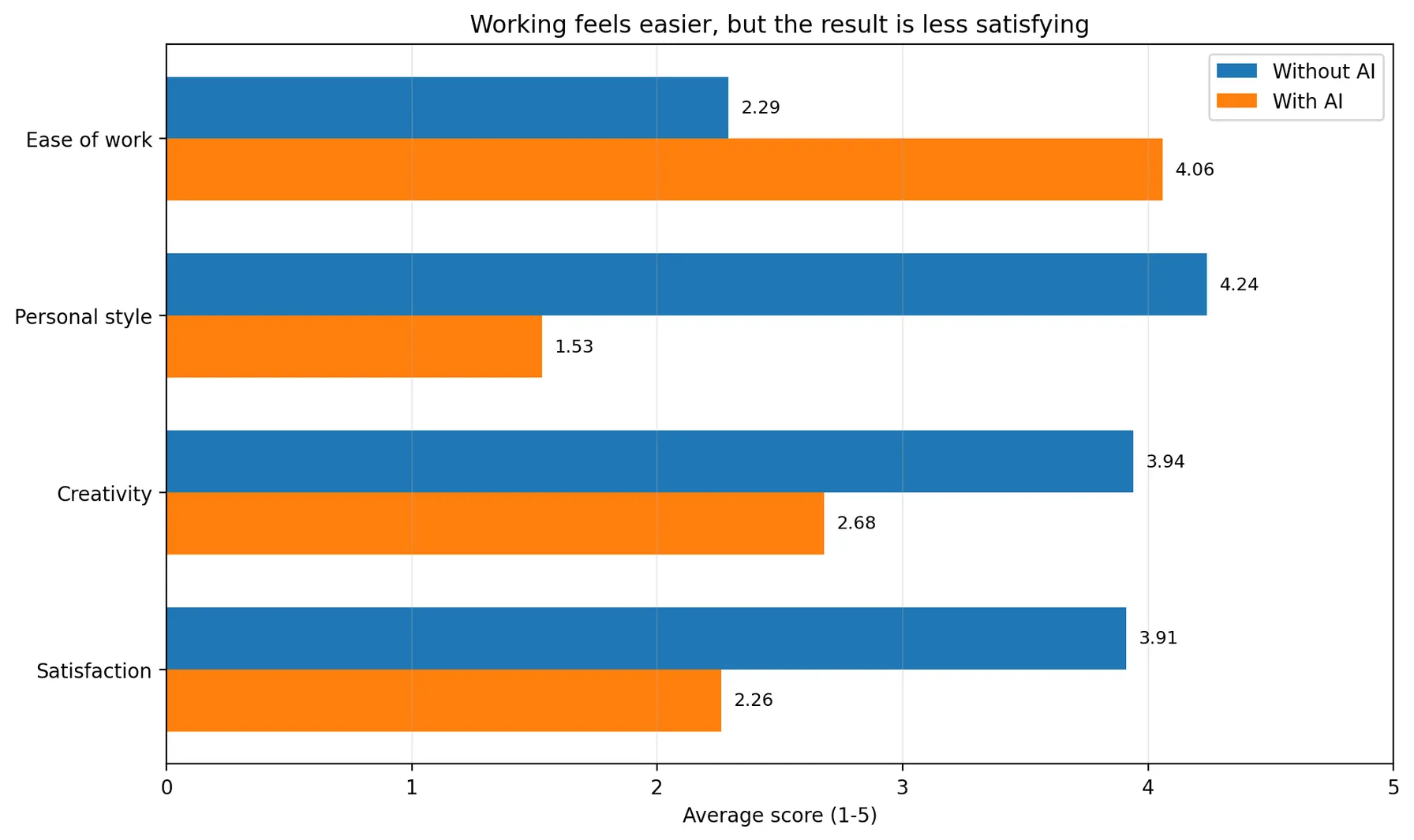
What the comparison showed
| Indicator | Without AI | With AI |
|---|---|---|
| Ease of completing the work | 2.29 | 4.06 |
| Ability to express personal style | 4.24 | 1.53 |
| Ability to edit | 3.91 | 2.47 |
| Creativity of the result | 3.94 | 2.68 |
| Aesthetic appeal | 4.09 | 2.74 |
| Satisfaction with the result | 3.91 | 2.26 |
| Correspondence to the original idea | 4.03 | 2.00 |
Average subjective ratings by participants on a five-point scale. Source: From designer to curator: cognitive and creative trade-offs in GenAI-assisted design.
The generative tool received a significantly higher ease-of-use rating. However, satisfaction with the finished result was substantially lower: 2.26 out of 5 compared to 3.91 when working independently.
The study also included a qualitative phase. Of 18 students who agreed to detailed interviews, 16 said the neural network effectively made design decisions for them. Another 12 spent extra time manually editing the generated images, trying to restore individuality to their work.
Instead of directly creating the image, people increasingly chose from options offered by the system. Their role shifted from creator to editor or curator.
However, it is important to consider the experiment’s limitations. Participants had experience with Illustrator but had not previously used its generative features. All first completed tasks manually, then with AI. Additionally, Firefly did not always accurately reproduce the intended style and made editing individual elements inconvenient.
Therefore, the study does not prove that AI objectively makes design worse or that reduced satisfaction is solely due to loss of authorship feeling.
But it raises an important question: why doesn’t technically easier work necessarily bring more pleasure?
Why a good result is not always perceived as a personal achievement
An answer comes from a study published on March 15, 2026, in the journal Scientific Reports.
Scientists conducted an experiment with 269 participants who were asked to complete writing tasks related to their professional activities.
Participants were divided into three groups:
- The first completed the task entirely on their own.
- The second first wrote their own draft, then improved it using ChatGPT.
- The third used a ready-made text fully generated by ChatGPT.
Researchers measured satisfaction with the result, sense of authorship, confidence in their abilities, and the perceived significance of the work.
The results revealed an unexpected contradiction.
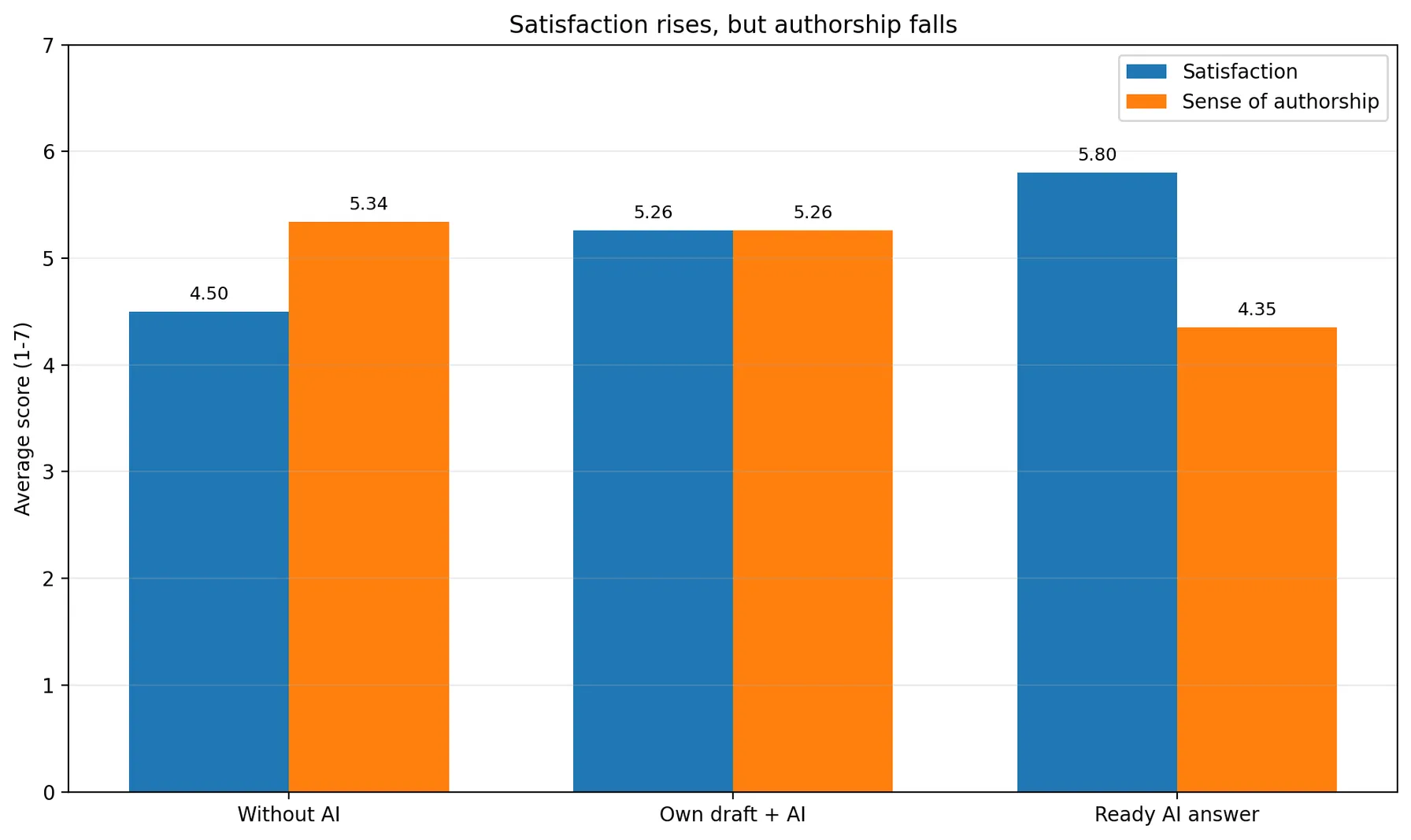
| Method of completion | Satisfaction with result | Sense of authorship |
|---|---|---|
| Completely independently | 4.50 | 5.34 |
| Own draft + AI | 5.26 | 5.26 |
| Ready AI answer | 5.80 | 4.35 |
Average ratings on a seven-point scale. Source: Scientific Reports.
People who simply used a ready AI-generated answer were most satisfied with the quality of the result but felt significantly less that it was their own work.
They also rated the significance of the task and their ability to do similar work without AI lower.
It turns out that a neural network can give a person a good result but not the same feeling of personal achievement.
What happens if AI is removed?
After the first task, researchers asked participants to complete another task without AI.
Those who had previously just copied ChatGPT’s answers showed decreased satisfaction with their independent work and its perceived significance.
The authors suggest a contrast effect may have occurred here. After easily obtaining a quality result from AI, one’s own work begins to seem harder and less enjoyable.
Meanwhile, participants who first created their own draft and then used AI for improvement did not show a comparable decline in sense of authorship.
Researchers found a similar pattern in an additional survey of 270 working adults.
But it is important not to overstate the conclusions. The experiment was short-term and does not prove that long-term use of neural networks necessarily lowers self-esteem or deprives a person of the ability to enjoy work.
The main takeaway is different: the psychological consequences of using AI depend not only on the presence of the neural network but also on the role the person retains for themselves.
Psychology of Creativity: Where Do Pleasure and Pride Come From
Why is a result created by one’s own efforts often valued more highly? Psychologists studied this question long before the advent of ChatGPT.
Several mechanisms underlie creative satisfaction, and generative AI can influence them in different ways.
1. Sense of Competence: “I Was Able to Do It”
According to the self-determination theory by psychologists Edward Deci and Richard Ryan, a person’s intrinsic motivation is linked to the satisfaction of three basic psychological needs:
- Autonomy – the feeling that we choose what and how to do something ourselves.
- Competence – the feeling that we can handle tasks and develop our own abilities.
- Relatedness to others – the sense of belonging, recognition, and meaningful relationships.
Source: Deci & Ryan, The “What” and “Why” of Goal Pursuits, 2000.
When a person independently solves a difficult creative task, they receive confirmation of their own competence.
For example, a programmer who spends several hours searching for a bug and finally fixes it experiences pleasure not only from the working program. The success proves to them that they are capable of understanding the problem.
If AI finds and fixes the bug in a few seconds, the program works just as well. But the personal confirmation of one’s own abilities may be less.
How AI changes this mechanism: a neural network can both weaken the sense of competence by doing all the work for the person and strengthen it by helping to master what was previously inaccessible.
For a beginner, the opportunity to create a website or musical composition for the first time can become confirmation of new capabilities. For an expert who is used to enjoying solving complex tasks independently, full automation may have the opposite effect.
2. The IKEA Effect: Why We Love What We Made Ourselves
In 2012, psychologists Michael Norton, Daniel Mochon, and Dan Ariely published a study dedicated to the so-called IKEA effect.
In a series of experiments, participants assembled IKEA boxes, folded origami, and built Lego models.
It turned out that people often valued items made with their own hands higher than similar ready-made products. Even if the result was far from professional quality.
But the researchers found an important limitation: the added value arose mainly when the person managed to successfully complete the work. If participants could not finish the task or their creation was destroyed, the effect disappeared.
Source: Norton, Mochon & Ariely - The IKEA Effect, 2012.
This helps explain why an artist may love their own imperfect drawing more than a technically flawless generation.
The result is connected to the effort invested, difficulties overcome, and the feeling of successfully completing the work.
How AI changes this mechanism: it reduces the required effort, and along with it potentially the part of the value that arises from personal effort.
However, IKEA effect studies have not been conducted directly on generative neural networks. Therefore, applying them to AI should be seen as a possible psychological explanation, not as a proven mechanism.
3. Flow State: Pleasure from the Process Itself
Another important mechanism is flow, or the flow state, studied by psychologist Mihaly Csikszentmihalyi.
Flow is called a state of deep involvement in an activity when a person is focused on the task, loses track of time, and enjoys the process itself.
One factor in the emergence of this state is the balance between task difficulty and existing skills.
If the task is too simple, boredom arises. If it is too difficult – anxiety and frustration. If the difficulty matches the person’s abilities, the likelihood of deep involvement increases.
Imagine a musician trying to come up with a melody. They experiment with chords, change the rhythm, try different combinations, and gradually find the right sound.
This process includes many difficult and even tiring moments. But it is precisely these that can create the conditions for flow.
If a neural network immediately offers a ready-made composition, the person misses part of these actions.
At the same time, AI can also support flow. For example, if a musician uses a neural network to find arrangement options but develops the melody independently, the tool can remove technical obstacles while preserving the creative complexity of the task.
The key question is not how much AI eases the work, but whether it leaves the person with an interesting task to immerse themselves in.
4. Sense of Progress: Pleasure from Small Victories
Psychologist Teresa Amabile and researcher Steven Kramer studied which events make a workday emotionally positive.
They analyzed nearly 12,000 work diaries collected from 238 employees of creative teams.
One of the main conclusions was that the sense of progress in meaningful work is closely linked to positive emotions, intrinsic motivation, and creative productivity.
Moreover, this does not necessarily mean major achievements. Sometimes a small but noticeable victory is enough: finding an interesting idea, fixing a bug, writing a successful paragraph.
The authors called this effect the Progress Principle.
Source: Teresa Amabile & Steven Kramer - The Power of Small Wins.
Generative AI can sharply shorten the path from idea to result. Instead of ten intermediate steps, a person immediately gets a finished work.
This increases efficiency but potentially reduces the number of moments when a person feels their own progress.
However, for a complex project, AI can have the opposite effect. If before a person could not start work for months due to technical obstacles, a neural network allows them to finally move forward.
Thus, automation can either deprive one of the pleasure of small victories or, conversely, make these victories achievable for the first time.
5. Psychological Authorship: “This Is Really Mine”
In psychology, there is the concept of psychological ownership – the subjective feeling of ownership of a result.
It is not directly related to legal copyright. A person can consider something theirs without having exclusive rights to it, and vice versa.
Psychological authorship is formed, among other things, through control over the object, personal contribution, and deep familiarity with it.
Source: Pierce, Kostova & Dirks - The State of Psychological Ownership, 2003.
In creativity, this can manifest quite simply.
If a person invented a character, developed their story, independently made important decisions, and spent time refining the image, the result is likely to be more strongly connected to their personality.
If they wrote one sentence and chose the most attractive picture, the degree of psychological involvement may be lower.
But the number of button presses alone does not determine authorship. A film director can feel like the author of a movie without personally doing the work of the cameraman, composer, and editor.
For collaborative creativity with AI, the question is which decisions remain with the person and how important their contribution is to the final result.
New Experiment: More AI Does Not Always Mean More Enjoyment
A particularly interesting study appeared on October 9, 2026, in the journal Frontiers in Psychology.
Scientists conducted two experiments involving a total of 600 participants, studying the creation of digital images.
The first experiment compared independent creativity, AI image generation, and collaborative work between a human and a neural network.
In the second study, researchers compared three workflows with different levels of AI involvement: low, moderate, and high.
They measured the sense of authorship, control over the process, the state of creative flow, and the perception of the creativity of the result.
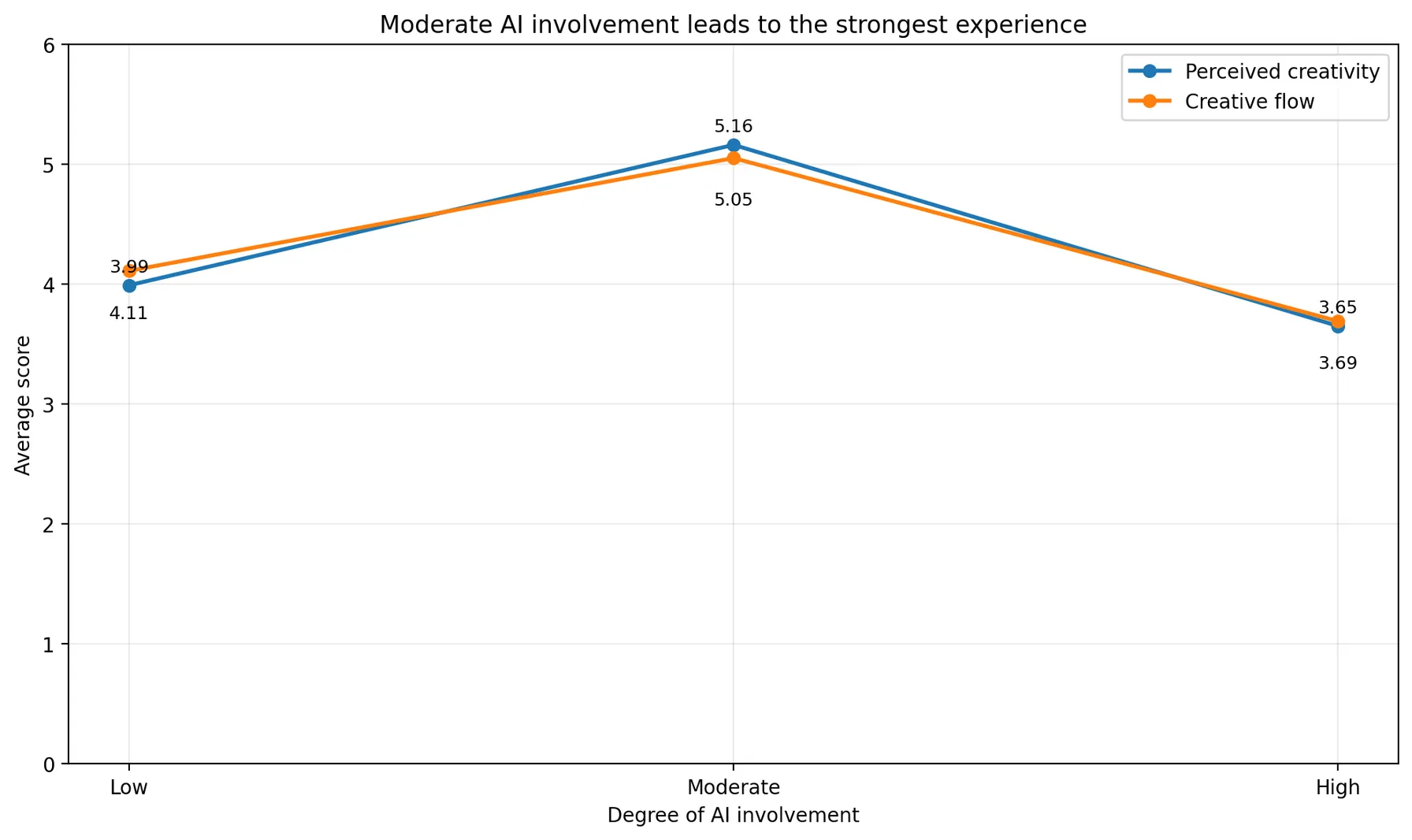
What the Experiment Showed
| Level of AI Involvement | Creativity Rating | Creative Flow |
|---|---|---|
| Low | 3.99 | 4.11 |
| Moderate | 5.16 | 5.05 |
| High | 3.65 | 3.69 |
Average subjective ratings of participants in the second experiment. Source: Wang, Chen & Yang, Frontiers in Psychology, 2026.
The most favorable ratings were not given to maximum automation, but to an intermediate option where the neural network helped create images, but the human retained active involvement in creative decisions.
With this approach, participants also demonstrated higher levels of psychological ownership and a sense of control.
The researchers suggest that the sense of authorship, control over the process, and creative flow are interconnected and jointly influence the perception of the creativity of the result.
However, the levels of AI involvement were not set on a continuous scale but as three distinct work scenarios. Therefore, it cannot be claimed that the scientists found a universal ideal proportion of human and machine labor.
Nevertheless, the study complements previous findings well: for the creative experience, preserving meaningful human involvement may be more important than maximum automation.
A similar conclusion was reached by the authors of the CHI 2026 experiment with 486 participants. When the neural network independently rewrote ideas, their quality improved, but diversity and the sense of idea ownership by the user decreased. In scenarios where AI asked clarifying questions and helped the human develop their own thoughts, quality also improved, but the sense of authorship was better preserved.
Why Musicians Are Especially Sensitive to Automation
In May 2026, another study was published in Frontiers in Psychology—this time about music creation.
The experiment involved 162 students divided into groups based on their level of musical training. They worked in Ableton Live with generative tools from Magenta Studio.
Depending on the conditions, AI either suggested individual musical elements or created a significant part of the composition.
The results showed that a high degree of automation reduced subjective workload but simultaneously weakened the sense of authorship and control over the creative process.
Moreover, this effect was more pronounced in participants with longer musical training.
It is possible that as mastery accumulates, the creative process increasingly becomes part of one’s identity. For an experienced musician, independently searching for a melody or harmony is not just a technical operation to be sped up.
It is part of what makes them a musician.
However, the participants were students differing in the length of musical training, not professional composers with many years of careers. Therefore, it is not possible to claim a proven effect for the entire music industry.
What Famous Creative People Think: Process or Result?
Scientific research helps to understand psychological mechanisms. But the views of artists, musicians, and directors themselves show how differently people define the value of creativity.
Nick Cave: The Meaning of Art Is in Human Effort
Australian musician Nick Cave takes a rather firm stance on generative AI.
In a The New Yorker interview in March 2023, he reflected on why a machine cannot replace the creative process for him.
According to Cave, writing a good song helps the author learn something new about themselves. Through creativity, a person confronts their own limitations, weaknesses, and experiences, trying to overcome them.
Even if AI can create a song indistinguishable from his own or technically superior, it will not change Cave’s attitude toward art.
For him, the value of a work lies not only in its sound but also in the human experience that led to its creation.
This view aligns well with the psychology of competence and effort: not only the achieved result matters but also the internal path the creator has taken.
Brian Eno: The Author Is Not Obliged to Create Every Note
A completely different perspective is offered by musician Brian Eno, known for his experiments with generative music.
In a The Guardian interview in January 2025, he reminded that for many years he has been creating compositions using systems that independently generate musical sequences.
For Eno, authorship does not necessarily mean direct control over every note.
A person can come up with an idea, develop a system, set rules, and then evaluate and modify what results.
But this does not mean he supports fully automatic content production. Eno emphasizes the importance of careful human selection: the author must understand what turned out well and what needs to be changed.
Essentially, he proposes to consider creativity as creating the conditions in which a work arises, not only as manually crafting every part of it.
Guillermo del Toro: A Work Needs Human Experience
Director Guillermo del Toro is also critical of generative AI.
In an NPR interview, first aired in October 2025, he explained why he does not want to use this technology in his films.
For del Toro, a work of art is inseparable from the emotions and life experience of a person.
He gives the example of performers who can transform an already existing song into a completely different work through their own interpretation.
In other words, authorship is defined not only by the novelty of the material but also by the personality of the person who gives it meaning.
This is a fundamental difference in viewpoints.
Cave and del Toro place special importance on human experience and direct creative involvement. Eno believes that significant creative contribution can also be expressed in developing a system, selecting, and managing the result.
Their positions are not scientific proofs but show that even professional authors do not have a unified understanding of where tool use ends and the transfer of creativity to a machine begins.
What Ordinary People Say: Pride, Pleasure, and Guilt
An equally interesting discussion unfolds on Reddit, where users share their own experiences creating images, music, books, and programs with the help of AI.
"I Like AI Images, But I'm Not Proud of Them"
In August 2026, a user in the r/aiwars community asked a question to AI image creators.
He admitted that he also generates images but almost never feels proud of them. Drawing by hand brings him more satisfaction because he watches the picture gradually emerge through his own efforts.
The author compared generation to ordering food at McDonald's: you might like the result, but it feels strange to be proud of having made it if someone else actually prepared it.
However, other participants disagreed.
For example, one user said he creates tabletop role-playing campaigns and uses neural networks to visualize the invented characters and creatures.
For him, the reason for pride is finally being able to show others his own fantastic world. AI acts as a tool to realize his vision.
These are two different understandings of creativity. In the first case, the value lies in the direct creation of the image; in the second, in the realization of one’s own idea.
"People Like My Album, But I Feel Guilty When They Praise Me"
In February 2026, a user of r/SunoAI shared a moral dilemma.
He released an album that was created using AI. Strangers praised the songs, shared them on social media, and the author himself was pleased with the result.
But the compliments caused him to feel guilty. He doubted whether he deserved recognition if an algorithm participated in the music creation.
Later, the author added to the post: he wrote the lyrics himself and determined the creative direction of the album, so he decided he should not devalue his own contribution.
This story reveals another problem: a person can feel like the author but doubt whether others will recognize that authorship.
Here, satisfaction depends not only on the creative process but also on social evaluation.
"I’m Proud of My Novel, But Afraid to Say I Write with ChatGPT"
A similar problem was described by a participant in r/WritingWithAI.
She had long wanted to write a novel but found it difficult to turn ideas into a full text.
ChatGPT helped formulate thoughts, while the writer herself carefully read, corrected, and edited the resulting chapters.
She admitted she was proud of the result but afraid to discuss it with others because of the negative attitude toward AI literature.
Another participant in the same community described the opposite experience: when he writes independently, he feels proud of his work, even if he doesn’t dare to show it to anyone. But using AI is accompanied by a strong sense of guilt, despite saving effort.
It turns out that two people using similar technology can have almost opposite emotional reactions.
"I Created an App with Claude, Even Though I Didn’t Know How to Code Before"
A completely different picture can be seen in the r/ClaudeAI discussion about projects users are especially proud of.
Participants share their own apps, work tools, games, and automation systems.
Some say that before AI appeared, they hardly did any programming, but now they are able to create useful products.
For them, the technology does not take away the pleasure of creativity but opens up completely new possibilities.
Psychologically, this is an important distinction.
An experienced specialist may perceive automation as a loss of a familiar creative role. A beginner—as the emergence of opportunities they never had before.
However, Reddit is not a representative sample. The stories presented show a variety of personal experiences but cannot determine how many people feel pride, shame, or disappointment from working with neural networks.
Why Audiences Also Perceive AI Works Differently
So far, we have mostly talked about the feelings of creators. But the perception of AI creativity also depends on the audience.
In August 2026, the journal Judgment and Decision Making published a study examining readers’ attitudes toward literary texts written by humans and neural networks.
The first experiment involved 1682 adults. They read short stories and rated their quality and ability to engage the reader.
At the same time, researchers varied the information about authorship: some participants were told the work was by a human, others that the text was created by ChatGPT.
The result was paradoxical.
Stories created by AI were on average rated higher in quality and engagement. But ratings for any text increased when readers believed it was written by a human.
In two additional experiments with a total of 905 participants, people were asked to distinguish human stories from generated ones. On average, they performed no better than random guessing.
It turns out that information about authorship can change the evaluation of a work even when the work itself remains unchanged.
Why?
A possible explanation is that people value in creativity not only the aesthetic result but also the human experience, intention, and effort behind it.
This idea is well illustrated by a discussion in r/SunoAI.
One user wrote that good sound alone is not enough for him in an AI song. He wants to know why it was created, who wrote the lyrics, what idea the author wanted to express, and why they chose that particular musical form.
For him, the origin of the work is part of its value.
It is important, however, not to confuse aesthetic evaluation with ethical approval. A person can recognize an AI song as beautiful but criticize the way it was created due to issues of copyright, use of others’ works in training models, or consequences for professional musicians.
How Neural Networks Affect Human Creativity
Can AI, on the contrary, enhance creative satisfaction?
Yes. And some studies directly point to this possibility.
For example, Microsoft researchers conducted an experiment in April 2026 with 36 participants who created advertising layouts both with and without generative AI.
Independent evaluators perceived images created with AI as more creative and unusual. However, clients did not find a comparable improvement in the usefulness of the design or its brand alignment.
Source: Microsoft Research - Decoupling of Usefulness and Novelty.
A study published on November 6, 2026 in the journal Design Science examined four design workshops involving 20 teams.
Participants preferred AI-supported design processes over traditional ones, and the quality of results from the compared methods was comparable.
Source: Design•AI - A study of practice-based integration of AI as a creative partner in design.
These results do not contradict studies about the decline of authorship. They show that creative satisfaction is multi-component.
For one person, the most enjoyable part of drawing is the direct work with shape and color. For another, it is more important to see the idea realized, even if the technical execution is done by a neural network.
The same applies to music, literature, and programming.
A person who enjoys writing code may lose some of that pleasure with full automation. But a person who has long dreamed of creating an app but never knew how to program may feel genuine pride thanks to AI.
Both experiences are quite explainable from a psychological perspective.
AI – A New Level of Abstraction or Loss of Authorship?
Perhaps generative AI should be considered as another level of abstraction, allowing a person to realize ideas without having to perform all technical operations themselves. Just as a photographer does not need to draw an image, and a director does not personally shoot every frame, a project author with AI does not have to write every line of code or create every element of an image.
But there is a significant difference: AI is capable of taking on not only execution but also creative decisions, which previously remained the domain of humans.
Therefore, satisfaction from creativity cannot be reduced only to the speed of achieving a result, its quality, and the amount of effort spent. It is important to distinguish pleasure from the process, satisfaction with the result, and pride in one’s own contribution. These feelings may not coincide: a person can rejoice in an excellent result but hardly feel like its author.
Perhaps, with the development of AI, the very understanding of creative achievement will change: we will take more pride not in technical execution but in the originality of the concept and the ability to manage its realization. But it is still unknown whether this can fully replace the pleasure of independent creation.
How to Use Neural Networks Without Losing the Pleasure of Creativity
Research results allow formulating several practical recommendations.
1. Retain Important Creative Decisions for Yourself
A neural network can suggest options, find errors, and perform technical operations. But it is useful to leave the choice of idea, direction, and quality criteria to the person.
For example, when writing a story, you can develop the plot and characters yourself, then use AI to find weak points and refine the text.
This approach is closer to active collaboration, which in the Scientific Reports study better preserved the sense of authorship.
2. Do Not Automate What Brings You Pleasure
If you enjoy composing melodies, it is not necessary to delegate their creation to a neural network. It may be more useful to use AI for arrangement or mixing.
If you love writing, you can keep working on the text yourself and entrust AI with checking logic, finding inaccuracies, or editorial suggestions.
Conversely, if the most unpleasant part of the work for you is technical implementation, automating exactly that may bring the greatest benefit.
3. Use AI for Learning, Not Just Getting Answers
Instead of asking AI to write a program entirely, ask it to explain the solution, suggest several approaches, or give a hint.
Instead of generating a finished story, discuss the structure, character traits, and possible plot twists.
This way, the neural network helps develop skills and maintain a sense of competence.
4. Leave Space for Experimentation and Mistakes
It is not always worth choosing the first successful result.
Try refining the image, changing the composition, rewriting part of the text, combining several musical ideas.
What matters is not the duration of work itself but the presence of decisions that truly change the result and allow you to feel your own contribution.
5. Separate Creativity for the Sake of the Result and Creativity for the Sake of the Process
If you need to quickly prepare a working presentation, commercial text, or standard report, maximum automation may be quite justified.
But if a person draws, composes music, or writes a story for pleasure, completely eliminating creative effort may contradict the very purpose of the activity.
There is no universal right way to use AI here.
One person needs to learn to solve complex problems independently. Another finally gets the opportunity to realize ideas that were previously inaccessible.
The main thing is to understand what exactly you expect from creativity.
Conclusion: What Makes Us Authors?
Generative AI is gradually changing the very concept of authorship.
Previously, creating a complex work usually required not only an idea but also the skills to implement it. Now, between the concept and the finished result, there may be a neural network performing a significant part of the technical and creative operations.
This opens up enormous possibilities. People without special education can create images, music, videos, and software products that were previously inaccessible to them.
But along with new opportunities arises the question: what exactly makes a person an author?
Is it enough to come up with an idea and choose the best option? Or does genuine pleasure from creativity require direct involvement in the creation of the work?
Science does not yet provide a universal answer.
Most of the mentioned experiments were conducted with a limited number of participants, specific tools, and short tasks. They do not allow confident predictions about the long-term impact of AI on the motivation of professional artists, writers, musicians, and programmers.
However, several conclusions can already be drawn.
First, pleasure from the result and pride in one's own achievement are different things. A neural network can increase the former while simultaneously decreasing the latter.
Second, full automation does not necessarily bring maximum satisfaction. It may be important for a person to maintain control, develop their own skills, and make decisions that significantly affect the outcome.
Third, AI can both weaken and strengthen the sense of creative competence. It all depends on whether it helps a person realize their own potential or replaces an activity that was valuable to them in itself.
And finally, the value of a work is determined not only by its quality. For many people, the personality of the author, the story of creation, and the effort invested matter.
Perhaps the main change that neural networks will bring is not that people will stop creating. Rather, they will have to redefine which part of creativity they want to keep for themselves.
After all, getting a great picture, song, or story is one thing.
But feeling proud of the thought "I created this" is quite another.
In the end, creating something is not only satisfaction from being involved in the process and result but also joy from realizing that it helped someone or brought them happiness.
Scientific Research and Sources
Studies on the Impact of AI on Creativity
-
Jang S. Y. - From designer to curator: cognitive and creative trade-offs in GenAI-assisted design. Fashion and Textiles, March 2026. Experiment with 34 designers.
-
Lee E. H. et al. - Relying on AI at work reduces self-efficacy, ownership, and meaning while active collaboration mitigates the effects. Scientific Reports, March 2026. Experiment with 269 participants and survey of 270 people.
-
Gero K. I. et al. - From Planning to Revision: How AI Writing Support at Different Stages Alters Ownership. DIS 2026. Experiment with 253 participants.
-
Wang C. et al. - The impact of human-AI co-creation on perceived creativity in generative AI art. Frontiers in Psychology, October 2026. Two experiments, 600 participants.
-
He W. - Subjective task load and psychological ownership in generative AI collaborative music creation. Frontiers in Psychology, May 2026. Experiment with 162 participants.
-
Partnering with Generative AI: Experimental Evaluation of Model-Led and Human-Led Interaction in Human-AI Co-Creation. CHI 2026. Experiment with 486 participants.
-
Fu Y. et al. - Decoupling of Usefulness and Novelty. CHI 2026. Microsoft study with 36 participants.
-
Design•AI: A study of practice-based integration of AI as a creative partner in design. Design Science, November 2026.
-
Bot or not: Can people tell the difference between stories written by a human or by an AI system?. Judgment and Decision Making, August 2026.
Psychological Theories
-
Deci E. L., Ryan R. M. - The «What» and «Why» of Goal Pursuits. Psychological Inquiry, 2000. Self-determination theory.
-
Norton M. I., Mochon D., Ariely D. - The IKEA Effect: When Labor Leads to Love. Journal of Consumer Psychology, 2012.
-
Moneta G. B., Csikszentmihalyi M. - The Effect of Perceived Challenges and Skills on the Quality of Subjective Experience. Journal of Personality, 1996.
-
Pierce J. L. et al. - The State of Psychological Ownership. Review of General Psychology, 2003.
-
Amabile T., Kramer S. - The Power of Small Wins. Harvard Business Review, 2011.
Interviews and User Opinions
-
Nick Cave on the Fragility of Life. The New Yorker, March 2023.
-
Brian Eno on Art and AI. The Guardian, January 2025.
-
Guillermo del Toro on Generative AI. NPR Fresh Air, October 2025.
-
Reddit: Does anyone else feel AI guilt when your music takes off?.
-
Reddit: What's your proudest side-project made with Claude?.