

The modern neural network market is a "colorful bouquet" of assistants for marketers, copywriters, journalists, students — for anyone who regularly needs to write different kinds of text. These models offer high speed, a variety of styles, and the ability to fact-check written material.
The main thing is to choose the right neural network for text generation, one that's well suited to the specific task at hand:
- Essays;
- Academic papers;
- Business letters;
- Posts.
Using GPTunneL's aggregator, we tested 7 neural networks, giving each one its own task.
A quick overview of different models' capabilities
ChatGPT
ChatGPT is close to a jack-of-all-trades. It excels at articles, is logical in its reasoning, and can simplify a complex concept down to a level accessible to a non-expert reader.
It's best at:
- Analytics;
- Condensing a large text down to its core meaning;
- Scientific explanations.
Weaknesses: it sometimes comes across as overly academic. But the tone of explanations can be adjusted with the right prompt.
Claude
Claude is a careful, meticulous, "polite" neural network for text creation. It's the optimal choice when you need to draft a business letter or break an explanation down into its component parts.
It's best at:
- Letters;
- Explanations;
- Instructions;
- Summaries.
Emotional, creative writing, however, isn't the model's strongest suit.
Perplexity
Perplexity is like a "patient teacher" who first checks the facts, then presents them to the user in clear language, and backs up the answer with plenty of links.
The neural network's winning aspects:
- Popular science texts;
- Topics that require confirming a large number of facts;
- Reference material;
- Complex explanations.
That said, if you need to write vivid, literary prose with a distinct personal style, Perplexity isn't the best choice.
Qwen
This is an excellent neural network for analytical breakdowns. Qwen navigates numbers, tables, and trends with ease. Logical conclusions aren't a challenge for the model either.
The neural network is well suited to:
- Reports;
- Analytics;
- Business content.
The neural network is weaker at creative writing, humor, and conversational style.
DeepSeek
DeepSeek is a model that isn't a stranger to the liveliness of human speech. If you use DeepSeek for online text generation, you're guaranteed a story told in a modern voice, seasoned with irony when needed. The model works well for generating:
- Social media content;
- Marketing creatives;
- Storytelling.
This tool has a somewhat harder time with formal letters and rigorous analytics.
Grok
Grok is a great assistant when you need to edit heavy, overloaded texts. It's able to find logical connections even within bulky constructions full of tangled reasoning.
Grok is a good fit when you need to:
- Restructure and rewrite a text;
- Make sense of dense academic writing;
- Cut through the thicket of bureaucratic phrasing.
That said, in terms of emotional depth and literary expressiveness, Grok falls behind other neural networks.
YaGPT
YaGPT is an AI tuned for creating practical, unpretentious material.
The model is best at generating:
- Short articles;
- Instructions;
- Business and everyday content.
YaGPT is less developed when it comes to deeply scientific knowledge and creative writing.
All the models listed above are available on GPTunneL, even without an upfront subscription. The service works on a pay-as-you-go basis: you pick the neural network that fits your needs and pay for the generation.
Free options
Free text-generation neural networks are also available. Among the free AI tools for creating text:
Free models are convenient for handling simple tasks. Paid tools, on the other hand, are worth using when you need more complex, more polished texts.
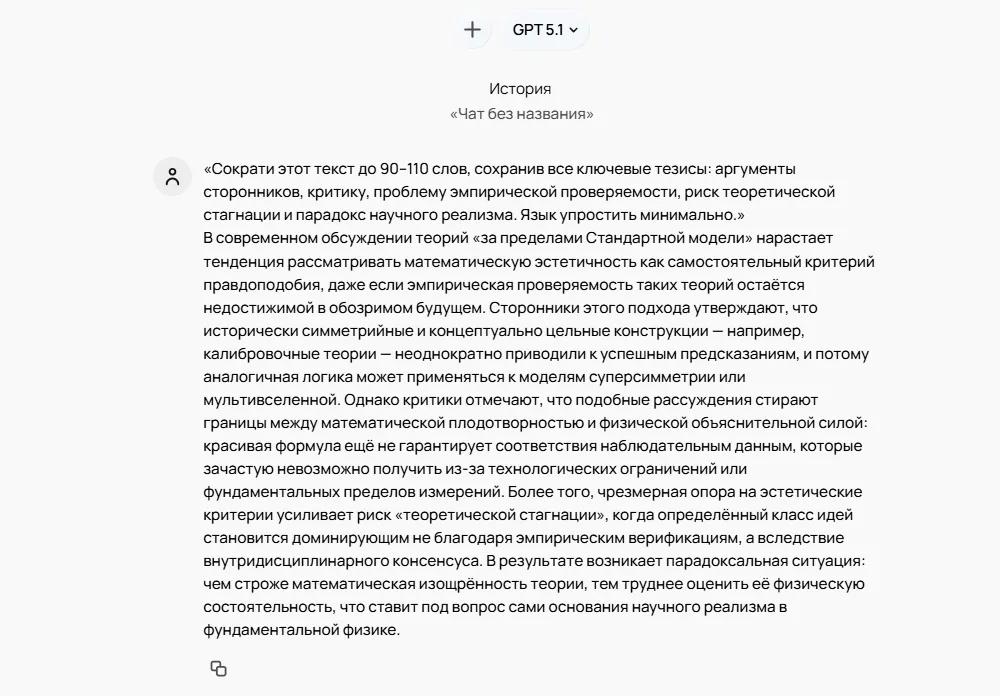
Test 1. How GPT handled compressing an ultra-complex scientific text
Prompt:
"Condense this text to 90–110 words while keeping all the key points: the arguments in favor, the criticism, the problem of empirical testability, the risk of theoretical stagnation, and the paradox of scientific realism. Simplify the language as little as possible."
What we're evaluating:
- The ability to pick out what matters from a large flow of ideas;
- Preserving accuracy and complex meanings;
- Style: clear, without distortion.
Result
GPT handled the task with ease. It compressed the massive passage by nearly half without losing a single key idea. All the requested elements stayed in place, but the text itself became more compact. The vocabulary didn't suffer either — GPT preserved the scientific style. See the model's response in our chat.
Test 2. How Claude handled a business letter
Prompt:
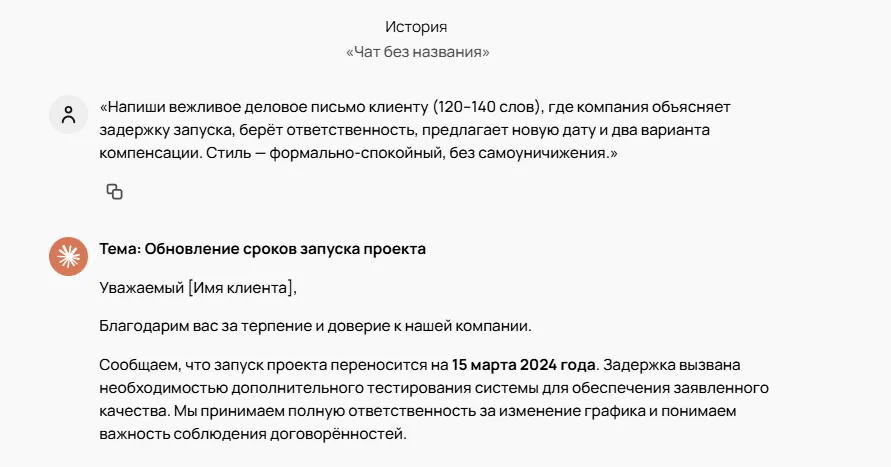
"Write a polite business letter to a client (120–140 words) in which the company explains a launch delay, takes responsibility, offers a new date, and proposes two compensation options. Style — formally calm, without excessive self-deprecation."
What we're evaluating:
- tact, structure, and precision of phrasing;
- proper business style;
- the ability to write without filler.
Result
Claude produced an absolutely flawless business-letter template. The letter came out neat, polite, well structured, and fully maintained a professional tone.
The model immediately stated the topic, easily articulated the reason for the delay — additional quality-assurance testing — and framed the paragraph on the company's responsibility skillfully. At the same time, the letter isn't overloaded with excessive apologies.
It's also convenient that the proposed compensation options are laid out as a list. This format makes the letter easier to read and helps focus the reader's attention on what matters.
The clarity of the structure is also pleasing: greeting → reason for the delay → new date → compensation → request for confirmation. All of this without filler or excessive emotion. See the model's response in our chat.
Test 3. How Perplexity explained the dark matter hypothesis in plain language
Prompt:
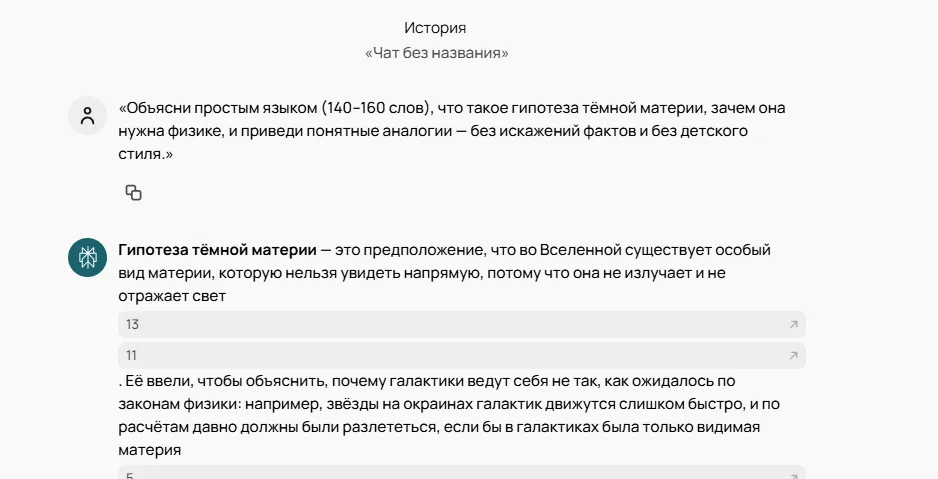
"Explain in plain language (140–160 words) what the dark matter hypothesis is, why physics needs it, and give clear analogies — without distorting the facts and without a childish tone."
What we're evaluating:
- factual accuracy;
- accessibility of a complex topic;
- logic of presentation.
Result
Perplexity handled the task excellently, producing a clear, readable popular-science text. The model explained the key idea concisely yet accessibly: dark matter doesn't interact with light, but it does affect how galaxies move.
The text isn't short on analogies either. The carousel comparison doesn't oversimplify the text, but it does help the reader grasp the principle of the theory faster. The structure also deserves a mention: what it is → why it's needed → the metaphor. No factual errors and no unnecessary "decoration." And, true to form, the model backed up its explanation with links to scientific sources. See the model's response in our chat.
Test 4. How Qwen handled a sales data analysis
Prompt:
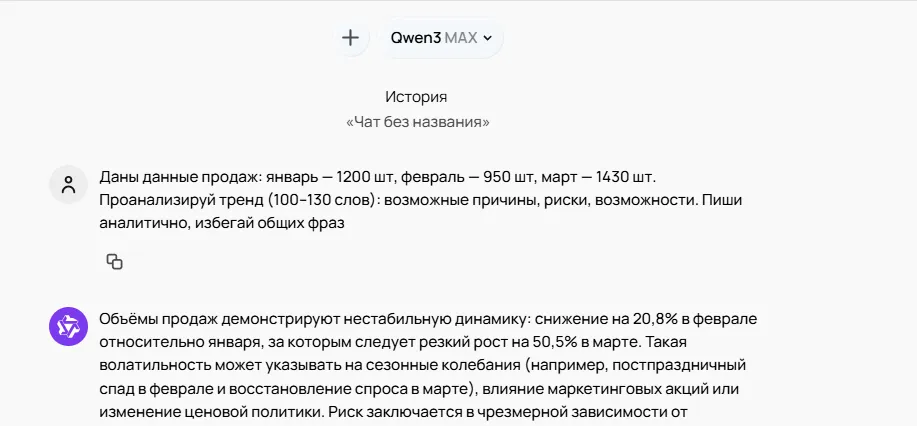
"Given the following sales data: January — 1,200 units, February — 950 units, March — 1,430 units. Analyze the trend (100–130 words): possible causes, risks, opportunities. Write analytically, avoid generic phrases."
What we're evaluating:
- the ability to spot trends rather than just restate the numbers;
- logic and compactness;
- the soundness of the conclusions.
Result
Qwen showed that analytics is right in its wheelhouse. Instead of a summary, it delivered a concise report with an interpretation of the figures:
- Flagged February as a seasonal dip;
- Identified March as a possible recovery or promotion-driven spike;
- Carefully phrased the risks tied to a potential instability in the trend.
Qwen also separated "signal" from "noise." It drew the reader's attention to the fact that future sales planning should be based on the reasons behind March's growth. The business tone, lack of filler, and skillful presentation mean the text could be dropped into a report or presentation with almost no edits. See the model's response in our chat.
Test 5. How DeepSeek handled a creative story for social media
Prompt:
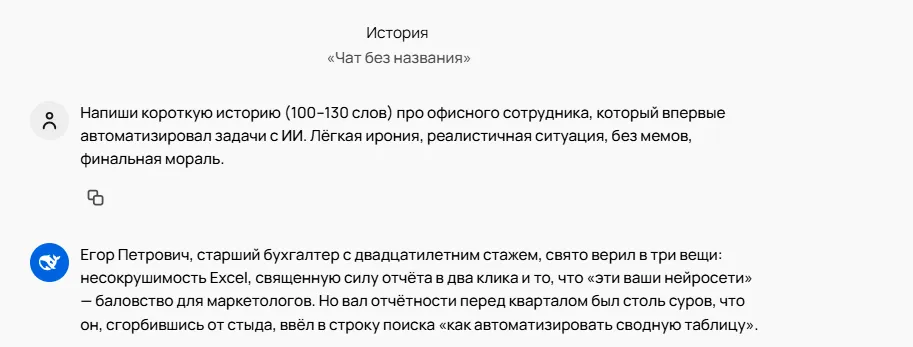
"Write a short story (100–130 words) about an office worker automating tasks with AI for the first time. Light irony, a realistic situation, no memes, a final moral."
What we're evaluating:
- creativity, a feel for language;
- liveliness of delivery;
- naturalness of the situation.
Result
DeepSeek produced a story that would be a perfectly good fit for some corporate Telegram channel. The tone is lively and ironic, but without going overboard. The character is a thoroughly recognizable office worker: 20 years of experience, wary of new technology, and resigned to defeat under deadline pressure.
The text reads easily, though it could still use a proofreading pass. Some spots, especially the final paragraph, need minor edits to make the language flow more naturally. Even so, the neural network delivered a solid framework for a social media post. See the model's response in our chat.
Test 6. How Grok rewrote an overloaded academic text
Prompt:
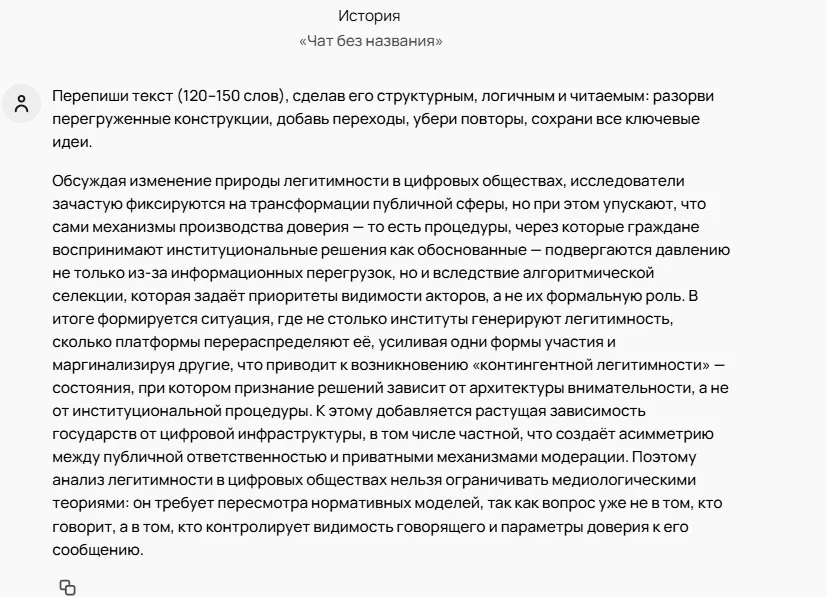
"Rewrite the text (120–150 words) to make it structured, logical, and readable: break up overloaded constructions, add transitions, remove repetition, and keep all the key ideas."
What we're evaluating:
- The ability to structure a diffuse presentation;
- The logic of the arguments;
- A style close to quality journalism.
Result
Grok did a solid job editing the text. It broke the overloaded passage into logical blocks, justified the transitions from one idea to the next, and cut the noise out of the argumentation.
The neural network made the structure clearer and more coherent: transformation of the public sphere → algorithmic curation → redistribution of legitimacy → state dependency → the need to rethink models. In the process, the AI didn't lose any key ideas but did remove repetition.
That said, it's worth noting: the text is still a bit heavy lexically. Grok improved the structure but kept the scientific terminology and density typical of academic writing. That's a good sign if what you need is specifically an edit of a scientific text. But to reach a broader audience, the passage would need to be simplified further. See the model's response in our chat.
Test 7. How YaGPT handled an argumentative paragraph for an article
Prompt:
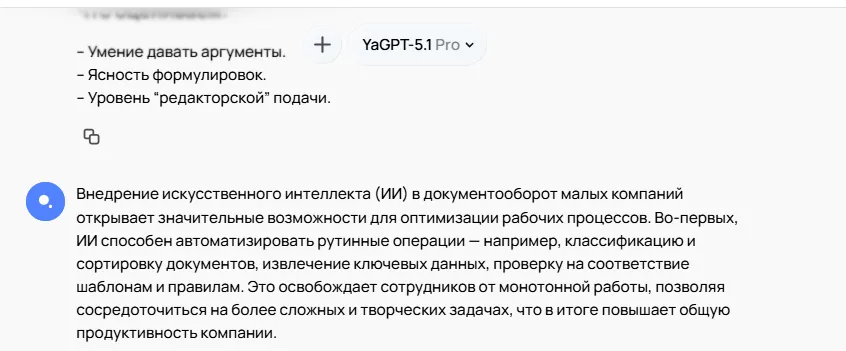
"Write an article paragraph (110–130 words) about the benefits of introducing AI into document workflows at small companies. Give 2–3 arguments, avoid clichés, write in an editorial voice."
What we're evaluating:
- The ability to provide arguments;
- Clarity of phrasing;
- The level of editorial polish.
Result
YaGPT generated a coherent business text that genuinely reads like a professional editorial note.
The model provided 3 solid arguments:
- Automating everyday tasks;
- Reducing errors;
- Saving time.
All these arguments are woven in organically, without clichés or bureaucratic jargon.
The tone of the note is even and pragmatic — in short, a decent block of content for an analytical report or a corporate website. YaGPT didn't overcomplicate its phrasing, didn't reach for loanwords, and didn't try to sound overly clever. The only thing missing was a final takeaway, but the prompt didn't call for one anyway. See the model's response in our chat.
Model comparison table
Model
|
Factual accuracy
|
Logic
|
Style
|
Creativity
|
Long texts
|
Structuring
|
English
| |
GPT
|
high
|
very strong
|
neutral, literary
|
good
|
best overall
|
strong
|
natural, fluent
| |
Claude
|
stable
|
precise
|
human, business-like
|
moderate
|
confident
|
high quality
|
clean, slightly dry
| |
Perplexity
|
excellent
|
strong
|
explanatory, academic
|
weak
|
good
|
confident
|
good, logical
| |
Qwen
|
high
|
very strong
|
rigorous, business-like
|
below average
|
stable
|
good
|
confident, formal
| |
DeepSeek
|
average
|
stable
|
lively, modern
|
one of the best
|
satisfactory
|
average
|
natural, conversational
| |
Grok
|
good
|
strong
|
direct, editorial
|
limited
|
confident
|
best overall
|
good, occasionally blunt
| |
YaGPT
|
stable
|
good
|
practical, clear
|
limited
|
fine
|
good
|
one of the most natural
|
Conclusion
Having tested a range of neural networks, we can draw one conclusion: the point isn't to find the single best AI for creating texts online. What matters is analyzing each model's strengths and finding the one aligned with your specific tasks.
- GPT compresses texts excellently without losing the core idea;
- Claude can write a flawless business letter;
- Perplexity can explain complex topics clearly and back up the answer with links to sources;
- Qwen is an indispensable assistant for analytics;
- DeepSeek brings text to life and handles creative writing well; Grok can bring order to even the most scattered structure;
- YaGPT is an excellent neural network for creating text, producing balanced, concise, and coherent copy.
The GPTunneL interface lets you quickly pick the right tool and makes creating text with a neural network simple and convenient.