
In brief. Physicist Nathaniel Craig introduced a candidate non-perturbative definition of the Standard Model on a spacetime lattice. The concept was refined alongside GPT-6 Astra, to which the researcher credits a central role in developing the technical proof. The preprint was initially posted on October 6, and on November 15 OpenAI published a comprehensive account of the collaboration. The result captured the interest of prominent theoretical physicists: Edward Witten has already proposed a related construction, while Peter Woit outlined why an ultimate resolution of the problem remains distant.
In 2026, reports of AI "solving a major mathematical problem" surface almost weekly. Typically, these are benchmark records or laboratory demonstrations. Nathaniel Craig's story is far more compelling: it tackles a specific scientific challenge, features an open preprint, documents the model's exact contribution, and has sparked genuine discussion within the professional community. Yet claiming that artificial intelligence has "proven the Standard Model" would be a substantial overstatement.
Why the Standard Model Needs a New Definition
The Standard Model describes electromagnetic, weak, and strong interactions, alongside all known elementary particles. Its predictions have been repeatedly verified by experiments, including particle accelerator measurements. The underlying issue is not that the theory "fails" or that physicists cannot apply its equations. The question is more fundamental: how can we rigorously define a fully interacting quantum field theory non-perturbatively, without relying on series expansions in a small coupling parameter?
Many of physics' most precise predictions are derived using perturbation theory: one starts with a simplified, non-interacting system and adds interaction corrections term by term. This approach excels as long as corrections remain sufficiently small. However, numerous physical phenomena cannot be described as minor deviations from a non-interacting baseline. A prime example is proton mass, which primarily arises from non-perturbative quark and gluon dynamics rather than the sum of bare particle masses.
To tackle such non-perturbative problems, physicists turn to lattice quantum field theory. Instead of continuous spacetime, fields and interactions are defined on a discrete grid with a finite spacing. This regularizes the theory with a finite cutoff, enabling rigorous formulations and numerical calculations on computers. Lattice QCD, in particular, proved essential in calculating the properties of strongly interacting hadrons.
However, extending this success to the entire Standard Model is drastically more difficult. The primary obstacle is the chiral nature of the weak interaction: it acts differently on left-handed and right-handed fermions. When one naively discretizes such particles on a lattice, spurious states of opposite chirality inevitably emerge. This obstacle is known as the fermion doubling problem (fermion doubling), and failing to resolve it leads to a mathematically tractable yet physically incorrect model.
What Was Developed Before Astra
Craig's work did not emerge in a vacuum. In 1982, Paul Ginsparg and Kenneth Wilson formulated a foundational condition for preserving chiral symmetry on a lattice. Later, Rajamani Narayanan and Herbert Neuberger introduced the overlap fermions construction, effectively resolving the fermion doubling problem. Martin Lüscher subsequently investigated how to build a consistent integration measure for chiral theories, achieving a non-perturbative construction for abelian gauge theories in 1999.
Yet having the correct spectrum of particles is only half the battle. In path integral computations, one must also construct a smooth and gauge-invariant phase for the fermion measure — a mathematical rule that remains consistent under field variations and gauge transformations. Without this, the theory risks violating fundamental symmetries or suffering from anomalies. Lüscher made breakthrough progress for abelian gauge theories, but extending this framework to non-abelian chiral gauge theories like the Standard Model remained an open challenge for decades.
Thus, the significance of the new research lies neither in inventing the lattice nor in discovering "new particles." Craig sought to address a specific gap in an existing mathematical framework: establishing a smooth, local, and gauge-invariant fermion measure for a class of non-abelian theories that encompasses the Standard Model.
Craig's Core Idea and GPT-6 Astra's Contribution
The overarching strategy originated with the human researcher. Craig proposed taking a field configuration on an initial coarse lattice, reconstructing an interpolated smooth field, and mapping it onto a sequence of increasingly refined lattices. By comparing admissible fermion states across adjacent levels, one can systematically evaluate phase corrections. When summing these phase corrections across the refinement hierarchy, intermediate contributions cancel telescopically, ensuring the initial phase remains well-defined along closed paths in gauge field space.
This is precisely where Astra made its key contribution, according to Craig. The model formulated the specific field-smoothing and refinement mapping, analyzed the convergence of the comparison sequence, and worked out much of the detailed technical proof. The author reviewed and edited the arguments, designed cross-checks with colleagues, and engaged with peer experts on subtle aspects. Among the physicists who raised substantive technical questions during the proof's development, OpenAI notes Maarten Golterman, Andreas Kronfeld, and Yigal Shamir.
The research was posted on arXiv on October 6, 2026, titled A gauge-invariant measure for lattice chiral fermions. The abstract describes constructing a gauge-invariant measure for overlap fermions on four-dimensional Euclidean lattices under specific gauge field conditions. A crucial word here is "candidate": the paper provides a mathematical construction at finite lattice spacing, rather than a full proof of the existence of the physical Standard Model in continuous spacetime.
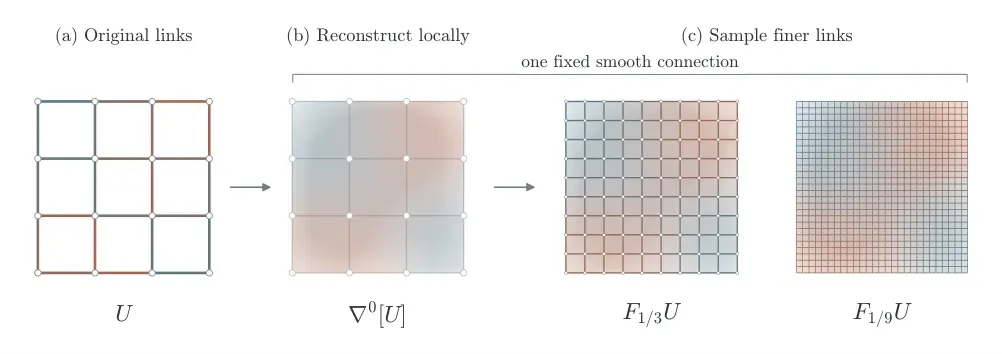
Illustration: Nathaniel Craig, "A gauge-invariant measure for lattice chiral fermions", Fig. 2, arXiv:2610.09093, CC BY 4.0 license. The diagram illustrates the iterative lattice refinement mechanism central to the research.
Scientific Response: Witten Explores Alternatives, Woit Urges Caution
A vital part of the scientific process often gets overlooked in brief news items. On November 3, Edward Witten from the Institute for Advanced Study published a paper titled A Note On Lattice Definition of Gauge Theories With Chiral Fermions. He explicitly cited Craig's construction and investigated a related path toward lattice formulations of chiral gauge theories. Witten also highlighted a complementary approach by Stephen Hsu published during the same period.
This reaction serves as a strong signal that the underlying problem and proposed direction warrant serious investigation. However, Witten's publication is not an automatic endorsement of every lemma in Craig's work. Furthermore, Witten emphasized a practical limitation of his own variant: the resulting fermion path integral is not positive-definite, meaning standard Monte Carlo sampling algorithms cannot use it directly for realistic simulations due to the sign problem.
Mathematician and physicist Peter Woit also examined the development. While commending the collaboration format — where a human scientist provides conceptual direction and the AI acts as an assistant on rigorous mathematical derivations — Woit viewed the extension of Lüscher's program as incremental. He expressed skepticism that it would readily yield practical non-perturbative computations for the electroweak sector and noted that he had not audited every technical detail of the manuscript.
Both reactions are essential for understanding the actual significance of the news. Witten's work shows that Craig's paper has entered genuine theoretical discourse. Woit reminds us that a mathematically intriguing construction is distinct from a fully resolved physical theory. These viewpoints are complementary: a research result can represent genuine progress without instantly resolving a half-century-old open problem.
What Remains Unresolved
Craig himself outlines several critical areas requiring further investigation. One is reflection positivity, a fundamental requirement needed to establish a consistent link between Euclidean lattice formulations and quantum physics in real time. Another is taking the continuum limit as lattice spacing approaches zero. A third challenge is formulating an efficient numerical algorithm capable of extracting practical physical predictions.
Independent peer review and verification remain ongoing. While the preprint and supplementary materials detail various mathematical checks, including partial formal verification in Lean, formalizing individual steps cannot substitute for expert assessment of problem framing, physical assumptions, and broader validity.
What the paper does not prove: it does not incorporate gravity into the Standard Model; it does not resolve dark matter or neutrino mass mechanisms; it does not produce numerical simulations of the complete electroweak sector; and it does not construct a continuum quantum field theory. Nor should this work be conflated with OpenAI's separate announcements regarding Yang-Mills existence problems.
What This Case Reveals About AI's Scientific Role
The most meaningful takeaway concerns the extent of real scientific research an AI system can handle. In standard benchmarks, models solve predetermined problems with clear, verifiable answers. Craig's investigation represents a fundamentally different paradigm: a longstanding problem, a human-designed strategy, multi-round iteration with expert peers, and an outcome subject to rigorous open criticism.
This case offers a realistic template for AI-assisted discovery: the human researcher selects the problem, defines the strategy, and assumes responsibility for the conclusions, while the neural network accelerates the formal development of complex proofs. Concurrently, it underscores the limits of current models: rapid generation of intricate proofs guarantees neither ultimate mathematical correctness nor physical viability.
Conclusion: GPT-6 Astra helped produce a technical scientific preprint that is already being actively engaged with by leading theoretical physicists. This represents a far more meaningful milestone than routine benchmark scores. Yet as of November 16, 2026, it is properly characterized as a candidate mathematical construction undergoing rigorous community evaluation, rather than a finalized solution to a foundational physics problem.
References
- Nathaniel Craig, account of the work and Astra's role, OpenAI, November 15, 2026
- Nathaniel Craig, "A gauge-invariant measure for lattice chiral fermions", arXiv:2610.09093, October 6, 2026
- Edward Witten, "A Note On Lattice Definition of Gauge Theories With Chiral Fermions", arXiv:2611.05051, November 3, 2026
- Peter Woit, "AI and Chiral Fermions", Not Even Wrong, October 8, 2026