

On September 29, at DevDay 2026, OpenAI made more than twenty announcements, but two of them define where the company is heading. Dots are always-on agents running on GPT-6 Astra, each with its own cloud computer, browser and access to 4,000+ apps. And GPT-6.1 Sol is a model that nearly catches Astra on agentic coding and computer use while costing five times less: $2 per million input tokens and $10 per million output.
The first is about how OpenAI wants to sell AI to people. The second is about what everyone else, including us, will be running on.
Timeline
September has been dense for OpenAI. On September 3 it shipped GPT-6 Astra, the flagship at $10/$50 per million tokens. On September 8 Meta launched its Muse agent in the US. On September 22 OpenAI released GPT-6 Sol and Luna at half the price of GPT-5.6. On September 28, a day before DevDay, the company dropped plans to ship GPT-6.1 Astra: by its own account, the model didn't meet internal safety requirements. September 29 brought Dots, GPT-6.1 Sol, the Pro 500 plan and the ChatGPT Space workspace.
The Astra 6.1 cancellation explains why Sol became the model of the day: the flagship update didn't make it, so all the gains landed on the mid-tier model.
Dots: an agent that doesn't wait for a prompt
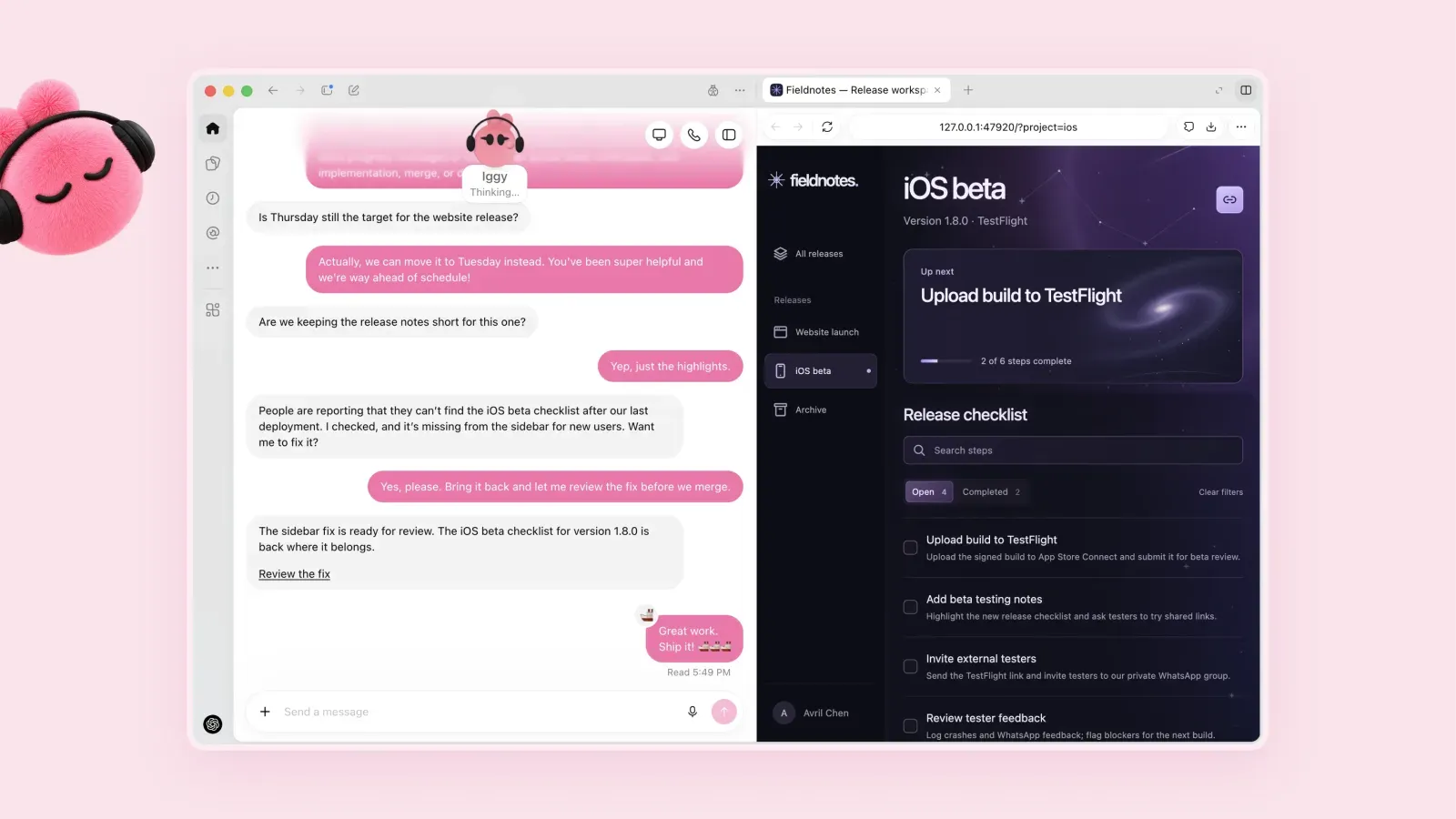
Technically, a dot is Astra given a persistent virtual machine in the cloud. It has its own browser, its own apps connected through plugins, memory of your preferences, and it can run several projects in parallel without a separate thread for each. You can open the dot's computer at any moment and watch what it's doing. With permission, it can also connect to your laptop.

You can message your dot in ChatGPT on desktop, web and mobile, as well as in Slack and Teams; texting is promised later. You can also just call it by voice. Context is shared across channels: start a task in ChatGPT, continue in Slack, and the agent remembers everything.
The key difference from earlier ChatGPT agents is a mode OpenAI calls proactive research. When you're not working with your dot, it browses your connected apps on its own and looks for ways to help. The example from the announcement: an early tester's agent noticed he'd forgotten to invoice a publication, prepared the invoice and sent it after his approval. Inside OpenAI, dots pick up bugs straight from Slack and build working prototypes from new designs.
How control works
This is where OpenAI was careful, and it shows in the details. Background research runs only through read-only tools: in that mode the agent can't send messages, change data or control a browser. The dot uses saved passwords to sign in to sites without exposing them to the model. Changing a password and other sensitive actions are never done by the agent; they always stay with the human.
Everything else is governed by Custom Rules: which actions are allowed right away, which need approval and which are blocked. Every action that touches accounts or sends data out goes through auto-review against those rules. All background work is visible in Activity View. If monitoring spots suspicious behavior, such as an attempt to follow an instruction injected into a page, the agent's work is paused.
For companies, OpenAI announced specialist dots: agents with their own identity, credentials and a defined area of responsibility, such as procurement, invoice processing, email marketing, support and contracts. For now these are pilots that OpenAI engineers set up together with the customer, plus an integration with Microsoft Agent 365.
Pricing and what's still rough
Dots are rolling out to Pro and Business Premium in eligible markets, with a beta for Enterprise, Edu and Healthcare when an admin enables it. The first dot is included in the plan at no extra cost. Chatting with it doesn't count toward ChatGPT limits, but tasks it launches in Codex or ChatGPT Work count as usual. Limits for deeper work are extended for the first month. Later OpenAI promises extra agents and faster ones as add-ons, so monetization will follow the volume of work, not the number of seats.
Early reviews are measured. Every, who tested Dots before the announcement, say the agent quickly became their main way of using ChatGPT: it triages incoming Slack and email and warns about calendar conflicts in advance. But they're not ready to recommend it yet: permission failures, dropped messages, a browser that disconnects, and confusion about where the agent works on its own and where it works inside a thread. Their advice is to wait a week or two.
Dots vs Muse
The comparison is obvious, and everyone covering DevDay made it. Meta launched Muse three weeks earlier: an agent on phone and web that can buy tickets, book appointments and order goods, and that recently got a video avatar, its own email address and control of Mac apps. There's a free tier and subscriptions at $20 and $100 a month. Meta's flagship model is Muse Spark 1.3.
Even visually OpenAI went the same way: Dots have fluffy cartoon avatars you give names to. But the positioning is fundamentally different. Muse is a consumer helper for everyday errands at $20. Dots are a work agent on OpenAI's strongest model, with its own computer and enterprise access control, and they ship only in the top plans. OpenAI isn't competing with Muse on price; it's taking the segment where people trust an agent with work credentials.
GPT-6.1 Sol: nearly Astra at a fifth of the price

GPT-6.1 Sol is an update to GPT-6 Sol, which came out just a week ago. The API identifier is gpt-6.1-sol. Standard prices are unchanged; only the cache got cheaper:
| Model | Input, $ per 1M | Cached, $ per 1M | Output, $ per 1M |
|---|---|---|---|
| GPT-6 Astra | $10 | $1 | $50 |
| GPT-6 Sol | $2 | $0.20 | $10 |
| GPT-6.1 Sol | $2 | $0.10 | $10 |
A $0.10 cache is 95% off regular input. For agents that replay the same long system prompt and tool history, that's the main cost line, so the real price of a long session drops much more than the price list suggests.
Numbers from the announcement and the first independent measurements:
- DeepSWE v1.1 (agentic coding): on par with Astra at roughly 20% of its cost per task, +6.4 pp over GPT-6 Sol;
- OSWorld 2.0 (computer use): within 2.1 pp of Astra at a seventh of the cost;
- scientific tasks at maximum reasoning effort: 68.1% at $5.47 per task versus $23.21 for Claude Opus 5.5 and $23.80 for Astra;
- factuality: 7.7% errors on the adversarial set versus 11.4% for GPT-6 Sol;
- broken search: the model fails the task 2.1% of the time, GPT-6 Sol 4.9%, Astra 1.5%.
Not everything is smooth. Artificial Analysis records a drop of about 100 Elo on GDPval-AA v2.1, office tasks where a finished document is required. The reason: the model now answers more briefly and more often skips required elements. For code and agents that's a plus; for reports and documents, run your own examples before switching.
In ChatGPT the model is rolling out in ChatGPT Work and Codex for Plus, Pro, Business, Enterprise and Edu.
Pro 500, Ultrafast and the rest
The new Pro 500 plan costs $500 a month: 25 times the limits of Plus, no five-hour window and access to Ultrafast. Ultrafast is a premium speed tier: up to 8x faster in Codex, around 300 tokens per second, and up to 6x in the API. Every notes separately that Astra Ultrafast at ~250 tokens per second is impressive but burns through limits just as fast.
ChatGPT Space is a shared workspace for people and agents where you can hand a task to a dot like a colleague. Alongside it came Pages, documents that people and agents write together, with charts, images, checklists and a "keep updated" toggle. Private Intelligence is zero data retention plus Private Inference on confidential computing in preview, for the API, Codex and ChatGPT Work on Pro 500 and Enterprise.
What this changes
OpenAI has split its product into two layers for good. On top is a subscription at hundreds of dollars where an agent lives on its own computer and works around the clock. Below is a model that nearly equals the flagship at a fifth of the cost. The top layer is a bet that people will trust an agent with their email and work credentials. The bottom layer is already changing the economics of everyone building on the API: tasks that needed Astra a month ago now get done with Sol.
For most teams that means not moving into OpenAI's ecosystem but recalculating routing: which steps go to the cheaper model, where the flagship stays, and where it's no longer needed at all.
Where to try it
Dots only work inside ChatGPT on the expensive plans. The models behind them are available without a subscription: GPTunneL already has GPT-6.1 Sol at $0.004 per 1K input and $0.02 per 1K output tokens with a 50% launch discount ($0.008 and $0.04 without it), and GPT-6 Astra at $0.02 and $0.10. With the discount, Sol 6.1 output tokens cost a fifth of Astra's, the same ratio as at OpenAI. One balance covers every model, so you can compare Sol, Astra and Claude Opus 5.5 on your own tasks without a $500 subscription. Current prices are on the pricing page.