
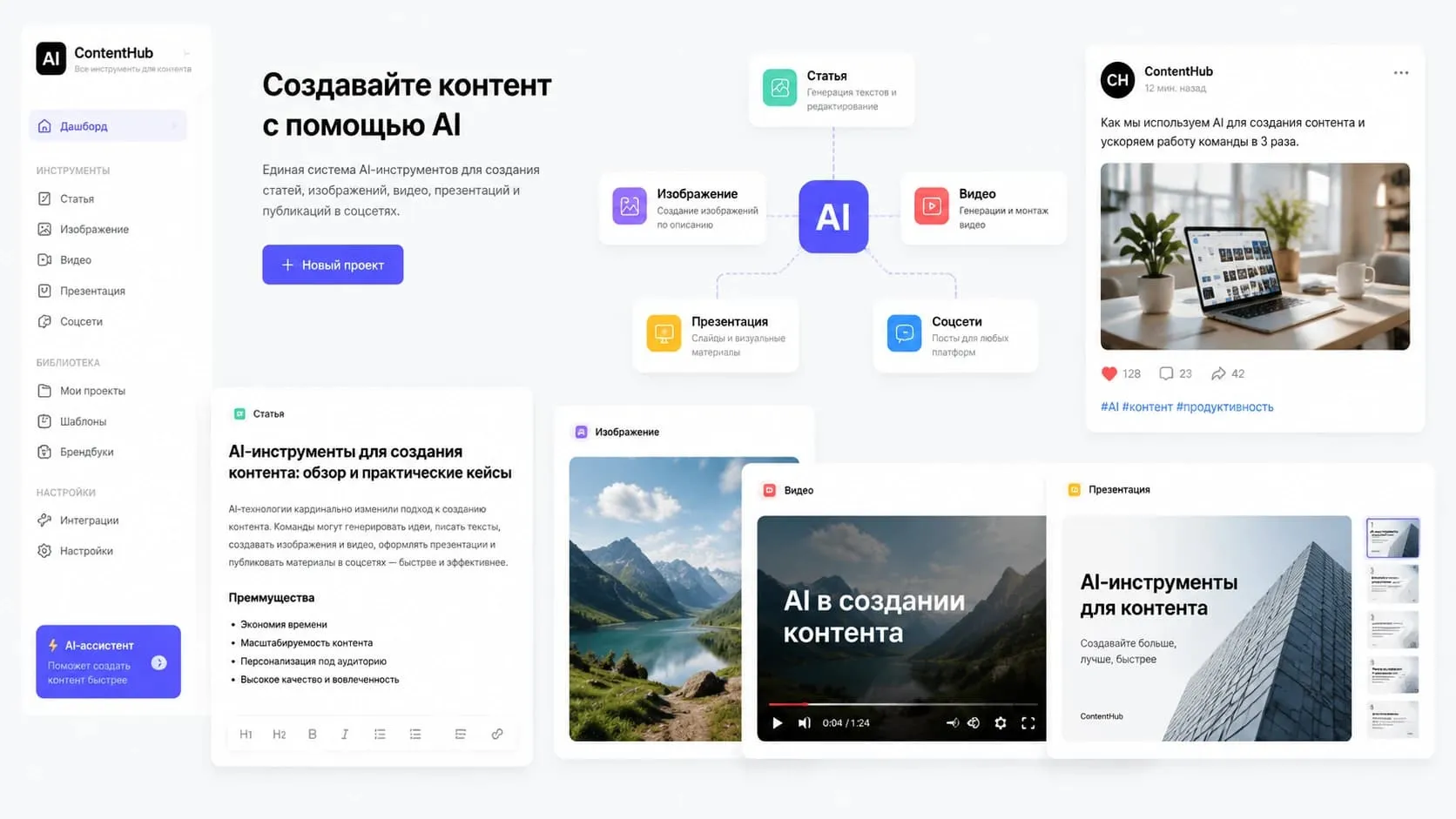
Content creation stopped being just about text a long time ago. Today, creators work with several formats at once: blog articles, social media posts, images, video, presentations, and newsletters. At the same time, publishing speed has become one of the key competitive factors.
That's why AI services for content creation have become part of the workflow for marketers, editors, entrepreneurs, SEO specialists, and website owners. Neural networks help draft articles, come up with post ideas, generate images, enhance photos, and even edit video.
That said, it's important to understand that artificial intelligence doesn't fully replace a human. The best results happen when AI takes on the routine work while a specialist is responsible for quality, facts, and the final edit.
What are AI content creation services
AI services are usually understood as platforms that use artificial intelligence to generate various materials — text, images, video, presentations, or audio.
If preparing a single article used to take several hours, today a neural network can build a structure, suggest headlines, and write a draft in a few minutes.
The most in-demand solutions are for:
- writing text;
- creating images;
- generating video;
- preparing social media posts;
- creating presentations;
- editing photos.
Let's break down the most popular tools by category.
Best AI services for text generation
ChatGPT
ChatGPT remains one of the most popular solutions for content creation. The service is well suited for writing articles, product descriptions, email newsletters, video scripts, and social media posts.
A practical example: an online store can use the neural network to generate dozens of product cards. Instead of writing every description by hand, it's enough to build a template and feed in the product data.
Strengths:
- high text generation speed;
- support for different styles;
- handling large volumes of information;
- ability to refine finished materials.
Claude
Claude is often used by editors and specialists who work with long-form material. The neural network handles document analysis, text rewriting, and detailed articles well.
The service's strength lies in working with large volumes of content. If you need to process a lengthy guide, a research paper, or a report, Claude delivers consistent results and loses context less often compared to other models.
Gemini
Google's Gemini is actively used for content work tied to research and analytics. The service can combine text generation with data processing from various sources, and it integrates with Google Docs, Gmail, and other tools in the Google ecosystem.
For preparing expert-level materials, this approach is useful because it lets you gather data and work with documents faster, all in one place.
Neural networks for image creation
Text content rarely exists separately from the visual side. That's why image generators have become an important tool for creators, designers, and marketers.
Midjourney
Midjourney is considered one of the leaders in AI graphics. The service creates detailed images of almost any type — from illustrations and concepts to advertising creatives.
It's used for:
- article covers;
- illustrations;
- advertising creatives;
- product concepts.
The quality of the resulting images is often good enough to use in commercial projects after minor touch-ups.
Flux
Flux quickly became popular thanks to a good balance between quality and realism. The model was developed by Black Forest Labs and is available both through standalone platforms and via API.
Many specialists use this generator to create photorealistic images of people, objects, and scenes. In terms of detail quality, Flux is often compared to Midjourney, while being easier to integrate into your own projects.
Recraft
Recraft is especially interesting for designers and marketers. The neural network can create both raster images and full-fledged vector graphics.
This is handy when preparing logos, icons, illustrations, and brand identity elements for a website. The service also lets you apply brand colors and visual guidelines when generating images.
AI for video creation
Kling
Kling is a video generator from Kuaishou that quickly gained popularity among content specialists. The service creates short clips based on a text description or an image.
Kling performs well when generating object motion, character animation, and realistic scenes. It's used for ad clips, visual stories, short videos for social media, and product presentations.
For small companies, a tool like this makes it possible to get video content without organizing shoots or bringing in a large team of specialists.
AI for presentations
Gamma
Gamma helps create presentations, reports, and small landing pages from a text prompt. The user only needs to describe the topic, and the service suggests the structure, design, and slide content on its own.
The tool is especially useful for marketers, managers, and entrepreneurs who need to quickly prepare a presentation for a client or leadership.
Tome
Tome is focused on creating presentations, proposals, and pitch decks. The service can automatically build the structure of the upcoming material and select a visual style.
In practice, Tome is often used by startups and product teams that need to quickly pitch a new idea to investors or partners.
AI services for social media
Jasper
Jasper was built as a marketing and copywriting tool. It helps generate posts, ads, and landing page copy.
Many teams use the service to speed up publishing content across several platforms at once.
Copy.ai
Copy.ai is focused on preparing marketing materials and posts.
The neural network can suggest dozens of post variations on a single topic, which helps find good ideas faster and test different communication formats.
Notion AI
Notion AI is convenient to use within a company's workflows. It's a built-in tool in the Notion platform that helps work with documents, tasks, and content.
The tool lets you:
- create notes;
- write articles;
- prepare content plans;
- structure information.
The service is especially useful for content teams working with a large volume of materials at once.
Practical examples of using AI
For a blog
Suppose you need to prepare an article of 5,000–7,000 characters.
The process might look like this:
- ChatGPT creates the structure of the material.
- Claude helps add facts and rework the draft.
- Midjourney generates the cover image.
- An editor reviews the material and publishes it on the site.
As a result, the time needed to prepare the article shrinks several times over.
For an online store
AI makes it possible to automatically create product descriptions, generate images, and prepare ad copy.
If the catalog contains several hundred or thousand items, automation helps significantly cut content production costs. Employees can then focus on growing the product range and marketing.
For social media
AI tools let you prepare a month's content plan, write posts, and suggest visual ideas.
For example, a marketer can put together a month of publications, get headline options, and create images for each post in just a few hours instead of several working days.
For a corporate website
Content isn't only needed by blogs and online stores. Many companies use AI to prepare service descriptions, case studies, FAQ sections, and informational pages.
This approach helps fill a website with quality content faster and keep information up to date without constantly bringing in outside writers.
How to choose an AI service for content creation
The choice depends on the specific tasks at hand.
If your main work involves articles and text, look at ChatGPT, Claude, and Gemini. Designers and visual content specialists will find Midjourney, Flux, and Recraft more suitable.
If you regularly create presentations, it's worth testing Gamma and Tome. And if your main format is short videos for social media, Kling is a logical choice.
Don't rely on a tool's popularity alone. Even the best service can turn out to be inconvenient for a specific workflow. So before buying a subscription, it's useful to test several solutions and compare results on real tasks.
Advantages of AI in content creation
The main advantage is time savings. Instead of doing routine tasks, a specialist can focus on strategy and the quality of the material.
Additional benefits:
- high generation speed;
- help finding ideas;
- lower content production costs;
- ability to scale publishing;
- support for various formats.
For a business, this means the ability to put out more content without a proportional rise in costs.
Limitations and drawbacks
Despite its impressive capabilities, AI can't be considered a fully autonomous tool.
Main limitations:
- factual errors are possible;
- text still needs editing;
- images sometimes contain inaccuracies;
- models can produce templated wording;
- quality control is necessary.
So the best approach is to use artificial intelligence as an assistant, not as the sole author.
Where to follow AI tool developments
The AI market is moving very fast. New models appear almost every month, and existing services regularly get updates and new features.
In practice, specialists rarely stick to a single platform. An article might call for ChatGPT, an image for Flux or Midjourney, a video for Kling, and a presentation for Gamma.
That's why many people use GPTunneL, which provides access to popular neural networks through a single interface. This is convenient when you need to compare results from different models and quickly pick the right tool for a specific task without constantly switching between services.
Conclusion
AI services for content creation have already become a working tool for marketers, editors, website owners, and entrepreneurs. They help speed up text generation, create images, prepare video and presentations, and automate routine processes.
If you need text for a blog, look at ChatGPT and Claude. For graphics, Midjourney, Flux, and Recraft are a good fit. For video — Kling. For presentations — Gamma and Tome.
The practical recommendation is simple: start with one task, such as writing an article or preparing posts. Then gradually add tools for images, video, and presentations. This approach lets you master AI's capabilities faster and get real value from the technology without wasting time.