

AI is advancing fast, but not in the way most people assume. Flashy announcements and marketing noise tend to focus on compute power and model size, while the real breakthroughs happen in how AI gets applied to everyday tasks, how it handles complexity, and how it adapts to human logic.
ChatGPT 4.5 arrives right at this turning point. This large language model marks a shift from AI that simply generates answers to AI that thinks in a structured way. But what does that mean in practice? And, more importantly, how does it fit into the broader trends shaping AI development?
What's actually changing with ChatGPT 4.5?
In simple terms, ChatGPT 4.5 is the final stage before reasoning intelligence is fully built into OpenAI's models. For a long time, large language models relied on a quantitative approach — billions of parameters, massive training datasets, and statistical patterns. But real intelligence depends not just on scale, but on structure.
1. The end of non-reasoning models
One of AI's biggest limitations has always been a tendency toward hasty conclusions. It gives answers without showing its reasoning process, like a student who memorized the answers without understanding the subject. While ChatGPT 4.5 remains highly optimized and efficient, it won't perform structured reasoning the way future models, such as ChatGPT-5, will.
This progress highlights an important point: ChatGPT 4.5 is the last non-chain-of-thought model before OpenAI fully transitions to systems with structured reasoning.
2. Unified intelligence is coming, but not yet
Right now, OpenAI offers several models: GPT-4, GPT-4o, DALL-E, and the experimental O-series. This makes it hard to pick the right tool for different tasks. According to OpenAI's official roadmap, GPT-5 will fully unify these models, so users will no longer have to choose between depth, speed, or specialized capabilities.
ChatGPT 4.5 won't be that unified system, but it will be the last iteration before that change arrives. And the change will be significant: AI will stop being a set of separate tools and become a single system that intelligently adapts to the user's needs, smoothly switching between quick answers and deep reasoning as needed.
OpenAI has been building toward ChatGPT-4.5 for a while
Over the years, OpenAI has refined every generation, improving reasoning, efficiency, and usability.
GPT-3.5 was the first step toward smoother, more "human" conversation, but it struggled with logical consistency. While it could generate text naturally, it lacked structured thinking, and its answers often sounded plausible while containing logical flaws.
Key milestones in OpenAI's models:
- GPT-3.5 – high fluency, but no structured reasoning.
- GPT-4 – expanded multimodal understanding with better logical accuracy.
- GPT-4o – higher efficiency and lower compute costs.
- o1 and o3 – experiments with chain-of-thought methods.
- GPT 4.5 - more natural conversation, an extensive knowledge base, minimal hallucinations, enhanced emotional intelligence
- GPT-5 (in development) – expected to fully integrate structured-reasoning models.
GPT-4 improved on its predecessor by introducing multimodal capabilities through DALL-E integration and better context handling, making it better suited to complex tasks. However, it remained limited in compute efficiency and lacked reliable step-by-step reasoning.
The release of GPT-4o struck a balance between depth and speed, making AI models more responsive. Even so, its reasoning remained unstructured, since it relied on probabilistic generation rather than breaking a task into logical steps.
In parallel, OpenAI ran experiments with chain-of-thought (CoT) models in o1 and o3, building AI systems capable of breaking tasks down into structured reasoning chains. These models improved outcomes on complex tasks by splitting queries into logical steps before producing an answer.
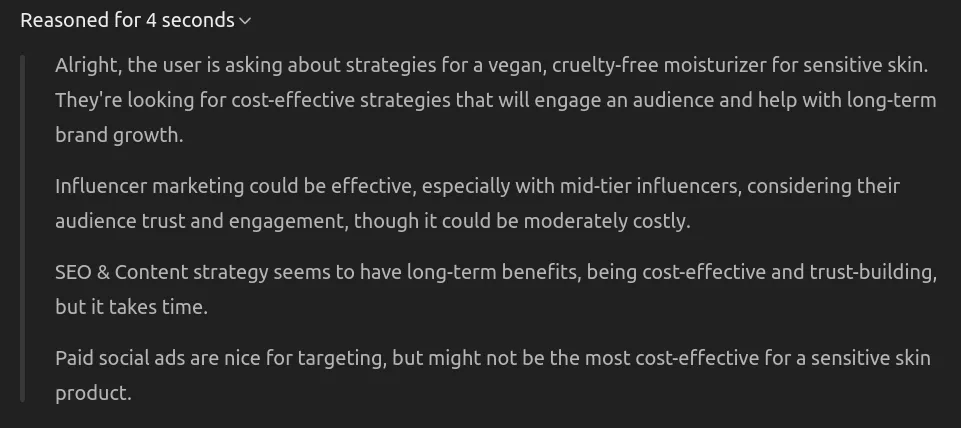
The o3-mini reasoning process. This experimental model has fairly limited reasoning capabilities, and only a small part of its chain of thought is visible. ChatGPT-5 will likely offer a much more detailed view of its reasoning process.
Finally, the release of ChatGPT-4.5, the last non-chain-of-thought model, will lay the groundwork for ChatGPT-5, which is expected to fully integrate reasoning-based processing. ChatGPT-5 will merge OpenAI's previous models into a single system, letting AI decide when to engage in deep reasoning and when to give quick, intuitive answers.
How ChatGPT 4.5 compares to other models
It's not just ChatGPT 4.5 — every model is advancing rapidly in reasoning, efficiency, and multimodal capability. While OpenAI refines its approach with structured intelligence, competitors like Anthropic, DeepSeek, and Google are rolling out their own models.
Here's how ChatGPT 4.5 stacks up against the latest AI innovations:
Claude 3.7 Sonnet (Anthropic)
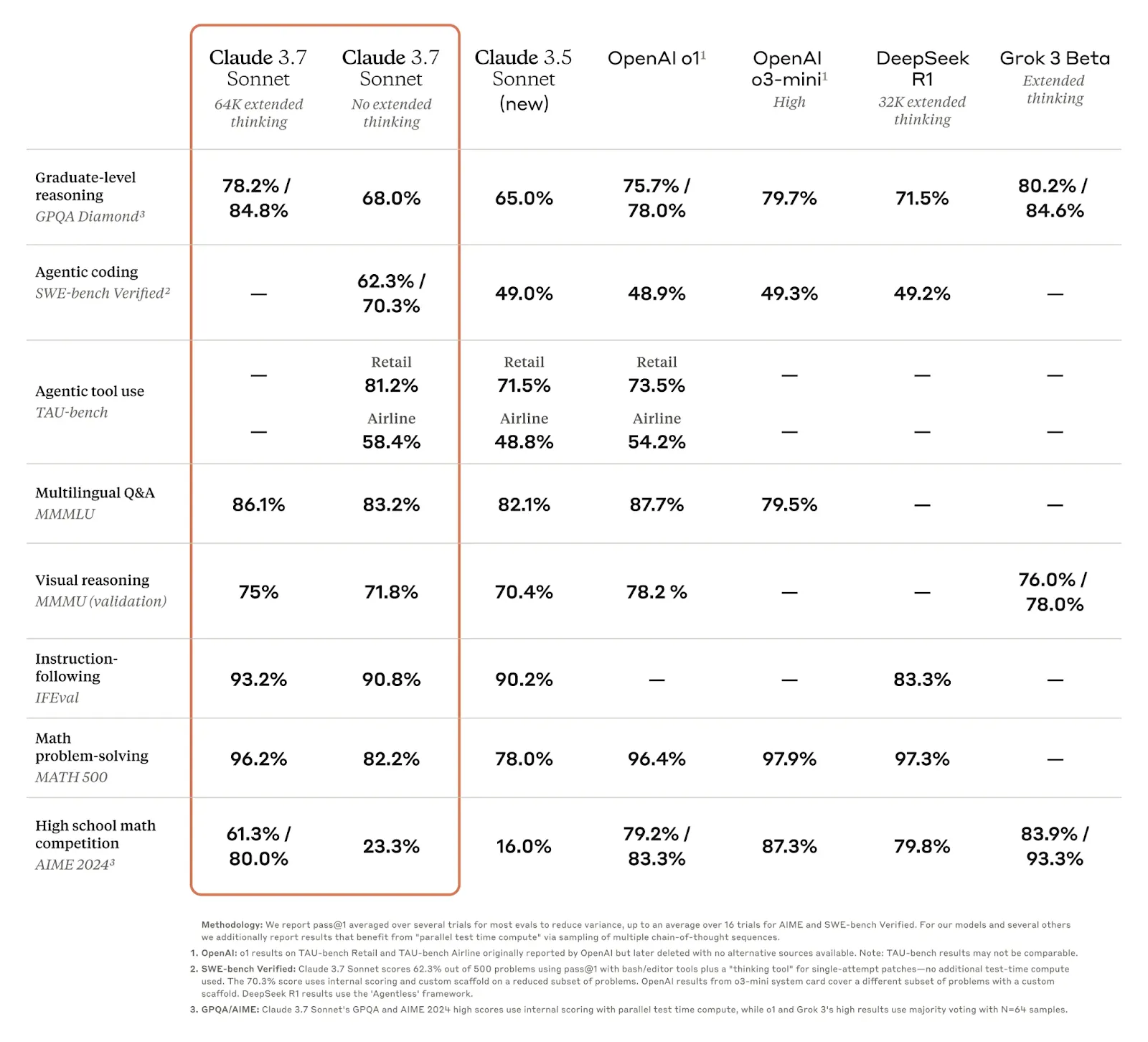
Source: Anthropic - Claude 3.7 Sonnet
Claude 3.7 Sonnet is Anthropic's hybrid reasoning model, combining fast intuition with deep, structured problem-solving. One of its major innovations is full-scale extended reasoning, letting you observe the thought process itself, which boosts transparency and trust in decision-making. The model set new benchmarks in complex reasoning, especially in coding, legal analysis, and scientific applications.
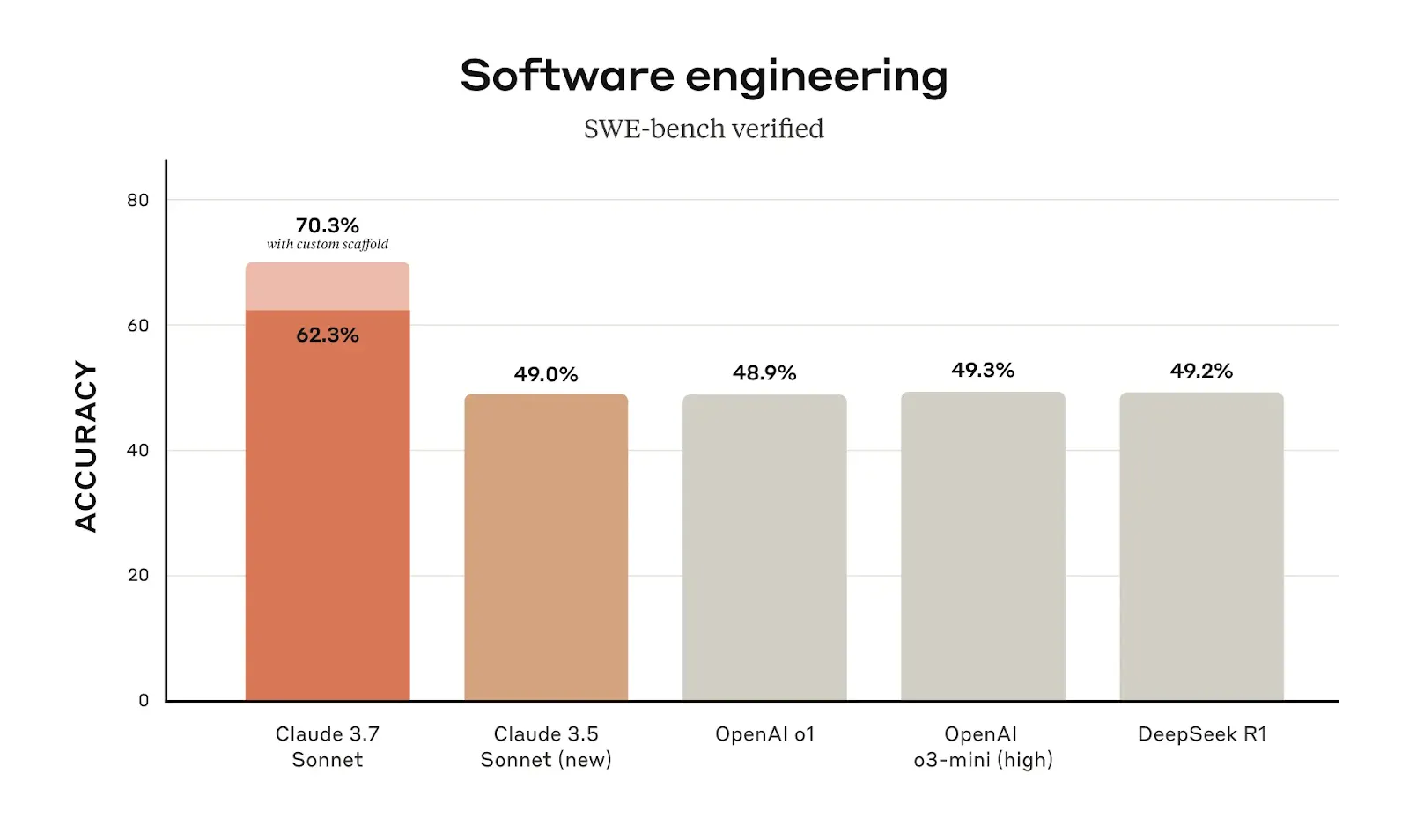
Source: Anthropic - Claude 3.7 Sonnet
ChatGPT 4.5 is expected to improve its performance on complex coding tasks, building on the progress of OpenAI's o3 model. Specifically, o3 achieved a 49.3% success rate on the SWE-bench Verified benchmark, which evaluates real-world software engineering tasks, slightly ahead of o1's 48.9% and roughly on par with Claude 3.5 Sonnet.
DeepSeek R1
DeepSeek R1 made a strong impression thanks to its advanced math and logic capabilities. While it runs on fewer compute resources than its Western competitors, DeepSeek R1 competes directly with OpenAI's O-series models on structured tasks, as shown, for instance, on Artificial Analysis's MMLU-Pro (Reasoning and Knowledge) benchmark.
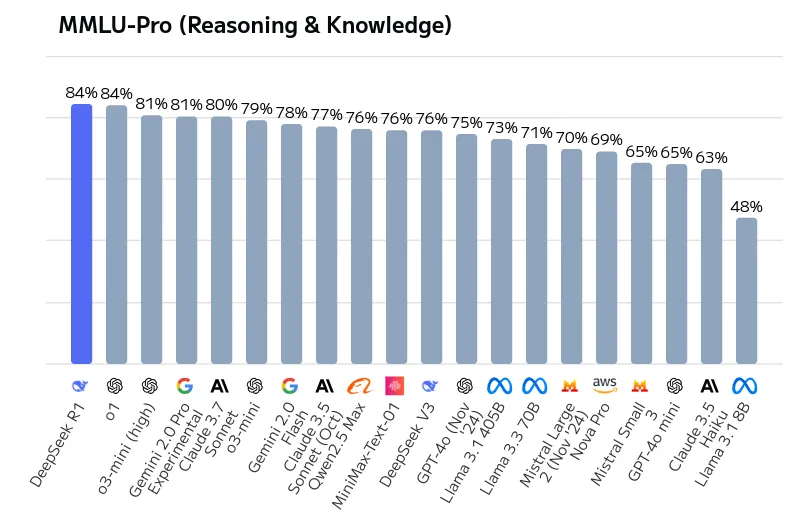
Source: Artificial Analysis - DeepSeek R1
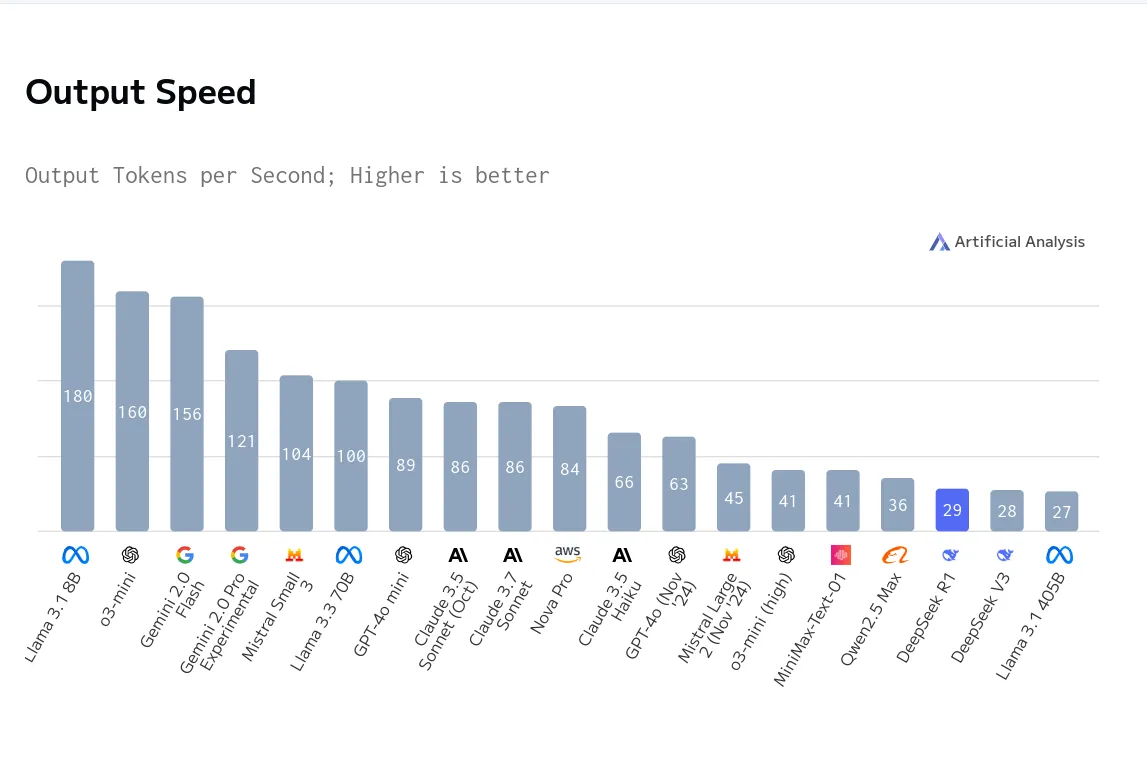
Even after ChatGPT 4.5 and GPT-5 launch, DeepSeek R1 will remain a serious competitor. Built to handle creative, scientific, and technical tasks, it offers a 128K context window, making it an attractive choice for complex AI-driven work. However, according to AA's benchmarks, it's one of the slowest models on the market, generating just 29 tokens per second.
Source: Artificial Analysis - DeepSeek R1
By comparison, OpenAI's models have always stood out for speed. For example, o3-mini generates 160 tokens per second, the second-best result as of February 2025. GPT-4o outputs 63 tokens per second, more than twice as fast as DeepSeek.
ChatGPT 4.5's speed will likely land somewhere between o3-mini and the other models — around 120–140 tokens per second.
Google's Gemini
Google's Gemini lineup stands out for its ability to handle huge amounts of text. The GPTunneL 2.0 Flash model has a 1-million-token context window, while Gemini 1.5 Pro can process up to 2 million tokens, letting them retain and analyze massive amounts of data.
ChatGPT 4.0 and O3 handle nearly 20 times less — 128K tokens — but even that is more than enough for most use cases, from writing an article to analyzing several books at once. It's hard to imagine ChatGPT 4.5 having as large a context window as Gemini.
Source: Artificial Analysis - Gemini 2.0 Flash
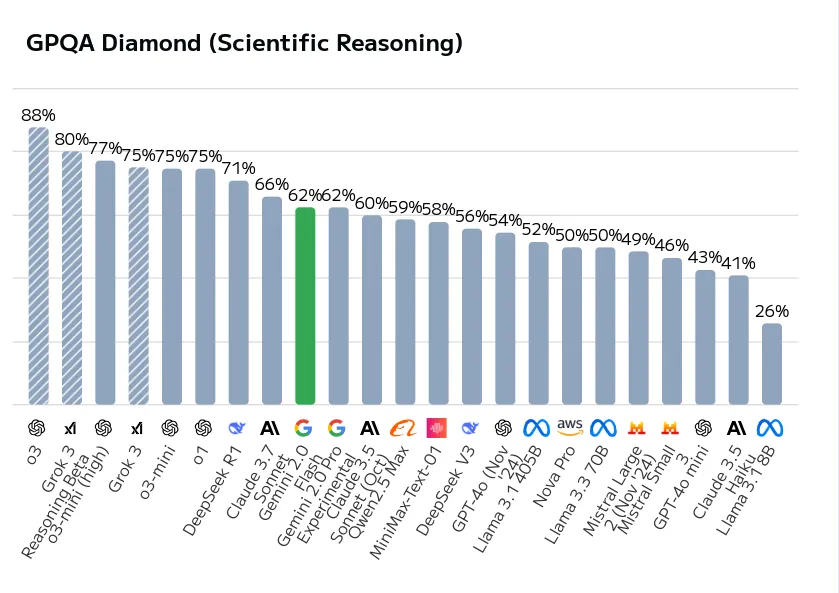
On top of that, one of Google's latest models, Gemini 2.0 Flash, is among the fastest and cheapest on the market. Thanks to the generational gap, it outperforms GPT-4o on the GPQA Diamond benchmark, which tests models on difficult scientific problems, as well as on most other benchmarks.
Source: Artificial Analysis - Gemini 2.0 Flash
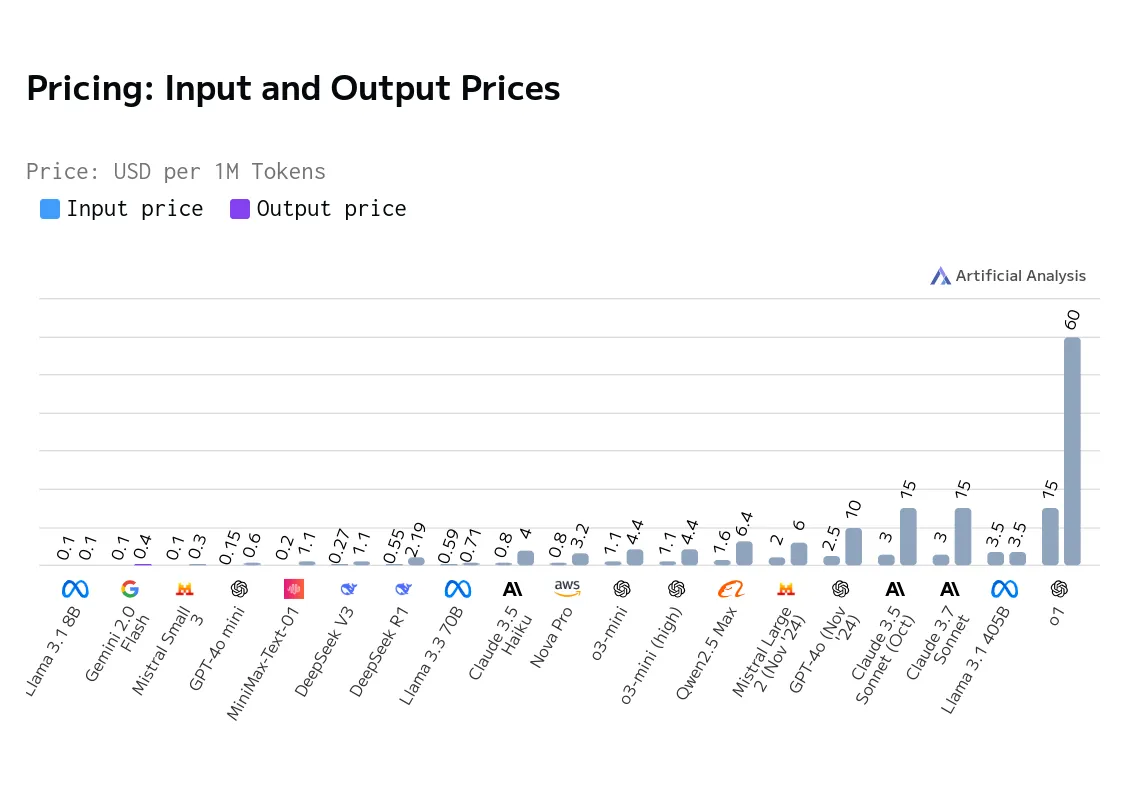
Given that ChatGPT 4.5 will be a transitional model after the O-series, its results should be at least on par with Gemini's. That said, OpenAI's models have always been known for their high price. The price per million tokens affects both API costs and pricing on GPTunneL, since we connect these services through a direct integration.
For example, one million output tokens costs $10 for GPT-4o and $60 for o1. By comparison, the same volume costs $0.40 for Gemini 2.0 Flash. So there's no reason to expect ChatGPT 4.5 to be a budget-friendly model.
Model comparison
table { border-collapse: collapse; width: 100%; font-family: Arial, sans-serif; } th, td { border: 2px solid black; padding: 8px; text-align: left; vertical-align: top; } th { font-weight: bold; }
| Model | Chain of thought | Context window | Specialized strengths |
|---|---|---|---|
| ChatGPT 4.5 | No | TBD | Optimized text efficiency |
| Claude 3.7 Sonnet | Yes | 200K tokens | Dual-mode structured thinking, transparency |
| DeepSeek R1 | Yes | 128K tokens | High-performance logical and math reasoning |
| Gemini | Yes | 1-2M tokens | Extensive context memory, multimodal AI |
What's next?
The main trend driving OpenAI's models is the push toward general artificial intelligence. The company also plans to introduce its first AI agents capable of integrating into work environments in 2025. These agents promise to boost company efficiency and change how everyday tasks get done.
At GPTunneL, we're closely tracking these trends and continuously improving our platform. We've brought on a new specialist focused on building AI agents, and we've launched a training program to help company teams get the most out of neural networks.
Beyond our prompt engineering guide, you can now also work directly with professional prompt engineers ready to help you take your AI skills to the next level. Stay tuned — all updates get published on the blog and on Telegram.