

DeepSeek R1 became a breakthrough in the world of artificial intelligence, proving that building state-of-the-art language models doesn't require astronomical budgets. The Chinese startup DeepSeek didn't just catch up with recognized industry leaders like OpenAI and Anthropic — it offered a more efficient approach in terms of compute usage.
This solution is built on a Mixture-of-Experts (MoE) architecture and uses mechanisms such as multi-token prediction. Together, these deliver strong performance at a fraction of the development cost – just $5.6 million compared to $100 million for GPT-4. The model recently became available in GPTunneL. Below we explain what makes it stand out.
Key technical features of DeepSeek R1
DeepSeek R1 stands out among other language models thanks to several innovative design choices:
- Mixture-of-Experts (MoE) architecture
DeepSeek uses a Mixture-of-Experts (MoE) architecture, which significantly boosts the model's efficiency. Unlike Claude and ChatGPT, which rely on standard transformers and engage all of their layers and parameters to process every prompt, DeepSeek activates only a portion of its resources for a given task.
In other words, out of a total of 671 billion parameters, each task engages a dedicated expert with roughly 37 billion parameters. In the context of the MoE architecture, a "task" refers to a specific type of data processing or request — whether that's text generation, image description, answering a question, or running code.
Hence the term "experts" in Mixture of Experts: each expert has its own specialization, and using different layers of its architecture, DeepSeek R1 figures out which experts to "call in" to resolve a given query. This approach delivers high performance while requiring fewer compute resources, making the model more accessible and cost-effective to run.
Recommended reading: GPTunneL's prompt engineering guide – the architectures behind GPTunneL's models
- Multi-Head Latent Attention (MHLA)
DeepSeek uses an innovative processing mechanism called Multi-Head Latent Attention (MLA), which compresses data into a dynamic latent space. This approach lets the model focus on critical information while discarding unnecessary detail, improving speed and efficiency when working with long texts.
The MLA mechanism gives DeepSeek the ability to analyze several aspects of the incoming data simultaneously, improving its understanding of context and relationships. By focusing on key elements, the model generates coherent and relevant answers even when working with complex or extensive information.
- Compute optimization
DeepSeek uses 8-bit floating-point representation (FP8) for certain calculations, which significantly reduces GPU memory usage and speeds up training without sacrificing quality. It also uses the DualPipe framework, which efficiently distributes computation across GPUs.
Notably, only 2,048 GPUs were used during development – almost 50 times fewer than what was used for GPT-4. As a result, the model cuts computation by 75% without sacrificing response quality or speed.
- Multi-token prediction
Unlike most language models, which process text word by word, DeepSeek R1 can analyze and predict several tokens at once, effectively perceiving text in whole phrases. This substantially improves context understanding and produces more coherent, meaningful responses.
Recommended reading: GPTunneL's prompt engineering guide – Tokens and tokenization
- Web search capability
In GPTunneL, the model can connect to the internet, search for information, cite sources, and back up its answers with data pulled from the web.
Together, these features cut the model's development cost to $5.6 million, reduced system load, and increased stability without compromising answer quality. For context: developing GPT-4 cost over $100 million, and by 2030, the company projects, the cost of developing AI models will reach $500 million – almost 100 times what DeepSeek spent!
Practical applications
How the model performs directly depends on the kind of prompts you give it. Overall, it handles most requests well as long as you know how to write a good prompt. That said, DeepSeek R1 shows especially impressive results in the following use cases:
- Content generation;
- Multilingual responses and content adaptation;
- Deep contextual understanding;
- Data analysis with reasoning;
- Mathematics;
- Coding.
Content creation
The model is particularly effective at generating high-quality text – from marketing copy to technical documentation. It's able to maintain a natural tone and stay on track with context across long conversations.
Multilingual support and localization
DeepSeek R1 performs strongly across a wide range of languages, making it especially valuable for translation and content localization tasks. The model shows a deep understanding of context and preserves nuance in meaning during translation.
Data analysis
Thanks to its advanced architecture, the model efficiently processes large volumes of information, making it useful for data analysis tasks such as processing customer feedback or building analytical reports.
Mathematical problems
DeepSeek R1 demonstrates expert-level performance on math problems, including olympiad-level tasks and academic tests. For example, the model produces detailed solution steps including self-checks and hypothesis testing, automatically breaks a problem down into stages, verifies intermediate results, and adjusts its approach if it makes a mistake.
Programming and development
On programming tasks, the model performs at a level comparable to specialized coding tools, handling complex Codeforces problems and scoring well on SWE-bench Verified. DeepSeek works effectively across a range of programming languages, helping with writing, debugging, and optimizing code.
You can check generation pricing on the pricing page.
DeepSeek R1 performance and efficiency
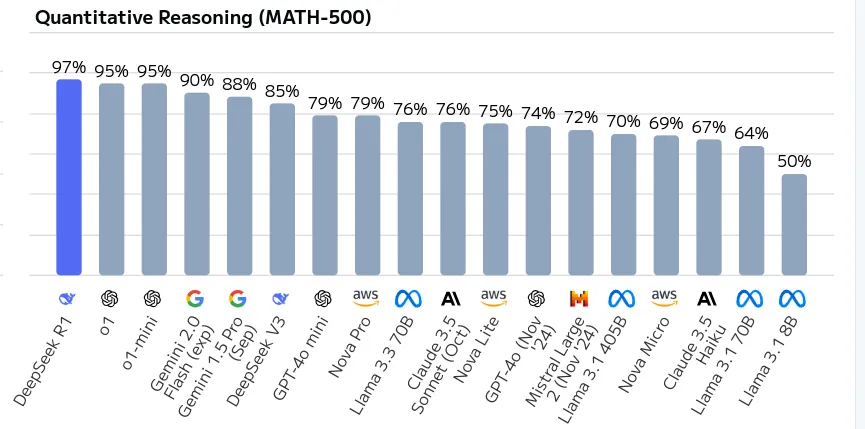
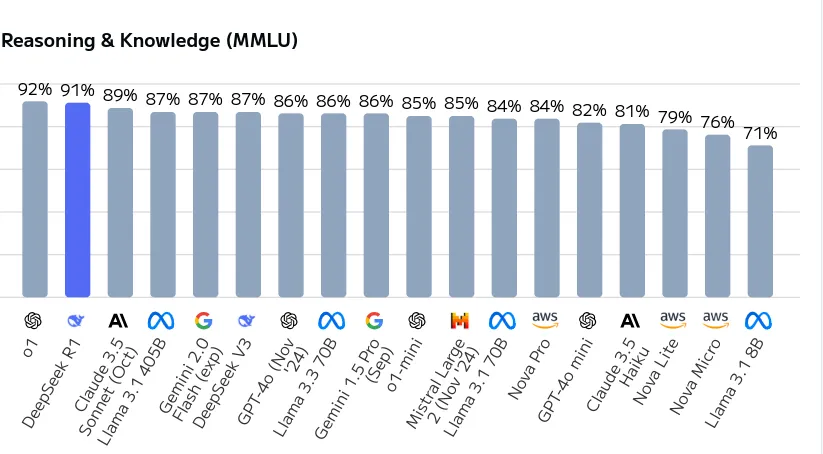
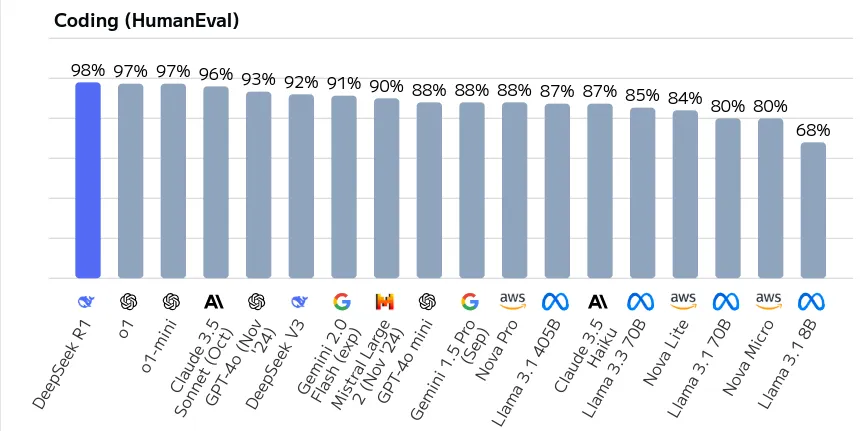
One of DeepSeek's key achievements is its impressive results in demanding benchmarks from Artificial Analysis:
- A 97% score on MATH-500 (a benchmark made up of 12,500 challenging math problems). The Chinese model comfortably outperforms Claude 3.5 Sonnet, every LLaMA model in the comparison, as well as OpenAI o1 and Gemini 2.0 Flash.
- A 91% result on MMLU (testing across a range of academic and professional domains). The model outperforms o1-mini and LLaMA 3.1 405B, confidently beats Claude 3.5 Sonnet, but trails the full o1 model — long considered the leader — by just 1%.
- A 98% score on coding tasks in the HumanEval benchmark. That beats o1, Gemini 2.0 Flash, as well as LLaMA, GPT-4o, and Claude 3.5 Sonnet, which had long been considered the leader in coding. These results let DeepSeek R1 stay ahead across the full comparison.
In our Arena you can compare how different models answer your own real questions – just pick DeepSeek R1 and a competitor, write a prompt, and watch the results.
Wrapping up
The arrival of DeepSeek R1 can be seen as a major milestone in the development of artificial intelligence, showing that technological progress doesn't have to come only from scaling up compute — it can also come from smarter architectural choices. This opens up new possibilities for accessible, efficient AI solutions going forward.
Key achievements of DeepSeek R1:
- An MoE architecture that makes optimal use of compute resources;
- Strong performance at a lower training and operating cost;
- Effective handling of a wide range of tasks, from content creation to data analysis;
- Competitiveness with leading commercial models.
The model shows that Chinese companies are not only capable of competing with industry leaders, but can also offer innovative approaches that reshape how large language models are built. This approach to building AI systems could become a new industry standard, one where efficient use of resources plays an increasingly important role.
DeepSeek R1 is now available in GPTunneL alongside its earlier sibling, released in late 2024 – DeepSeek V3. Try it right now on our platform!