

In brief. OpenAI has introduced ChatGPT for Sales, a specialized set of workflows and integrations tailored for sales departments. The new Sales plugin helps find promising leads, prepare for negotiations, craft proposals, and identify stalled deals using data from CRMs, meeting notes, and other business apps. The launch includes over 30 new and expanded partner plugins, while the dot agent can handle continuous background monitoring. This marks a step toward AI as an operating interface for sales, though outcomes remain strictly dependent on CRM data quality, configured permissions, and human verification.
On November 17, OpenAI announced ChatGPT for Sales, an industry-specific toolkit aimed at the daily routines of account executives and sales reps. The company proposes bringing together CRM records, customer communication history, meeting transcripts, collateral, and deal signals into a single chat dialogue.
The primary friction this product tackles is familiar to every B2B team: customer data is fragmented across multiple disparate silos. The contract resides in an e-signature platform, correspondence is buried in email threads, call recordings sit in a transcription tool, and deal stages and contact roles live in the CRM. Preparing for an upcoming meeting requires manually piecing these fragments together.
OpenAI envisions reps phrasing tasks in natural language while ChatGPT queries authorized sources to prepare the final output. Crucially, ChatGPT for Sales is not a single autonomous "AI salesperson." According to the announcement, it is a Sales plugin with built-in workflows, supported by partner plugins and general ChatGPT capabilities combined in flexible patterns.
What ChatGPT for Sales Can Do
The vendor outlines four core areas: prospecting, meeting preparation, deal execution, and pipeline analysis.
| Task | How ChatGPT Is Used | Connected Tool Examples |
|---|---|---|
| Finding prospective leads | Gathers company insights, prioritizes contacts, and personalizes initial outreach | Apollo, Clay, Common Room, ZoomInfo |
| Meeting preparation | Consolidates account history, correspondence, and past agreements into a concise brief | Salesforce, HubSpot, Close CRM, monday CRM |
| Post-call follow-up | Analyzes notes, extracts mutual commitments, drafts emails, and outlines next steps | ChatGPT Meetings, Gong, Otter.ai, Granola |
| Presentations and collateral | Helps prepare tailored proposals, presentations, and ROI calculations | Gamma, Canva, Figma, ChatGPT Sites |
| Pipeline visibility | Evaluates deal progression and flags potential bottlenecks or stalled stages | Backstory, Hex, Data plugin, Rox |
| Deal documentation | Assists in drafting contracts, proposals, and supporting sales paperwork | Docusign, Ironclad, PandaDoc, ServiceNow CPQ |
This list is compiled directly from OpenAI's official announcement. Specific actions and read/write permissions vary across plugins: the inclusion of an integration in the directory does not imply that every feature is immediately accessible to every organization.
▶ Introducing ChatGPT for Sales, 17.11.2026
Official OpenAI demonstration from November 17, 2026.
From Lead Research to First Outreach
Consider an enterprise software company. A sales rep might ask: "Select ten accounts from our CRM that match our current ideal customer profile. Explain why each is promising and identify missing data points."
The system leverages accessible data to generate a prioritized list of prospects. The rep then specifies industry segments, company size, strategic priorities, and anticipated requirements. A tailored outreach hypothesis can be drafted for each target company.
A critical boundary separates preliminary research from verified fact: assumptions regarding prospect pain points should not be automatically written into CRM fields as confirmed truths. Contact details, decision-maker authority, and objection reasons require diligent human review.
Preparing for Negotiations
Another scenario involves a client call starting in 15 minutes, where the rep is inheriting an account recently handed off by a colleague. In a conventional workflow, they would need to comb through CRM logs, review past call transcripts and email exchanges, and track down the latest commercial proposal.
ChatGPT for Sales can assemble a briefing: corporate background, core requirements, decision-makers involved, prior commitments, and unresolved objections. Armed with this context, the rep can generate discussion prompts and a tailored slide deck through connected design tools.
All of this relies on which data sources are connected and how thorough their records are. If critical agreements exist only in personal messages out of reach of the system, the resulting briefing will remain incomplete.
Post-Meeting: Emails, CRM Updates, and Commitment Tracking
OpenAI also highlights the integration of transcripts and meeting summaries from Meetings, Gong, Otter.ai, or Granola. The model can identify deadlines, objections, mutual agreements, and next steps, drafting a comprehensive follow-up email.
The announcement showcases writing outcomes back into the CRM via compatible integrations such as Attio. However, the ability to "prepare a record update" does not mean every change should be applied automatically. Teams must define clear guardrails distinguishing safe background updates from entries requiring explicit rep confirmation.
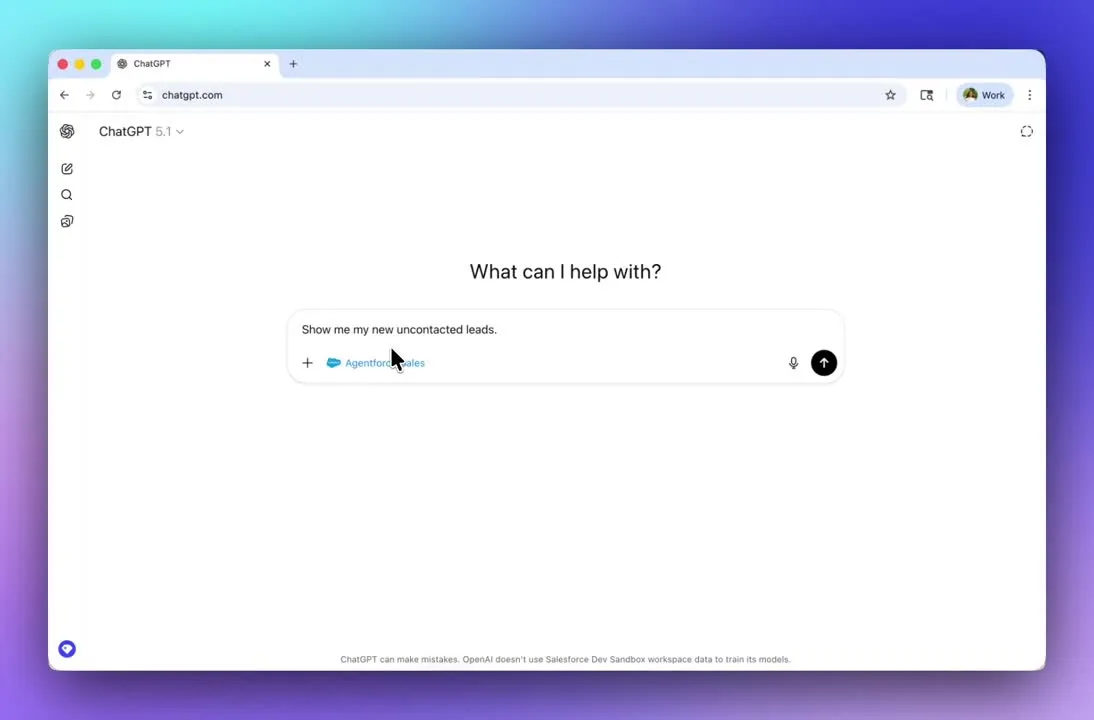
Salesforce Agentforce Sales in ChatGPT demo; this is a related integration, not the new Sales plugin UI. Source: Salesforce.
How the dot Agent Operates in Sales
A distinct role in OpenAI's architecture belongs to dot, ChatGPT's persistent agent. Rather than engaging only in one-off prompt sessions, users can delegate continuous monitoring tasks: generating morning briefings, tracking account milestones, or flagging when customer follow-up is due.
According to OpenAI, dot can draw upon the same authorized plugins and conversational context. For example, the agent can monitor a high-value opportunity daily, detect status shifts, draft suggested next steps, and surface them for rep review.
This unites two operational modes: an on-demand conversational assistant and a persistent background agent. This does not grant the system autonomous rights to send unreviewed emails, execute agreements, or modify production databases without oversight. Permitted actions depend entirely on workspace configurations.
Early Customer Feedback and Case Studies
The official announcement highlights endorsements from several early adopters. These offer valuable illustrations of real-world use cases, though they should not be conflated with controlled scientific benchmarks.
For instance, NeoBid reports pairing HubSpot with ChatGPT for Sales to research real estate assets, enrich CRM data, qualify target leads, and draft personalized communications. According to co-founder Gunnar Gombert, manual effort across these tasks declined by approximately 65%.
While impressive, OpenAI does not provide measurement protocols, sample sizes, observation windows, or control comparisons. It is therefore accurate to describe this as a single client's self-reported metric rather than verified industry-wide productivity gains.
Representatives from the Michael J. Fox Foundation describe utilizing the Salesforce plugin for partner and donor prospecting, while Pallet combines ChatGPT for Sales with Rox to monitor deal health and surface pipeline risks early.
These testimonials demonstrate where early value is emerging: consolidating context, analyzing relationship history, and organizing subsequent touchpoints. Independently verified data on win-rate improvements or aggregate revenue growth has not yet been shared.
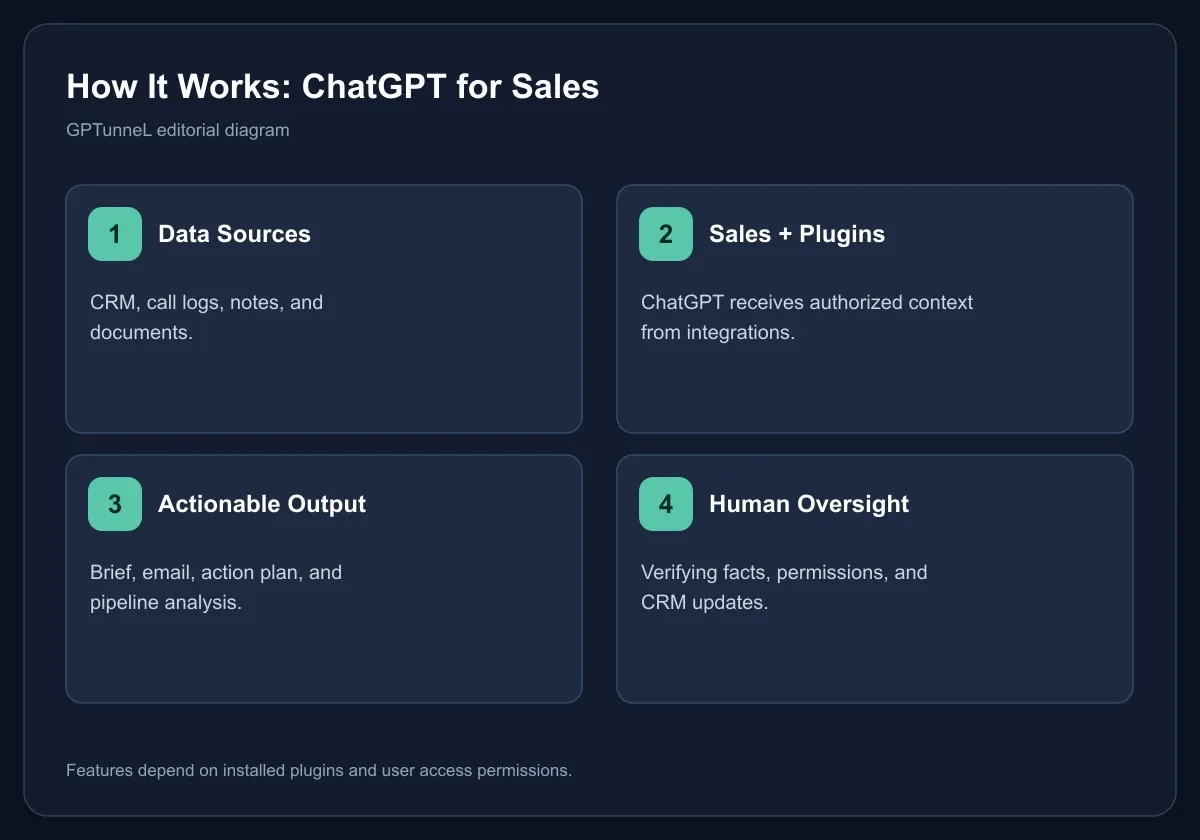
GPTunneL editorial diagram based on OpenAI announcement. Not a product UI screenshot.
Why OpenAI Is Developing Role-Specific Tooling
This launch aligns with the broader transition from general-purpose chatbots toward specialized vertical workflows. Enterprise AI value is measured by how seamlessly models integrate into established business procedures and securely interface with corporate data.
The enterprise sales market has long trended in this direction. Microsoft Dynamics 365 features embedded AI agents for sales operations, with similar capabilities developed across major CRM and automation platforms.
OpenAI approaches the ecosystem from an alternative vantage point: the rep stays inside ChatGPT, treating CRMs and business apps as connected external systems. This reduces context switching across browser tabs and enables cross-platform synthesis. Yet the CRM remains the canonical system of record for deal history; ChatGPT does not replace it.
Competition will center on deep integrations, data cleanliness, enterprise access governance, and dependable end-to-end task execution rather than eloquent copywriting alone.
Key Limitations: Data Hygiene, Permissions, and Accuracy
1. CRM Data Quality. If cards contain obsolete contacts, missing rejection notes, or incorrect pipeline stages, the model will base its deductions on flawed foundations. Generative frontends cannot bypass the requirement for sound data hygiene.
2. Data Privacy. CRMs store sensitive customer contacts, contract terms, recorded calls, and commercial negotiations. Administrators must carefully verify retention policies, plugin scopes, and individual user permissions before activating connectors.
3. Confident Hallucinations. Models can misinterpret prospect remarks, blend details across unrelated accounts, or confuse tentative suggestions with firm commitments. This risk is particularly critical when dealing with contracts, pricing concessions, and binding proposals.
4. Cost and ROI. The announcement lacks a standardized total cost-of-ownership model factoring in multi-tool API calls and employee verification time. Practical returns must be assessed against specific operational tasks and remediation overhead.
5. Rollout Availability. OpenAI notes that features and partner plugins depend on subscription tiers, geographical regions, and corporate workspace configurations. Not every ChatGPT user will immediately access all 30+ integrations.
Evaluating ChatGPT for Sales in Practice
To evaluate the product, teams should select a recurring high-frequency task, such as pre-call briefing preparation or post-call CRM logging. Comparing a pilot cohort against a control group across quantifiable metrics—time spent per task, correction rates, data completeness, rep satisfaction, and buyer engagement—provides grounded insights.
Where the goal is revenue growth, organizations must track deal velocity, stage conversion rates, and average contract values. Merely shaving minutes off email drafting does not automatically translate into higher revenue.
Takeaway. ChatGPT for Sales exemplifies OpenAI's ambition to position ChatGPT as an enterprise command center unifying business data, specialized plugins, and persistent agents. Early strengths focus on meeting preparation, account context retrieval, and commitment tracking. Proving tangible advantages over native CRM assistants will require measurable business outcomes rather than sheer integration counts.