
Anthropic reported two new results from Claude Fable 5.2 in theoretical physics. In one case the model carried out a calculation formulated back in 2003. In the other it found the exact limit of applicability of a mathematical method researchers use to study possible theories of quantum gravity. The work has been published as preprints, and according to the company its main content was checked with Lean and by physics researchers.
These results matter specifically for theoretical models of black holes. Claude did not discover a new astronomical object, did not observe the formation of a black hole and did not build a complete theory of quantum gravity. But it advanced two problems that specialists had been working on for years.
Why black holes interest physicists so much
Einstein's general theory of relativity describes gravity as the curvature of spacetime. Quantum mechanics explains the behaviour of particles at small scales. Both theories work perfectly within their domains, yet reconciling them into a single mathematical picture remains one of the central problems of physics.
Inside black holes and near extreme conditions both theories have to be taken into account. That is why physicists often study simplified "toy universes" where the calculations can be checked. One of the key tools is holographic duality: some problems about gravity inside a space can be rewritten in the language of a quantum theory on its boundary.
Both of Claude's studies are tied to exactly such a model universe.
The first problem: does a hot gas turn into a black hole abruptly
In 1983 Stephen Hawking and Don Page showed that in a space of the anti-de Sitter type, as the temperature rises, the dominant state changes sharply. Below the critical temperature the system is described by a gas of particles; above it, by a state with a black hole. It is a phase transition, somewhat similar to boiling water.
The classical calculation, however, works in a particular regime where spacetime has a fairly well-defined geometry. Physicists were interested in whether the transition stays sharp in another regime, where quantum effects can no longer be described by the familiar gravitational picture.
In 1999 researchers found an analogue of the transition in the corresponding quantum theory. In 2003 a group led by Ofer Aharony formulated a calculation capable of establishing whether the transition is smooth or abrupt. Answering it required computing a complicated coefficient of the three-loop approximation, tied to thousands of diagrams. The full version of the calculation for N=4 super Yang-Mills theory remained unfinished for more than two decades.
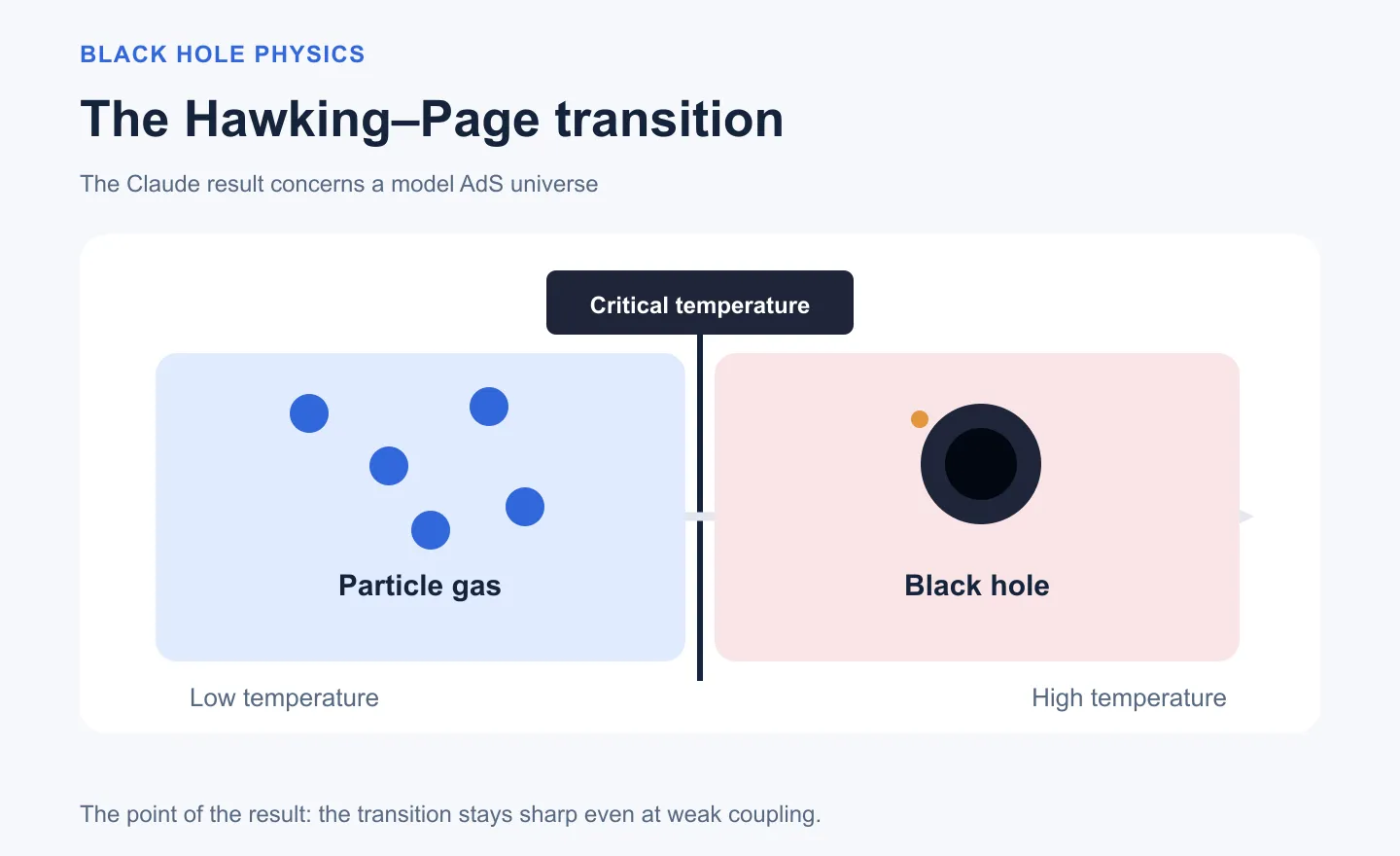
Diagram: the two dominant states of the theoretical system on either side of the critical temperature. The illustration explains the model, not an observation of a real black hole.
Claude carried out the calculation and, according to the preprint, obtained a first-order transition, that is, an abrupt switch between states. So the qualitative picture on the quantum side of holographic duality matched the result previously obtained on the gravitational side in a different regime.
This does not prove that the behaviour is the same for all possible parameters. But it substantially strengthens the link between the two descriptions.
The second problem: how heavy the lightest black hole can be
The second study concerns modular bootstrap, an approach that allows discarding mathematically inconsistent variants of a quantum theory. Researchers set consistency conditions and obtain constraints on the properties of admissible states.
In the simplest variant of a three-dimensional model of gravity, what matters is the central charge c and the mass of the lightest state corresponding to a black hole. Earlier it had been rigorously proved that M₁ ≤ c/8.5. Numerical results suggested it could be improved to roughly c/9.1, but the exact limit remained unknown.
Claude spotted a pattern in the numerical data and used a mathematical tool from another field, the spectral curve. As a result the model obtained an analytical bound M₁ ≤ c/9.1266… and showed that for this simplified variant of bootstrap it is the optimal bound.
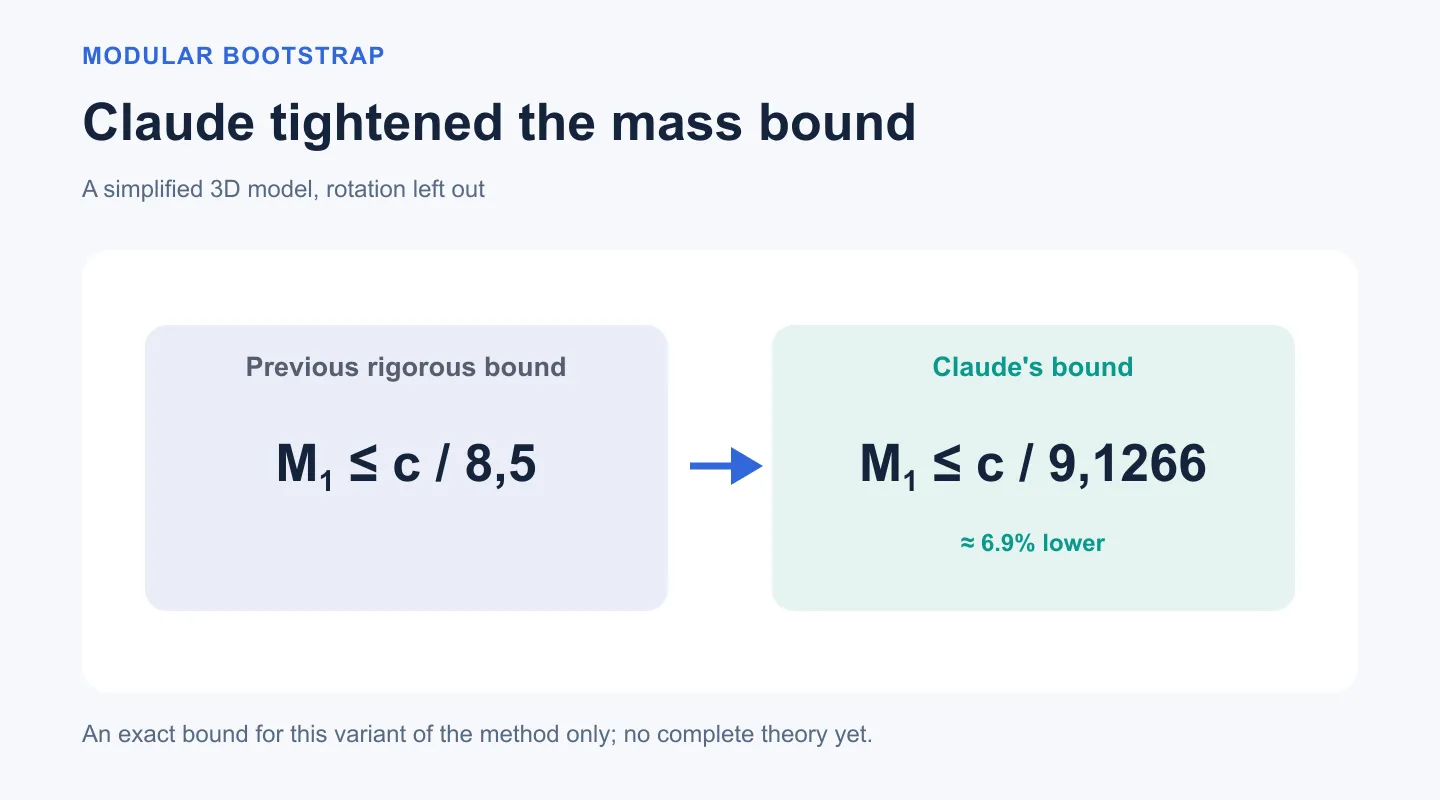
Diagram: the upper mass bound drops by roughly 6.9%. This concerns only the spinless version of the method, with no rotation taken into account.
What matters here is that "optimal" means the limit of a specific set of mathematical conditions. Getting closer to a full theory requires additional constraints and new methods.
How Claude worked on the problems
The story began in August 2026. Anthropic researcher Hongbin Chen asked Claude to suggest interesting open problems in black hole physics. The model put together a list of 22 problems. Separate agentic processes were launched for them, able to read each other's progress messages and exchange ideas. They worked for about six weeks.
When computing the phase transition, important parts of the calculation were performed in parallel and re-checked by independent agents. According to Anthropic, another physicist separately obtained the same result with Claude, but by a different method. That served as an additional check.
In the second problem the agents kept failing at first: one approach made 61 parallel attempts without a solution. The idea came after studying the numerical results and transferring a method from a related mathematical problem. Anthropic reports that in September the results were formally verified in Lean, and a physicist checked the main claims of the study.
How much of a scientific breakthrough this is
The strength of the story is the combination of a long autonomous search, numerical experimentation and formal verification. In the first problem the model completed a calculation far too laborious to do by hand. In the second it proposed transferring a mathematical idea between fields.
At the same time, a Lean check is not equivalent to universal scientific recognition. A formal system confirms that the proof is correct relative to the statements and assumptions encoded in it. The community has yet to study the problem statements, the calculations and the interpretation of the results. Both studies are so far available only as preprints.
The story shows a possible role for AI in science: agentic systems are capable of waiting months without hints at every step, organising parallel checks and looking for unexpected connections between studies. The most significant results are the ones people can independently reproduce and use for further research.