
Baidu has introduced ERNIE 5.5 Flash Preview — a neural network with 280 billion parameters and a context window of up to 1 million tokens, focused on programming, automation, and AI agent operations. In benchmarks, the model demonstrates strong results when working with documents, spreadsheets, and tools, outperforming even Claude Opus 5.5 and GPT-6.1 Sol in specific tests, but significantly trailing them in complex reasoning tasks. Baidu also demonstrated the creation of games, 3D models, and analytical reports using autonomous agents. The main advantage of the new release is the combination of advanced agentic capabilities and relatively low API costs, although its real economic efficiency still requires independent verification.
In a demonstration, the new model built a game in Unreal Engine 5.8 in 11 hours, worked in Blender and FreeCAD, and created multi-page research papers, financial tables, and videos. This does not mean that a single request to the model will automatically replace a developer, engineer, or analyst: the examples were run in agentic environments, using tools and ready-made resources. However, they show which market Baidu is targeting with the new model: autonomous AI agents that manage a project from task setting to final result files.
ERNIE has 280 billion parameters, of which about 14 billion are active per token, a context window of up to one million tokens, and a claimed generation speed of over 200 tokens/s. The model is available through Baidu Qianfan. The developer promises to publish the Preview weights under Apache 2.0; Chinese materials mention a target date of up to November 25, 2026, but as of the date of this article, the weights have not yet been released. [1], [2]
Test Highlights: ERNIE leads among all seven models in Baidu's published table for AutomationBench, SpreadsheetBench V2, and MCP-Atlas. However, on Terminal-Bench-Science, it scored 21.0% compared to 57.0% for GPT-6.1 Sol and 63.3% for Claude Opus 5.5. On AA-Omniscience-Public, the gap is also large: 25.2% versus 52.8% and 62.0%. Therefore, its strength is not universal intelligence, but specific types of work with tools. [1]
How ERNIE 5.5 Flash Preview Differs from the Regular Flash Model
Baidu has released more than just a new version of a chat model. Preview is the first stage of additional training (post-training) based on ERNIE 5.5 Flash Base, which was published earlier. Baidu explicitly calls it an intermediate checkpoint: fine-tuning continues, and some skills may be unstable. [1]
| Parameter | Characteristic |
|---|---|
| Developer | Baidu |
| Announcement Date | November 11, 2026 |
| Architecture | MoE, including multi-router MoE; hybrid sparse attention |
| Parameters | 280 billion total / approx. 14 billion active per token |
| Context | Up to 1 million tokens |
| Available Input | Text; work with other formats via external tools |
| Generation | Over 200 tokens/s according to Baidu; not a guaranteed speed for every request |
| Access | Baidu Qianfan API, model ernie-5.5-flash-preview |
| Status | Preview, additional training not yet complete |
| Open Weights | Announced under Apache 2.0, but not published as of 12.11.2026 |
280 billion is not the same as 280 billion active computational parameters. Thanks to Mixture of Experts, only a portion of the blocks is involved in the generation of each token. This reduces computational costs compared to activating all weights, although the full model still cannot be deployed on hardware designed only for 14 billion parameters.
According to Chinese technical publications, the model uses multi-router MoE, hybrid sparse attention, the ECHO approach for multi-token prediction, and FP4 expert weight optimization. Baidu Qianfan materials specifically mention FP4 and generation acceleration mechanisms. These are technological solutions that explain the claimed efficiency, but independent measurements are needed to verify actual speed and the cost of a successful task. [2], [3]
Why the Focus Shifted to Agentic Systems
According to Baidu, to strengthen programming capabilities, more than 14 million executable code tasks and work trajectories of various agentic frameworks were used. For office and industry-specific tasks, the company prepared 300,000 workspaces, 10 million reference files, and more than 40 document types. Some virtual spaces contained dozens of files, while others contained thousands. [1], [2]
This is an important distinction from training simply to answer questions. An agent must create a plan, call a program, check an intermediate result, notice an error, and fix it. These are the skills Baidu demonstrates in the projects below.
11 Hours in Unreal Engine: The Model Wrote a Game Without Seeing the Screen
The most impressive demonstration is Yunxiu Xing, a third-person wuxia-style game on Unreal Engine 5.8. In a single 11-hour agentic run, ERNIE integrated resources prepared for different generations of Unreal Engine and wrote the game code in C++. The scene used third-party models of the Zhangjiajie mountain landscape and the protagonist. [1]
It is particularly interesting how the model fixed errors. ERNIE 5.5 Flash Preview is a text model; it does not see the game screen image itself. Therefore, testing problems — such as a character hovering above the ground, running direction not matching controls, or incorrect camera placement — were translated into verifiable software conditions. Over several iterations, tests accumulated and game mechanics were modified.
This is much more interesting than typical "AI wrote code based on a prompt": the task involved long-term adjustment of a working project rather than a one-time generation of an answer. At the same time, the published video is a developer demonstration, not a controlled experiment with independent verification.
The second demonstration involves nearly 100 mobile mini-games based on ready-made game design documents. Cocos, Unity, LayaAir, PixiJS, and Canvas 2D were used; 24 projects are shown in the public video. Genres include tower defense, roguelike, racing games, card RPGs, and puzzles. In many cases, rules were separated from visual representation: algorithms checked level reachability and balance.
Where this is applicable: fast game prototypes, checking mechanics, generating auxiliary systems, migrating projects between engine versions. Where caution is needed: code security, the quality of game balance, and the stability of large repositories still require manual verification.
Blender and CAD: AI as an Engineering Process Coordinator
Baidu specifically fine-tuned the model for working with Blender and CAD, including spatial reasoning, procedural modeling, and the reuse of existing assets. [1]
Airport and Airliner. Two ERNIE-based agents used the Blender Python API to build different parts of a project: one for the airport, the second for the airplane. The system located geodata, selected external models and textures, constructed the terminal, runway, fuselage, and interiors, and then synchronized scales and camera angles. Cycles and OptiX were used for rendering, and FFmpeg for assembling the video. This is an example not of "magical 3D-from-text generation," but of tool coordination and sequential scene assembly.
Horyu-ji Temple. Another agent researched the layout of the Japanese temple complex and assembled it in Blender piece by piece: multi-tiered roofs, columns, bridges, gardens, a pond, and materials. External open assets were utilized in the process.
W16 Engine. In FreeCAD, the model created editable geometry for cylinders, the crankshaft, pistons, and connecting rods. The demonstration shows the mechanism's movement as the crankshaft rotates. Two other CAD examples include models of the Baidu building in Shenzhen and a lunar rover with rocker-bogie suspension and folding solar panels.
Crucially, the result consists of files and geometry suitable for further editing, not just a pretty render. At the same time, Baidu does not provide an independent assessment of engineering accuracy, tolerances, or compliance with industrial standards.
Tables, Financial Models, and Research: The Most Practical Scenario
In office tasks, Baidu demonstrates three different types of outputs:
- The AI Power Bill — a 20-slide research presentation on electricity consumption for AI data centers in the US. The model synthesized several groups of public sources, compared cost distribution scenarios, and added charts and calculation methodologies.
- LIFEWEALTH — an Excel file with 10 sheets for personal financial planning. It integrates income, expenses, assets, debts, and retirement scenarios, and uses 1000 random Monte Carlo trajectories to assess the risk of savings shortfalls.
- Driverless, by the Numbers — a 24-page analytical report on Waymo and Tesla FSD. According to Baidu's description, the system processed 4169 federal accident reports, deduplicated them, and compared metrics from different sources.
These are good examples of task setting via the final work artifact: a presentation, a spreadsheet, a report. However, the published examples do not prove that the data and conclusions in every file are error-free. This particularly applies to financial models and vehicle safety analysis.
Possible application scenarios include report preparation, creating tables based on technical specifications, analyzing accounting and legal documents, working with corporate knowledge bases, and regular analytical reviews. Here, the test results for SpreadsheetBench V2, OfficeQA Pro V2, and AutomationBench are especially indicative.
Video, 2D Animation, and Music — Without Native Video Modality
Baidu claims it has prepared over 150,000 virtual creative environments for content creation tasks, covering over a thousand skills and approximately 5300 minutes of finished video. [1]
In The Pelican Test example, the model wrote over 10,000 lines of Python code for a two-minute (116 seconds) animation. The pelican passes through 20 artistic styles, with images built using Pycairo and processed via NumPy/Pillow. External image generators are involved at specific stages.
There is also a popular science video about the physics of a "flying" car, where an agent links the script, voiceover, visual effects, and force diagrams. Baidu also demonstrates an original orchestral composition, Beyond the Event Horizon, with a duration of 6 minutes and 34 seconds, exported as a WAV file.
It is important not to confuse the model's role: ERNIE 5.5 Flash Preview does not become a video generator or multimodal editor in itself. It manages code, programs, and specialized generators. This is a possible architecture for a future creative assistant, but the cost and quality of the entire process depend on the connected tools.
How ERNIE Compares to Expensive Flagships: Six Visual Comparisons
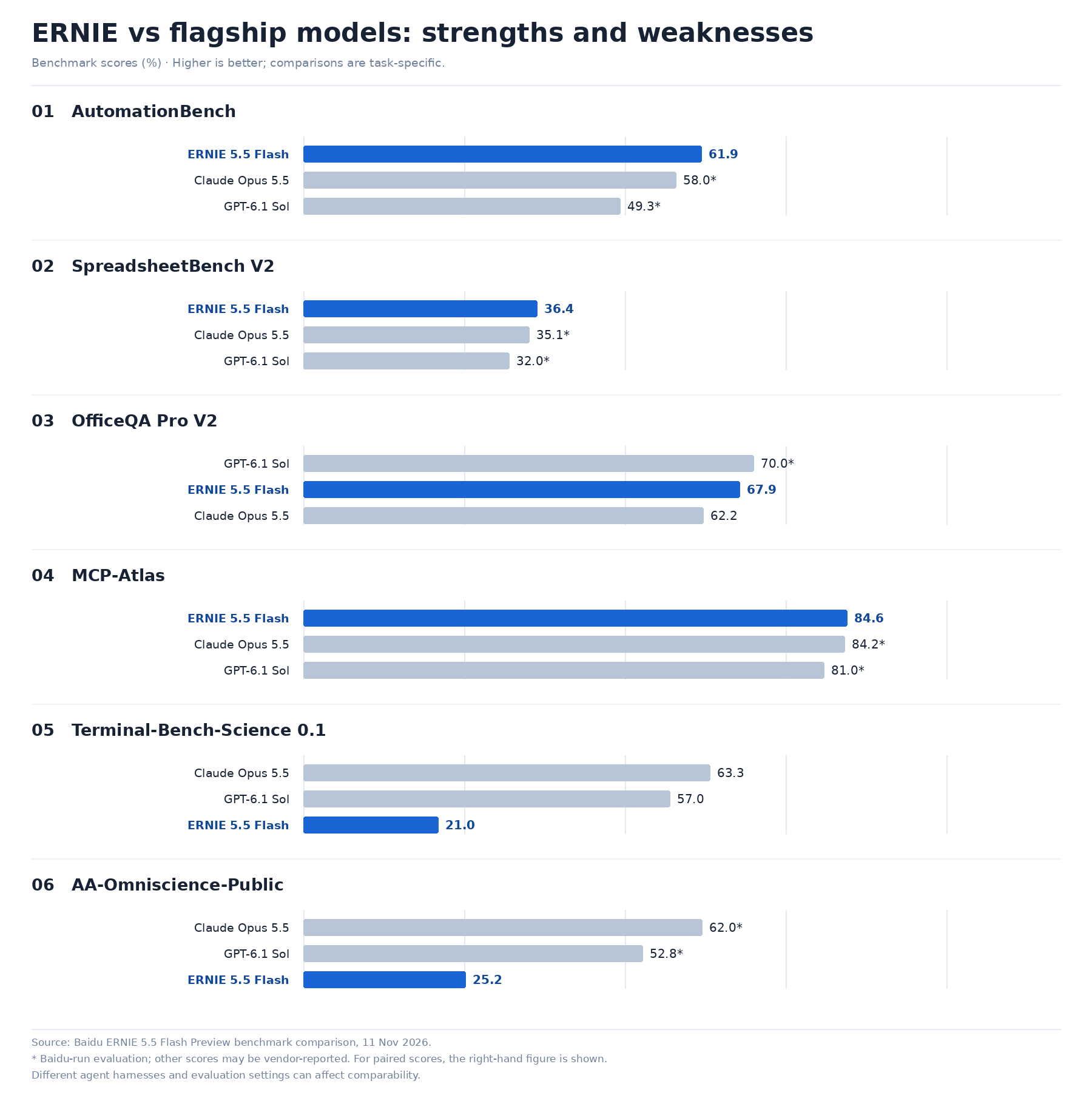
The diagram reveals two contrasting pictures. In applied automation, ERNIE looks unexpectedly strong: 61.9 on AutomationBench, 36.4 on SpreadsheetBench V2, 84.6 on MCP-Atlas — higher than the results of both flagship models in Baidu's published table. On OfficeQA, it trails GPT-6.1 Sol (67.9 vs. 70.0) but outperforms Opus 5.5 (62.2).
Conversely, on Terminal-Bench-Science, ERNIE scores 21.0, while GPT-6.1 Sol and Opus 5.5 score 57.0 and 63.3. On AA-Omniscience-Public, the gap is even more pronounced: 25.2 vs. 52.8 and 62.0. These are tests where depth of reasoning and handling complex constraints are vital. Consequently, ERNIE cannot be considered a universal substitute for flagships, especially for the most difficult research and scientific-technical tasks.
Disclaimer: values with an asterisk denote measurements performed by Baidu, not independent verification. Different models may have used different agentic wrappers, and in some tests, the developer compared results from their own runs with results from external reports.
Programming: Strong on Terminal Tasks, Weaker in Code Fixing
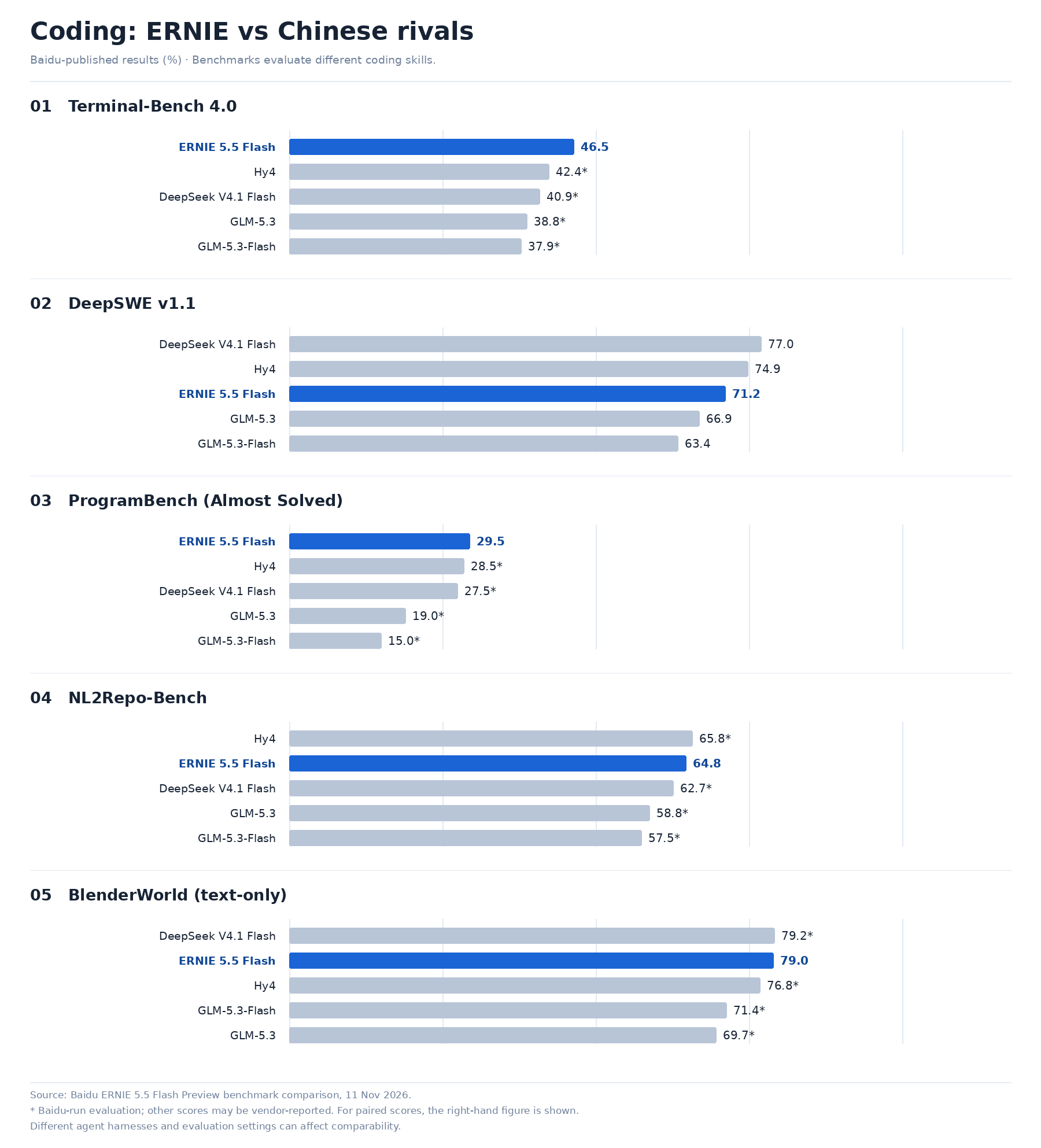
In comparison with Hy4, DeepSeek V4.1 Flash 1017, GLM-5.3 Flash, and GLM-5.3, the new model shows 46.5% on Terminal-Bench 4.0, higher than the four listed competitors according to the values used in Baidu's comparison. On ProgramBench, it scores 29.5%, also slightly better than its closest rivals. On Terminal-Bench-Science, its 21.0% is higher than other Flash models but significantly lower than the flagships.
However, DeepSWE v1.1 clearly delimits this success: ERNIE scores 71.2%, DeepSeek 77.0%, Hy4 74.9%, and GPT-6.1 Sol 75.2%. This test is specifically important for fixing existing software projects. On NL2Repo, ERNIE scores 64.8, slightly below Hy4 (65.8) and above DeepSeek in Baidu's own test (62.7).
Conclusion: ERNIE is worth trying for terminal actions, generating game prototypes, and assembling individual components; for working with existing repositories, DeepSeek and Hy4 remain strong contenders. The game demo does not disprove the DeepSWE result: one successful long run and stability across a massive set of tasks are different things.
Documents and Office Automation: This is where ERNIE truly stands out
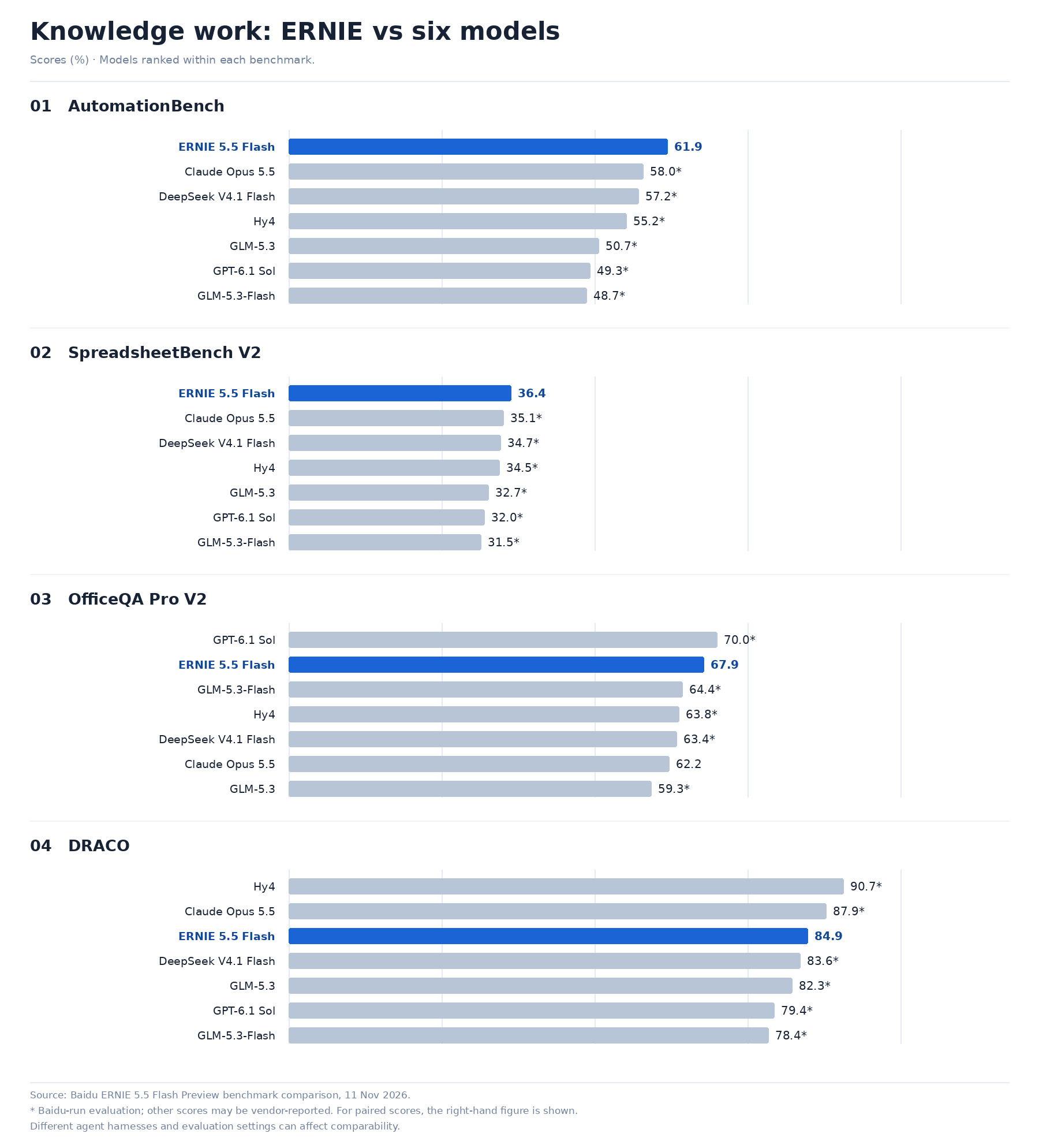
In AutomationBench, ERNIE scores 61.9, Opus 5.5 — 58.0, DeepSeek — 57.2, and Hy4 — 55.2. In SpreadsheetBench V2, the model leads with 36.4 against 35.1 for Opus. In OfficeQA Pro V2, GPT-6.1 Sol leads with 70.0, while ERNIE takes the next position with 67.9.
Another office test, DRACO, shows the flip side: Hy4 is higher here (90.7), Opus is also ahead (87.9), and ERNIE scores 84.9. This means "strong in documents" should not be turned into the claim "best at solving any office task." Benchmarks measure different components of work.
Agentic Benchmarks: Much depends on the tooling
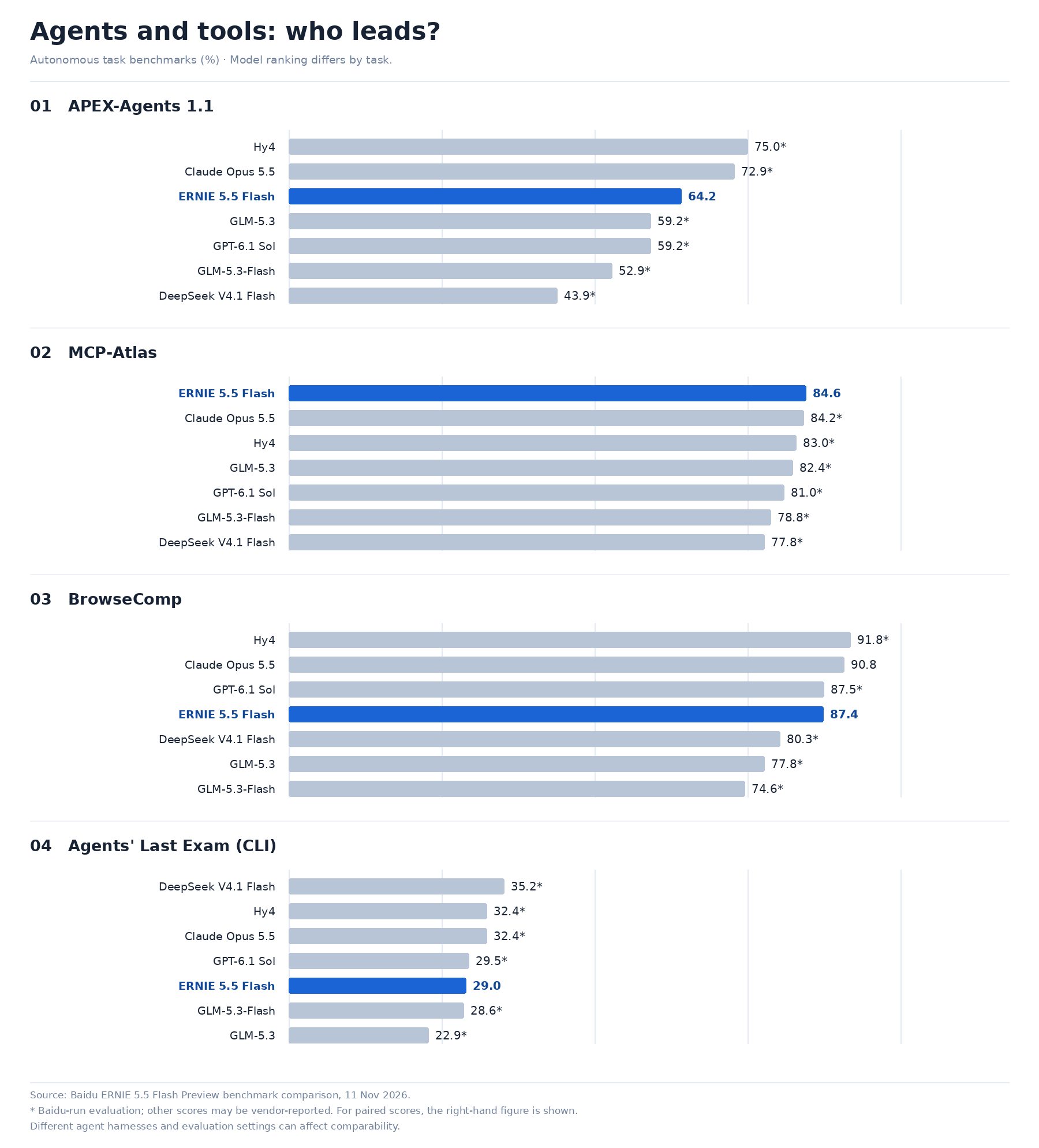
In MCP-Atlas, ERNIE with 84.6 outperforms Opus (84.2) and Hy4 (83.0). This is a positive signal for systems where an agent interacts with external programs via MCP.
But on APEX-Agents 1.1, Hy4 is significantly ahead (75.0 vs. 64.2 for ERNIE), and on BrowseComp, Hy4 also leads (91.8 vs. 87.4). In Agents’ Last Exam (CLI), DeepSeek gets 35.2 against ERNIE's 29.0.
Furthermore, in APEX-Agents, some models were evaluated by replacing visual observations with text descriptions; in other tests, different versions of Claude Code and Codex were used. This is not a fully standardized "seven models under identical conditions" tournament, so the results should be considered guideposts rather than a definitive ranking.
Reasoning: An impressive contrast with the flagships
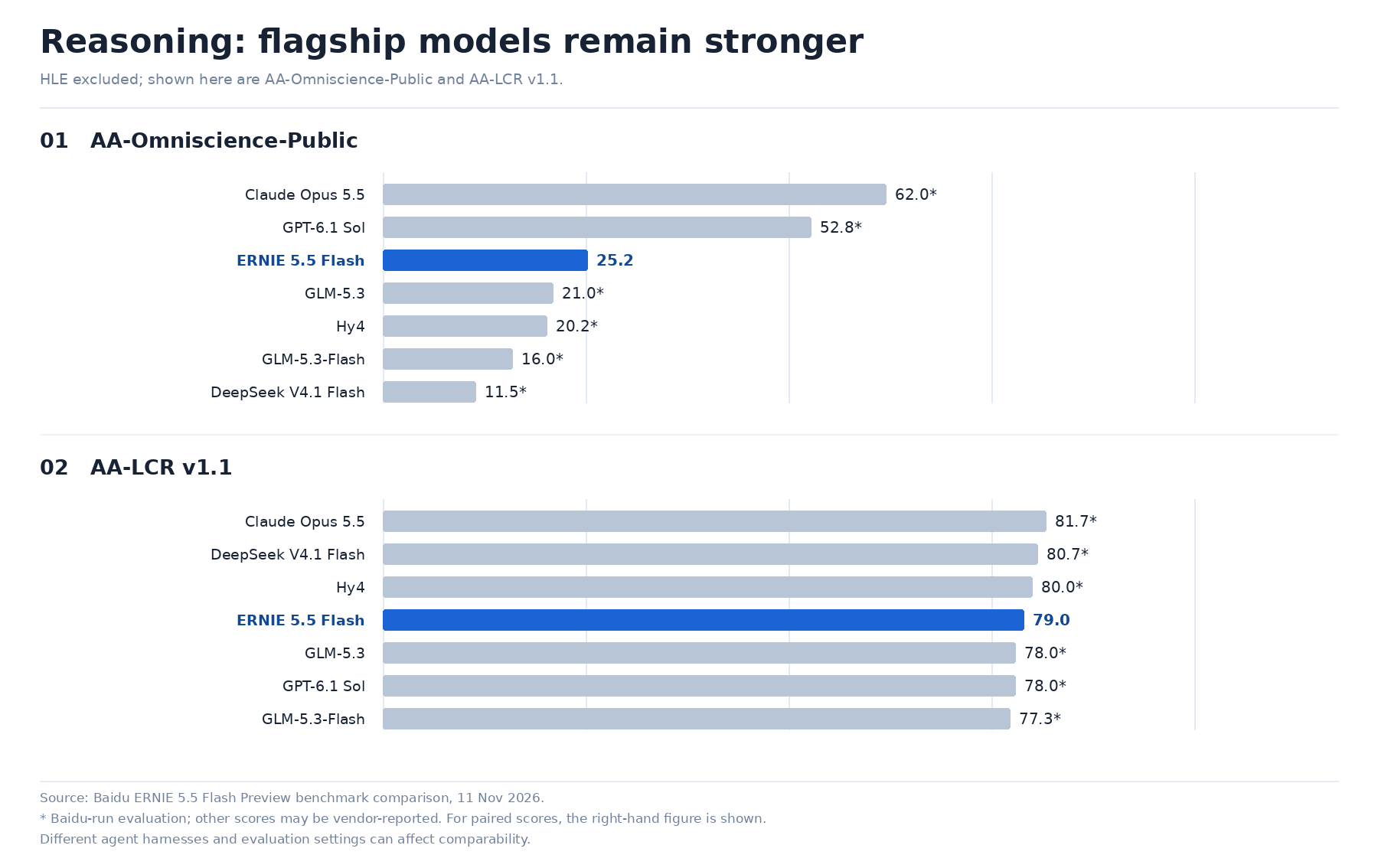
On AA-Omniscience-Public, ERNIE outperforms the three closest Flash models but trails Claude Opus 5.5 by more than double according to the published score. ERNIE's AA-LCR v1.1 score is 79.0; here the flagships are closer, and the competitors' results are presented through both public assessments and Baidu’s measurements.
In the HLE (without tools) row, some results are marked with the † symbol, signifying a text-only subsample. Mixing these with scores from the full HLE sample and ranking them as a single test is incorrect. Therefore, HLE is preserved in full in the table but has not been turned into a misleading comparative graph.
Baidu's Full Table: 20 Tests and 7 Models
This is not a reduced sample. All rows and numerical values are reproduced from the official app screenshot; *, †, and pairs like 44.4 / 42.4* are preserved.
Notation: * — Baidu's own measurement; no mark — figure from the model developer's report or a public ranking; † — HLE text sub-sample. In pairs separated by /, the left figure is from an external report, and the right is Baidu's re-measurement result. All models were tested with the maximum available reasoning level, but frameworks and test conditions did not match in all cases.
| Benchmark | ERNIE | Hy4 | DeepSeek V4.1 Flash | GLM-5.3 Flash | GLM-5.3 | GPT-6.1 Sol | Claude Opus 5.5 |
|---|---|---|---|---|---|---|---|
| AGENTIC PROGRAMMING | |||||||
| Terminal-Bench 4.0 | 46.5 | 44.4 / 42.4* | 42.3 / 40.9* | 35.8 / 37.9* | 41.8 / 38.8* | 56.1 | 66.4 / 63.6* |
| DeepSWE v1.1 | 71.2 | 74.9 | 77.0 | 63.4 | 66.9 | 75.2 | 74.2 |
| ProgramBench (Almost Solved) | 29.5 | 30.0 / 28.5* | 29.1 / 27.5* | 15.0* | 19.0 / 19.0* | — | 65.0 |
| NL2Repo-Bench | 64.8 | 65.8* | 68.1 / 62.7* | 56.3 / 57.5* | 58.0 / 58.8* | — | — |
| Terminal-Bench-Science 0.1 | 21.0 | 19.8 / 17.1* | 15.7 / 14.3* | 5.7* | 8.1 | 57.0 | 63.3 |
| CookieBench | 88.2 | 88.8* | 87.9* | 76.9* | 80.4* | 89.7* | 91.5* |
| BlenderWorld (text-only) | 79.0 | 76.8* | 79.2* | 71.4* | 69.7* | 85.3* | 86.1* |
| DOCUMENT WORKFLOWS | |||||||
| AutomationBench | 61.9 | 56.2 / 55.2* | 60.5 / 57.2* | 48.8 / 48.7* | 48.2 / 50.7* | 49.3* | 58.0* |
| APEX-Agents 1.1 | 64.2 | 77.6 / 75.0* | 69.8 / 43.9* | 52.8 / 52.9* | 56.6 / 59.2* | 60.0 / 59.2* | 73.5 / 72.9* |
| DRACO | 84.9 | 90.7* | 83.6* | 78.4* | 82.3* | 79.4* | 87.4 / 87.9* |
| SpreadsheetBench V2 | 36.4 | 34.5* | 34.7* | 31.5* | 32.7* | 32.0* | 35.1* |
| OfficeQA Pro V2 | 67.9 | 63.8* | 63.4* | 64.4* | 59.3* | 70.0* | 62.2 |
| GENERAL AGENTIC TASKS | |||||||
| Agents' Last Exam (CLI) | 29.0 | 32.4* | 35.2* | 28.6* | 22.9* | 29.5* | 34.3 / 32.4* |
| SkillsBench 1.1 (text-only) | 73.5 | 77.4* | 67.5* | 65.4* | 62.0* | 72.6* | 71.8* |
| Toolathlon-Verified | 75.0 | 73.1* | 71.2* | 78.5 / 76.8* | 73.0 / 72.2* | 67.8* | 80.1* |
| MCP-Atlas | 84.6 | 83.0* | 77.8* | 78.8* | 82.4* | 81.0* | 84.2* |
| BrowseComp | 87.4 | 91.8* | 80.3* | 74.6* | 77.8* | 87.5* | 90.8 |
| REASONING | |||||||
| HLE (w/o tools) | 46.4† | 46.7*† | 44.0† | 39.9 | 42.0† | 52.9 | 61.4 |
| AA-Omniscience-Public | 25.2 | 20.2* | 11.5* | 16.0* | 21.0* | 52.8* | 62.0* |
| AA-LCR v1.1 | 79.0 | 80.0* | 82.7 / 80.7* | 77.3* | 79.7 / 78.0* | 83.0 / 78.0* | 84.7 / 81.7* |
Original Baidu table (PNG): full source screenshot. It also contains explanations for each test, including environment versions, evaluation methods, and tool usage specifics.
Important technical caveats from the original application
This is not a single testbed for all rows: different runner systems, step limits, and judge models were used. Below are all 20 of Baidu's methodological explanations briefly preserved in the order of the table.
- Terminal-Bench 4.0: GPT-6.1 Sol score is taken from Artificial Analysis; other models were tested with Claude Code 2.1.246.
- DeepSWE v1.1: mini-swe-agent 2.4.6 with anti-manipulation rules; sandbox with 8 CPUs and 16 GB of memory.
- ProgramBench: Almost Solved version used; agentic environment Claude Code 2.1.246, though environments from other models' own reports were sometimes used for them.
- NL2Repo: Claude Code 2.1.226; suspicious tool calls were blocked by rules and an LLM judge.
- Terminal-Bench-Science 0.1: Claude Code 2.1.246.
- CookieBench: 1000 React tasks, Cookie scaffold (13 tools, maximum 80 steps), official verification module, and Qwen3.8-Max evaluation.
- BlenderWorld: only 78 text-based tasks; Blender 4.2.10, up to 24 hours per task, Claude Code 2.1.220 and Qwen3.8-Max as judge. For text-only models, images were described by an external tool using Claude Opus 5.5.
- AutomationBench: open sub-sample of version 1.0.6, official testbed with default settings.
- APEX-Agents 1.1: maximum 100 steps and 10,800 seconds per agent; for text-only models, visual results were replaced with text placeholders. DeepSeek scored 43.9 with a 100-step limit, but 71.7 when the limit was relaxed to 500 steps; thus, configuration significantly affects the score.
- DRACO: GPT models were run in Codex 0.162.1, others in Claude Code 2.1.296; maximum 4 hours and 1000 agent steps, Claude Opus 5 served as the judge.
- SpreadsheetBench V2: Codex was used for GPT, DSH for DeepSeek, and Claude Code 2.1.138 for others; web search disabled, visualization evaluation via Qwen3.8-Max.
- OfficeQA Pro V2: similar differing agentic environments; web search disabled, WebFetch restricted to allowed domains; Opus score taken from Kimi K3.1 Pro report.
- Agents' Last Exam (CLI): CLI sub-sample only, 5 hours per task; GPT in Codex, Opus and other models in various versions of Claude Code.
- SkillsBench 1.1: 78 text tasks excluding 9 multimodal ones, up to 6 hours per task; different execution environments used for GPT and others.
- Toolathlon-Verified: maximum 200 steps and 7,200 seconds, protection against searching for answers on GitHub and escaping the container.
- MCP-Atlas: public sample from the official release, 500 tasks, standard settings.
- BrowseComp: different environments for GPT, DeepSeek, and others; up to 4 hours and 1000 steps, judge — DeepSeek V4.1 Flash 1017.
- HLE:
†denotes the text-only sub-sample, judge Gemini 3.1 Flash-Lite. Comparison with full-sample scores is limited. - AA-Omniscience-Public: public sample of 600 tasks, judge Gemini 3.1 Flash-Lite.
- AA-LCR v1.1: judge DeepSeek V4 Flash.
Why you shouldn't mechanically average all 20 benchmarks
Some tests evaluate programming, others web search, others spreadsheets or scientific reasoning. Their complexity and scales vary, and some values for competitors were not obtained under identical conditions. You cannot simply add up all 20 percentages to obtain a proven "intelligence index." A summary ranking would require normalization across tests, pre-defined weights, control over identical tools, and independent runs.
Even without a single index, the table provides a clear picture. ERNIE takes first place among the listed models on AutomationBench, SpreadsheetBench V2, and MCP-Atlas. At the same time, DeepSeek is stronger on DeepSWE, Hy4 on APEX-Agents and BrowseComp, and flagship GPT and Claude models lead in complex scientific reasoning.
How Much Does ERNIE Cost: Official Baidu Rates in Yuan and Dollars
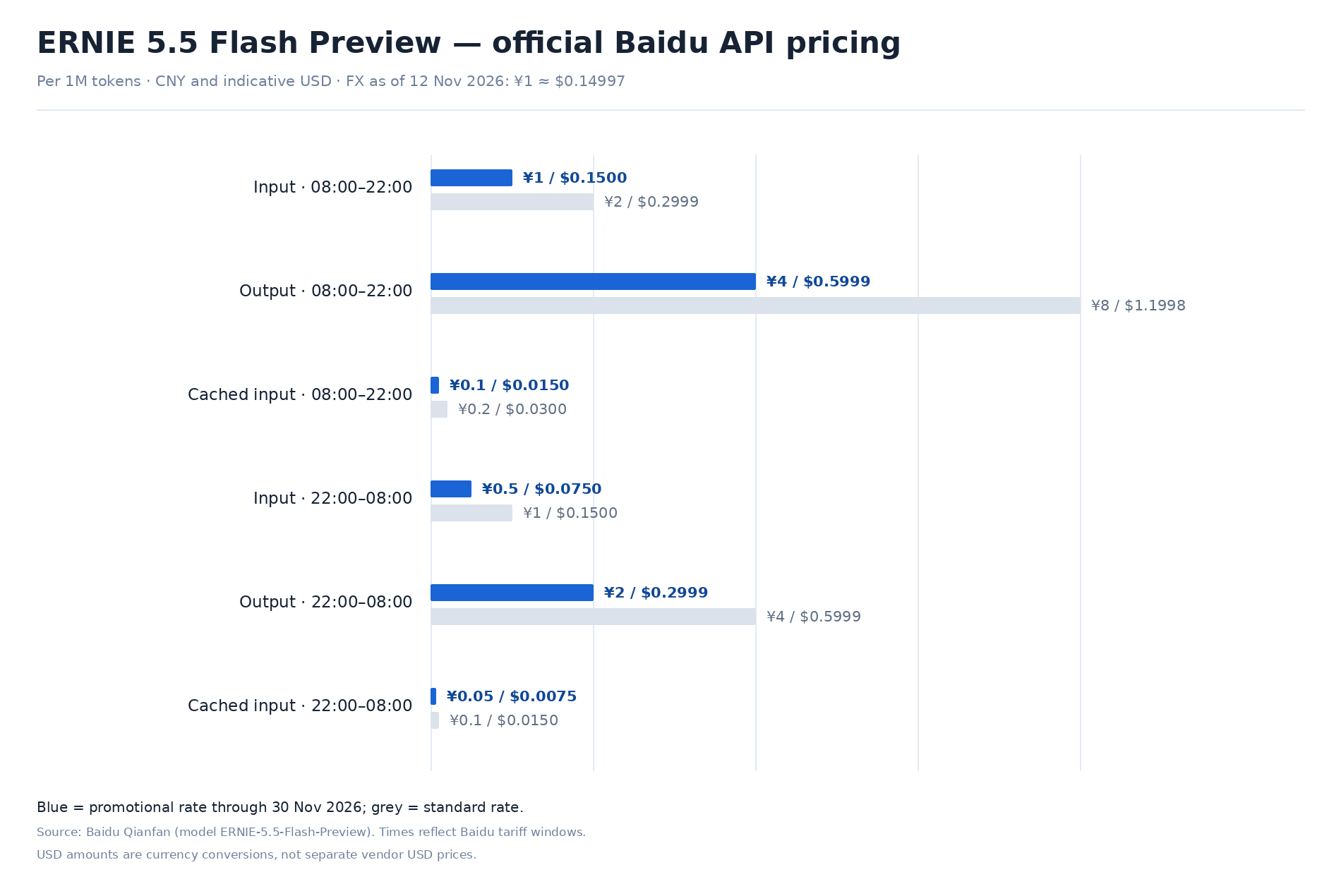
Baidu Qianfan specifies promotional and standard prices per million tokens, separately for daytime (08:00–22:00) and nighttime (22:00–08:00) hours. As of the publication date, a 50% discount promotion is in effect; the time zone is not explicitly labeled in the rate table itself. Therefore, you should not automatically convert the hours to Moscow or European time. [4]
| Tokens | Promotion, day | Promotion, night | Regular rate, day | Regular rate, night |
|---|---|---|---|---|
| Input | ¥1 / $0.150 | ¥0.50 / $0.075 | ¥2 / $0.300 | ¥1 / $0.150 |
| Output | ¥4 / $0.600 | ¥2 / $0.300 | ¥8 / $1.200 | ¥4 / $0.600 |
| Cache hit | ¥0.10 / $0.015 | ¥0.05 / $0.0075 | ¥0.20 / $0.030 | ¥0.10 / $0.015 |
Exchange Rate: November 12, 2026, approximately ¥1 = $0.14997. The dollar values are an approximate currency conversion, not a separate dollar-denominated tariff from Baidu. [5]
For example, a single agent run that consumed 200,000 new input tokens and 50,000 output tokens would cost ¥0.40 ≈ $0.060 at the promotional daytime rate (0.2 × ¥1 + 0.05 × ¥4). At the nighttime rate, it would be ¥0.20 ≈ $0.030. This calculation does not include additional tools, rendering, re-runs, or other costs.
The promotion may end, and rates are subject to change.
How Much ERNIE 5.5 Flash Preview Costs Compared to DeepSeek and GLM
Price snapshot: November 12, 2026. API rates are compared directly from the developers — Baidu Qianfan, DeepSeek, and Z.ai. All amounts are specified per 1 million tokens. Conversion at the rate of $1 = ¥6.67035 on 11/12/2026; amounts in parentheses are approximate.
| Model and Rate | Input Tokens | Input from Cache | Output Tokens |
|---|---|---|---|
| ERNIE 5.5 Flash Preview, promotion, peak hours | ¥1 ($0.150) | ¥0.10 ($0.015) | ¥4 ($0.600) |
| ERNIE 5.5 Flash Preview, promotion, off-peak | ¥0.50 ($0.075) | ¥0.05 ($0.0075) | ¥2 ($0.300) |
| DeepSeek V4.1 Flash 1017, peak hours | $0.300 (¥2.00) | $0.006 (¥0.04) | $1.200 (¥8.00) |
| DeepSeek V4.1 Flash 1017, off-peak | $0.150 (¥1.00) | $0.003 (¥0.02) | $0.600 (¥4.00) |
| GLM-5.3-Flash | $0.150 (¥1.00) | $0.030 (¥0.20) | $0.500 (¥3.34) |
| GLM-5.3 (more expensive model from the benchmark table) | $1.400 (¥9.34) | $0.260 (¥1.73) | $4.400 (¥29.35) |
Conditions: Baidu is providing a 50% discount until November 30, 2026, 23:59:59 China time; peak hours are 08:00–22:00 (Beijing). After the promotion, ERNIE's peak rates will be ¥2 / ¥0.20 / ¥8 per 1 million regular input / cached input / output tokens; off-peak will be ¥1 / ¥0.10 / ¥4. For DeepSeek, peak hours are 01:00–04:00 and 06:00–10:00 UTC on weekdays, excluding Chinese public holidays; off-peak rates apply at other times. Z.ai does not differentiate between day and night rates for the listed models.
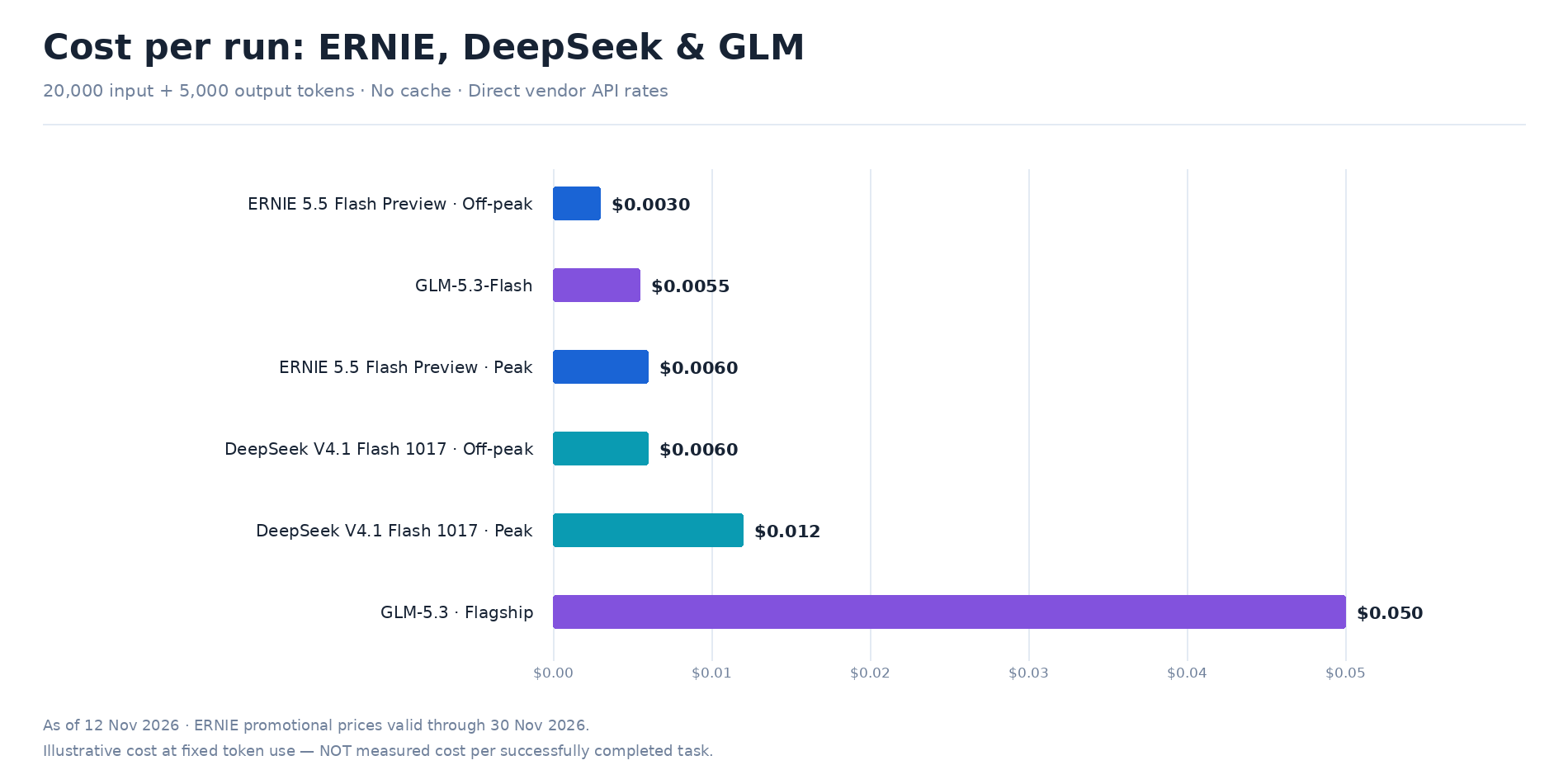
| Model and Mode | Estimated cost of a single run |
|---|---|
| ERNIE 5.5 Flash Preview, off-peak, promotion | $0.0030 |
| GLM-5.3-Flash | $0.0055 |
| ERNIE 5.5 Flash Preview, peak hours, promotion | $0.0060 |
| DeepSeek V4.1 Flash 1017, off-peak | $0.0060 |
| DeepSeek V4.1 Flash 1017, peak hours | $0.0120 |
| GLM-5.3 | $0.0500 |
Conclusion. During the promotion, Baidu ERNIE turns out to be cheaper than DeepSeek V4.1 Flash 1017 given the same consumption of non-cached tokens and comparing the respective tariff periods. At the same time, DeepSeek has significantly cheaper cached input, and GLM-5.3-Flash is cheaper than ERNIE for output tokens during peak hours. Once the discount ends, ERNIE's price advantage over DeepSeek for non-cached tokens will disappear.
Important: this chart compares the cost of a single run with fixed consumption, rather than the actual cost of successfully solving a task. In agentic scenarios, models may differ in token consumption, the number of tool calls, and retries. To compare economic efficiency:
There is currently no comparable independent study that puts ERNIE 5.5 Flash Preview and its direct competitors in identical agentic conditions and evaluates the cost of successful task completion.
Where the New Model Can Actually Find Application
| Task | Potential Assessment | Why |
|---|---|---|
| Reports, tables, presentation prep | High — worth testing first | Strong AutomationBench and SpreadsheetBench; relevant demonstrations with ready-made files |
| Agents managing MCP tools | High | Leadership on MCP-Atlas, experience with long tool chains |
| Game prototyping | High for experiments | Unreal Engine, nearly 100 mini-games, specialized training tasks |
| Procedural 3D and CAD | Promising, requires engineering verification | Blender Python API, FreeCAD, spatial operations, and editable projects |
| Support for large codebases | Compare with DeepSeek and Hy4 | Competitors score higher on DeepSWE |
| Complex math and scientific tasks | Not a primary strength | Significant lag behind GPT-6.1 Sol and Claude Opus 5.5 in scientific tests |
| Video production and animation | As an agent-orchestrator | Manages code and generators rather than generating video footage with its own video modality |
What Is Still Unknown and What to Watch Out For
- No independent comprehensive comparison. The tests published by Baidu are useful, but they are data from an interested party.
- Preview is not a finished model. Baidu explicitly warns about potential fine-tuning shortcomings.
- The text model may use visual assistants. When it builds a 3D scene or a clip, visual perception may be provided by a separate tool rather than ERNIE itself.
- One million tokens is a limit, not a guarantee of perfect memory. For long documents, accuracy in search, citations, and fact aggregation still needs to be evaluated.
- Weights have not yet been published. Statements about Apache 2.0 and the scheduled date should be confirmed by the actual release of the repository and license.
- Official speed of 200+ tokens/s is a developer claim. Real latency and performance need to be measured under your own load.
Conclusion: Baidu is trying to make the Flash model a performer, not just a conversationalist
The main intrigue of ERNIE 5.5 Flash Preview is not so much the 280 billion parameters or the low token price, but rather the focus on autonomous workflows. The model is intended to write and test code, control Blender/FreeCAD, compile reports and spreadsheets, coordinate creative tools, and bring tasks to a final file result.
Baidu's published benchmarks partially confirm this specialization: ERNIE shows strong results in automation, spreadsheets, and MCP tools, sometimes even surpassing the performance of expensive flagships. At the same time, it lags significantly behind flagships in a number of complex scientific and intellectual tests and loses to some Flash competitors in code correction or search agents.
Therefore, the new release is most interesting as a candidate for cheap, long-lived agents, rather than as the "smartest Chinese neural network." The next important stage will be the publication of weights, independent testing, and measuring the cost of successfully completed work in real-world projects.
Sources and Methodology
- Baidu, 11.11.2026. Official announcement of ERNIE 5.5 Flash Preview — architecture, demonstrations, the full table of 20 benchmarks, and methodological notes.
- Baidu Intelligent Cloud. Official ERNIE 5.5 Flash Preview product page — training data, context, speed, scenarios, and release parameters.
- IT Home, 11.11.2026. Description of hybrid sparse attention, multi-router MoE, ECHO, and ERNIE Evolve technologies. Technical details not provided in the public English-language note are attributed to the source.
- Baidu Qianfan, official documentation. Model inference rates — prices in yuan per thousand tokens, converted in the article to per million.
- Twelve Data. CNY/USD exchange rate as of 11.12.2026 — ¥1 ≈ $0.14997.
- Van Data Team. Monitoring of external ERNIE benchmarks — lack of independent assessments at the time of article preparation; developer data is separated from external measurements.
Regarding the source figures: in the official table, an asterisk denotes measurements taken by Baidu itself; † indicates a limited text-only HLE sample. Where two numbers were provided, we kept both in the table, while the charts display the right-hand value measured by Baidu, marked with *. This does not make all results fully comparable: differences in agent frameworks, prompts, execution environments, and judges remain.