

Google has expanded the capabilities of Ask Maps: the AI assistant inside Google Maps can now build multi-day itineraries, divide journeys across individual days, pin stops on the map, and adjust plans mid-trip. Instead of manually searching through dozens of places, travelers can describe their desired trip in everyday natural language. The service draws on Google Maps data regarding businesses, routes, and live traffic. The update is rolling out gradually, with several advanced capabilities currently limited to the United States.
On November 16, Google announced new Ask Maps capabilities on Android and iOS. A key example from the announcement is a three-day coastal driving journey featuring scenic walks and seaside dining. The AI is designed to organize a day-by-day schedule, select stops, plot numbered waypoints across the map, and deliver tailored recommendations for each location. Completed itineraries can be shared with travel companions or exported to Google Docs on desktop devices. [1]
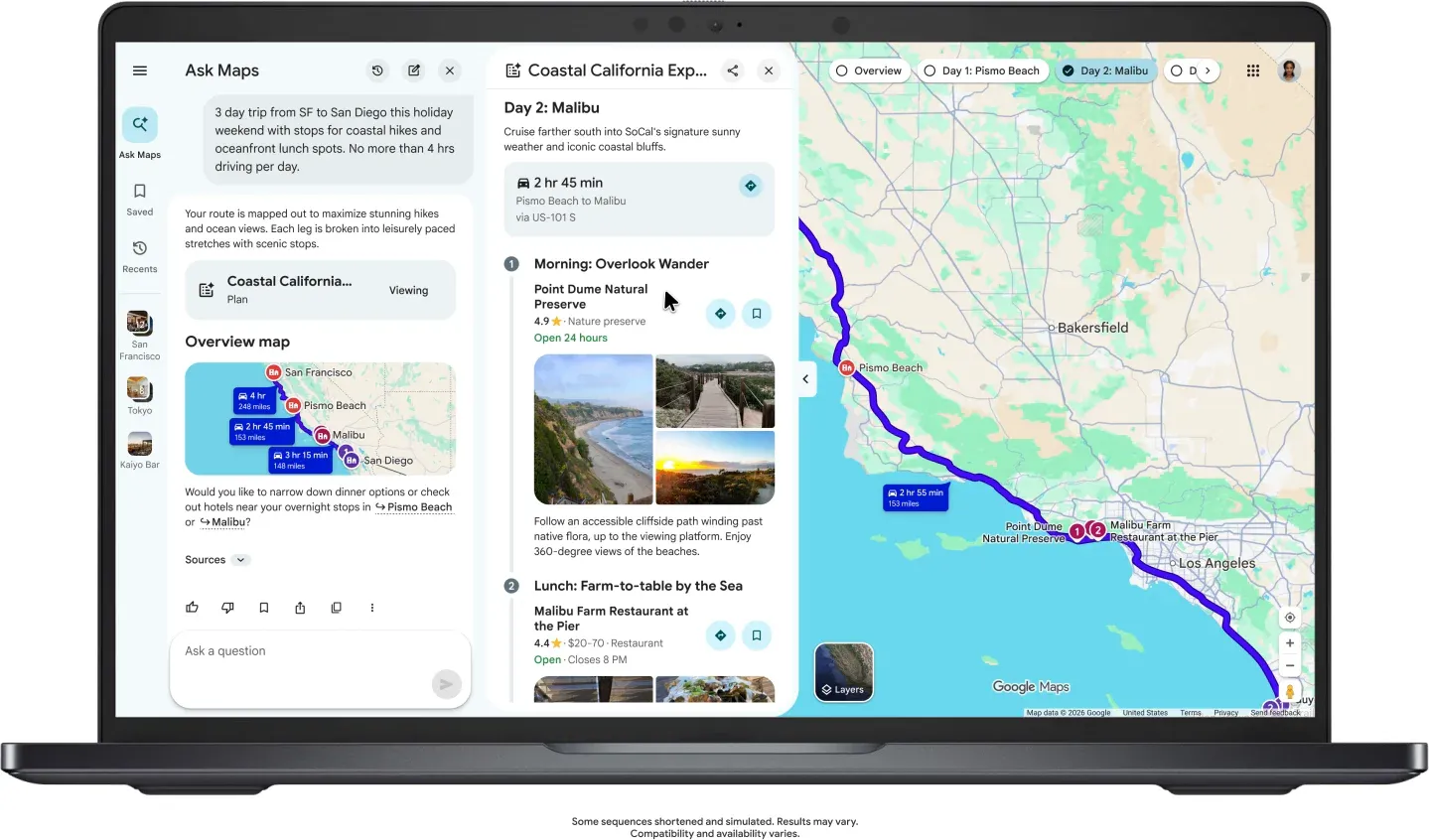
Ask Maps builds multi-day itineraries and shows stops on the map. Source: Google
What Changed in Google Maps
Ask Maps was initially introduced in March 2026 as a conversational interface for Google Maps powered by Gemini. It allowed users to ask compound questions—such as finding venues matching several complex criteria—without manually cycling through filters. In August, Google expanded its geographic availability and connected the service with select personal context when enabled. The November update shifts focus toward treating an itinerary as an actionable, sequential plan that continues to guide users throughout their journey. [2][3]
Rather than presenting an unorganized list of attractions, Ask Maps creates a structured travel plan:
- Day-by-day schedules. Multiple destinations are combined into a cohesive route, with stops organized across consecutive days.
- Direct map integration. Every stop receives a numbered pin on the map, making it easy to visualize the trip's geographic flow.
- Real-time information. Travelers can check current traffic, operating hours, and live conditions before arriving at their next destination.
- Conversational refinements. Users can add a lunch spot, scenic viewpoint, or detour without having to rebuild the itinerary from scratch.
- Itinerary sharing. Routes can be shared directly with friends and family, or exported to Google Docs on desktop. [1]
Importantly, itinerary creation and turn-by-turn navigation remain complementary but distinct workflows. Ask Maps suggests where to travel and in what order, while Google Maps' standard navigation engine handles route guidance for each specific segment.
How It Works in Practice
Consider a traveler planning a three-day coastal road trip who prefers not to pre-book every single stop and cafe manually. They can query Ask Maps with a request like this:
"Create a three-day scenic coastal drive. I want short walks with ocean views, local seafood spots, and no more than three hours of driving per day. Take business hours into account and suggest a sensible sequence of stops."
In response, Ask Maps presents a day-by-day progression with numbered map pins. From there, the user can refine the plan—mentioning they are traveling with a young child, requesting EV charging stops, or swapping an outdoor hike for an art museum during rainy weather. According to Google's vision, a traveler can open their saved plan on the day of departure, review live traffic, and launch navigation directly to the first destination. [1]
This dynamic adjustment is particularly valuable as real-world circumstances shift. A closed restaurant, unexpected rain, or highway congestion would traditionally require manual research and rescheduling. The conversational interface lets travelers accommodate changes with a single prompt.
What Real-Time Data Actually Delivers
Google Maps' primary advantage over a standalone AI chat generator is its foundational mapping infrastructure. The platform maintains an extensive database of venues, reviews, street data, navigation networks, and live traffic telemetry. Google reports that Maps encompasses information on more than 300 million places and leverages contributions from a community of over 500 million contributors. These metrics reflect the broader platform rather than an independent benchmark of the new feature. [2][4]
During a trip, Ask Maps highlights traffic conditions and verifies whether a destination is currently open. The announcement also notes concise summaries of a venue's vibe based on available user feedback. In addition, Google introduced a Know before you go module providing information on parking availability, EV chargers, weather forecasts, toll roads, and expected delays. However, itinerary insights for this module are initially launching in the United States. [1]
It is worth distinguishing live telemetry from user-generated business descriptions. While traffic signals update continuously, details regarding venue atmosphere or specific amenities rely on business profiles and reviews that may not always be up to date. The phrase "real-time data" does not guarantee that every detail was independently verified the moment the prompt was processed.
Ask Maps Now Assists with Appointment Bookings
Alongside trip planning, Google previewed additional agentic capabilities. Users can ask Ask Maps to find appointment openings for specific services, such as hair salons, auto repair shops, or pet grooming. The system is designed to search for open slots across online scheduling platforms and, in supported scenarios, place automated phone calls to merchants to confirm availability. It then surfaces suitable options for the user to review. [1]
This extends the Maps service model: where Google Maps previously helped discover businesses and navigate to them, it now participates in initiating customer contact. However, the announcement does not imply that Ask Maps can autonomously book or pay for services without explicit user confirmation.
Another feature enables semantic search within personal saved lists. For example, instead of scrolling through dozens of saved spots, a user can ask which saved restaurants can seat five people within the next thirty minutes. This merges saved preferences with real-time merchant availability. [1]
Where the Feature Is Available
Rollout began on November 16, 2026 across Google Maps apps on Android and iOS. Google announced the expansion of Ask Maps to more than 30 European countries, including the United Kingdom, Germany, and Spain. Overall, the company states Ask Maps is accessible across more than 200 countries and territories. [1][4]
However, the new capabilities are launching on different schedules:
| Feature | Stated launch availability |
|---|---|
| Multi-day trip itinerary planning | Wherever Ask Maps is available; phased rollout |
| Searching within saved lists | Wherever Ask Maps is available; phased rollout |
| Know before you go insights | United States first |
| Booking search and merchant calls | United States first |
Availability varies by region and supported languages. The availability of Google Maps in a specific country does not guarantee immediate access to Ask Maps on every individual account.
How Ask Maps Compares with ChatGPT and Gemini
General-purpose large language models can already draft travel itineraries, suggest attractions, and divide visits across multiple days. However, itinerary quality depends on connected data sources, access to live local information, and how effectively the model validates factual claims.
| Capability | Ask Maps | General-purpose AI chat |
|---|---|---|
| Generate travel ideas | Yes | Yes |
| Plot stops natively on a map | Built directly into Maps | Depends on specific client and plugins |
| Check traffic and launch turn-by-turn navigation | Native Maps infrastructure | Requires external mapping apps |
| Account for user context | Conversational prompts and Maps data | Conversational prompts, memory, or extensions |
| Adjust plans on the road | Inside the Maps interface | Feasible, but depends on connected tools |
This comparison does not mean Google Maps will always generate a superior travel plan. General AI assistants excel at exploratory research—analyzing visa rules, organizing travel budgets, comparing lodging options, or compiling detailed guide documents. Ask Maps focuses specifically on connecting venue discovery, geography, and real-time transit on the road.
Earlier in 2026, Google brought Gemini models into Maps search and navigation. The November announcement continues a broader industry shift: AI is migrating from standalone chat boxes directly into applications that house authoritative data and execution workflows. For travelers, the underlying model matters less than whether they can immediately drive the route or act on the recommendation.
Potential Limitations to Keep in Mind
At launch, Google demonstrated feature capabilities without publishing independent benchmarks assessing multi-day itinerary quality. Travelers should consider several practical considerations:
Logistics. An appealing list of attractions does not automatically create an efficient driving route. It remains wise to double-check total driving times, transit connections, parking logistics, and inter-stop distances.
Operating hours. Venue data can be inaccurate or outdated, particularly around holidays. For critical stops, verifying information on official websites or contacting the merchant directly is recommended.
Real-world conditions. Changing weather patterns, seasonal trail closures, and regional access permits may require independent verification beyond mapping tools.
Personalization and privacy. Searching personal lists is convenient, but users should remain aware of what context they share and which data integrations are active.
Regional feature rollout. Even where Ask Maps is supported, specific capabilities may arrive at different times across regions.
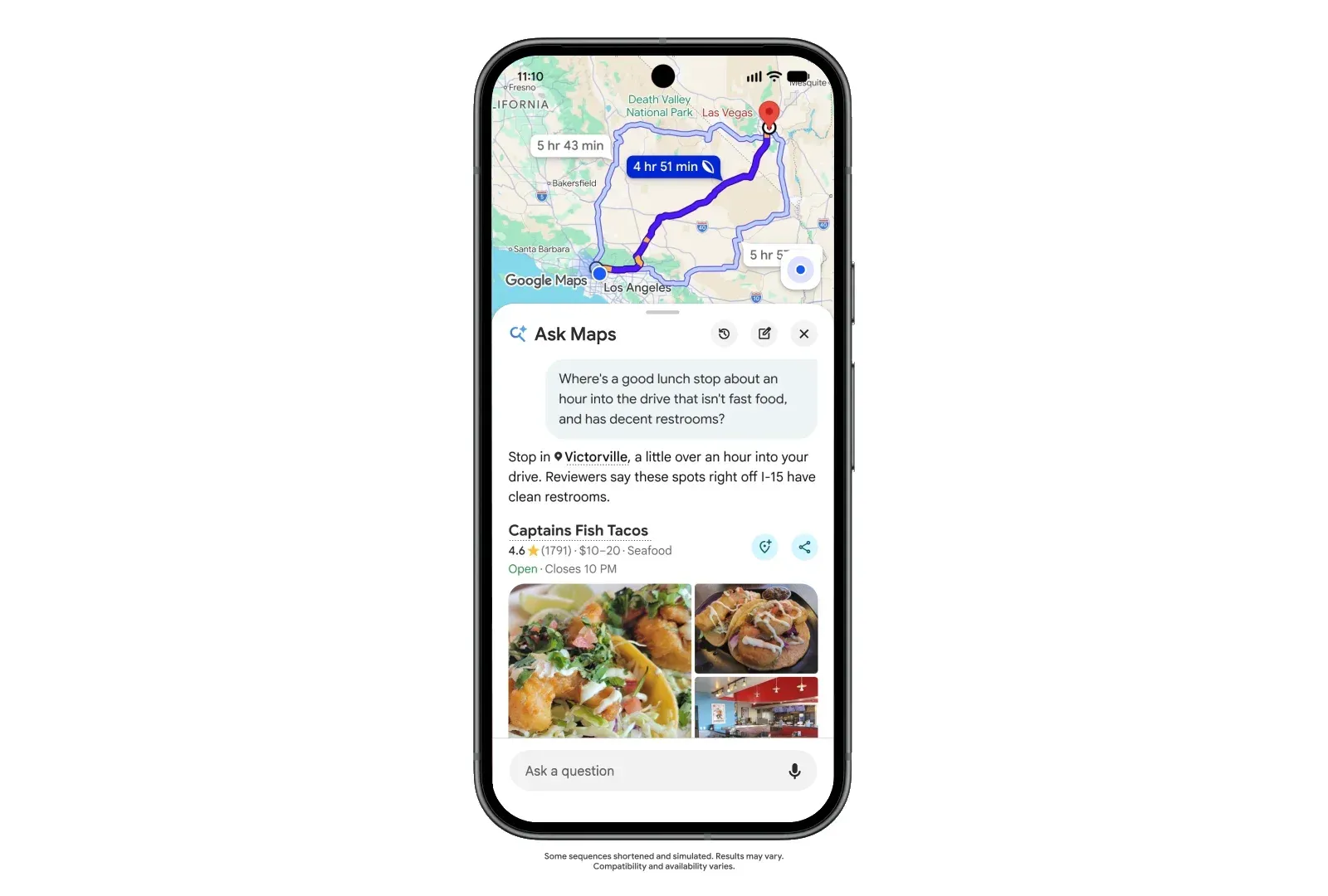
Users can modify the generated itinerary directly in a conversation with Ask Maps
Conclusion
The November update to Ask Maps positions Google Maps as a more autonomous travel copilot. Users can delegate multi-day itinerary drafting, adjust waypoints conversationally, and move directly into turn-by-turn navigation within a single app. The most significant advancement is pairing generative language understanding with real-world mapping databases and routing engines. However, regional availability varies, and the practical quality of logistics and venue suggestions still warrants user review on the road.
Sources
- Google: New Ask Maps features to help with holiday travel and prep, November 16, 2026
- Google: How we’re reimagining Maps with Gemini, March 12, 2026
- 9to5Google: Ask Maps global expansion and Personal Intelligence, August 2026
- Google: Ask Maps is coming to Europe, November 16, 2026
- The Verge: Google Maps can now create trip itineraries for you
- TechCrunch: Google Maps can now build trip itineraries with real-time details about each stop