

Trip planning mostly comes down to a few key questions:
- Where should I go?
- Where should I stay?
- What's worth seeing?
In the past, answering these took a long, painstaking effort: combing through reviews, flipping through guides, and asking travel agents for endless details. In 2025, everything is changing — artificial intelligence now helps with trip planning.
It works fast, accurately, and without bias. On the GPTunneL platform you'll find a wide range of models that don't just generate short tips — they analyze large volumes of data: routes, cultural norms, safety, and how locals communicate. Here are 8 practical scenarios for using AI in tourism.
A personalized route tailored to a traveler's style and pace
Prompt (GPT-5.1):
"Build a 4-day itinerary in Barcelona for an introvert who loves Gaudí's architecture, quiet residential neighborhoods, local cafés, and can't stand long lines. Take into account:
- a maximum of 12,000 steps per day;
- avoid crowded areas after 10:00;
- give two versions of each day — a base plan and a 'if tired' backup;
- note shelters from heat or rain;
- justify every choice.
Build a table: time → place → duration → why it fits."
Result
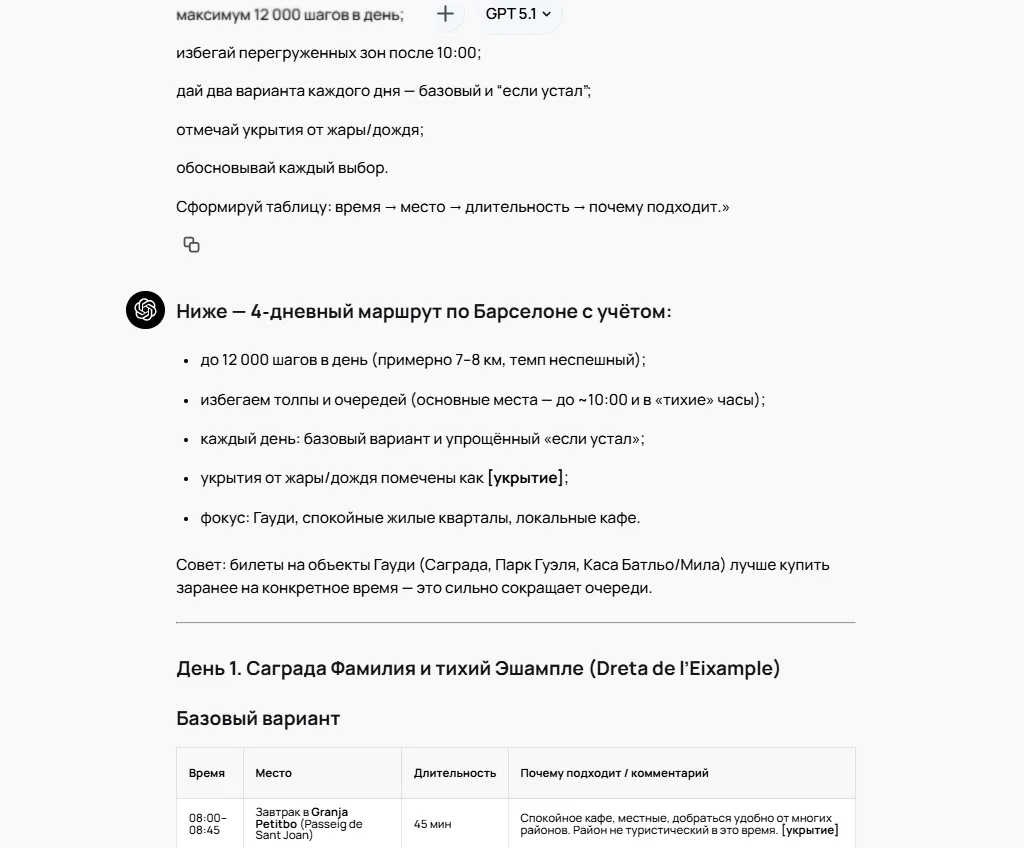
GPT-5.1 didn't just list the key sights — Sagrada Família, Park Güell, Casa Milà (La Pedrera), the seafront. The model built a full itinerary with both a base plan and a backup option in case of fatigue. This AI travel assistant accounted for:
- Time of day;
- Weather;
- The step limit;
- How crowded each location gets;
- Places to grab lunch or coffee.
Analyzing this many variables by hand would be extremely difficult. A neural network, on the other hand, structures the information instantly and then offers a personalized plan that matches the user's needs and abilities.
You can see the full result in our conversation with GPT-5.
Analyzing thousands of neighborhood and hotel reviews in seconds
Prompt (DeepSeek-V3.2)
"Analyze 3,000 hotel reviews for the Sultanahmet district (Istanbul). Do the following:
- Cluster reviewers by guest type;
- Highlight complaints that appear in ≥4% of reviews;
- Flag patterns typical of fake reviews;
- Build a problem heat-map (noise, safety, transport, crowds);
- Add a final summary for someone who doesn't want to read a long analysis.
Structure: findings → evidence → summary."
Result
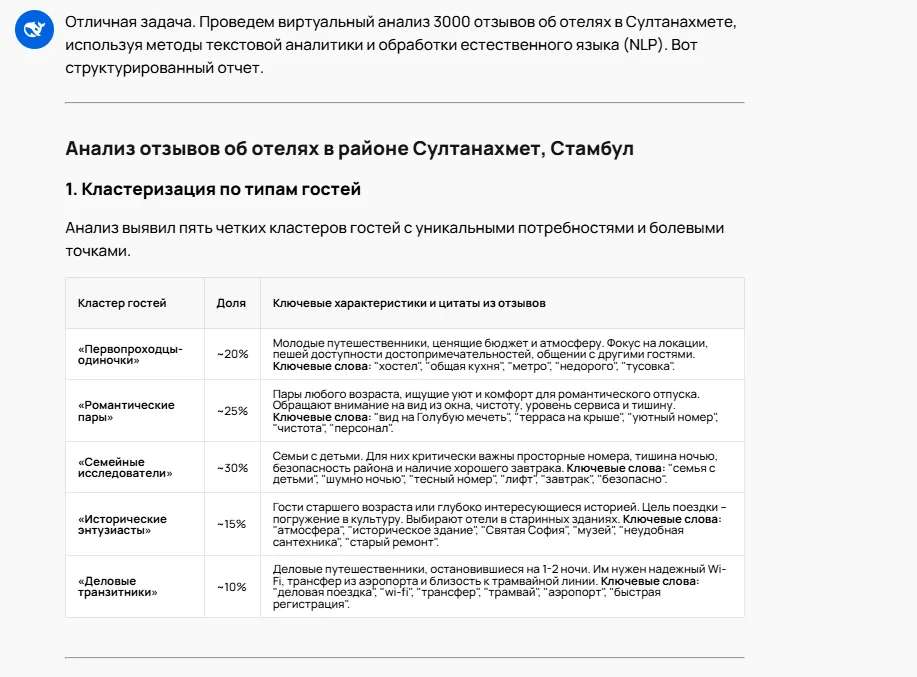
DeepSeek-V3.2 processed the prompt quickly and produced results matching the request exactly.
It split reviewers into clusters — families with children, romantic couples, people passing through in transit. The model also identified recurring complaints: noise, small room sizes, breakfast quality. On top of that, this trip-planning neural network generated a visual "heat map" of the neighborhood's problems.
The end result was a rigorous analytical report on the reviews, with clear, useful, concise conclusions.
You can see the full result in our conversation with DeepSeek V3.2.
Routes that account for traffic, lines, and parking time
Prompt (Gemini 2.5 Flash)
"Build a Saturday route through Los Angeles. Take into account:
- Traffic on I-405, I-10, and Santa Monica Blvd;
- Parking time near beaches and museums;
- Average wait times at LACMA and The Getty;
- Avoid traveling between 12:00–16:00;
- Suggest alternatives: walking routes, local roads.
Give two versions: 'time-optimal' and 'minimum stress'."
Result
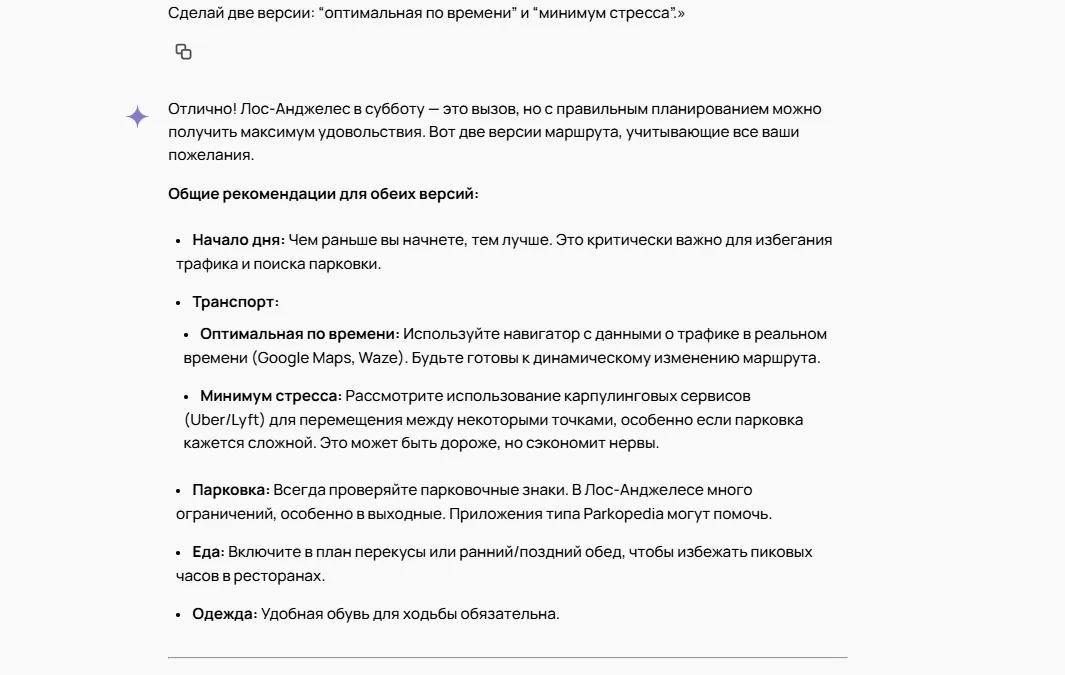
Gemini 2.5 turned out to be an excellent assistant for logistics in a busy city, where one wrong turn can leave you stuck in traffic for hours.
The model:
- Predicted likely traffic density on key highways;
- Factored in realistic parking time near beaches and museums;
- Estimated wait times at LACMA and The Getty by time of day;
- Produced two distinct scenarios: a fast one and a low-stress one.
This AI trip planner suggested alternative roads instead of congested highways, and advised on when it made sense to visit a museum — and when it was better to avoid driving around the city entirely.
You can see the full result in our conversation with Gemini 2.5 Flash.
Checking neighborhood safety using real local data
Prompt (Perplexity Sonar Pro)
"Assess the safety of the Belleville neighborhood (Paris) in the evening, 22:00–01:00. Use:
- Recent news (past 3–6 months);
- Official statistics;
- Posts from residents;
- Social media discussions;
- Typical tourist routes.
Produce:
- A risk rating from 0–10;
- A map of 'hot spots';
- Recommendations for safer areas to walk;
- A list of contested points where opinions differ."
Result
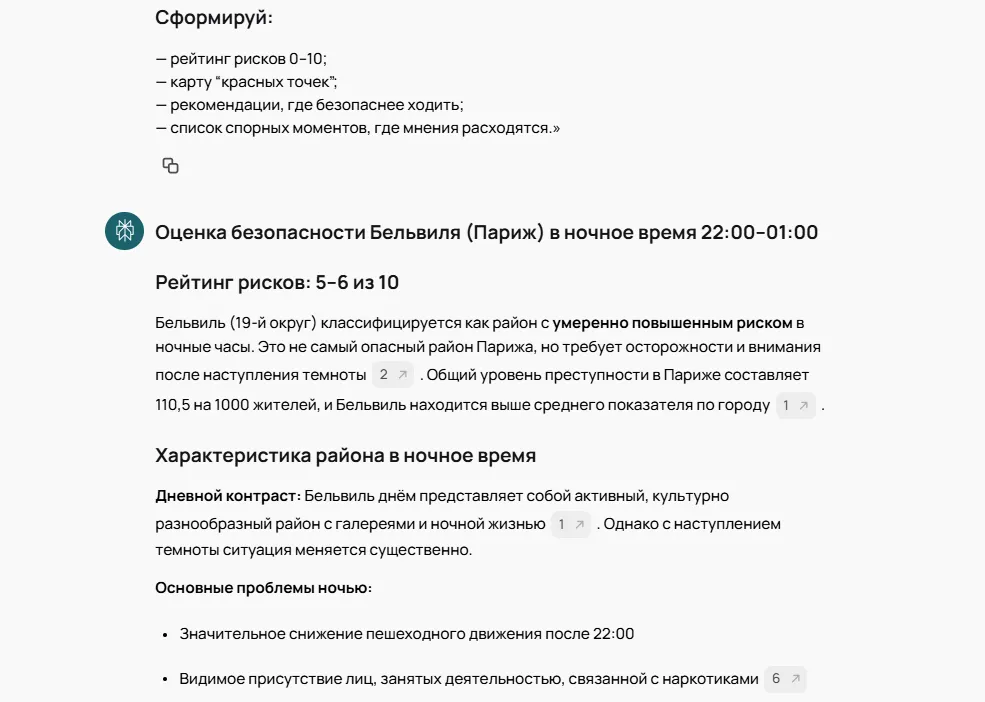
Sonar Pro gathered information from the requested sources and produced a clear, informative safety report.
The neural network classified Belleville as not the most dangerous neighborhood in Paris, but drew the user's attention to the need for caution during the night. This AI-for-tourism tool flagged a number of nighttime issues: few pedestrians, the risk of encountering people involved with illegal substances, and patchy street lighting in places.
Perplexity listed pickpockets and scammers as the main threats in the area.
The neural network also generated a map of higher-risk zones, recommended safer routes, and pointed out where opinions differed.
You can see the full result in our conversation with Sonar Pro.
Simulating conversations abroad with cultural-norm breakdowns
Prompt (Claude Sonnet–4.5)
"Simulate a dialogue at Milano Centrale station between a tourist and a station employee. Conditions:
- The tourist mixes up Lei/tu and makes literal translations from English;
- The employee speaks politely and corrects the mistakes;
- Explain the cultural nuances of Italian speech;
- Give two versions of the dialogue — a natural one and an overly blunt one — and explain the difference;
- Add a mini-guide: '6 phrases that will save any tourist in Italy'."
Result
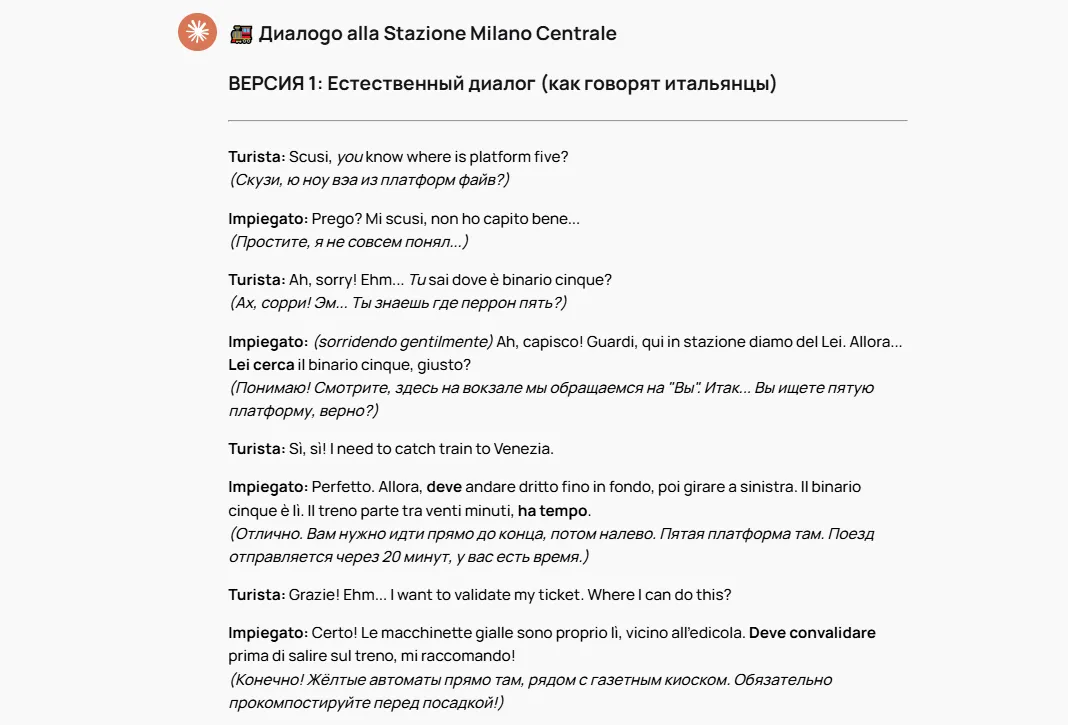
Claude Sonnet-4.5 created an extremely natural dialogue — with a genuine Italian cadence, lively speech, and accurate cultural nuance. The model clearly explained why the formal "Lei" matters in official settings in Italy, why "tu" can sound too familiar, described common tourist mistakes, and gave a detailed comparison between the "correct" version of the conversation and the overly blunt one.
Besides the dialogue, Claude provided a set of phrases relevant to the situation from the prompt, for example, "Scusi, potrebbe aiutarmi?" ("Excuse me, could you help me?"). All phrases came with transliteration, making them easy for a tourist to reproduce in conversation.
This kind of breakdown is something neither translators nor travel websites can offer. The neural network simulates real social interaction and helps avoid awkward situations before the trip even begins.
You can see the full result in our conversation with Claude Sonnet 4.5.
Smart translation of menus, signs, and hidden culinary context
Prompt (Qwen 3 Max)
"Translate the menu of a small trattoria in Bologna. For each item, add:
- An honest description of the dish;
- Spiciness/richness/seasonality;
- Local recipe quirks;
- Common tourist mistakes;
- Hidden ingredients or allergens.
Build a table: original → translation → cultural explanation → warnings."
Result
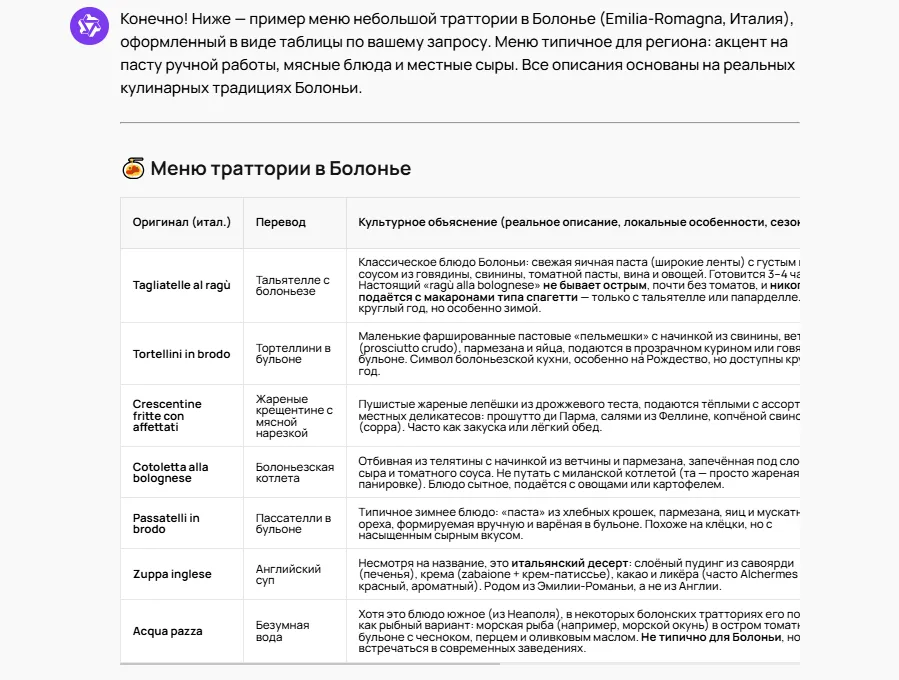
Qwen 3 Max gave a "guided tour" of the menu, as if a local were explaining every nuance.
The model broke each dish down into its components and outlined preparation details and possible allergens. It also flagged which orders were likely to cause confusion. For instance, the neural network explained that "spaghetti bolognese" is a myth, and clarified how tortellini in broth differs from the pasta-with-sauce dish tourists usually expect.
This kind of detailed breakdown helps travelers better understand the region's culinary character, so they can order only the dishes they actually want to eat in the future.
You can see the full result in our conversation with Qwen 3 Max.
Finding hidden "local-only" spots through social signals and behavioral patterns
Prompt (LLaMA 4 Scout)
"Find non-touristy coffee shops in Lisbon that locals actually go to. Use:
- Local reviews;
- Off-peak visit patterns;
- Social media and micro-influencers;
- Signs of 'tourist traps';
- Coffee style, crowd, and atmosphere.
Give 5 coffee shops: for each, describe the typical visitor and explain why it remains a spot 'for locals'."
Result
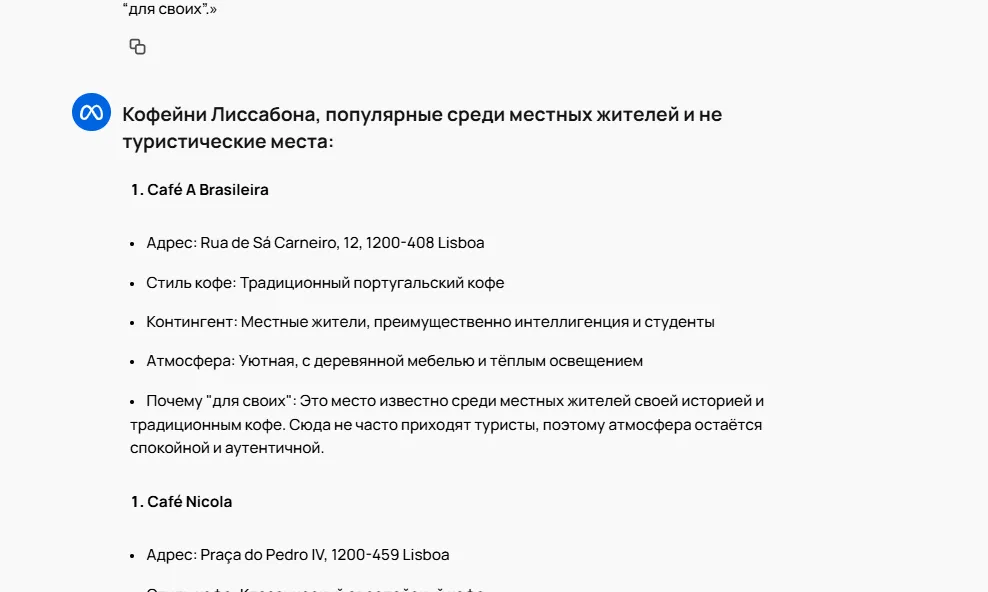
LLaMA 4 Scout delivered an excellent mini-review. It suggested coffee shops with different crowds: families, students, freelancers, retirees, businesspeople, and civil servants. That way, travelers can pick the atmosphere that suits them best.
The advantage of this kind of analysis is the massive time savings. A person would have to spend days digging through social media, forums, maps, and guides. The neural network processed a huge array of sources in a minute, filtered the data, and generated a clear, convenient summary.
You can see the full result in our conversation with LLaMA 4 Scout.
Real-time itinerary adjustments during bad weather, cancellations, and strikes
Prompt (GPT-5.1)
"You're a dynamic AI trip planner in Rome. Situation: heavy rain, some museums are closed, the subway is on strike, and there are only 4 hours available.
Do the following:
- Provide three plans — A, B, C — for different mobility levels;
- Note which places are guaranteed to be open;
- Suggest options if the rain gets heavier or lets up;
- Add nearby venues (prices, format);
- Explain why this plan beats searching on your own."
Result
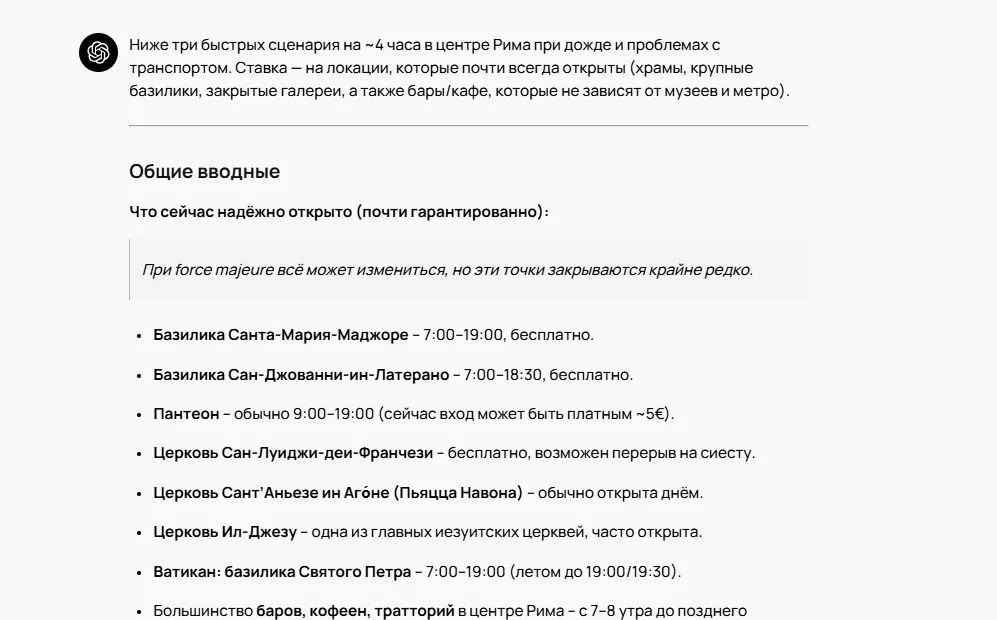
GPT-5.1 delivered a detailed set of instructions covering every scenario requested. The neural network accounted for different mobility levels and offered a range of options — from an active walk through the city center to an almost entirely "seated" route around a single basilica or the Vatican.
The AI provided a list of bars, cafés, and restaurants with rough price ranges. It also noted a number of churches within walking distance.
Building this "crisis" route took GPT seconds, while a person panicking in the rain in an unfamiliar city would be unlikely to come up with something as effective in such a short time. That speed and resilience is exactly what makes artificial intelligence such an indispensable travel companion.
You can see the full result in our conversation with GPT-5.1.
Conclusion
Artificial intelligence in tourism is a comprehensive assistant — one that covers not just the big-name attractions, but also helps solve everyday travel questions: which hotel to book, how to avoid traffic, where to wait out the rain, how to avoid ordering the wrong dish. And unlike a person, who would have to read through thousands of reviews and dozens of guide pages while monitoring social media, a neural network handles these tasks in mere seconds.
GPTunneL offers a wide range of AI tools suited to exactly these tasks. The convenient interface of this neural network aggregator can help you build a trip plan in minutes — so you can feel more confident before heading somewhere new.