
In brief. OpenAI analyzed 580,186 scientific messages from 1,819 researchers and surveyed 251 participants in its academic program. Most commonly, ChatGPT helps scientists review literature, draft manuscripts, analyze results, and write code. Survey participants estimate saving time by roughly 1.9x, and 98% expect AI to accelerate scientific discoveries. However, fully autonomous research accounts for only 0.4% of scientific messages, and the actual impact on the pace of discovery has yet to be measured.
On November 16, 2026, OpenAI published the study Science at the Frontier: How Scientists Use ChatGPT. Unlike benchmarks where models tackle pre-designed test problems, this study investigated day-to-day AI adoption by practicing scientists. The authors sought to understand which research workflows are shifting due to language models, who originates research ideas, and how much time researchers actually save.
The findings reveal a nuanced picture. ChatGPT is already deeply integrated into scientific routines, from hypothesis generation to formal mathematical analysis. Yet the most frequent use cases center on processing and articulating knowledge, while producing and verifying definitive scientific results still relies fundamentally on human researchers.
How the Study Was Conducted
The dataset comes from the ChatGPT for Academic Researchers pilot program launched in July 2026. Participating researchers used ChatGPT, Work mode, and Codex, including the command-line interface. The cohort encompassed scientists across biology, chemistry, materials science, computer science, mathematics, physics, engineering, and geosciences.
| Metric | Data |
|---|---|
| Usage analysis participants | 1,819 scientists |
| Scientific messages analyzed | 580,186 |
| Observation window | August 20 – September 22, 2026 |
| Survey participants | 251 scientists |
| Survey window | September 30 – October 7, 2026 |
| Task classification | 10 domains and 40 research activity types |
In total, participants sent approximately 1.26 million messages over the observation period, of which roughly 580,000 were classified as scientific work. OpenAI utilized automated classifiers to categorize messages, allowing the research team to work strictly with aggregate labels without inspecting raw message contents. According to OpenAI, participant data from this program is excluded by default from model training.
A key methodological feature is that task proportions were calculated individually per researcher before averaging. As a result, highly active outliers could not skew overall distribution benchmarks. At the same time, the dataset reflects participants in a specialized OpenAI pilot rather than an unbiased random sample of the broader scientific community.
What Scientists Use ChatGPT Prompts For
Four primary areas account for 85.1% of average scientific prompt activity: reading existing literature, scientific writing, scientific analysis, and research coding.
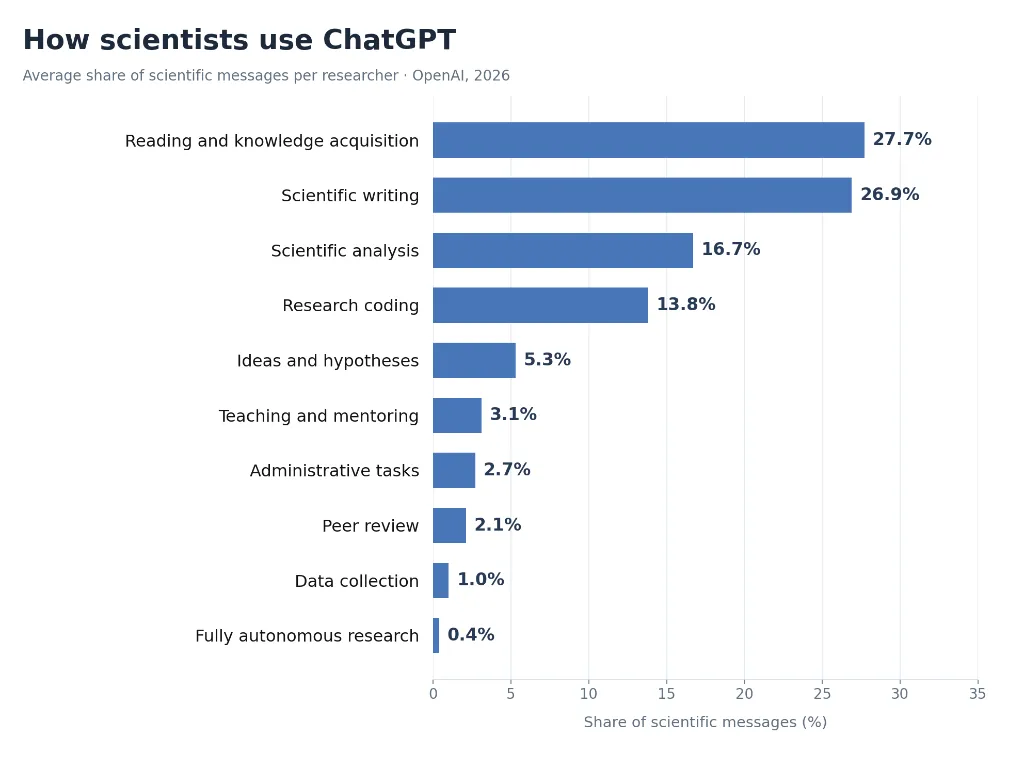
Figure 1. Average share of scientific messages per researcher by workflow domain. Rounded values may not sum to 100%. Source: OpenAI, Science at the Frontier, November 2026.
The largest category is reading and knowledge acquisition (27.7%). This encompasses concept explanations, literature synthesis, and factual retrieval. Another 26.9% is dedicated to scientific writing, including manuscript drafts, grant proposals, and figures. Scientific analysis (16.7%) and research coding (13.8%) collectively represent nearly a third of all interactions.
A more detailed task breakdown reveals specific activities performed by researchers:
| Specific Task | Share of Scientific Messages |
|---|---|
| Explaining scientific concepts | 18.8% |
| Drafting manuscript text | 13.9% |
| Literature search and retrieval | 5.3% |
| Developing research software | 4.7% |
| Drafting grant proposals | 4.7% |
| Creating charts and figures | 4.2% |
| Proof development and verification | 4.2% |
| Problem formulation and modeling | 3.9% |
Here, the distinction between task prevalence and volume is particularly telling. For example, 55.4% of researchers prompted the model for scientific visualization at least three times, while 26.2% did so for formal proof development and verification. Yet both tasks account for exactly 4.2% of the average scientific message volume. Technically rigorous prompts are adopted by specialized cohorts who query them intensively.
Workflow distributions also vary substantially across disciplines. In mathematics, scientific analysis represents 33.7% of messages, compared to just 9.3% in biology. Conversely, literature assimilation is much more prominent for biologists: 32.8% versus 25.5% for mathematicians. The same tool effectively serves as a literature synthesis partner in life sciences and a formal analytical engine in mathematical fields.
68% of Researchers Use AI for Idea Formulation
Perhaps the most consequential finding involves the role of AI in shaping research agendas. 67.6% of participants sent at least three messages categorized under "ideas and hypotheses" during the observation period. The headline figure of 68% reflects the proportion of researchers engaging with this task, whereas the 5.3% in Figure 1 indicates its share of overall scientific prompt traffic. These two metrics describe distinct phenomena.
The researchers analyzed who steers the direction in idea-related conversations:
- 35% — The scientist defines a concrete problem and asks AI to explore it.
- 36% — The scientist introduces a preliminary concept, and the model helps refine or reframe it.
- 23% — The researcher asks ChatGPT to autonomously propose topics or hypotheses.
- 6% — The model's exact steering role could not be determined.
In 71% of messages in this category, the initial starting point originates with the human scientist, even though AI frequently reshapes how the problem is framed. While researchers leverage LLMs for brainstorming, the system most commonly assists in sharpening an early intuition into a structured research problem.
This shift could fundamentally alter research dynamics: question selection dictates where laboratory hours and grant capital are allocated. However, prompt frequency alone indicates nothing about idea originality, peer-reviewed validity, or likelihood of empirical success.
How Much Faster Does Research Actually Become?
In a companion survey, scientists were asked to estimate how long equivalent work of comparable quality would take without AI access. Across eight core research activities, respondents estimated an average ratio of 1.9 to 1. In other words, a task completed with AI in one hour would take approximately 1.9 hours without it.
The highest self-reported gain was in scientific software development — roughly 2.8x. For reading and literature review, estimates averaged 2.2x, for scientific analysis 2.05x, and for idea development 1.9x.
These figures require careful interpretation. A 1.9x ratio represents subjective self-reported time savings on discrete tasks, not a measured 1.9x acceleration in groundbreaking scientific discoveries. The study did not conduct randomized controlled trials comparing matched research cohorts, nor did it independently audit output quality or count confirmed breakthroughs. Accelerating a literature synthesis does not eliminate multi-month lead times for lab equipment, wet-lab experiments, or peer-reviewed funding cycles.
Consequently, the most reliable takeaway is that researchers experience substantial subjective productivity gains. How that translates into verifiable discoveries remains an open empirical question.
98% of Surveyed Scientists Anticipate Faster Breakthroughs
OpenAI presented respondents with a thought experiment: consider a major scientific discovery that would otherwise take 10 years without AI assistance. How much sooner could it occur with AI tools? 250 researchers answered this question.
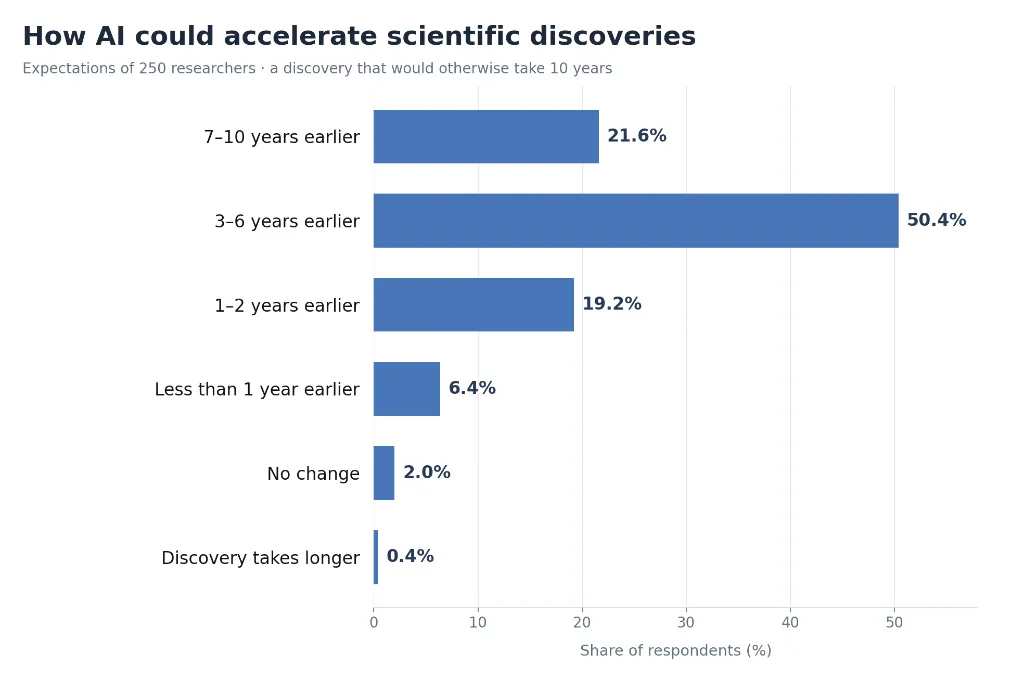
Figure 2. Anticipated timeline compression for a hypothetical 10-year discovery. These represent subjective respondent forecasts, not empirically measured outcomes. Source: OpenAI.
97.6% of respondents believe AI will shorten the timeline to some degree (rounded to 98% in OpenAI communications). 72% expect a compression of at least three years, and 21.6% believe a 10-year research arc will be accomplished in three years or less.
Expectations diverge sharply across fields. Among mathematicians and statisticians, 31% anticipate acceleration by 7–10 years. Among engineers and materials scientists, only 9.8% share that optimism. A plausible driver is the contrast between purely digital, software-verifiable proofs and physical lab research bounded by hardware, biological latency, and material synthesis constraints.
When asked why AI would accelerate breakthroughs, respondents provided 224 open-ended responses from which researchers extracted 367 distinct arguments. Among these arguments, 52% highlighted speedups in routine research workflows, 23% cited more efficient exploration of promising hypotheses, and 14% pointed to the capacity to tackle broader interdisciplinary problems. Percentages reflect shares of coded arguments, rather than distinct shares of scientists.
Researchers Continue to Verify and Refine AI Outputs
OpenAI also tracked follow-up prompts where researchers requested clarifications, corrections, or revisions after an initial model response. On average, iterative follow-ups occurred after 32% of scientific prompts. In text preparation, this reached 38%, in scientific analysis 34.4%, and in research coding 33.7%.
Iteration rates do not equate to error frequencies. A user might polish an already sound draft or expand upon a successful computation; conversely, the absence of a follow-up prompt does not prove that an output was factually flawless. Furthermore, the telemetry captured only in-chat continuity within seven days, missing external offline validation such as wet-lab trials or formal peer checks.
Significantly, the category of fully autonomous research accounted for merely 0.4% of scientific messages on average. This represents the prevalence of autonomous instructions, not an assessment of agent capabilities. The evidence shows that scientific adoption remains overwhelmingly collaborative, coupling human guidance with AI synthesis.
Why Saved Hours Do Not Automatically Equal Scientific Breakthroughs
Flawless code cannot replace physical sample microscopy, clinical trials, or grant committee reviews. OpenAI asked researchers which obstacles persist despite access to advanced AI systems.
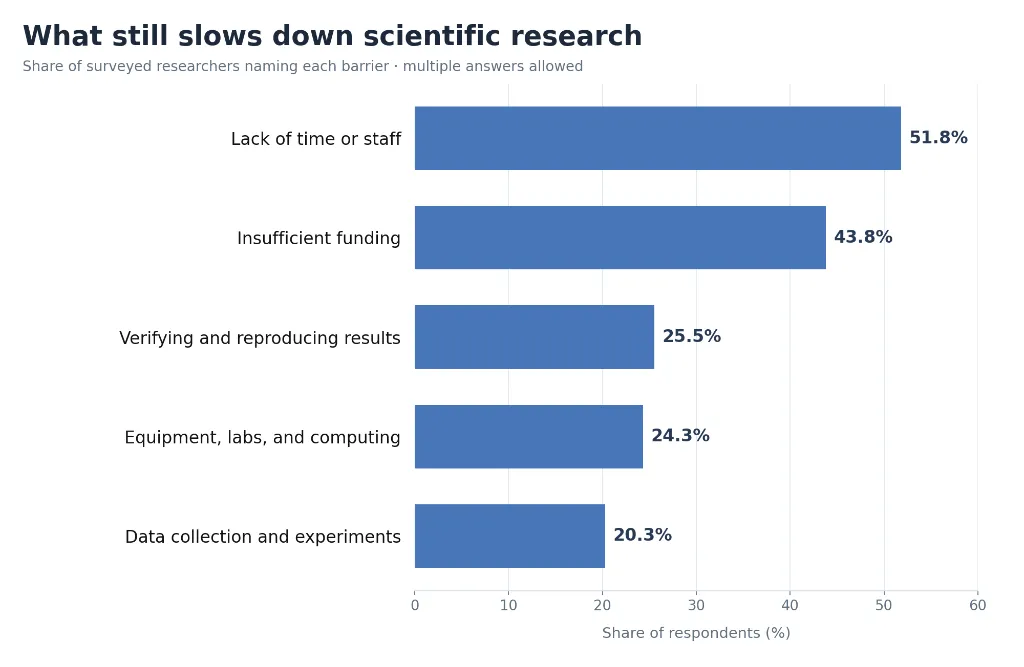
Figure 3. Primary barriers reported by surveyed researchers. Multiple answers allowed. Source: OpenAI.
Most frequently, researchers cited shortages of time or qualified personnel (51.8%) and funding (43.8%). Another 25.5% pointed to difficulties in verifying and reproducing findings, 24.3% cited access to physical hardware, wet labs, and specialized computing, and 20.3% highlighted data gathering and experimental execution.
This explains why drastic reductions in cognitive task friction may yield diminishing returns in aggregate scientific output. While AI can draft dozens of plausible hypotheses in minutes, human teams must triage which ones merit physical validation. When hypothesis pipelines expand faster than laboratory throughput, the bottleneck simply shifts from ideation to empirical verification.
What Findings from Anthropic, Google, and Nature Reveal
OpenAI's report arrives alongside several concurrent investigations into scientific AI adoption, providing broader context across frontier model architectures.
Anthropic: Claude Is Predominantly Applied to Data Analysis
On November 5, Anthropic published a study of 207,049 scientific sessions across Claude and Claude Code. According to its data, data analysis accounted for 33.7% of standard Claude sessions and 48.1% of Claude Code sessions. Reading and literature assimilation represented just 7.6% and 3.7% respectively. By contrast, literature reading represents 27.7% in OpenAI's distribution.
While striking, this disparity does not establish the superiority of either tool for specific tasks. Anthropic analyzed sessions classified as scientific across consumer and enterprise accounts; OpenAI evaluated prompts from verified academic pilot participants. Methodologies and user cohorts differ substantially. Nevertheless, both studies converge on the core reality: code generation, literature digestion, and data workflows dominate genuine scientific LLM usage.
Google and MIT: ~7 Hours Saved Weekly, but a Growing Hypothesis Queue
In AI in Science: Early Insights, published in September 2026, researchers examined 15 million Gemini interactions, evaluated over 2,600 specialized scientific models, and surveyed more than 600 researchers. Scientists reported saving nearly seven hours per week, re-allocating the bulk of that recovered time back into research.
The researchers highlighted emerging systemic friction: a compounding backlog of unverified hypotheses and escalating demands for result validation. The study underscored the complementary relationship between general-purpose LLMs and specialized scientific models tailored for domain-specific predictions and molecular scoring, aligning with OpenAI's observations on downstream verification bottlenecks.
Nature: Accelerated Publishing Does Not Guarantee Diverse Science
In January 2026, Nature published Artificial intelligence tools expand scientists’ impact but contract science’s focus. Drawing on an analysis of 41.3 million scientific papers, the authors found that while AI tools boost individual citation impact, they are correlated with a narrowing of collective scientific inquiry across disciplines.
This provides a cautionary caveat to productivity metrics: AI tends to optimize work in well-mapped domains with rich training corpora, potentially starving nascent, data-sparse frontiers of comparable attention. Genuine scientific progress must be weighed by epistemic novelty and robustness, rather than manuscript throughput alone.
Progress in autonomous science also remains mixed. The Sakana AI project The AI Scientist, covered in Nature, generated an end-to-end paper that passed peer review at an ICLR workshop. However, only one of three submitted manuscripts met the bar, and workshop thresholds are noticeably lower than main conference tracks. The creators noted hallucinated citations, superficial problem formulation, and brittle implementations. While autonomous discovery shows conceptual promise, current reliability precludes treating isolated proofs of concept as standard practice.
Why OpenAI Conducted This Study
The report informs OpenAI's roadmap for academic product development and institutional outreach. Simultaneously, the company is scaling its presence in higher education: on November 16, it announced the expansion of ChatGPT for Academic Researchers to grant subsidized access to up to 200,000 researchers globally. In its next phase, the initiative will distribute 50,000 ChatGPT Plus grants to academic labs.
Coinciding with the release, OpenAI launched a dedicated science blog documenting domain-specific prompting techniques, case studies, and boundary conditions. These efforts position the global research community as a strategic audience in OpenAI's ongoing competition with Anthropic and Google DeepMind.
Context is critical when assessing these findings. The study was executed by the product vendor's internal research division, and survey respondents had applied for expanded AI access. While this does not diminish the value of a 580,000-prompt empirical dataset, user satisfaction ratings from an invested cohort cannot simply be extrapolated to global academia at large.
Conclusion: AI Speeds Up Research Tasks, but Discovery Velocity Remains Unmeasured
The defining achievement of Science at the Frontier is an empirical map detailing where scientists derive tangible utility from ChatGPT. Daily workflows concentrate around reading, manuscript writing, data analysis, and code. AI also plays a growing role in steering problem formulation: two-thirds of observed researchers queried models for hypothesis ideation.
Surveyed researchers estimate saving roughly half their task time and express high expectations for future acceleration. Yet these remain subjective participant sentiments. Neither 98% optimistic forecasts nor doubled speeds on desktop tasks prove that confirmed scientific breakthroughs are occurring twice as fast.
Future assessments must track the entire evidentiary chain from initial hypothesis to laboratory reproduction and publication. That end-to-end trajectory is where the true scientific impact of language models will be tested: the friction of drafting ideas has collapsed, but empirical verification remains the ultimate gatekeeper of scientific truth.
References
- OpenAI — Science at the Frontier: How Scientists Use ChatGPT, November 16, 2026. Full research report (PDF).
- OpenAI — Broadening access to AI for scientists, November 16, 2026.
- Anthropic — AI for scientific discovery: How researchers use Claude, November 5, 2026.
- Codreanu et al. — AI in Science: Early Insights, September 16, 2026.
- Hao et al. — Artificial intelligence tools expand scientists’ impact but contract science’s focus, Nature, 2026.
- Towards end-to-end automation of AI research, Nature, 2026.