
Thinking Machines Lab introduced an open-weights model designed for coding and AI agents. Inkling 2 Mini reuses layers across computation cycles, fits into roughly 20GB of memory, and demonstrates strong performance on software development benchmarks.
On November 20, 2026, Thinking Machines Lab announced Inkling 2 Mini. The model contains 26.4 billion total parameters, yet activates only a compact subset per token pass. The developers specifically tailored it for software engineering, tool calling, and long-horizon agent workflows.
The standout practical capability of this release is local execution on Apple Silicon machines equipped with 32GB of unified memory. Delivered as a ~20GB checkpoint, the model can run entirely on-device without relying on remote servers or transmitting proprietary source code to cloud endpoints.
Model Architecture and Specifications
Inkling 2 Mini is built on a Mixture of Experts (MoE) foundation. Out of 26.4 billion total parameters, only 3.4 billion are actively engaged for processing an individual token. Accounting for repetitive passes through looped layers, the effective active compute reaches 5.4 billion parameters per token.
The model processes multimodal text and image inputs while generating text outputs. It supports an advertised context window of up to one million tokens. Weights are published under the Apache 2.0 license, permitting commercial deployment subject to license terms.
Weights are formatted using NVFP4 and MXFP8 representations. Thinking Machines emphasized that core components of the network were trained natively in low precision from the start, avoiding the quality degradation often associated with post-training 4-bit quantization.
How the Looped Transformer Works
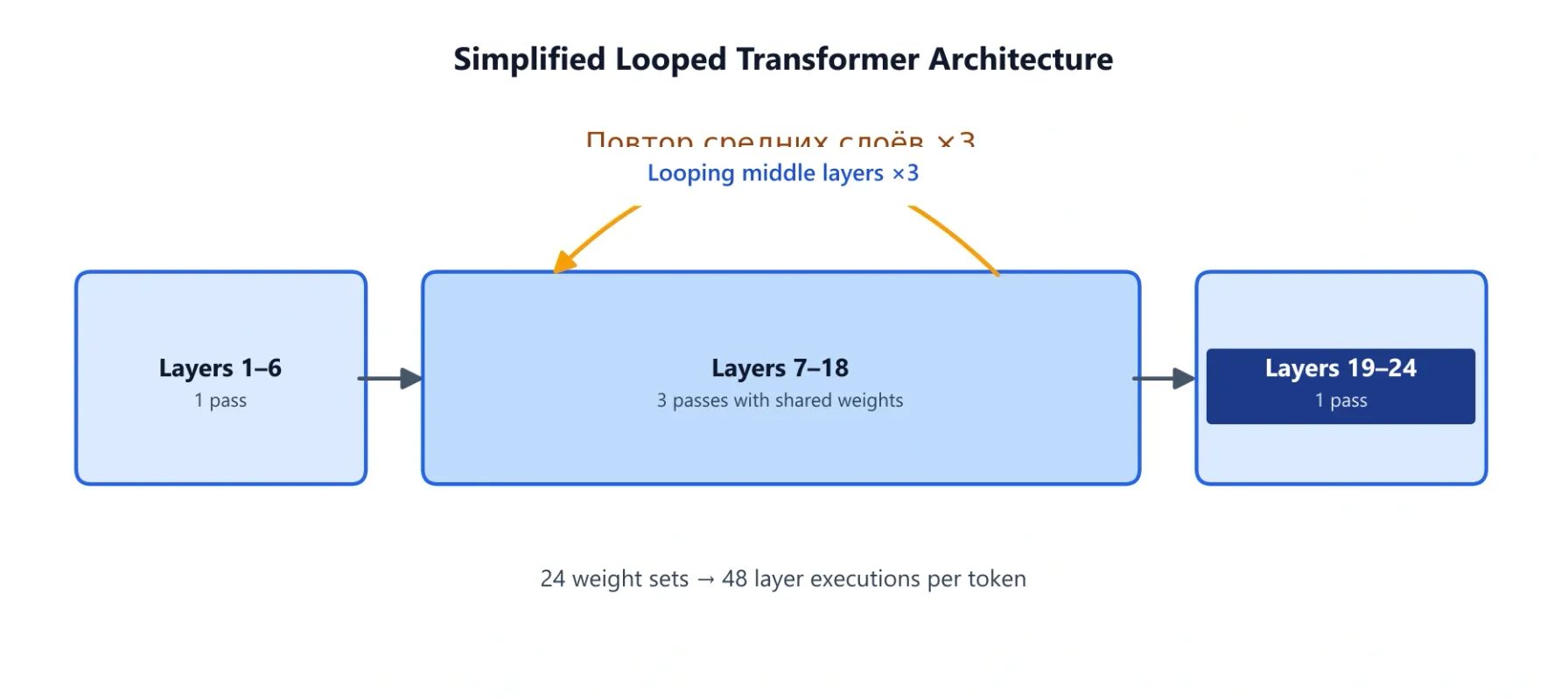
Figure 1. Simplified schematic of the Looped Transformer architecture based on Thinking Machines Lab documentation. Layers 7–18 execute three times using shared weights.
Traditional transformers route representations through a sequential cascade of distinct layers. Inkling 2 Mini employs 24 physical layers partitioned into four six-layer blocks. The initial block (layers 1–6) and terminal block (layers 19–24) each process tokens once, while the two intermediate blocks (layers 7–18) execute three times in a recurrence loop.
This setup achieves 48 total layer executions while only storing the weights for 24 layers. It scales effective computational depth without expanding parameter memory footprints. Crucially, these internal computation passes operate purely at the latent layer level and do not correspond to external reasoning tokens generated in the output text.
According to the research team, looping intermediate layers outperformed looping final layers in 27 out of 28 empirical evaluations. However, recurrence introduces trade-offs: total per-token FLOPs increase, meaning wall-clock throughput depends heavily on optimization within local inference runtimes.
Benchmark Performance
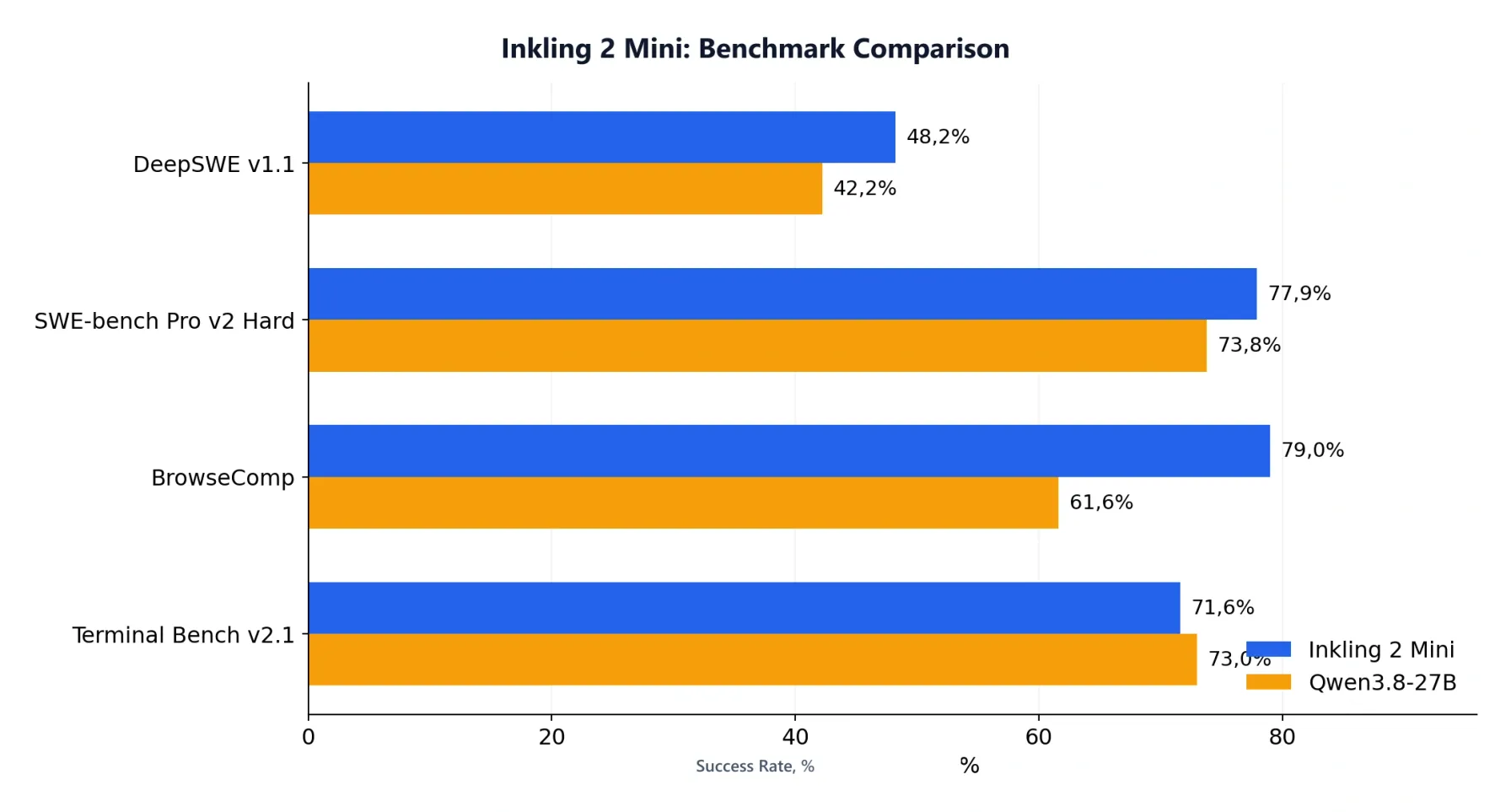
Figure 2. Comparison of reported benchmark scores between Inkling 2 Mini and Qwen3.8-27B. Data sourced from official model cards; higher percentages indicate stronger performance.
In evaluations released by Thinking Machines, Inkling 2 Mini achieved 48.2% on DeepSWE v1.1 compared to 42.2% for Qwen3.8-27B. On SWE-bench Pro v2 Hard, the models scored 77.9% and 73.8%, respectively, while in BrowseComp Inkling reached 79.0% against 61.6%.
Conversely, Qwen3.8-27B retained an edge on Terminal Bench v2.1, scoring 73.0% versus 71.6% for Inkling. On the composite Artificial Analysis Index v5, both models tied at 20.1 points. These metrics evaluate distinct capabilities and cannot be collapsed into a single universal leaderboard rank.
Additional reported figures are equally notable: 79.2% on SWE-bench Verified and 85.3% on DeepSearchQA. However, these figures originate from vendor self-evaluations and frequently utilize customized agent scaffolds. Objective comparisons require independent reproduction under strictly standardized environments.
Independent Benchmarking by Artificial Analysis: Speed and Economics
Independent benchmark platform Artificial Analysis published comprehensive empirical findings on the model. On their composite Intelligence Index v5.0.1, Inkling 2 Mini registered a score of 20 points, matching dense models such as Qwen3.8-27B (xhigh) and Nanbeige4.3-33B while operating with 5–6× fewer active parameters (5.4B effective vs. 27–33B).
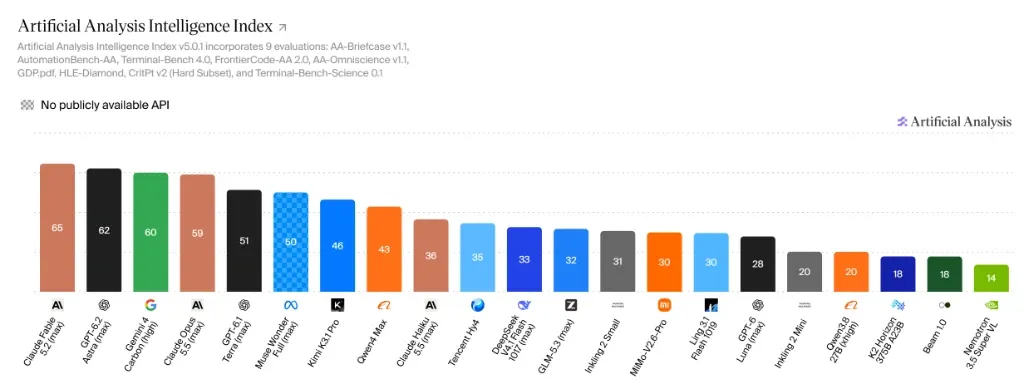
Figure 3. Artificial Analysis Intelligence Index v5.0.1 leaderboard: Inkling 2 Mini shares a 20-point rating with Qwen3.8-27B. Data: Artificial Analysis.
Key takeaways from the independent evaluation focus on computational efficiency and execution speed:
- 2.8× Lower Compute Footprint: On benchmark evaluations, Inkling 2 Mini generates approximately 38% more reasoning tokens, yet its looped architecture requires nearly 3× fewer total floating-point operations (FLOPs) than Qwen3.8-27B.
- 6× Cheaper and 4× Faster: The average benchmark task in Artificial Analysis testing cost $0.59 and required 9.0 minutes for Inkling 2 Mini, whereas the same workload required $3.53 and 38.2 minutes for Qwen3.8-27B.
- Pareto Frontier Position: Analysts situated the model directly along the contemporary Pareto frontier for overall intelligence relative to parameter scale. Reusing weights enables reasoning depth comparable to substantially heavier networks while preserving the economics of a compact architecture.
Feasibility of Running on Mac
According to the official model card, hardware requirements specify Apple Silicon MacBook, Mac mini, or Mac Studio configurations with at least 32GB of unified memory. Recommended runtimes include Ollama, alongside GGUF releases compatible with llama.cpp and Unsloth.
Nevertheless, meeting the minimum RAM threshold does not guarantee uniform real-world performance across hardware configurations. Background processes and system memory overhead constrain available headroom. As context lengths expand, key-value cache memory grows rapidly, while looped layers compound computational loads.
Support for a million-token window likewise does not imply that full million-token sessions run smoothly on entry-level hardware. For production workflows, starting with modest context windows and profiling memory and tokens-per-second on target hardware is essential.
Demonstration Artifacts
In official launch demonstrations, Thinking Machines showcased Inkling 2 Mini running locally on a MacBook Pro powered by an M5 Pro with 48GB of unified memory placed in airplane mode. In one test, the agent built a fully functional flight simulator in a few minutes. In another, the model orchestrated twenty autonomous agents inhabiting a simulated pixel-art village named Thinkyville.
Original Video Demonstrations: Flight Simulator and Thinkyville on the developer website. The recordings appear under the Demo Artifact and Thinkyville sections, highlighting the agent operating entirely disconnected from external networks.
These showcases illustrate the primary appeal of local agent deployment: proprietary source code and sensitive project context never leave the local machine. Nonetheless, curated promotional demos do not replace rigorous independent assessments of stability and execution reliability.
Limitations and Operational Risks
Inkling 2 Mini exhibits weaker performance in extended multi-turn dialogs and tasks with dense constraint sets. On MultiChallenge it achieved 50%, while on ComplexConstraints v1.1 it scored 33.4%.
The model card explicitly cautions users against runaway reasoning chains, erroneous task completion assertions, and unintended destructive operations, such as deleting files without confirmation. Autonomous pipelines should always operate within sandboxed environments with human-in-the-loop approvals for irreversible operations.
Running locally does not eliminate hallucinations. The model remains susceptible to factual inaccuracies, particularly when compared against frontier-scale cloud models. Text generation quality in non-English languages may also show degradation.
Industry Significance
Inkling 2 Mini demonstrates a compelling architectural direction for foundation model efficiency. Rather than continuously inflating raw parameter counts, recurrence allows a compact network to perform repeated computational refinement over its latent states. This yields strong coding and reasoning scores from a remarkably small footprint.
For end users, the primary benefit is accessing an capable engineering assistant running directly on local hardware. For the developer community, open weights and diverse inference runtime options facilitate experimentation.
Whether looped transformers will establish an industry-wide standard remains to be seen. Even so, Inkling 2 Mini provides tangible evidence of what compact, recurrence-driven models can achieve across complex software engineering workloads.