

LLaMA (Large Language Model Meta AI) is a family of open language models developed by Meta. Released in February 2023, they are designed for researchers and developers looking to use high-performance artificial intelligence at lower computational and financial cost.
LLaMA's goal is to make powerful language models more accessible without requiring massive server infrastructure. Unlike ChatGPT or Claude, LLaMA models are geared toward open research, customization, and deployment. We are actively adding LLaMA models to the GPTunneL library. Here's a closer look at each one.
How does LLaMA work?
The LLaMA neural network is built on a transformer architecture. It's a complex system that breaks text into tokens, looks for relationships between words, and then predicts the most likely response based on context. For example, if you ask "What is the sun?", the AI understands that "sun" is connected to sky, warmth, and light. This is possible thanks to the attention mechanism, which helps the model focus on the important parts of the text.
LLaMA also uses positional encoding, which tracks word order so sentences stay meaningful. For stable performance, the network includes normalization and special activation functions — filters of sorts that make it smarter and more accurate.
As a result, LLaMA doesn't just read text — it understands its meaning and can create something new, like writing a letter or summarizing an article.
What else is worth knowing about LLaMA?
LLaMA comes in different sizes, depending on the number of parameters — the numerical values it's made of. Here are the main options available in GPTunneL:
- LLaMA 3.2 3B: 3 billion parameters — a compact and extremely fast model with a generation speed of 148 tokens per second. It can produce solid answers to most questions, though it falls short of the largest variants.
- LLaMA 3.2 11B: 11 billion — this AI is even smarter and more precise, but slightly slower in generation speed.
- LLaMA 3.3 70B: 70 billion parameters — a much more powerful model. It handles complex tasks and generates more coherent answers.
- LLaMA 3.2 90B: 90 billion — even more powerful, capable of tackling more complex tasks.
- LLaMA 3.1 405B: 405 billion — a true giant for the largest and most complex tasks.
The more parameters a model has, the better it understands language and the more precisely it can process data. However, larger models also tend to be slower and more expensive. The context window for all five models is 128,000 tokens. That means you can feed the model files and books hundreds of pages long within a single chat and still get useful answers.
What does this mean in practice?
LLaMA is a versatile tool that helps solve real-world tasks. It can write an article, translate instructions, answer a question, or condense a long text into a couple of sentences. That means the model can be adapted to almost any need — from personal assistants to coding helpers.
Key features of LLaMA
LLaMA stands out for its efficiency, flexibility, and accessibility. Unlike closed models such as GPT-4.5, GPT-4o, or Claude 3.5 Sonnet, it focuses on a balance of speed and efficiency rather than excelling in one narrow area. For example, LLaMA 3.3 70B scores 71% on MMLU-Pro and performs well on other benchmarks run by Artificial Analysis.
This benchmark evaluates the quality of a model's answers across 12,000 tasks in various disciplines, including physics, math, biology, and more. This result puts LLaMA on par with Claude 3 Opus, Gemini 1.5 Pro, and GPT-4o, which launched around the same time as LLaMA 3.
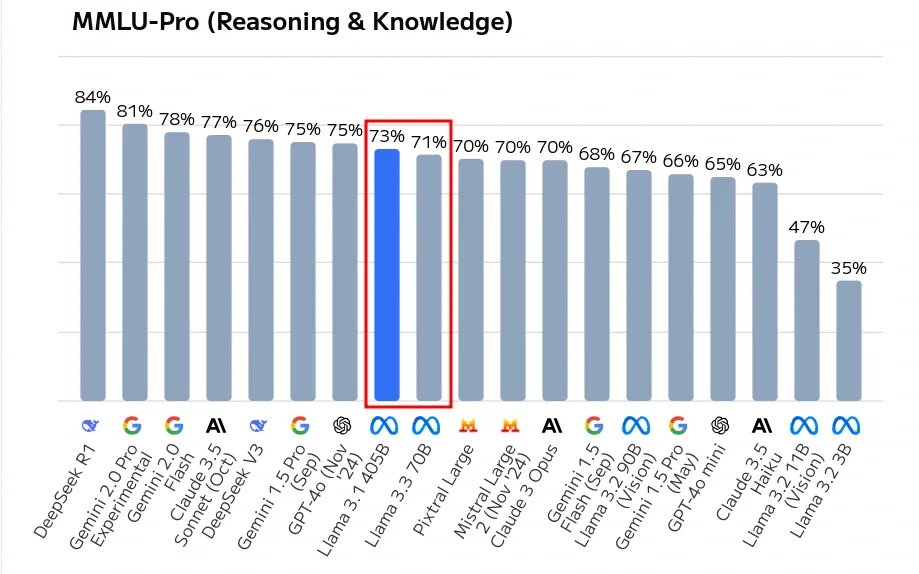
LLaMA 3.1 405B and LLaMA 3.3 70B post strong results on the MMLU-Pro benchmark — 73% and 71% of tasks completed, respectively. Among open-source models, LLaMA trails only DeepSeek V3 and DeepSeek R1. Source: Artificial Analysis testing.
But the main advantage is high performance at a lower cost. LLaMA models are cheaper than their competitors and run faster. For example, LLaMA 3.2 3B generates 148 tokens per second, one of the best rates available today. For content generation pricing on GPTunneL, see our pricing page.
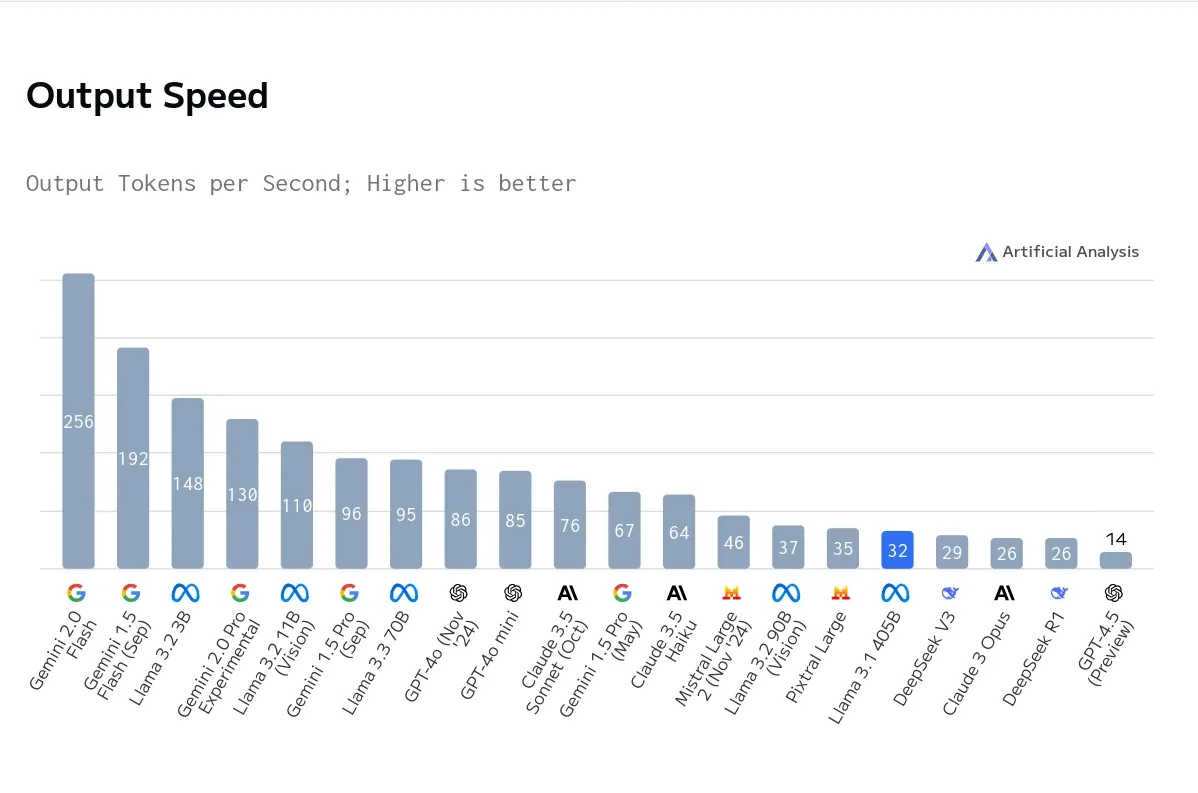
The lightweight LLaMA 3.2 3B, LLaMA 3.2 11B, and LLaMA 3.3 70B models generate answers at high speed — 148, 110, and 95 tokens per second respectively. This lets them outpace every model except Google's Gemini. Source: Artificial Analysis testing.
Where does LLaMA perform best?
Here are five use cases where the AI shines, based on benchmark data. Note that in GPTunneL, LLaMA 3 models can work with text but cannot process images.
Learning and education support
LLaMA is your personal tutor, explaining complex topics in simple terms. The AI shows a high level of comprehension and answer accuracy, making it a great fit for use cases like:
- Explaining scientific concepts or theorems.
- Helping with foreign language grammar.
- Breaking down historical events or literary works.
Support for professional work
LLaMA is a strong choice for working with professional texts. Its ability to follow context and generate coherent text helps professionals save time and improve output quality.
- Drafting business letters.
- Generating ideas for ad copy.
- Helping structure work reports.
Creativity and entertainment
LLaMA knows how to inspire. The model shows strong creative writing abilities, making it a great companion for entertainment and creative experiments.
- Writing science fiction stories.
- Creating poems or song lyrics.
- Generating hobby or art ideas.
Simplifying everyday tasks
In daily life, LLaMA is your personal assistant. Thanks to fast request processing and relevant answers, it helps you handle routine tasks easily and efficiently.
- Planning your day or to-do list.
- Finding cooking or travel tips.
- Recommendations for time management.
Improving communication and social skills
LLaMA adapts to your communication style and retains context throughout your conversation. It helps you practice dialogue and get advice, acting as a virtual conversation partner for any situation.
- Practicing conversations in a foreign language.
- Advice on negotiation or etiquette.
- Simulating conversations to prepare for meetings.
Local deployment option
All LLaMA 3 models are openly available, opening up wide possibilities for their use. You can either test them the usual way (through the GPTunneL interface, like other models) or deploy them locally on your company's own servers, since these are open models.
For businesses, this is especially important: we offer model deployment within your corporate environment. This ensures maximum data security, high performance, and the ability to adapt the model to your tasks. For instance, you can fine-tune the model on your company's data so it better understands your business specifics, customers, and services.
If you don't have the technical expertise needed for local deployment, GPTunneL's specialists are ready to help. We'll handle deployment on your server, letting you integrate one of the best language models into your business processes without relying on third-party services.
How does LLaMA compare to other models?
LLaMA 3.1 405B vs. competitors
LLaMA 3.1 405B, with its 405 billion parameters, performs well on long-context processing and instruction following. Across various Artificial Analysis benchmarks, LLaMA 3.1 405B beats GPT-4o Mini and stays on par with GPT-4o.
That said, it falls behind Claude 3.5 Sonnet and ChatGPT 4o, with its 1.7 trillion parameters, on coding and logical reasoning tasks. For instance, this model shows stronger performance generating code for Python game development.
LLaMA 3.2 90B vs. competitors
LLaMA 3.2 90B delivers impressive performance for its relatively modest size. It can reason and process long texts (such as articles or book excerpts) thanks to its 128K-token context window. It outperforms more compact models like Mistral Small on text comprehension and coding tasks, but falls short of larger models like GPT-4o and Claude 3.5 Sonnet in creativity and natural language generation.
LLaMA 3.3 70B vs. competitors
LLaMA 3.3 70B sits between compact and large models. It shows consistent results on benchmarks like MMLU-Pro (71%), where its performance is comparable to GPT-4o and Claude 3.5 Sonnet. This AI model is effective at coding tasks (HumanEval, 86%) and logical reasoning.
Its generation speed is higher than that of larger models, making it a good fit for most everyday use cases.
LLaMA 3.2 11B vs. competitors
LLaMA 3.2 11B is a compact model that balances performance and generation speed. It delivers competitive results compared to similar models like Mistral Small or Gemini 1.5 Flash, especially on logical reasoning, science, and text processing tasks.
However, it falls behind larger models like LLaMA 3.1 405B or GPT-4o on complex tasks that require deeper contextual understanding.
LLaMA 3.2 3B vs. competitors
LLaMA 3.2 3B is a small language model capable of producing detailed, coherent answers at high generation speed (148 tokens/second). This makes it ideal for cases that require an instant response. It outperforms Mistral 7B in speed while delivering similar performance on simple text comprehension tasks.
However, its capabilities are limited compared to larger models like Claude, Gemini, or GPT, particularly in coding and creative scenarios.
What should we expect from LLaMA in the future?
The LLaMA family of models has already earned a strong reputation in the AI community. Meta is actively working on improving performance and lowering computational requirements. Future releases are expected to bring larger context windows and improved training algorithms.
Key expected improvements:
- A larger context window for better understanding of long texts.
- Improved training algorithms for more accurate answers.
- A more compact architecture for faster performance with fewer resources.
- The ability to use web search while interacting with the model.
One of the biggest expectations for LLaMA's development is a full-fledged reasoning model capable of deep reasoning and planning, similar to o3-Mini and DeepSeek R1. In the future, LLaMA could become more than just a language model — a tool capable of analyzing situations and making decisions, a significant step toward strong artificial intelligence.
Risks and limitations
Despite its advantages, LLaMA faces a number of limitations and risks. One key challenge is balancing freedom of information with content moderation. Meta places restrictions during training to prevent the generation of harmful or toxic content, but this can lead to censorship and limits on freedom of expression.
Main risks and limitations:
- Ethical questions and censorship: balancing freedom of information with content control.
- Usage control: risk of use for questionable purposes.
- Vulnerabilities and manipulation: exposure to attacks and manipulation.
- Knowledge limitations: outdated information due to fixed training data.
Despite its advantages, LLaMA faces a number of limitations and risks. One key challenge is balancing freedom of information with content moderation. Meta places restrictions during training to prevent the generation of harmful or toxic content, but this can lead to censorship and limits on freedom of expression.
In addition, the model's openness creates a risk of misuse for questionable or harmful purposes, such as generating fake news or malicious code. Going forward, it will be important to strike a balance between freedom of information and content control to ensure LLaMA is used safely and effectively.
So why does LLaMA matter for the future of AI?
LLaMA has become one of the most promising language models, offering a balance of power, flexibility, and accessibility. Unlike closed solutions, it allows for customization and local deployment, making it especially valuable for researchers, businesses, and independent developers.
LLaMA's future is tied to further cost optimization, higher speed, and improved functionality. This AI model is already able to compete with ChatGPT and other modern AI solutions while remaining more accessible and flexible.