
In brief. In the November 13 update of the independent MathArena competitive math benchmark, Gemini 4 Carbon claimed first place with an expected performance of 85.4%. It is followed by Claude Fable 5.2 (82.8%) and GPT-6.1 Sol (80.6%). However, the expected compute expenditure per task varies dramatically across the trio: $15.70, $40.20, and $1.07 respectively. While Carbon surpasses Sol by 4.8 percentage points in overall accuracy, solving a problem with it costs 14.7 times more. This provides a striking real-world demonstration where top-tier accuracy and optimal economic efficiency belong to completely different models.
Google made Gemini 4 Carbon broadly accessible to developers and enterprise users on November 10, 2026, positioning it as its most capable flagship model for complex scientific reasoning, software engineering, and multi-step agentic workflows. Three days later, the independent MathArena benchmark integrated evaluation records for Carbon alongside Claude Fable 5.2. This makes it possible to compare not just algorithmic correctness, but the compute expenditure required to reach each solution.
The Leaderboard: Top Three Models and Cost Disparities
According to the public MathArena leaderboard as of November 16, the top tier stands as follows:
| Model & Mode | Rank | Expected Performance | Expected Cost per Task | Cost Multiplier vs Sol |
|---|---|---|---|---|
| Gemini 4 Carbon (high) | 1 | 85.4% ± 3.0 pp | $15.70 ± $1.33 | 14.7x |
| Claude Fable 5.2 (max) | 2 | 82.8% ± 5.3 pp | $40.20 ± $2.59 | 37.6x |
| GPT-6.1 Sol (max) | 3 | 80.6% ± 2.7 pp | $1.07 ± $0.018 | 1x (Baseline) |
Source: MathArena, Model Performance. Values correspond to the specified reasoning efforts and MathArena evaluation protocol, not universal pricing for arbitrary user queries.
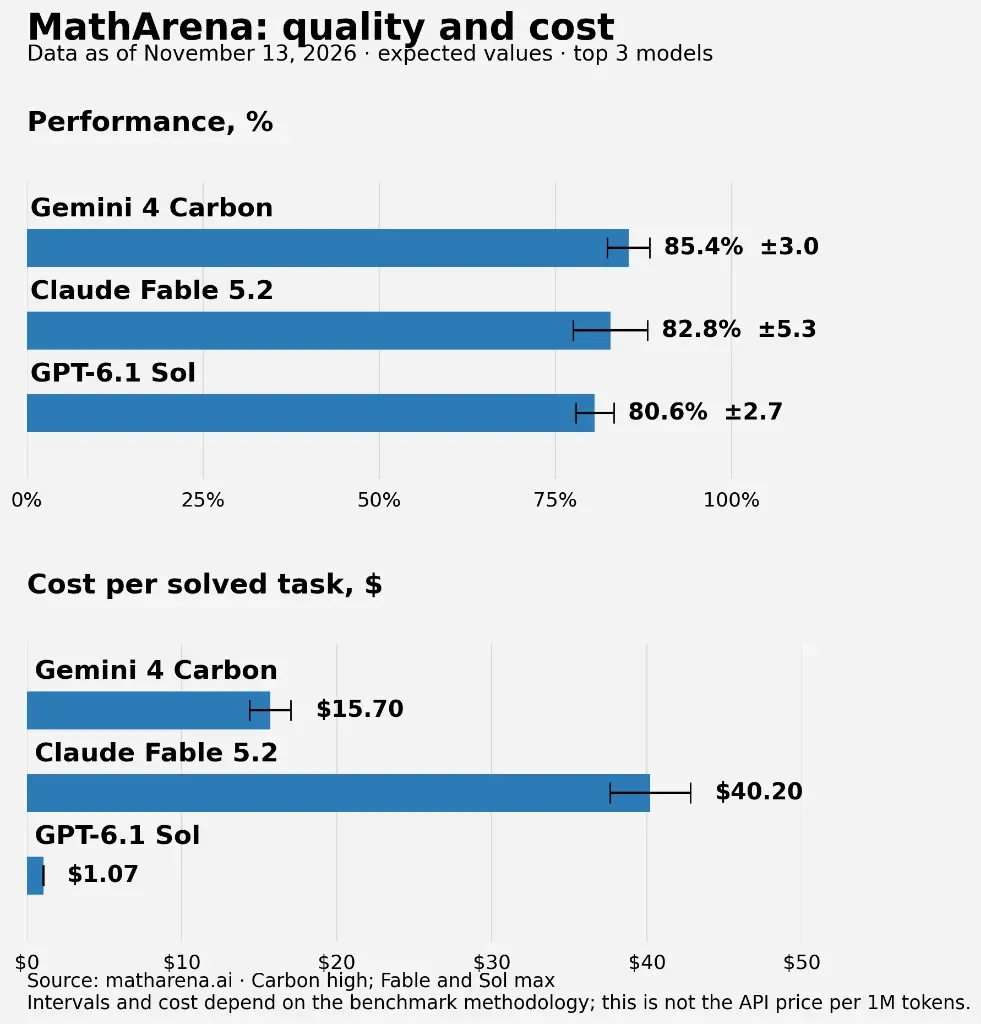
Infographic based on MathArena data from November 16, 2026. The upper panel charts expected accuracy with credible intervals; the lower panel plots expected compute costs per solved problem in US dollars.
The performance gap between the first and third-place models is 4.8 percentage points. In competitive olympiads and mission-critical automated pipelines, every incremental percentage point can matter. However, when a task allows automated retries and programmatic answer verification, cost efficiency can easily outweigh a slight raw capability delta.
Claude Fable 5.2's placement is equally telling. While trailing Carbon by only 2.6 percentage points in central performance, its average execution run is 2.5 times more expensive than Carbon and roughly 37.6 times more expensive than Sol. In this benchmark, Anthropic's maximum reasoning effort failed to secure either top accuracy or compute efficiency.
How MathArena Calculates Performance
The term expected performance is frequently misinterpreted. An 85.4% score does not mean Carbon solved 85.4% of a uniform, identical problem set evaluated identically across all three candidates. MathArena aggregates outcomes across multiple distinct mathematical competitions, each featuring varying problem counts and incomplete cross-model coverage.
The benchmark utilizes recent problems sourced from elite mathematical olympiads and research challenges. This minimizes the probability of test-set contamination during pre-training. For each challenge, the benchmark executes the model four independent times. Some competitions award partial credit; MathArena preserves fractional scoring when averaging observed results.
When a model lacks direct submissions for certain contest subsets, MathArena infers missing outcomes using two-parameter Item Response Theory (IRT). In simplified terms, this psychometric model simultaneously estimates the latent skill of the neural network and the discriminative difficulty of individual questions. The reported expected performance represents a synthesized average across all contemporary competitions, combining observed empirical data with model-estimated parameters. Credible intervals are derived through Monte Carlo simulations and iterative parameter refitting.
Estimated task cost is computed along similar lines: it represents the expected dollar expenditure for a single end-to-end attempt on a single problem. For contests lacking native token telemetry, the platform estimates cost using a regression model calibrated against observed pricing. Thus, figures like $15.70 or $1.07 are not flat fees billed to general API users, but rigorous workload-specific estimates.
These methodological nuances matter. The credible intervals — 85.4% ± 3.0, 82.8% ± 5.3, and 80.6% ± 2.7 — overlap considerably. As a result, the current leaderboard cannot definitively assert that Carbon statistically outperforms Fable or Sol across every arbitrary math task. Rather, Carbon claims first place specifically under MathArena's scoring paradigm and central estimates.
Granular Breakdown Across Individual Competitions
Looking beyond the headline index into specific contest formats reveals distinct behavioral profiles. MathArena provides disaggregated data for ArXivMath, BrokenArXiv, and ArXivLean (which emphasizes formal theorem proving).
| Competition | Gemini 4 Carbon (high) | Claude Fable 5.2 (max) | GPT-6.1 Sol (max) |
|---|---|---|---|
| ArXivMath (October 2026) | 93.62% | 93.62% | 90.43% |
| BrokenArXiv (October 2026) | 82.72% | 73.46% | 80.25% |
| BrokenArXiv (September 2026) | 82.39% | 80.50% | 82.70% |
| ArXivLean (September 2026) | 62.26% | No data | 35.85% |
Sources: Profile pages for Gemini 4 Carbon, Claude Fable 5.2, and GPT-6.1 Sol on MathArena. "No data" denotes absence of evaluated submissions, not a zero score.
This breakdown paints a nuanced picture. In the October ArXivMath dataset, Carbon and Fable are deadlocked at an identical 93.62%, with Sol trailing by roughly 3.2 percentage points. In October BrokenArXiv, Carbon leads Sol by less than 2.5 points, while Fable lags noticeably. Yet in September BrokenArXiv, Sol actually edges out Carbon — 82.70% versus 82.39%. No single contest establishes an undisputed, permanent victor.
The most dramatic divergence occurs in September ArXivLean, where Carbon scores 62.26% against Sol's 35.85%. This benchmark evaluates formalized theorem verification in the Lean interactive theorem prover, suggesting Carbon possesses a formidable advantage in rigorous formal logic and syntax management. However, generalizing this specific edge to every math domain remains premature.
Why Carbon Costs 15x More Despite Identical Token Pricing
The most counterintuitive finding is the stark divergence between list prices per million tokens and total cost per completed problem. At launch, Google set Carbon's introductory API pricing at $2 per million prompt tokens and $10 per million completion tokens. Officially, OpenAI lists GPT-6.1 Sol at identical standard rates of $2 and $10 per million tokens. When reviewing pricing tables alone, the two models appear equivalent in raw operational expense.
In real-world agentic execution, however, total cost is governed by computational persistence. Long-horizon reasoning, frequent external tool invocations, recursive script executions, and error-recovery iterations drive up token consumption exponentially. An agent configured with high persistence can achieve exceptional accuracy, but it arrives at the answer via an expensive computational path.
MathArena's published token counts for BrokenArXiv illustrate this disparity: Carbon averaged approximately 540,000 completion tokens, while Fable exceeded 600,000 completion tokens in October testing. While differing agent runtimes prevent a direct one-to-one comparison, these metrics illuminate why complex math problem-solving now incurs charges measured in tens of dollars per query.
MathArena researcher Jasper Dekoninck highlighted distinctive failure patterns in Carbon's execution style. According to his observations, Carbon frequently hit hard timeout ceilings and rarely abandoned unpromising search trajectories voluntarily. In one notable instance reported by The Decoder, the agent allowed an internal verification script to run unmonitored for over 11 hours. Extreme persistence is advantageous when a problem demands exhaustive exploration, but without strict budgetary and execution bounds, it morphs into an efficiency hazard.
Furthermore, the tooling environments differed across candidates. MathArena ran Carbon within Google Antigravity, Fable within Claude Code, and Sol within OpenAI Codex. Each orchestrator applies distinct tool calling loops and effort parameters (high and max). Consequently, MathArena measures integrated software-agent configurations rather than isolated base model weights in an idealized sandbox.
Google's Positioning of Carbon
Google's official product framing contextualizes these cost characteristics. The company targets Gemini 4 Argon at routine engineering and general productivity tasks, reserving Carbon for deep problem-solving scenarios requiring sustained goal tracking, tool coordination, and extensive self-verification. In its launch briefing, Google emphasized research science, complex codebase transformations, and security auditing.
According to Google, Carbon also posts strong scores on CursorBench 4.0, WANDR, and AutomationBench. These benchmarks reflect different dimensions of developer productivity that cannot be mapped directly onto mathematical problem costs. This creates an interesting contrast: while Google asserts that Carbon delivers strong economics across broad agent workflows, MathArena reveals specific workloads where Sol is radically cheaper.
Additionally, Google noted that Carbon's introductory pricing concludes on December 1, 2026, when rates will rise to $4 per million input tokens and $20 per million output tokens. Assuming token footprints remain unchanged, doubling the base tariffs will roughly double the associated execution costs. However, one cannot mechanically double MathArena's estimated cost to $31.40, as leaderboard metrics reflect caching efficiencies and historical execution data.
Strategic Model Allocation: Carbon, Fable, or Sol?
Rather than treating one model as an absolute replacement for the others, the MathArena findings point toward a tiered routing strategy:
- GPT-6.1 Sol is the rational choice for high-volume mathematical and analytical workloads where cost predictability, rapid turnaround, and programmatic validation matter. In this benchmark, it trails the leader by less than 5 percentage points while operating at nearly 1/15th the expense.
- Gemini 4 Carbon is compelling for difficult, high-stakes challenges where maximizing the probability of a correct proof justifies substantial compute investment. It is especially promising for interactive theorem proving and multi-step verification. When deploying Carbon through autonomous agents, enforce rigorous time limits, budget quotas, and tool invocation caps.
- Claude Fable 5.2 does not present an economical baseline for pure mathematical problem-solving based on these results. However, MathArena only measures a narrow slice of capability. Fable should be evaluated on its strengths in software engineering, Claude developer tooling, and specialized workflow requirements.
In production architectures, developers can build cascading ensembles: dispatch initial problems to cost-effective models like Sol, verify solutions programmatically or with a secondary check, and escalate to Carbon's high-reasoning mode only upon failure or when the cost of an error is exceptionally high.
Conclusion: Benchmark Victory vs Economic Viability
Gemini 4 Carbon rightfully leads the MathArena benchmark following the November 13 update. However, that supremacy specifically reflects expected accuracy within a particular evaluation framework. Under that same methodology, Carbon averages $15.70 per problem, compared to $1.07 for GPT-6.1 Sol. Claude Fable 5.2 occupies second place in performance while incurring the highest overall cost.
The takeaway is neither that Sol is uniformly superior nor that Carbon is inherently unviable. Instead, the data reinforces a critical evaluation principle for autonomous AI: measure solution accuracy against token expenditure, agent runtime dynamics, and total cost per completed task, rather than relying solely on raw leaderboard rank and list prices per million tokens.
References
- MathArena Leaderboard and Evaluation Methodology
- MathArena Detailed Profile: Gemini 4 Carbon
- MathArena Detailed Profile: Claude Fable 5.2
- MathArena Detailed Profile: GPT-6.1 Sol
- Google, "Gemini 4 Carbon is now available", November 10, 2026
- Google, "Introducing Gemini 4 Carbon", Pricing and Architecture Overview
- OpenAI, Official Pricing and Specifications for GPT-6.1 Sol
- The Decoder, Jasper Dekoninck on Gemini 4 Carbon Performance and Timeouts