
On October 19, Inception released Mercury 3, a diffusion language model: it writes a reply not one token at a time but as a whole batch, then refines it over several passes. It runs at 1,068 tokens per second with a 1M-token context, and in Inception's own tests it beats GPT-6 Luna and Claude Haiku 5.5 in 8 of 12 measurements.
What was released
| Mercury 3 | |
|---|---|
| Speed | 1,068 tokens/s on NVIDIA GPUs |
| Context | 1M tokens (Mercury 2.5 had 260K) |
| Max output | 131,072 tokens |
| Reasoning modes | instant, low, medium, high |
| Features | tool calling, structured output, OpenAI-compatible API |
| Price | $0.20 per 1M input and $0.70 per 1M output tokens; at launch half that: $0.10 and $0.35 |
| Free tier | 100M tokens for new accounts |
| Where to get it | Inception API, the Mercury chat and third-party platforms |
| Weights | not published |
Cached input costs 90% less. The prices in the table are the vendor's: Mercury 3 is not on GPTunneL yet. Mercury 2 and 2.5 are closed to new users, and current customers keep them until November 15.
How Mercury 3 differs from other models
GPT-6 Luna, Claude Haiku 5.5 and most other LLMs write token by token: each next token depends on the previous ones, so a reply can never be faster than that chain. A diffusion model drafts many tokens at once and refines them in parallel. The same principle has long worked in image generators; Inception brought it to a commercial text API.
| Mercury 3 | GPT-6 Luna | Claude Haiku 5.5 | |
|---|---|---|---|
| How it writes | a batch of tokens, several refinement passes | token by token | token by token |
| Speed, tokens/s (per Inception) | 1,068 | about 130 | about 240 |
| Context | 1M | 1.05M | 1M |
| Price on GPTunneL, $ per 1K, input / output | not available | 0.0004 / 0.002, now 0.0002 / 0.001 | 0.0003 / 0.0015 |
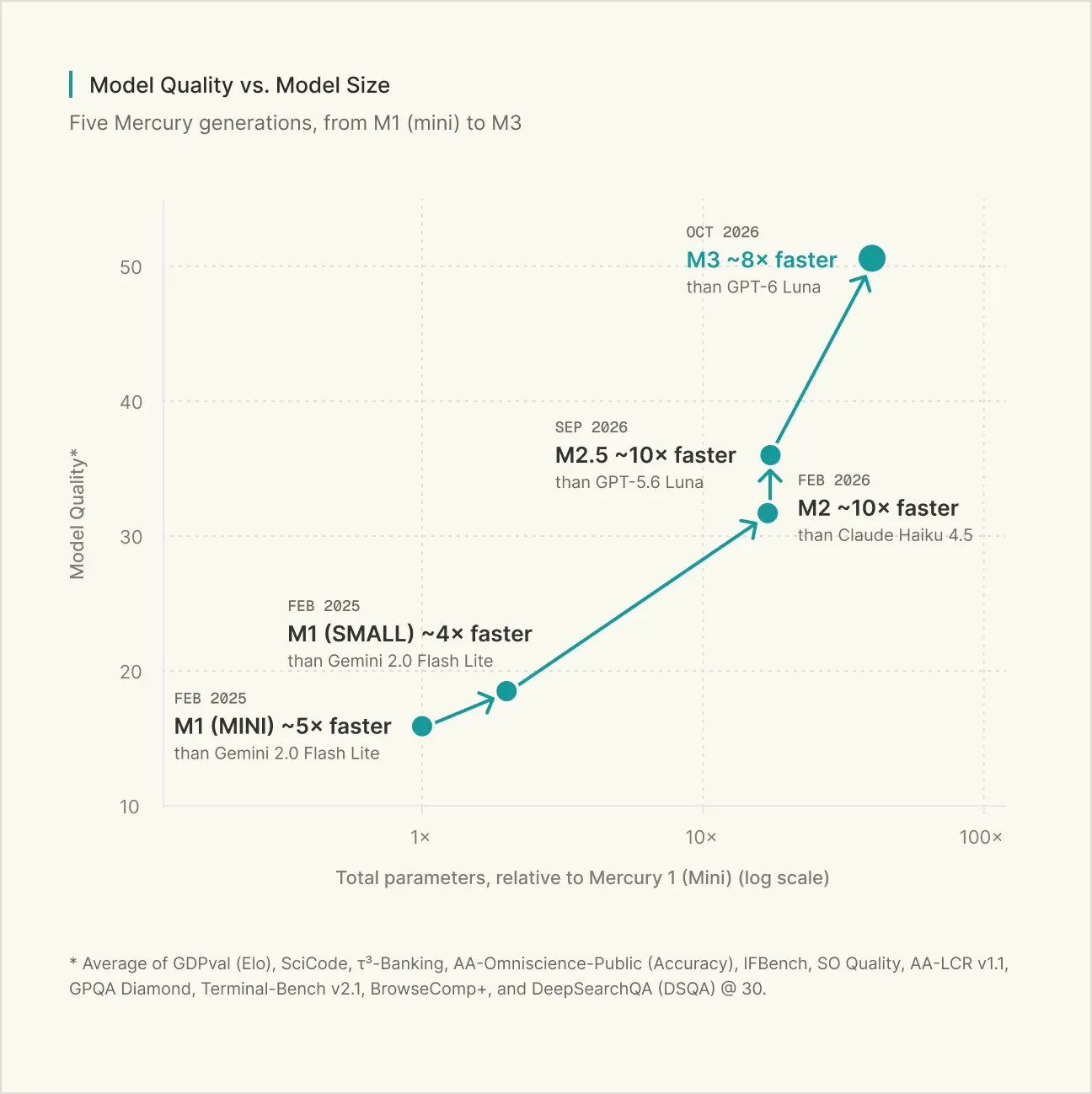
That is where "4-8 times faster" comes from: 1,068 against 240 for Haiku and against 130 for Luna. But Mercury 2.5 was even slightly faster, at 1,107 tokens/s. The third generation did not speed up, it grew: according to Inception, the model is more than 40 times larger than Mercury 1 and holds the same speed, while its results on standard tests rose roughly threefold relative to Mercury 1 mini.
Other diffusion models are still closer to research: at Google these are the experimental Gemini Diffusion and DiffusionGemma, and LLaDA remains an academic project. Mercury is available through a commercial API and a chat.
What Inception's tests show
All three models were compared in medium mode. Mercury 3 is ahead in 8 of 12 measurements, and by the widest margin in agentic tasks.
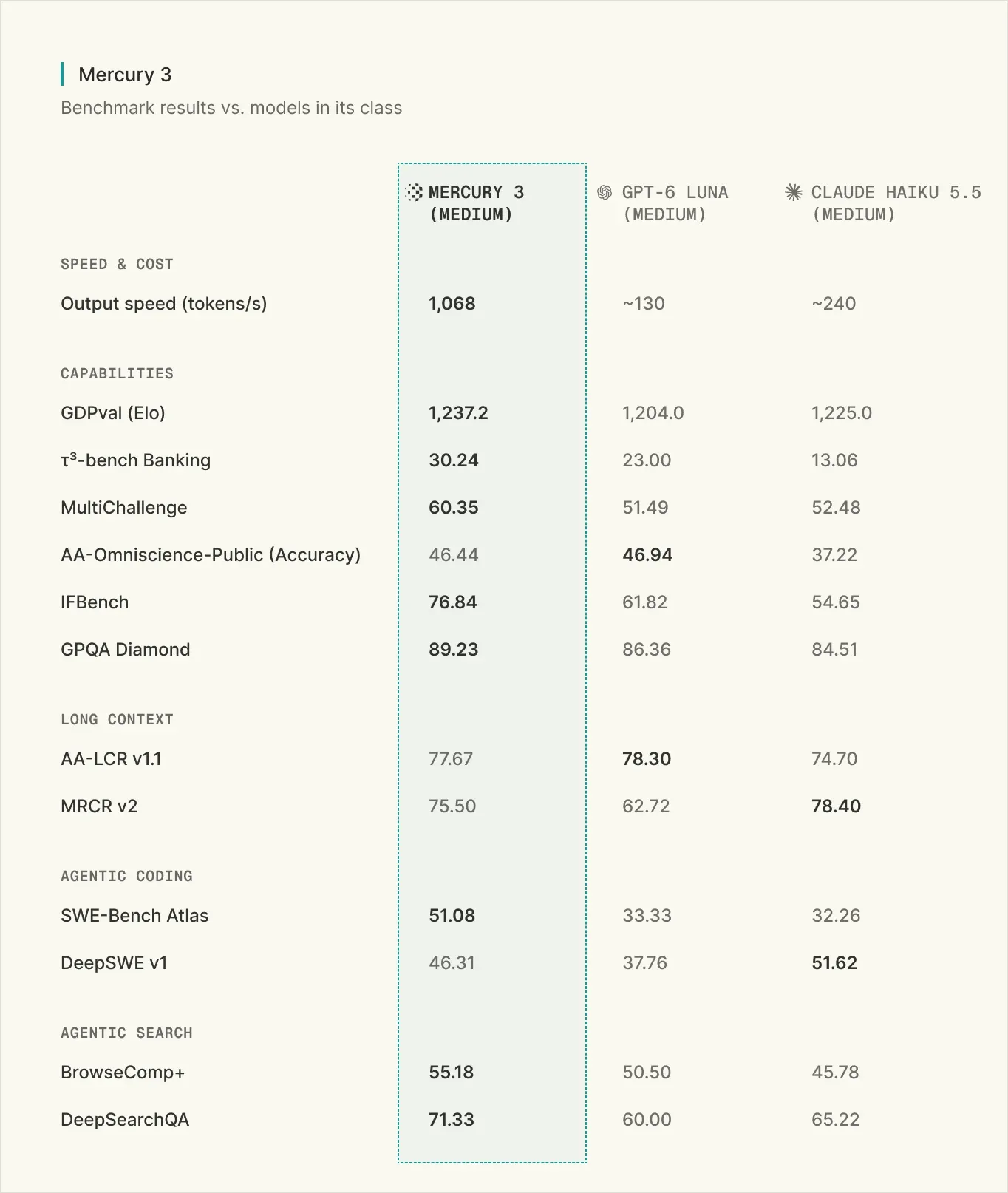
- Coding agents. SWE-Bench Atlas: 51.08 against 33.33 for Luna and 32.26 for Haiku.
- Banking scenarios. τ³-bench Banking: 30.24 against 23.00 and 13.06.
- Instruction following. IFBench: 76.84 against 61.82 and 54.65.
- Search. BrowseComp+: 55.18 against 50.50 and 45.78; DeepSearchQA: 71.33 against 60.00 and 65.22.
It loses in four: AA-Omniscience (46.44 against 46.94 for Luna), AA-LCR (77.67 against 78.30 for Luna), MRCR v2 (75.50 against 78.40 for Haiku) and DeepSWE (46.31 against 51.62 for Haiku). AA-LCR and MRCR v2 test long context: in these measurements Mercury 3's million-token window gave no advantage.
Where it matters
Speed matters wherever the model is waited on at every step. Examples from the announcement, all figures as reported by Inception and its partners:
- Browser agents. An agent calls the model on every click, and delays add up. Mercury 3 completed 50% of 50 live Mind2Web tasks and, according to the company, noticeably more than GPT-6.1 Sol. Inception did not name Sol's result.
- Real-time search. At Octen, search takes about 80 ms, while Mercury 3's median generation is 0.9 s and the full answer takes 2.2 s. For smart glasses the model remains the bottleneck.
- Voice agents. The Mercury Voice variant is built for the shortest time to first audio: median 320 ms, 95th percentile 750 ms. It is used by OpenCall, Audivi AI and Altur.
- Education. RevisionDojo returns hints, grades and definitions in about a second.
- Customer support. Lorikeet runs Mercury 3 in voice, chat and email for regulated businesses; the company gave no separate figures.
- Stream labeling. Mercury Decide classifies large volumes of requests.
It is not a fit if you need open weights or independently confirmed quality. And if your task is not limited by latency, 1,068 tokens per second change nothing: the user still waits for the full result.
What is not proven yet
Inception does not disclose its measurement method in the announcement, and Artificial Analysis had no page for Mercury 3 as of October 20. Sol has no number on Mind2Web, and the speeds of Luna and Haiku are approximate, "about 130" and "about 240". These are the vendor's claims, not third-party results.
What this means
If latency is the bottleneck of your product, Mercury 3 is worth running on your own requests: the API is OpenAI-compatible, so you only need to change the address and the key. For everything else, the choice between fast models is still decided by the price of an accepted answer, not by generation speed.
Tested on three tasks
For a small experiment I gave Mercury 3 three simple tasks, one attempt each. This is not a full benchmark, just a quick look:
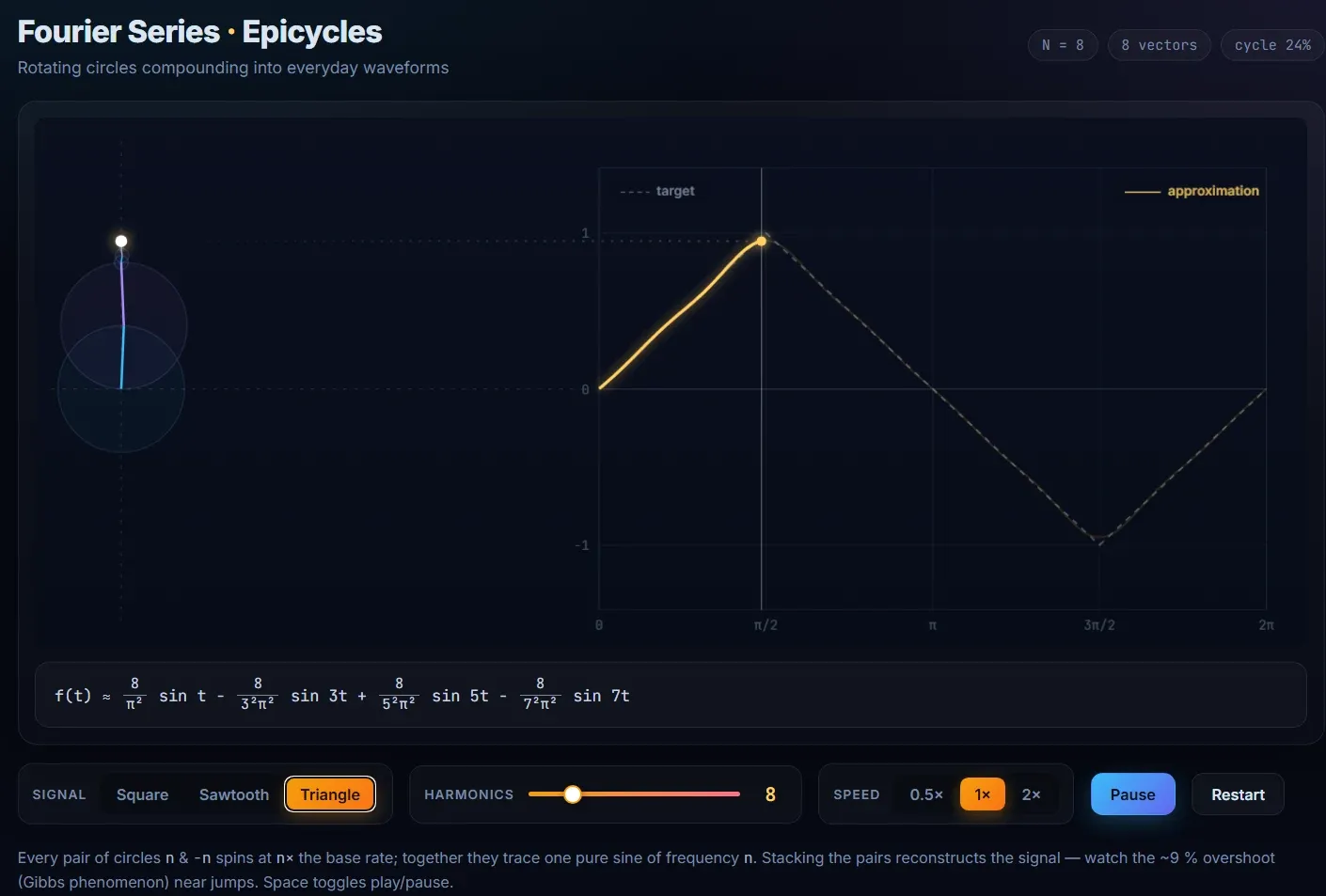
- An interactive explanation of Fourier series. Inception itself suggests the prompt for this task. The result is a working web page: rotating circles, a signal switch (square, sawtooth, triangle), the number of harmonics and the speed.
- A simple Mario-style game. The code did not run: instead of a game, a black screen and the error
Cannot set properties of undefined (setting '9'). DeepSeek and Haiku produced working code for the same task. - A one-page website for a Van Gogh exhibition. Mercury 3 managed with reservations: at first, the images on the landing page had nothing to do with Van Gogh.
Takeaway: Mercury 3 can be useful in narrow scenarios. The model itself describes them like this: "where you need parallel generation of long texts, strict format compliance and low latency in large streams of requests - I am faster and cheaper per finished result than DeepSeek and Haiku". These are its own words; we did not compare costs.
Where to try
Mercury 3 is not on GPTunneL, but fast models of the same class are: Claude Haiku 5.5 and GPT-6 Luna work from one balance. How to choose between them is in the breakdown Haiku 5.5 or GPT-6 Luna.
Sources
- Introducing Mercury 3, Inception, 19.10.2026 - speed, context, prices, charts and the test table, partners.
- Inception models, documentation - context, output limit, reasoning modes, prices.
- Inception model catalog - availability period of Mercury 2 and 2.5, Mercury Voice and Mercury Decide.
- Inception Launches Mercury 3, Business Wire, 19.10.2026 - press release.
- Introducing Mercury 2.5, Inception - speed of the previous version, 1,107 tokens/s.