
At its Ignite 2026 conference, Microsoft unveiled a new generation of proprietary MAI models designed for software engineering, cybersecurity, image generation, speech, and decision-making. The most eye-catching announcement focuses on MAI Code 2: according to Microsoft's own evaluation, the model achieves 96% of Claude Opus 5.5 performance at just 5% of its cost across an enterprise software development benchmark suite. Compared to GPT-6.1 Sol, Microsoft claims 98% quality at 40% of the cost. For companies deploying AI agents around the clock, this economic disparity could prove far more influential than a few percentage points on an evaluation leaderboard.
However, these figures require careful interpretation. Microsoft compared the models on four selected coding benchmarks using its own cost evaluation methodology. This is not a promise that every software engineering project will become 95% cheaper, nor is it an independent study of real-world development workflows. The announcement highlights Microsoft's strategic direction: shipping specialized systems for workloads already handled at massive scale across GitHub Copilot, Microsoft 365, and enterprise software.
Which Models Did Microsoft Introduce?
The official Microsoft AI announcement lists seven key directions within the family. Several models also include Flash variants, meaning the count of specific product names in press releases may differ from the number of headline announcements.
| Model | Purpose | Microsoft's Stated Claims |
|---|---|---|
| MAI Cyber 2 Flash | Software vulnerability inspection and system defense | Higher quality than GPT-6 Astra on CyberGym-E2E at under 2% of the competitor's per-task cost |
| MAI Code 2 | Agentic software engineering | 96% of Claude Opus 5.5 performance at 5% of its cost on selected test suites |
| MAI Code 2 Flash | Code explanation, lightweight edits, rapid iterations | Comparable quality to GPT-6 Luna and Claude Haiku 5.5 at lower cost |
| MAI Image 2.7 | Image generation and image editing | Ranked #1 for editing on Artificial Analysis at launch; includes an Image 2.7 Flash variant |
| MAI Realtime 1 | Low-latency voice conversations | Pricing starting at $0.01 per minute of audio |
| MAI Transcribe 2 | Speech recognition | Integrated into Dragon Copilot for clinical medical conversations |
| Decision 1.1 | Action selection and task routing | Reported speed and cost advantages over GPT-6.1 Sol |
Separately, Microsoft announced its custom accelerator Maia 200. This is specialized datacenter hardware, not an eighth language model. According to company data, the accelerator delivers 1.7x more tokens per watt compared to the previous generation.
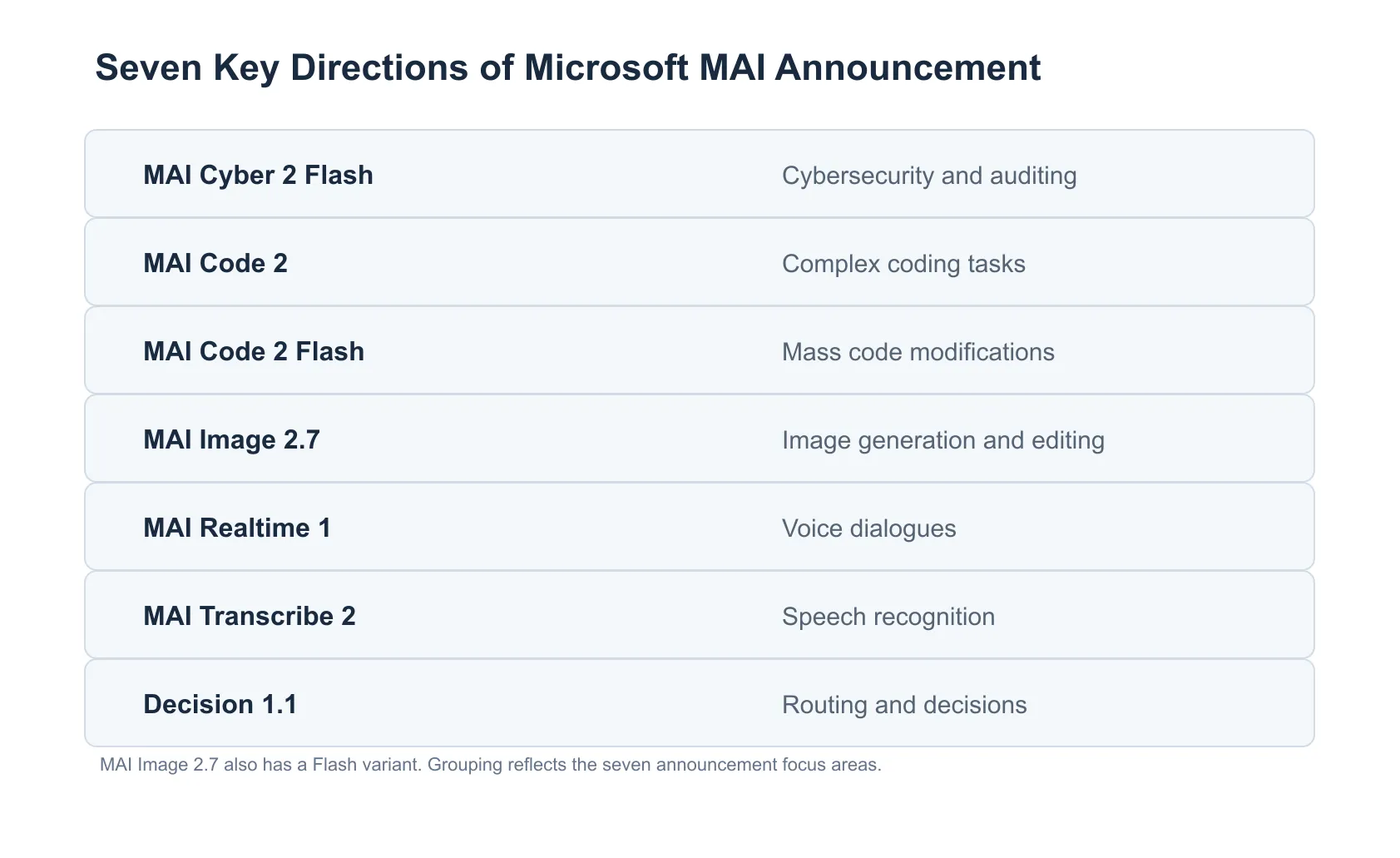
Figure 1. Seven key directions of the Microsoft MAI model family, compiled from Ignite 2026 announcements.
MAI Code 2: Where Did the 95% Savings Claim Come From?
Microsoft evaluated the models on four benchmarks: DeepSWE 1.1, Terminal Bench 2.1, SWE-Atlas, and FrontierCode v1.1. These tests mirror everyday engineering tasks common to agentic assistants in GitHub Copilot. Across these benchmarks, Microsoft claims MAI Code 2 averaged 96% of Claude Opus 5.5's score at 5% relative cost. While that translates to a 95% price reduction, it reflects the comparative expense within this specific benchmark harness rather than a flat API discount.
Against GPT-6.1 Sol, the dynamic changes: 98% quality at 40% of the cost. While financially compelling, it is significantly less dramatic than the Opus comparison. The headline 95% savings figure cannot be generalized to all frontier models.
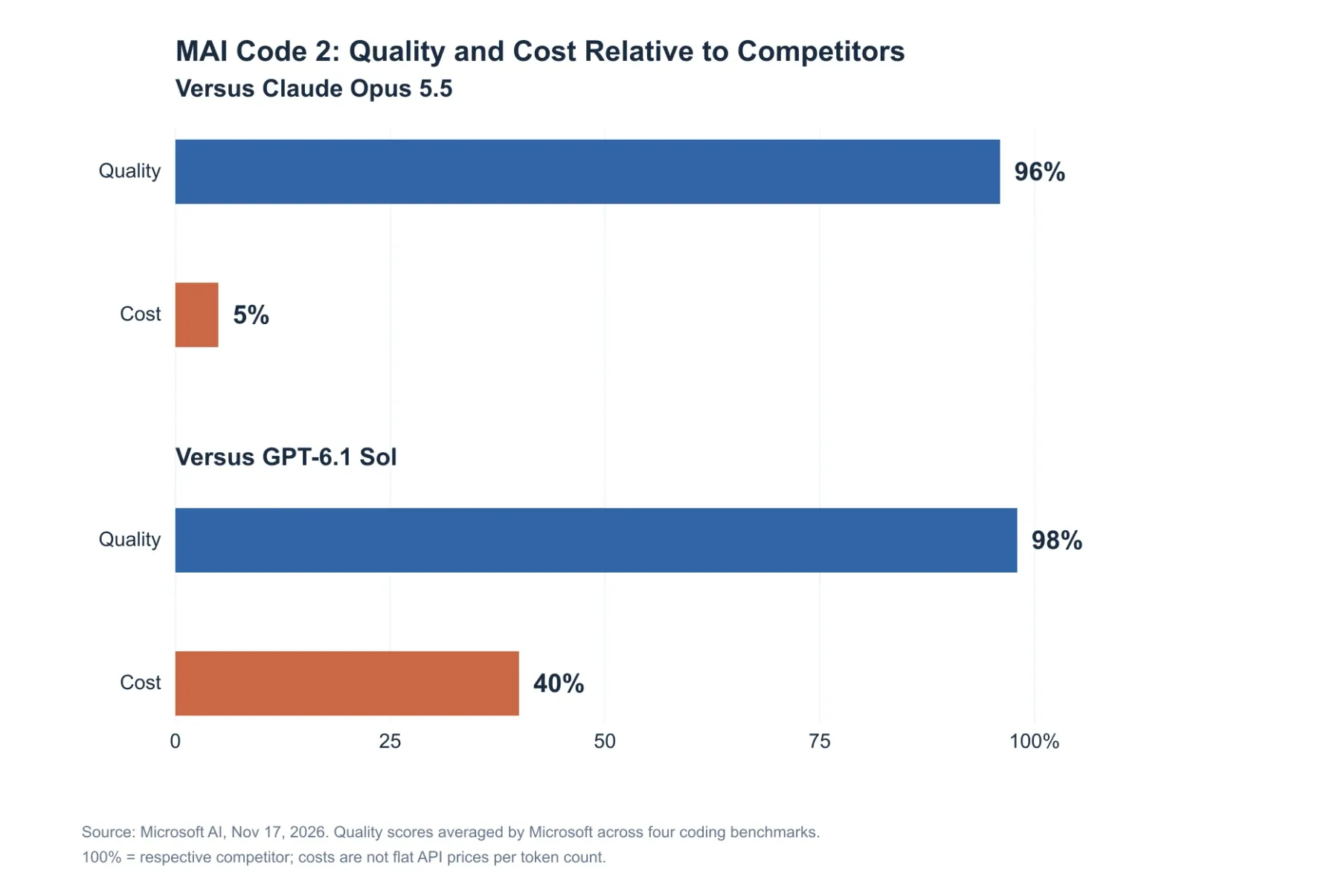
Figure 2. Two distinct comparisons for MAI Code 2, each indexed at 100% against the respective competitor. Data and methodology are Microsoft's; this is not an independent evaluation.
Why is this efficiency gap possible? Massive general-purpose models must retain competence across an immense spectrum of domains, whereas specialized coding models can be trained and optimized specifically for common developer workflows: bug triage, localized refactoring, explaining unfamiliar codebases, navigating repositories, and formatting pull requests. Compute infrastructure, inference lengths, and pass rates before finding a correct patch also significantly alter practical spend.
Microsoft itself acknowledges clear boundaries: the announcement explicitly notes that Code 2 is not yet optimized for fundamental scientific research or very long-horizon agentic workflows. Superior performance on corporate coding benchmarks does not equate to broader general intelligence.
What Flash Models Bring to Production
MAI Code 2 Flash targets high-frequency tasks: localized patches, inline docstrings, routine lint fixes, and rapid iterative completions. Microsoft compares it against GPT-6 Luna and Claude Haiku 5.5, reporting comparable efficacy at 65% and 20% of their respective costs. In real-world software products, such an architecture can absorb the vast majority of inexpensive operations, delegating occasional difficult challenges to standard Code 2 or a top-tier frontier model.
A similar pattern appears in computer vision: MAI Image 2.7 Flash is priced by Microsoft at approximately $10 per 1,000 images, compared to roughly $35 per 1,000 images for standard Image 2.7 on Microsoft Foundry. These figures represent published platform benchmarks rather than a uniform cost for arbitrary resolutions and inference modes.
For realistic editing quality, developers should consult the official demonstrations on the MAI Image 2.7 page rather than generic marketing headlines.
Why Microsoft Is Scaling In-House Models
Developing proprietary frontier models gives Microsoft direct architectural control over three critical pillars: model capabilities, inference costs, and deep integration into its productivity ecosystem. At the same time, Microsoft continues to offer third-party models across Microsoft Foundry. This creates a pragmatic hybrid model: enterprise clients can choose their preferred provider, while Microsoft can service repetitive, high-volume platform workloads far more cost-effectively with proprietary weights.
Another notable element is MAI Licensed Weights: Microsoft will allow selected enterprise customers to fine-tune weights and run them inside isolated Azure boundaries. This appeals to enterprises concerned with unit economics, data governance, strict compliance, and reproducible model behavior.
In one illustrative case highlighted by Microsoft, a joint initiative with AT&T tailored a model for 5G telecommunications analytics, reportedly outperforming GPT-6.1 Sol at a 50-fold reduction in operating costs. However, without public details regarding evaluation datasets, task complexity, and precision thresholds, this should currently be viewed as a vendor case study.
Industry Reactions and Real-World Verification
Reuters highlighted the announcement as a sharp escalation of Microsoft's competition with OpenAI and Anthropic in software development and enterprise cybersecurity. However, rigorous third-party evaluations reproducing the claimed price-to-performance advantage remain sparse. Key real-world variables include how many tokens and inference steps are consumed per successfully completed pull request, how frequently the agent hallucinates, and how many attempts are required to pass continuous integration.
For engineering organizations, meaningful evaluation requires empirical testing: running representative internal repository tasks under identical tooling constraints, measuring the acceptance rate of generated pull requests, and calculating the total cost per successful patch, including repeated attempts and human review overhead. Token pricing alone often masks the true cost of failure.
Availability and Outlook
According to Microsoft, MAI Code 2 is rolling out to GitHub Copilot, while Code 2 Flash is available in limited preview through Microsoft Foundry. MAI Image 2.7 and Image 2.7 Flash are also accessible via Foundry in preview. Regional availability, access tiers, and pricing terms will continue to evolve post-launch.
Microsoft is positioning its AI strategy around lowering the cost floor for continuous, production-scale software automation. The 95% savings claim is an effective headline, but its actual commercial impact will be determined by independent engineering evaluations. If MAI Code 2 consistently matches top-tier models on everyday software tasks while dramatically reducing execution expense, it could set an aggressive new pricing benchmark for agentic coding.