
Every practicing marketer, entrepreneur, or content manager knows the classic management mantra: "If you sell to everyone, you sell to no one." For decades, businesses tried to segment consumers with standard socio-demographic surveys. The result was flat, lifeless portraits like: "Maria, 35, lives in a large city, average income, married, has a child." But such surface-level data can no longer explain the real motives behind purchases. Two women with an identical social status and income level can show completely opposite behavior patterns: one carefully shops at farmers' markets in search of organic produce, while the other prefers fast food delivery through mobile apps to save precious time.
The turning point in audience analysis
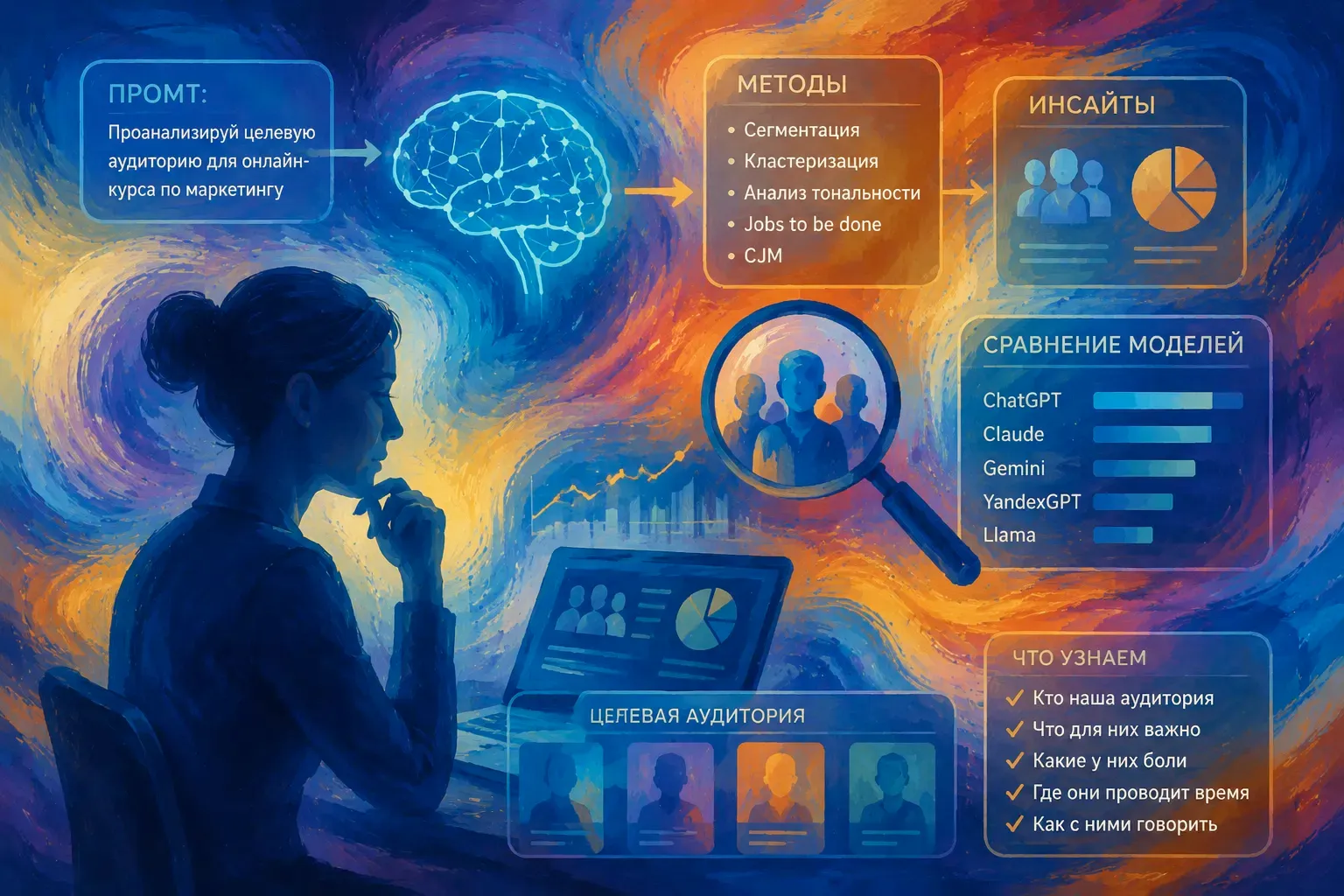
A real revolution in understanding consumer psychology came with the rise of large language models (LLMs) and generative AI. Neural networks learned to instantly analyze massive volumes of unstructured data: marketplace reviews, social media posts, forum discussions, and search queries. AI can effectively look deep into human psychology and extract hidden fears, non-obvious triggers, true barriers, and deep motivations that consumers themselves often can't articulate in direct surveys. The shift from intuitive guessing to precise AI-driven analysis lets small and medium businesses drastically cut spending on classic market research, which used to cost a fortune and take weeks.
How AI dissects an audience
An AI model acts as a highly experienced analyst-sociologist, able to process huge volumes of text without the fatigue a human would experience.
- Deep analysis of open sources. AI models integrate with scrapers that collect reactions and reviews from across the internet. The algorithm studies the words real people use to describe their everyday problems on forums, what complaints they leave in reviews on marketplaces and review platforms. AI identifies recurring metaphors and slang, letting a brand later speak to its audience in its own language.
- Sentiment detection. Modern language models flawlessly recognize not just positive or negative tone, but subtler shades of human emotion: sarcasm, disappointment, genuine admiration, anxiety, or hidden hope. This helps a business pinpoint consumer pain points precisely. For example, when analyzing reviews about flower delivery, AI might reveal that customers' main fear isn't price, but the risk of ruining a surprise for a loved one because the courier was late.
- Audience classification. Advanced algorithms can analyze a user's digital footprint and infer character traits from their texts. This allows splitting an audience into deep psychological types. A brand can offer conservatives stability and time-tested quality, while offering innovators exclusivity, technological breakthroughs, and bold emotional appeal.
- Matching products to buyers. AI can shift the analytical framework from "who is our customer" to "why does the customer buy our product." AI analyzes the life situations in which a need for a purchase arises. For example, the logical target audience for milkshakes at a fast-food restaurant is children and teenagers, but adult drivers often grab one too during a long morning commute.
Teaching AI to think like a marketer
The most common beginner mistake is sending short, vague prompts like: "Describe the target audience for a children's shoe store." In response, AI will generate a set of completely obvious, clichéd phrases that bring no practical value to your business. AI needs strict context, input data, and a clearly defined output format. Let's look at what that can look like.
Prompt instructions for AI: "Act as a leading UX researcher and expert in consumer behavioral psychology. We need to conduct a detailed target audience analysis for a local studio offering premium turnkey apartment renovations in a major city. Our unique selling proposition is a fixed estimate that doesn't increase during the project, and round-the-clock video monitoring of the site through a mobile app. The target segment is senior executives, entrepreneurs, and IT professionals with above-average income, buying apartments in business-class new developments.
Your task is to build a deep psychographic profile of the audience, completely avoiding banal phrases like "values quality" or "wants to save money." Break the analysis into 4 key segments based on their deep life tasks (using the Jobs-to-be-Done methodology).
For each segment, be sure to cover the following points:
- A real-life situation (situational trigger) that prompts them to hire our studio.
- Three hidden, non-obvious fears (barriers) that might make the client delay the purchase or doubt us.
- True internal motivators (emotional and social benefits of completing the renovation).
- Five specific, ready-to-use phrases (hook quotes) we can use on our website's hero section and in targeted ads to instantly grab their attention.
Present the result as structured blocks with subheadings, and use tables to compare segments."
Example answer for one segment:
Segment 1. "I can't afford to fall out of life"
Real-life situation
The client bought an apartment in a business-class new development, but their work rhythm is already overloaded: meetings, business trips, managing a team, running their own business or IT projects. They understand that a renovation could take months of their attention: approvals, site visits, disputes with contractors, sourcing materials, tracking deadlines. For them, renovation isn't a creative process — it's a risk of losing focus. They don't want to "live in a construction site," even mentally.
Hidden fears
| Barrier
|
What the client actually thinks
| | --- | --- | |
Losing control over their life
|
"I'll start the renovation, and then every day I'll be solving other people's mistakes instead of my own tasks"
| |
Becoming hostage to endless approvals
|
"At first everyone makes it sound great, and then I end up being the foreman myself"
| |
Getting a nice presentation but weak execution
|
"At the meeting it all sounds convincing, but who will actually be watching the workers?"
|
True motivators
The client wants to feel like they're not buying a renovation, but buying freedom from the process. It matters to them to get back to their own affairs and know the apartment is moving toward completion without their constant involvement.
The emotional benefit is peace of mind and the feeling of having made a mature managerial decision. The social benefit is being able to tell family, partners, or themselves: "I didn't get dragged into a construction project — I delegated it smartly."
Hook quotes for the hero section and ads
| #
|
Phrase
| | --- | --- | |
1
|
Business-class apartment renovation without daily calls, site visits, or oversight on your part
| |
2
|
You focus on work and family — we handle the renovation through to the finished result
| |
3
|
Turnkey means turnkey: no foreman role for the owner
| |
4
|
Premium renovation that doesn't take up your evenings, weekends, or attention
| |
5
|
The apartment gets ready for move-in while you get on with your life
|
Comparing AI models for audience research
| Comparison criterion
|
ChatGPT (OpenAI)
|
Claude (Anthropic)
|
Gemini (Google)
|
Other general-purpose models
| | --- | --- | --- | --- | --- | |
Maximum context window
|
High (holds the thread of a long conversation well)
|
Extremely high (you can load entire books and huge review datasets)
|
High (excellent at processing multimodal data)
|
Varies by model, generally moderate to high
| |
Quality of psychographic analysis
|
Excellent (deep understanding of behavioral triggers)
|
Outstanding (unmatched level of empathy and emotion decoding)
|
Excellent (strong at logical data structuring)
|
Good, but quality varies widely between providers
| |
Strengths when working with target audiences
|
Great for generating prompts, creatives, and JTBD segmentation
|
Excellent at surfacing hidden pains, insights, and fears from huge text datasets
|
Great at searching and analyzing real-time trends via search integration
|
Often strong in specific local languages or niche domains
| |
Main drawback
|
Sometimes prone to "hallucinations" and generic answers with weak prompts
|
Strict safety policies sometimes block harmless commercial requests
|
Text can feel overly dry and structured, lacking live empathy
|
Depth and reliability can be inconsistent across providers
|
Running an AI-driven audience research project from scratch
Step 1. Collect and prepare information
Go to the websites of your main competitors and open their product pages on independent review sites or major marketplaces. Copy 50–100 detailed user reviews — both glowing positive ones and sharply negative ones. Gather the questions potential customers ask in comments under posts in relevant communities. Copy this entire body of information into a single text file. Remember: the more alive, informal, and detailed these texts are, the deeper the insights AI will be able to extract in later steps.
Step 2. Set the context
In your first message, send the AI a command to set up context, without demanding an instant final answer. Write:
"I'm about to load a set of real reviews and comments from our product's customers. Your task at this stage is simply to read the text carefully, filter out spam, analyze the vocabulary, and confirm you're ready for further segmentation by replying: 'Data received, ready for analysis.'"

Paste in the text dataset you collected in step one and send the message. The AI will process the information and prepare its algorithms for the target task.
Step 3. Clustering and segmentation using the JTBD methodology
Once the AI confirms it has absorbed the data, send the structured segmentation prompt whose architecture we covered in detail above. Ask the AI to sort the whole customer base by their deep life tasks. At this stage, insist that the AI focus clearly on situational triggers: at exactly what moment does a person develop an urgent need for your product? Once you get a response, carefully review the proposed clusters. If any segment seems too vague or contrived, send a clarifying command:
"Segment #3 looks too general. Let's dig deeper into it. Analyze the loaded reviews again and highlight the specific traits of exactly this group of users."
Step 4. Finding pains, fears, and barriers
Move on to the most important stage — decoding consumer psychology. Send the AI the following request:
"For each confirmed target audience segment, build an empathy map. Identify three main pains (what problems are they trying to solve right now?), three key barriers (what's stopping them from paying on our website immediately?), and three hidden fears (what negative consequences do they imagine if the purchase goes wrong?). Base this strictly on the real complaints and quotes from the dataset loaded earlier."
Step 5. Crafting offers and creating ad creatives
In the final step, we turn pure analytics into concrete commercial tools that drive revenue. Ask the AI to convert the insights it found into ad headlines and calls to action (CTAs). The prompt might sound like this:
"Based on the fears and pains identified for each segment, write three versions of compelling ad copy for targeted advertising. Use the AIDA formula (Attention, Interest, Desire, Action). The tone should be persuasive, supportive, and completely free of aggressive hard-selling. Write the copy so the customer recognizes their own life situation in it."
Copy the generated variants, lightly edit them to match your brand voice, and launch them in test ad campaigns to measure real market conversion.
Risks, limitations, and ethical considerations of this approach
It would be a huge mistake to treat generative AI as an infallible expert able to fully replace a live human mind and classic marketing experience. AI is only a tool that works alongside your own expertise, and using it comes with a number of specific risks every researcher should keep in mind to avoid burning budget on flawed analytical conclusions.
Errors and hallucinations. The first and most important danger lies in what the industry calls "AI hallucinations." If you feed the AI too little real data or write a weak, abstract prompt, the algorithm, trying to please the user, will simply start making things up. It will generate an incredibly polished, logical, psychologically convincing audience portrait that has absolutely nothing to do with your actual market situation. That's why verifying every AI conclusion with common sense, personal experience, and targeted live surveys is a mandatory condition for successful research.
Quality of input data. If you copy fake, purchased competitor reviews or bot comments from social media for analysis, the AI will analyze that digital garbage with the same rigor as genuine customer pain points. You'll get a detailed breakdown of fictional problems that will steer your marketing strategy in the wrong direction. Always carefully filter your data sources before feeding them to the algorithms.
Protecting personal data. Finally, you can't ignore the legal and ethical nuances of working with sensitive information. Never upload your customers' personal data into public AI chat windows: their real names, phone numbers, personal email addresses, bank card numbers, or internal company reports containing strict trade secrets. All of this data could be used by platform developers to further train their models, which could lead to accidental leaks into the public domain. Only upload information in an anonymized, aggregated form, respecting your audience's privacy and strictly complying with data protection regulations.
How to balance AI analytics with human empathy
An AI model can flawlessly identify the structure of a text, break emotions down into clusters, and build neat tables, but it lacks the spark of genuine human empathy. AI doesn't know what it truly means to feel pain, celebrate a win, or feel deep relief from solving a long-standing problem. Real commercial success is born at the intersection of two worlds: the flawless, cold analytical power of AI and your own genuine human intuition, love for your product, and deep respect for your customers. Use AI as a wise, lightning-fast assistant, but always keep the final word, the right to creative risk, and a sincere, emotional dialogue with your customers for yourself!