
OpenAI has published an extensive study, Research acceleration: The jagged frontier, detailing how autonomous AI agents contribute to developing frontier neural network architectures. According to internal telemetry, between March and October 2026, the share of tasks completed by agents without human intervention surged from 23% to 46% in the category of work estimated to take an expert two to four hours. For four-to-eight-hour tasks, the completion rate jumped from 13% to 35%.
A crucial qualification must be emphasized: these workloads reflect internal operations within OpenAI's research divisions rather than open-ended scientific discoveries. The assignments primarily encompass infrastructure engineering, experiment telemetry monitoring, evaluation pipeline maintenance, and code refactoring. The duration denotes the estimated time a human researcher would spend on the task, not the agent's actual runtime. Furthermore, the 46% figure applies strictly to delegated operational tasks, not the share of research projects AI can conduct end-to-end autonomously.
Measuring the Acceleration of Autonomy
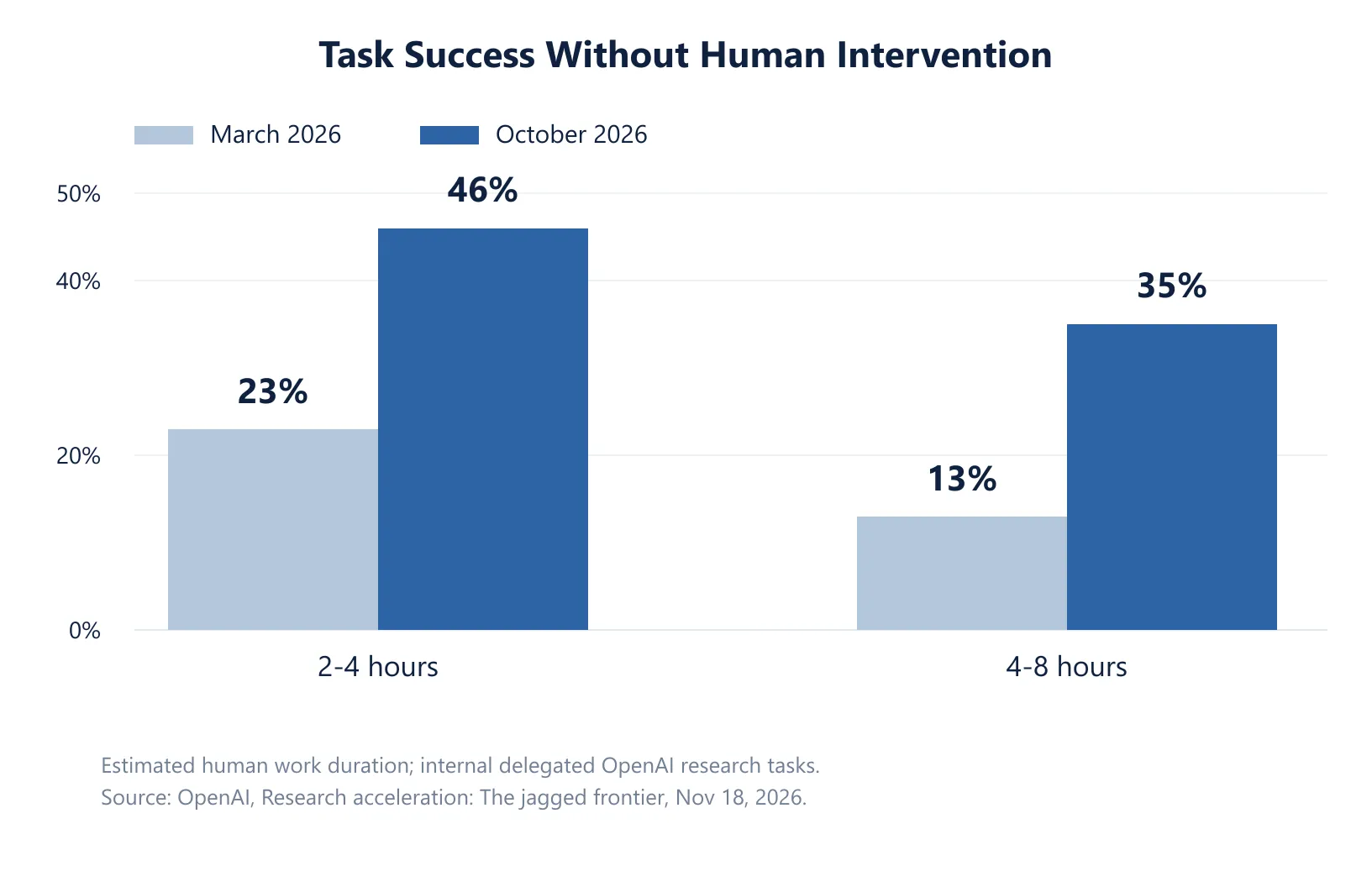
Figure 1. Estimated share of delegated research tasks resolved without human intervention. Duration reflects human labor hours, not agent execution time. Source: OpenAI.
Over a seven-month span, autonomous completion in the two-to-four-hour tier doubled, gaining 23 percentage points. In the more challenging four-to-eight-hour tier, success increased by 22 percentage points to 35%. This dynamic reflects a concrete shift: engineering routines that recently demanded dedicated developer time are increasingly handled autonomously by background agent workers.
However, the methodology comes with clear caveats. OpenAI notes that researchers evolve their delegation patterns over time. As models improve, team members may assign more difficult or, conversely, better-scoped tasks tailored to agent strengths. Consequently, performance shifts reflect both technological maturation and changing human adoption practices, rather than a static benchmark tournament.
Where Agents Excel — and Where They Fall Short
The most granular section of the report breaks down performance by task domain. The performance delta between writing core infrastructure code and monitoring running training clusters is substantial.
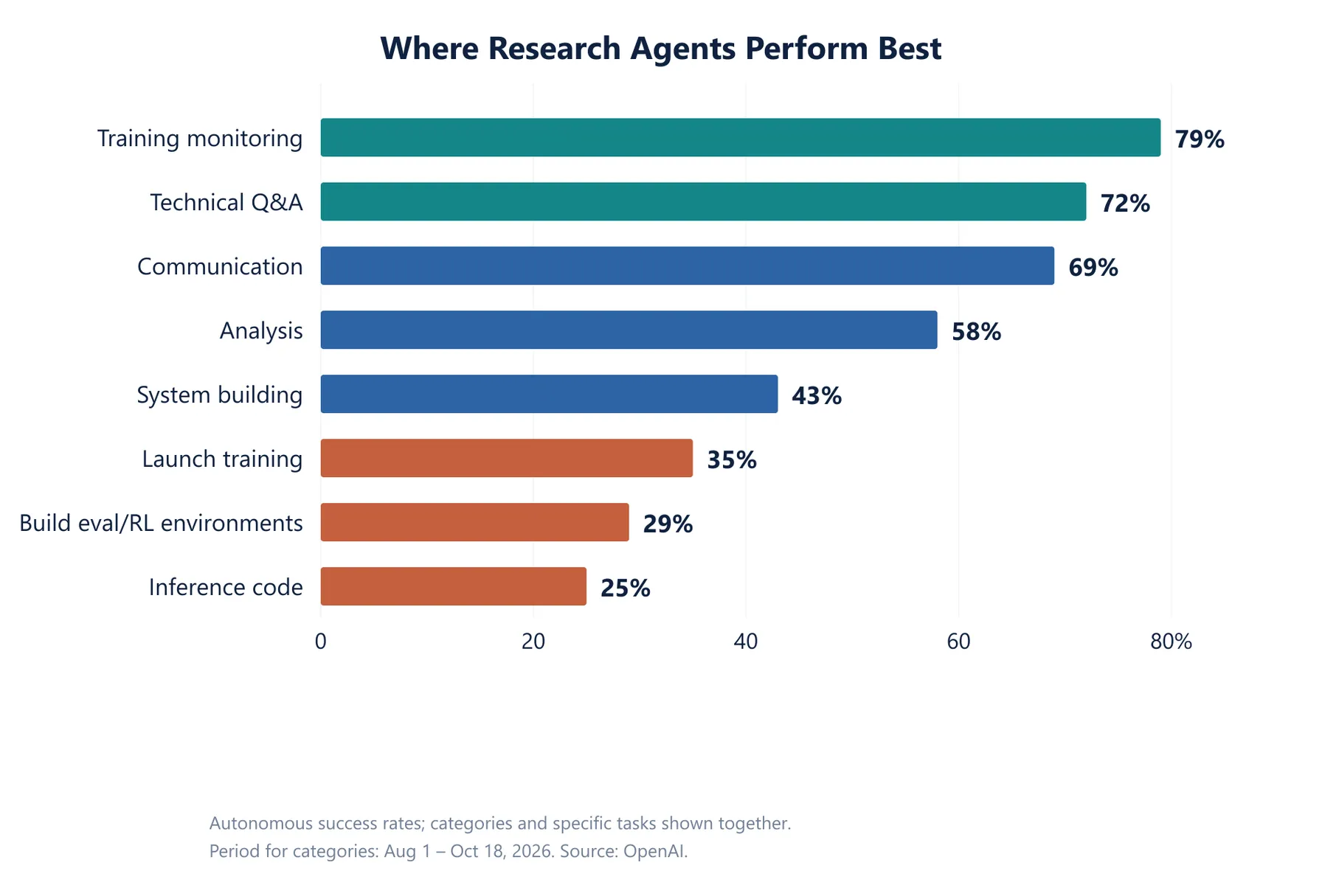
Figure 2. Autonomous success rates across task domains and specific actions. Categories vary in granularity and are not mutually exclusive. Source: OpenAI.
By high-level domain between August 1 and October 18, agents excelled at communication tasks (69%) and analysis (58%), but struggled with system and component construction (43%). Granular assignments revealed even sharper disparities: monitoring training runs reached 79%, answering technical questions hit 72%, while initiating training jobs managed 35%, setting up evaluation or reinforcement learning environments scored 29%, and writing inference/serving code landed at 25%.
This divergence is critical for understanding AI's practical role in frontier labs. An agent can autonomously parse logs from thousands of concurrent runs and flag anomalies. However, when required to reconfigure low-level distributed infrastructure, debug complex sandbox environments, or structure an experiment from scratch, the probability of unaided success drops sharply.
More Completed Tasks — But Is Research Actually Faster?
OpenAI provides several proxy metrics to gauge velocity. Over the four-week period ending October 18, the number of registered experiments per active researcher reached 1.68× relative to the 2025 baseline. Total modified lines of code also rose substantially. Nevertheless, the authors emphasize that raw experiment counts and code volume do not inherently equate to scientific discovery. Generating ten arbitrary test runs is less valuable than designing one rigorous experiment.
Separately, OpenAI tracks its internal OpenAI Epoch Capabilities Index (OECI), synthesized from proprietary and public benchmarks. The company estimates its frontier model trajectory at roughly 16.4 points per year since August 2025. By comparison, the public Epoch AI trend estimates roughly 14 points per year, though benchmark composition and weighting differ. Faster trajectory on an internal index does not conclusively prove agents caused the gain.
Compute Consumption: What Internal Researchers Spend
Equally striking is the scale of daily agent utilization. In October, median usage among researchers reached $2,400 per day evaluated at public API list prices, up from approximately $1,500 in September. At the 90th percentile, consumption escalated from $11,000 to $23,000 per day. Crucially, this represents an accounting metric based on public token pricing, not actual operating expenses or cash charges.
These figures illustrate a fundamental scaling shift: power users orchestrate dozens of parallel background threads, offloading large swathes of tactical engineering. Yet productivity remains bounded by how effectively human operators scope goals and review deliverables; lavish token expenditures do not guarantee breakthroughs.
Researcher Feedback: Strong Utility, Poor "Scientific Taste"
OpenAI surveyed 101 staff members across research teams. In a hypothetical scenario restricting access to advanced agents for three months, the median participant was willing to sacrifice 30% of their team's compute allocation or 40% of headcount to retain agent tooling. This indicates subjective workflow indispensability rather than evidence that agents can displace 40% of staff.
Interviews with ten senior researchers contextualize this sentiment. Agents dramatically accelerate dataset ingestion, test suite migrations, verification pipelines, and large-scale log audits. Concurrently, researchers highlight recurrent weaknesses: superficial hypothesis formulation, redundant exploratory paths, flawed analytical premises, and brittle code edits requiring manual rewrites. A prevalent workflow is to instruct an agent to produce one golden sample, inspect it rigorously, and only then authorize batched execution.
The report also observes evolving dynamics in conceptual ideation. For core breakthroughs powering GPT-6 Astra, researchers credited humans with fundamental concepts, delegating tactical execution to models. For GPT-6.2 Astra, however, co-ideation with Codex surfaced, with model suggestions directly aiding functional architectural discovery.
Industry Context: Anthropic, Google, and METR
Research acceleration has become an industry-wide focal point. Anthropic has shared internal evaluations regarding Claude's role in its own research lifecycles, while METR investigates the duration thresholds of autonomous coding agents. OpenAI's report explicitly contextualizes its findings against research from these organizations alongside Google DeepMind's reports on code assistance.
Direct numerical comparisons are fraught due to differing task suites, success criteria, and evaluation criteria. Nonetheless, a broad consensus emerges: autonomous engineering tasks are scaling in complexity, yet demand increasingly sophisticated supervisory architectures.
Safety and Recursive Self-Improvement
The feedback loop where frontier models help build successors creates the dynamics of recursive self-improvement (RSI). OpenAI explicitly states it has not achieved closed-loop autonomous model development. The authors urge labs to regularly publish verifiable acceleration benchmarks while keeping human judgment firmly in the loop.
Tellingly, documented employee hours dedicated to Safety & Alignment grew 77% from January to September 2026. OpenAI attributes part of this acceleration to post-incident safeguards following the July Hugging Face incident. Safety expansion is currently measured in allocated engineering effort rather than absolute vulnerability reduction.
Summary
The 46% benchmark marks tangible technical maturity, but its scope is bounded. OpenAI agents independently resolve nearly half of routine two-to-four-hour research tasks, whereas low-level infrastructure, environmental engineering, and novel experiment design remain stubborn bottlenecks. Current agentic strengths lie in executing voluminous, verifiable technical steps, while human researchers retain primary responsibility for framing questions, upholding rigor, and directing architectural decisions.