

AI for text analysis and checking is an assistant that's hard to do without these days, especially now that demand for content among internet users is growing at an incredible pace. At the same time, tasks are getting more complex, deadlines are shrinking, and content creators' attention to detail often suffers from overload.
This is exactly where artificial intelligence for text checking provides invaluable help. Some neural networks easily catch spelling mistakes, others fix punctuation, and others still work with logic, style, and structure.
The GPTunneL platform offers a variety of neural networks for handling checking-related tasks. We tested a range of models to find out which one is best at what.
What types of checks can AI perform
Modern models handle nearly the entire spectrum of tasks related to text quality:
- Spelling, punctuation, and syntax: neural networks for checking text literacy help find typos, spelling mistakes, misplaced commas and dashes, and syntactically inconsistent constructions;
- Style and readability: artificial intelligence can simplify delivery and make text smoother and more understandable;
- AI-likeness: services for checking text for AI generation can flag fragments generated by a neural network. The model can replace templated, overly smooth, or clunky phrases with more natural wording;
- Logic: when checking analytical texts, an AI tool can assess how logical a passage is, whether statements contradict each other, and whether the ideas are well structured;
- Fact-checking: with the right prompt, a neural network can confirm or refute the figures or facts presented in a text;
- Originality of ideas: AI for checking text for plagiarism can identify semantic similarity between the checked text and other sources. However, checking for plagiarism by form rather than content requires specialized services — not AI.
It's important to remember that each model is geared toward solving "its own" set of tasks. So when choosing the right service, start from the specific type of check you need.
Which neural network for text checking helps in a specific case
Gemini 3 Pro — accuracy, punctuation, spelling
This model is great for handling technical tasks: typos, word endings, agreement, missing punctuation marks. Gemini 3 Pro makes careful edits and barely interferes with the author's individual style.
This neural network for finding errors in text can process large volumes of information and edit:
- Instructions;
- Documentation;
- Business correspondence.
In short, Gemini is a strict-editing tool without spontaneous creativity.
GPT-5.1 — style, "humanizing," removing bureaucratic phrasing
If the task is to "humanize" a text, make it easy to read, lively, and natural, GPT-5.1 comes to the rescue. This model can significantly lighten complex constructions while staying within the given style guidelines. It handles long sentences, repetition, and awkward phrasing well. GPT is a great fit if you need to rework:
- An article;
- A landing page;
- Presentation material;
- Social media content.
GPT turns text into material that people will want to read and engage with.
Claude 4.5 Sonnet — logic, structure, cause-and-effect relationships
Claude 4.5 Sonnet is the editor that will instantly spot logical inconsistencies. It sees non-obvious contradictions, unfinished lines of reasoning, excessive generalizations, faulty conclusions, and semantic inconsistency between paragraphs.
This model is useful for checking:
- Reports;
- Business documents;
- Analytics;
- Academic papers.
DeepSeek V3.2 — fact-checking, numbers, statistics
You can actively use DeepSeek V3.2 to check:
- Facts;
- Numbers;
- Dates;
- Terms;
- Historical events;
- Statistics.
DeepSeek easily spots discrepancies between what's written and the actual state of affairs. That makes this neural network a great tool for journalists, financial analysts, and educators, for example.
LLaMA 4 — a solution for semantic plagiarism checking
LLaMA 4 Scout is a neural network for checking text originality in a semantic sense. It finds templated constructions, strong semantic overlap between fragments, and repeated passages — anything that could hurt uniqueness.
It's a handy tool for anyone who needs to run an initial text check without relying on paid third-party services, at least at first.
Tool availability
Every service mentioned can be found on the GPTunneL platform. The platform lets you quickly run a combined check:
- Literacy — with Gemini;
- Style — with GPT;
- Logic and structure — with Claude;
- Fact-checking — with DeepSeek;
- Originality — with LLaMA.
And you won't have to pay for a subscription — you only pay for the actual requests you make.
Practical case studies
Spelling and grammar (Gemini)
Prompt:
"Check the text below for spelling and grammar. Preserve the author's style and don't rewrite the meaning. Fix only the errors.
Format:
- Corrected text.
- List of corrections."
Result
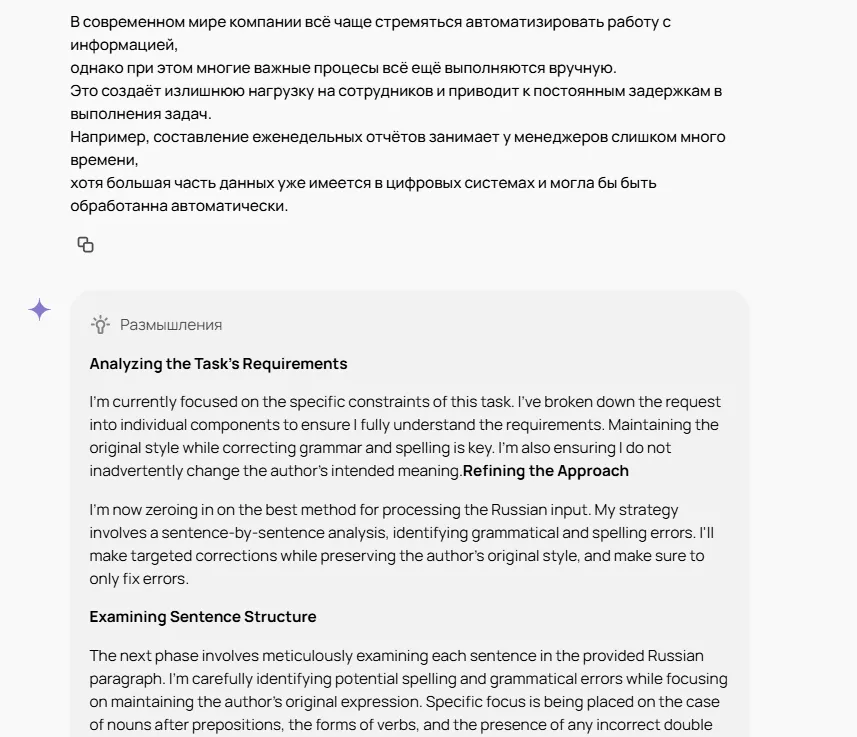
Gemini fixed typos and grammatical errors without disrupting the text's structure or style of delivery. The corrections involved verb forms, cases, and words with doubled consonants. For each correction, the neural network gave a brief explanation.
You can review the breakdown here.
Punctuation (Gemini + Claude)
Here we used two models at once. Gemini handled technical editing — correct placement of punctuation marks — while Claude handled meaning and syntax.
Prompt for Gemini:
"Check the text for punctuation and fix only the punctuation marks. Don't rephrase anything.
Format:
- Corrected text.
- List of corrections."
Result
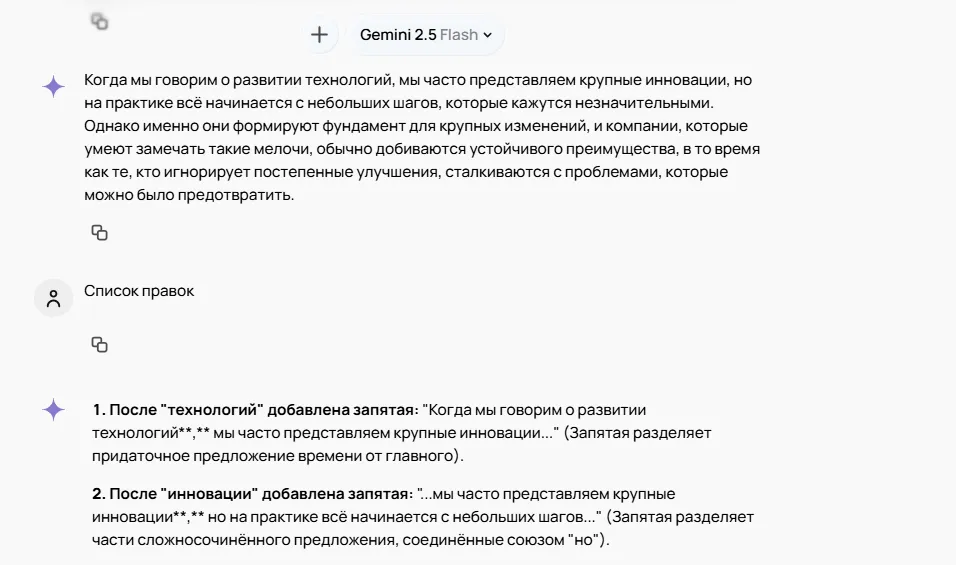
The model added all the missing commas, splitting complex constructions that had run together. It didn't change the style, only handled punctuation. And, of course, it explained each edit.
See Gemini's result here.
Prompt for Claude:
"Make punctuation edits that improve meaning and readability. Explain each edit."
Result
Claude changed the structure of the text. It split a couple of unwieldy sentences into several shorter ones. This improved readability and made the main idea easier to grasp quickly. It also replaced a comma with a dash in one place.
That syntactic choice emphasized the contrast between the two companies being compared. As a result, readability improved while the content stayed unchanged.
You can review Claude's work in this chat.
Style check and removing bureaucratic phrasing (GPT-5.1)
Prompt:
"Rewrite the text so it sounds natural, lively, and easy to read. Remove bureaucratic phrasing, heavy constructions, and excessive formality. Don't change the meaning.
Format:
- Improved text.
- Which phrases were changed and why."
Result
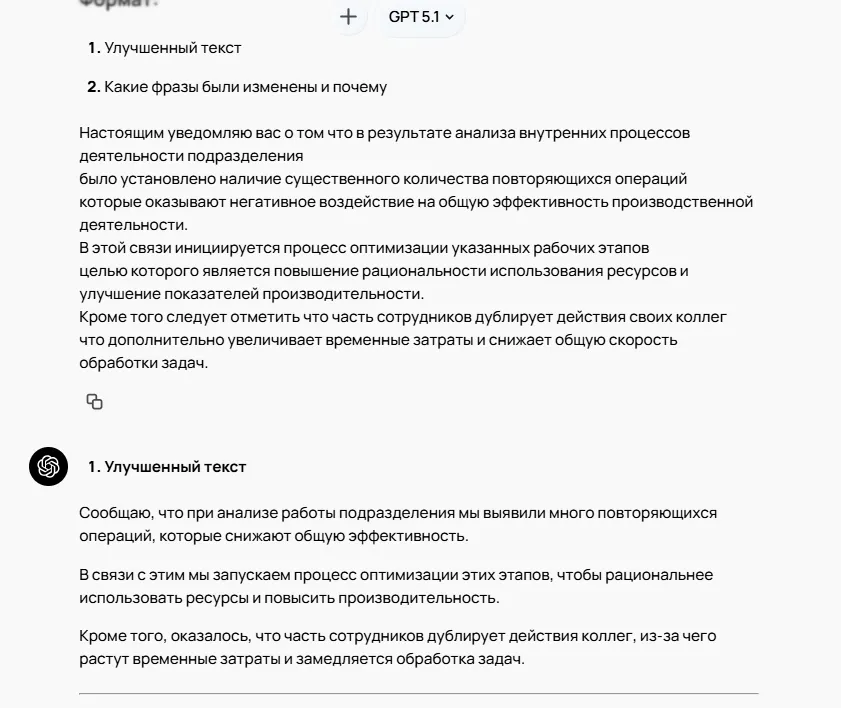
The model simplified unwieldy constructions, cleaned up bureaucratic phrasing, made the delivery livelier and more natural, and even worked on punctuation. The meaning was fully preserved throughout.
See how GPT transformed the text here.
Fact-checking (DeepSeek)
Prompt:
"Check the factual accuracy of the text.
Indicate:
- incorrect facts;
- correct data + sources;
- suggested edits."
Result
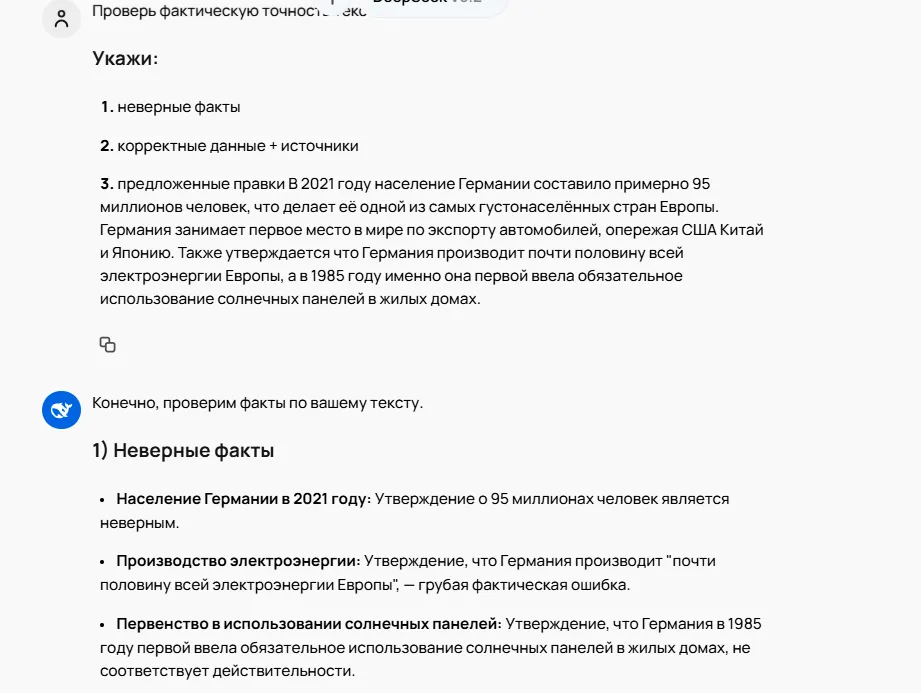
The model identified several factual errors:
- the population figure was overstated by nearly 12 million;
- the country's share of European electricity production is much less than half (19%);
- the claim about a 1985 law mandating solar panel installation was inaccurate.
The car export data was largely accurate for 2021 but needed clarification for the 2022–2025 period.
DeepSeek also proposed an edited version of the text with correct figures and facts. It provided source links as well, but one of them didn't open, and another led to a website's homepage rather than to the specific publication that supported the claim. That means the facts need deeper verification.
You can review DeepSeek's work by opening this conversation.
Originality check (LLaMA)
Prompt:
"Check the text for semantic originality. Find fragments that sound formulaic or generic. Suggest alternatives that preserve the meaning but increase originality."
Result
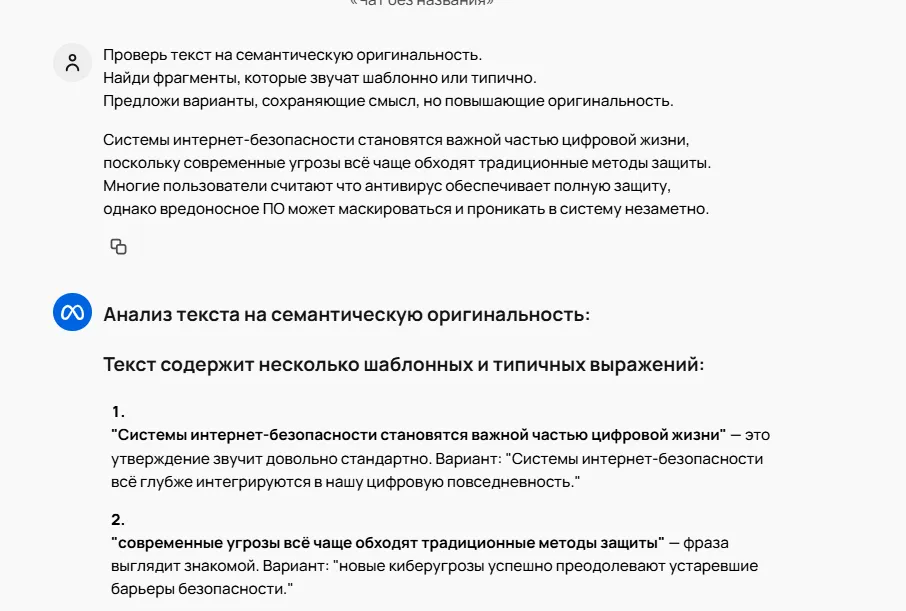
LLaMA found several generic, clichéd phrases like "an important part of digital life" or "modern threats bypass traditional protection methods." The model suggested removing these patterns and replacing them with livelier, more original wording. And the overall meaning wasn't affected by this editing.
The resulting text turned out easier to read and, at first glance, fairly unique.
You can read it in full here.
Comprehensive check (Claude)
Prompt:
"Do a comprehensive check:
- spelling;
- punctuation;
- style;
- logic;
- fact-checking;
- AI-sounding phrasing;
- originality.
Keep the structure intact.
Format:
- Corrected text.
- Error table.
- Recommendations."
Result
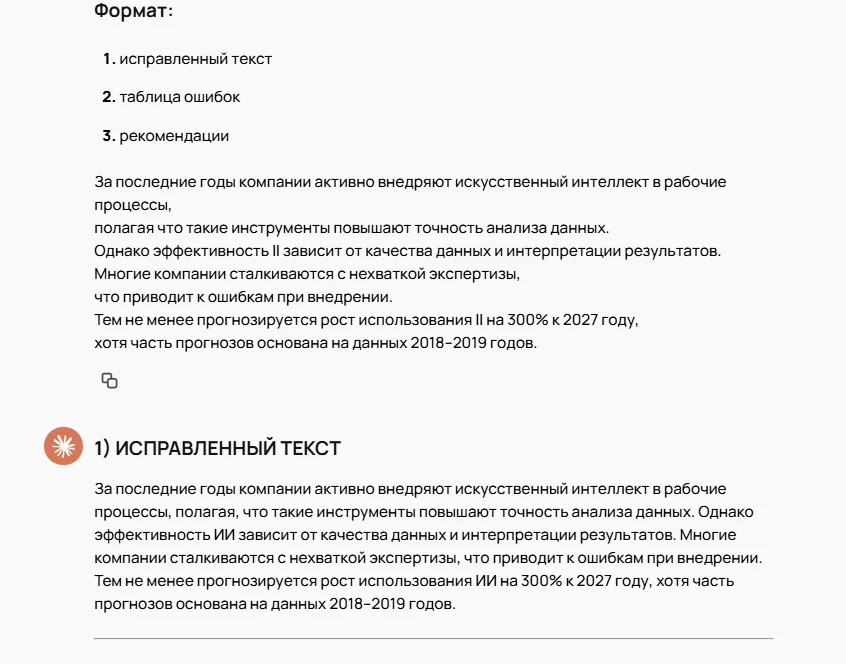
Claude edited the punctuation, replaced Latin characters with the correct script where needed, pointed out logical inconsistencies, and noted that the 300% growth forecast was based on outdated data, so its reliability remains questionable.
The neural network also identified AI-sounding clichés in the text and "wasn't happy" with the lack of specifics and supporting arguments. Claude recommended backing up the text with clearer wording, additional details, and facts.
To see the neural network's full "diagnosis," check out this chat.
How to write effective prompts
- State the task clearly: "Find errors," "Assess the logic";
- specify constraints: "Don't change the structure";
- define the response format: as a list, a table, two blocks, with explanations;
- paste the text that needs editing.
With a well-crafted prompt, the neural network will give you exactly the result you're looking for.
Conclusion
AI for checking text for errors is one of the most effective "remedies" for inattention and the "mental fatigue" that comes with editing.
By combining "detector" models for spelling, punctuation, style, logic, facts, and AI traces, you can quickly get quality content that engages readers. And GPTunneL's convenient interface makes the editing process as simple as possible.