
OpenAI opens ChatGPT for business: companies will be able to verify their profiles, manage product information, track mentions, and create their own AI consultants. This innovation may change not only online shopping, but also the very principle of brand promotion on the internet. Instead of competing for a spot in search results, companies will increasingly fight to be featured in AI recommendations.
On November 10, 2026, OpenAI introduced Businesses in ChatGPT — a set of tools that allows companies to interact directly with the ChatGPT audience. According to the developer, 1.2 billion people use the service weekly.
Until now, companies had almost no control over how ChatGPT presented them to users. The neural network independently collected data from open sources, compared products, and generated recommendations. Now, businesses have the opportunity to verify their brand ownership, provide up-to-date information, and analyze their presence in AI responses.
But the most intriguing part of the announcement is Business Agents, virtual company representatives capable of communicating with potential customers directly inside ChatGPT.
How business profiles and AI agents work
The new system consists of two main components.
Business Hub — the company's personal dashboard in ChatGPT. Through this hub, businesses can verify their profiles, update descriptions, add information about products and services, and upload product catalogs with current prices and availability.
After verifying identity and representative rights via the Persona system, a profile can receive a special verification badge.
For Shopify sellers, there is a simplified integration. Their product catalogs can already be used in ChatGPT through the Shopify Catalog.
Business Agents — AI consultants representing a specific company. Users can open a dialogue with such an agent directly from the brand profile that appears in the ChatGPT response.
For example, someone asks the neural network which robot vacuum is best for an apartment with pets. ChatGPT suggests several suitable options from different manufacturers. Interested in one of the brands, the buyer opens its profile and asks clarifying questions to the brand's AI agent:
- What are the differences between the two models, and which one is better for picking up fur?
- What are the warranty and return policies for the selected model?
- Is there a cheaper option with similar features?
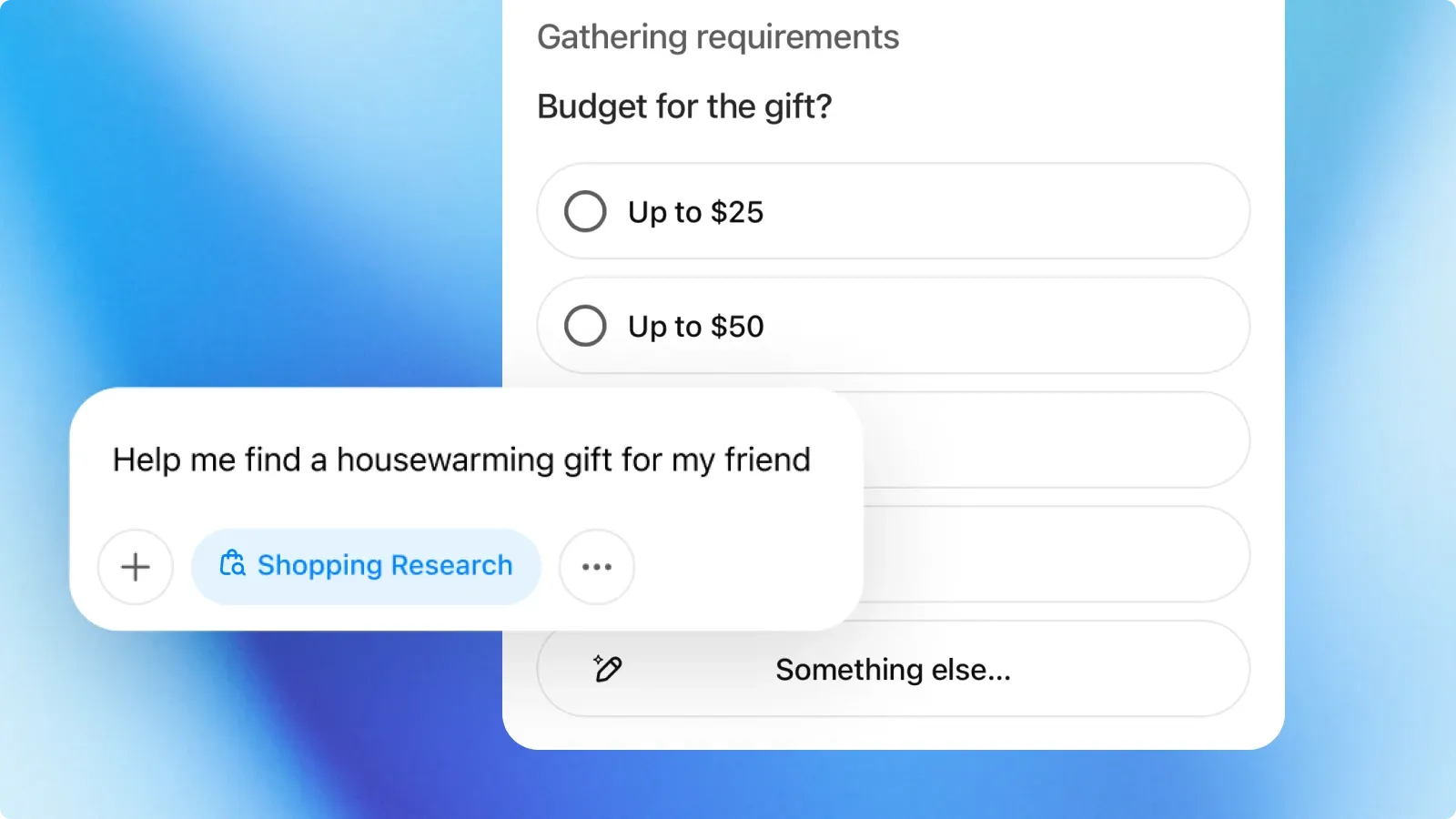
Example of Business Agent at work: Colorful Clatter AI consultant selects products based on the buyer's preferences and budget.
The agent responds based on the company's information, its catalog, and preset instructions.
At the same time, regular ChatGPT and Business Agent are not the same thing. The main assistant is supposed to provide independent recommendations, while the agent represents the interests of a specific seller. Their conversation will be separately indicated and won’t be mixed with the original chat.
Companies can configure the consultant's instructions and informational basis, but currently cannot connect their own independent agent system in place of it.
At the first stage, Business Agents are available to eligible online stores and online services in the US. Profile verification covers a wider range of companies and regions, but also depends on availability and verification criteria.
ChatGPT gets its own analytics for brand presence
Another important part of the update is analytics tools that show how often ChatGPT recommends or mentions a company.
Business Hub now features the following metrics:
- Mentions — the number of times the company is mentioned. For online businesses, cases when ChatGPT links to their website are counted; a mere mention of the brand name is not enough.
- Website clicks — user visits to the website from supported ChatGPT interfaces.
- Discovery topics — general request and response topics where users discover the company.
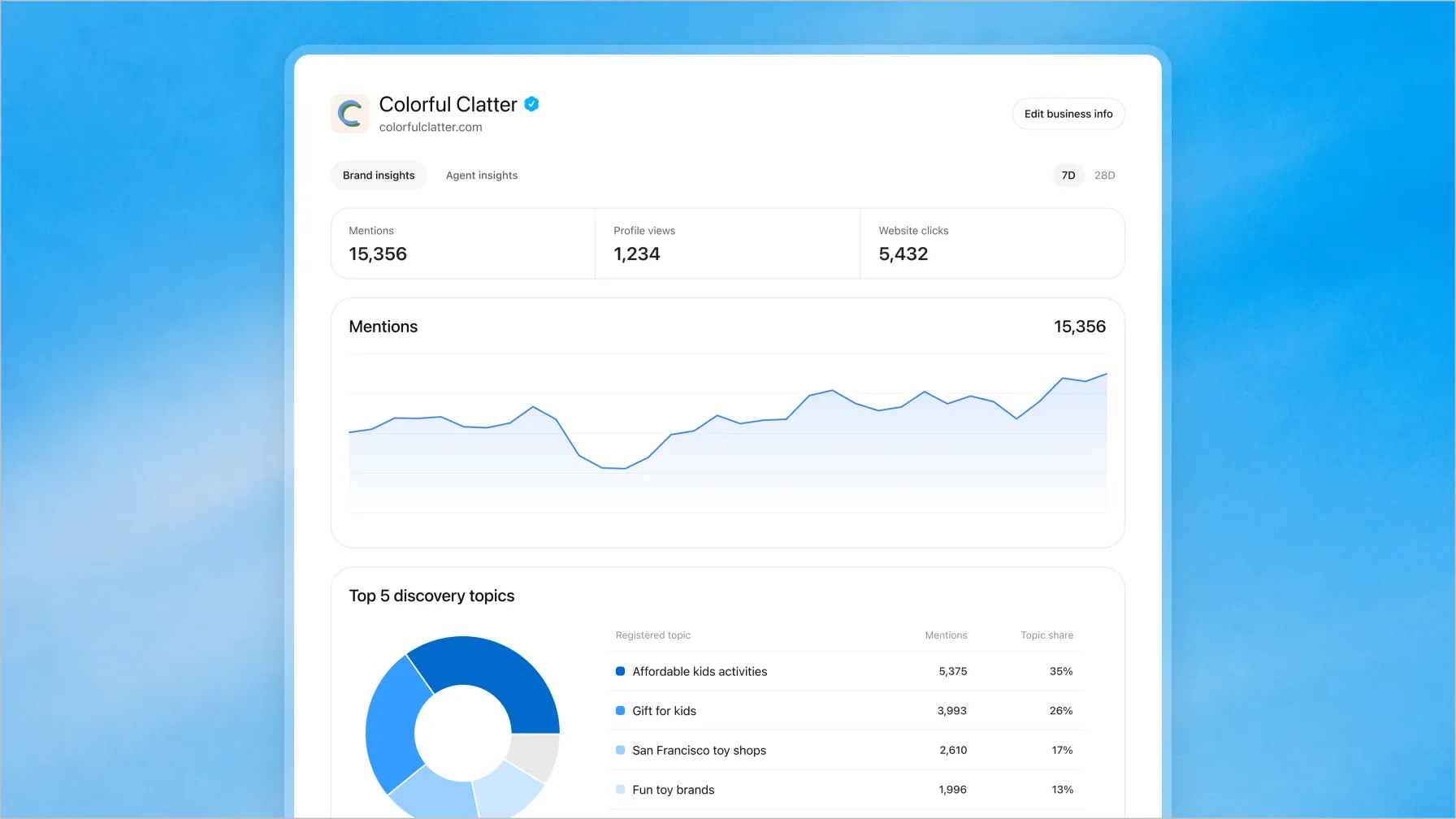
Example of brand analytics in Business Hub: mentions, profile views, website clicks, and topics through which users find the company.
The data is presented in an aggregated form, in particular for the last 28 days. OpenAI does not share individual user queries or conversations with companies, including chats with their Business Agents.
This is an important limitation: the new tool is not yet an equivalent of Google Search Console with a complete list of search phrases, impressions, ranking positions, and CTR.
Nevertheless, for the first time, companies are receiving analytics data about their presence directly from OpenAI, not just external results measured through third-party services.
For the GEO (Generative Engine Optimization) market — optimizing for generative search engines — this is a significant development.
Previously, specialized platforms assessed brand visibility by sending artificially generated queries to neural networks and analyzing the responses. This approach allows competitor tracking, but does not show the actual frequency of the company being mentioned in all user dialogues.
Now, businesses have an additional source of data based on real activity inside ChatGPT.
Will it be possible to buy a place in ChatGPT recommendations?
OpenAI separates organic presence from advertising.
Profile verification, adding products, or creating a Business Agent do not guarantee higher positions in neural network recommendations.
OpenAI's VP of Monetization, Benji Shomair, told Digiday that the company sees Business Agents as an organic way for brands to interact with customers.
At the same time, brands will be able to promote their agents through ChatGPT Ads. In such cases, users will see a sponsored placement leading to a dialogue with the company's AI representative.
Sponsored blocks will be distinctly labeled and should not influence the independent answers provided by ChatGPT.
Thus, a two-tier system emerges: brands can appear in recommendations organically or draw user attention via paid ads.
Creating a profile and agent is currently free, but OpenAI does not rule out changes to the monetization model in the future.
This is part of a major trend: AI becomes the new middleman between buyer and seller
This update is not an isolated experiment. Over the last year and a half, major tech companies have consistently developed tools for commerce via artificial intelligence.
OpenAI began building this infrastructure as early as 2025.
In September 2025, the company introduced Instant Checkout — the ability to purchase products directly via ChatGPT using the Agentic Commerce Protocol, developed jointly with Stripe.
In March 2026, an updated product search launched with visual cards and feature comparison. At that time, OpenAI acknowledged the limitations of the initial Instant Checkout implementation and shifted focus towards search and product selection, leaving sellers the option to process orders via their own stores.
Business Agents continue this strategy: ChatGPT helps a person choose a product and then hands the interested buyer off to the brand for the next stage of interaction.
Google is already developing similar tools
Interestingly, OpenAI is not the first company to introduce branded AI consultations.
In 2026, Google also launched a tool called Business Agent for customers to interact with companies via search.
In September, Google announced the expansion of Business Agent into YouTube ads. Users can now ask questions about products directly inside a sponsored ad.
At the same time, Google enabled brand presence analytics for AI Mode and AI Overviews via Merchant Center in several countries.
Moreover, Google already provides share-of-presence comparison with other brands — a feature not available at launch in OpenAI's Business Hub.
In October 2026, Google also launched Universal Cart in the US — a universal basket uniting products from different stores.
Thus, both companies are moving toward a similar model: AI helps users discover products, compare offers, receive consultations, and proceed to purchase.
Amazon and Walmart choose different strategies
For the largest online retailers, the issue is even more complicated: a third-party AI agent can bring in traffic but simultaneously deprive the platform of ad impressions and a degree of customer interaction control.
In a Reuters market study published November 4, it was noted that Amazon and Walmart are taking diverging approaches.
Amazon is developing its own commercial AI assistants and is restricting the access of some third-party agents to its platform.
Walmart, on the contrary, is building infrastructure for external agents: they can interact with buyer accounts with user permission and with set purchase restrictions.
According to Morgan Stanley analysts quoted by Reuters, by 2030, AI agents could account for 10–20% of US e-commerce spending. This is a forecast, not the current market share.
China is already testing AI-commerce in real purchases
The most illustrative results are appearing in China, where trading and payment functions have long been combined within large digital platforms.
According to Reuters data from November 11, in October about 5% of purchases on Douyin happened via links from AI chatbots. For some product categories requiring more careful selection, the share exceeded 20%.
JD.com reported nearly 80 million users of its commercial AI Assistant Dongdong during Singles' Day sales — more than three times greater than a year earlier.
These figures cannot be directly translated to the US or Russian markets. However, they show that conversational interfaces are already making a significant impact on real purchases, not just displaying products in experimental modes.
What experts say: GEO may become the new SEO industry
The appearance of official ChatGPT analytics has drawn the attention of digital marketing specialists.
Farhad Divecha, head of the agency Accuracast, told Digiday that his team used third-party services like Peec AI, Otterly AI, and Semrush to assess brand presence in AI responses.
In his opinion, data directly from OpenAI will allow brands to check how accurate previous estimates were. If differences are significant, companies will have to reassess the value of some paid tools.
Sonata Insights founder and industry analyst Debra Aho Williamson highlighted another consequence.
The emergence of data from ChatGPT itself may weaken the positions of third-party GEO platforms. However, OpenAI does not disclose all its information, and ChatGPT is only one of several major AI platforms. Therefore, the need for independent monitoring will persist.
The main change is the emergence of a new type of marketing data: companies can now not only check what the neural network answers to seeded questions, but also gauge part of the real user interactions with their brand.
However, it is still unknown how sufficient the new metrics will be for evaluating promotion effectiveness. The number of mentions does not equal the number of buyers, and website clicks do not reflect the full value of interacting with AI.
New features bring new risks
There is an important problem: the more actively people use neural networks for shopping, the higher the cost of mistakes in recommendations.
On November 12, The Verge published results of a study by Podqi about dangerous links in the responses of commercial AI assistants.
Researchers tested 6,795 answers to questions about 151 brands. The sample included queries about where to buy products, which sites are official, and whether regional stores exist.
Potentially dangerous addresses — fake, inactive, or other risky sites — appeared in 15% of Perplexity answers, 8% of ChatGPT answers, and 4% of Gemini answers.
The study was conducted on specially designed queries, so the results cannot be taken as the overall probability of receiving a harmful link during any normal use of these services.
However, the issue is real. A buyer may mistake an AI's inaccurate recommendation as endorsing the authenticity of a store.
Verified profiles may potentially reduce confusion about brand ownership and website validity, though mere verification does not guarantee error-free answers.
There's another complication — the independence of advice.
A branded Business Agent, by definition, represents the interests of a specific company. They can help customers choose products, but are not obliged to suggest competitor offerings or objectively assess the entire market.
Therefore, OpenAI specifically requires such agents not to pose as independent consultants, not to invent features or prices, and not to use manipulative sales tactics.
It is important for buyers to distinguish between an independent ChatGPT recommendation and a consultation from an agent representing a seller with vested interests.
What will change for SEO and company promotion
For businesses, the launch of Business Hub means the emergence of yet another platform where up-to-date information must be maintained.
Previously, the main goal was to make a website visible in search engines. Now, there's an added need to present products and services correctly to AI systems that independently select offerings.
Not only do traditional SEO factors matter, but also the completeness of product specifications, up-to-date pricing, delivery and return conditions, structured data, and reliable company information.
Especially interesting is the shift from short commercial queries to detailed descriptions of needs.
Instead of "best laptop," a person may ask AI to find a device for working with large spreadsheets, with good battery life, and within a certain price range.
In such cases, simply mentioning a keyword on a page is not enough. The neural network requires information that allows it to match a company's offer with the user's specific requirements.
It’s also important not to exaggerate the significance of the new tool. Profile verification does not guarantee an advantage in recommendations, and OpenAI continues to use other sources of business information.
Therefore, working with Business Hub should complement, not replace, the development of the company's website, SEO, and other customer acquisition channels.
Conclusion: from search results to brand dialogue
The launch of Businesses in ChatGPT shows what the next stage of e-commerce development may look like.
Previously, a user would find a company through search results, visit the website, and independently study the product range. Now, more decisions may be made in a single dialogue with artificial intelligence.
For shoppers, this means more convenient comparison of offers and the ability to get clarifying answers on the spot.
For businesses — a new customer acquisition channel, new analytics tools, and new competition for presence in recommendations.
For search engines and marketplaces — a battle for control over the decision point in the buying journey.
The most important part of the OpenAI announcement is not the launch of yet another AI consultant, but the attempt to turn ChatGPT into an independent infrastructure for buyer-brand interaction.
For now, Business Agents are limited to certain business categories in the US, and analytics capabilities remain relatively modest. But combined with similar developments from Google, Amazon, Walmart, and Chinese retail platforms, this already looks less like a standalone feature and more like a stable trend in e-commerce development.