
GPTunneL review. Benchmark data current as of November 13, 2026.
Google has recently been surprising the AI market with models that legitimately compete for top spots. The recently released Gemini 4 Carbon stands out as arguably the best frontier model in intelligence-to-cost ratio. But where does Gemini 4 Hydrogen fit?
At first glance, Hydrogen might be puzzling: its benchmark scores rival Gemini 4 Argon, yet it is faster and significantly cheaper. Let's examine where Hydrogen belongs in today's model landscape.
Google released Gemini 4 Hydrogen on November 12, 2026. The company positions it as a high-speed execution model tailored for coding, document processing, and AI agents—systems designed to inspect files, execute tools, and carry out autonomous sequences of actions.
Key takeaway: In GPTunneL's benchmark index, Hydrogen ranked 8th in overall intelligence. It excels at analytical tasks, responds exceptionally well to user guidance and steering, and translates code cleanly across languages. However, in autonomous debugging of unknown repository bugs, it trails several nearby competitors.
Comparing it to familiar alternatives clarifies its position. For instance, GPT-6.1 Sol achieved a higher overall score and is on average 38% cheaper across standardized task suites. Yet Hydrogen takes roughly 40% less time to generate complete responses in Artificial Analysis benchmarks. Compared to the flagship Gemini 4 Carbon, Hydrogen is approximately 23% cheaper and almost twice as fast. These cost figures reflect identical standardized test runs; subscription quotas behave differently, as discussed below.
What Is Gemini 4 Hydrogen and Why Google Built It
A Fast Execution Model in the Gemini Family
In Google's lineup, Hydrogen complements Gemini 4 Carbon and Gemini 4 Argon. Carbon is built for heavy reasoning and complex planning, Argon also targets high-complexity logic, while Hydrogen focuses on day-to-day execution where speed, strict instruction following, and tool interaction are critical. According to the Google DeepMind technical card, Hydrogen derives from the Carbon architecture, though Google has not disclosed exact architectural modifications.
Example: When building an application, a frontier model can design the system architecture, while Hydrogen writes individual functions, edits files, and runs validation suites. Google has formalized this approach in the Antigravity Orchestrator, which routes subtasks across different models. In Google's Terminal-Bench 4.0 evaluation, this coordinated setup ran 19% faster and consumed 24% less quota than relying solely on Carbon without delegation. See Google's announcement.
Core Specifications
| Parameter | What It Means in Practice |
|---|---|
| Multimodal Support | Text, images, audio, video, and documents. The model can inspect spreadsheets, visual diagrams, and codebases in supported applications. |
| Up to 1M Token Context | Accepts massive datasets in a single prompt, such as substantial chunks of a repository. Real limits depend on the client environment and output overhead. |
| Reasoning Modes | low, medium, high, xhigh: from rapid straightforward answers to deep multi-step thinking with increased token usage. |
| Standard Output Limit | Up to 65,536 tokens per generation segment; the API supports streaming extensions for longer outputs. |
| Google API Pricing | $1.50 per 1M input tokens and $7.50 per 1M output tokens, including internal thinking tokens. |
| Training Cutoff | Knowledge cutoff: March 2026. Live updates require web search tools. |
What does xhigh mode offer? The model spends more time analyzing the query and allocates more tokens to intermediate reasoning. This can improve solutions for intricate challenges, though it raises latency and token expense. For example, Artificial Analysis recorded 54 points for Hydrogen in xhigh mode.
Where Hydrogen Ranks Across All Models
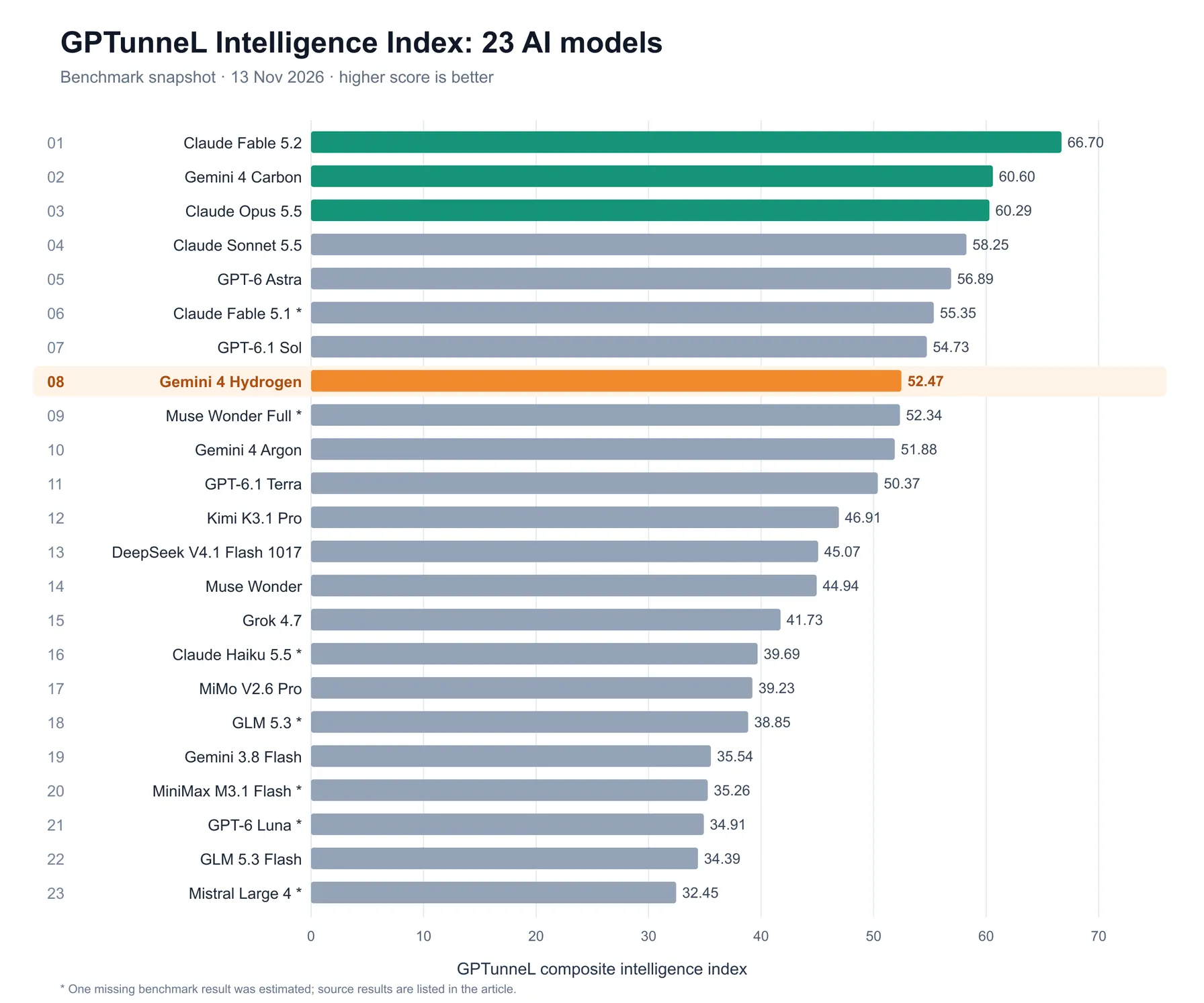
We aggregated data across six independent benchmarks—standardized evaluation suites testing identical problem sets. A combined rating allows direct comparison across multiple capabilities, while individual test results remain verifiable in the table below.
GPTunneL tracks 85 model configurations. The final leaderboard features 23 models that have completed at least five of the six selected benchmarks. Hydrogen has published measurements across all six and lands in eighth place.
Full Leaderboard: Overall Index, Cost, and Raw Benchmark Scores
In this table, the first two numeric columns are GPTunneL calculations: the Intelligence Index and the Cost Index. The remaining six columns contain published raw benchmark scores used to calculate the intelligence metric.
- AA (Artificial Analysis), Vals, and LiveBench evaluate reasoning, software engineering, and general intelligence across distinct scales.
- WebDev evaluates frontend UI generation; Elo represents a comparative matchmaking rating similar to chess ranking systems.
- Agent Arena captures net performance improvements when models use tools and incorporate feedback; negative numbers indicate regression compared to zero-shot baselines.
- Bug Hunt measures how many of 105 hidden bugs were successfully localized and fixed on average.
Higher is better across all six benchmarks. For the Intelligence Index, higher is also better, whereas for the Cost Index, lower indicates greater affordability. The cost methodology is explained in detail in the next section.
| Rank | Model | Intelligence Index | Cost Index | AA | Vals | LiveBench | WebDev, Elo | Agent Arena, % | Bug Hunt, /105 |
|---|---|---|---|---|---|---|---|---|---|
| 1 | Claude Fable 5.2 | 66.70 | 5.837 | 65 | 71.31 | 84.9 | 1838 | 30.48 | 58.0 |
| 2 | Gemini 4 Carbon | 60.60 | 1.073 | 60 | 70.45 | 83.5 | 1768 | 16.90 | 57.3 |
| 3 | Claude Opus 5.5 | 60.29 | 3.482 | 59 | 70.14 | 83.4 | 1815 | 19.51 | 41.7 |
| 4 | Claude Sonnet 5.5 | 58.25 | 2.297 | 55 | 70.85 | 77.0 | 1772 | 16.07 | 51.3 |
| 5 | GPT-6 Astra | 56.89 | 2.787 | 57 | 65.02 | 84.5 | 1764 | 14.56 | 45.0 |
| 6 | Claude Fable 5.1 | 55.35* | 4.418 | 49 | n/a | 84.0 | 1742 | 14.62 | 43.0 |
| 7 | GPT-6.1 Sol | 54.73 | 0.513 | 55 | 63.94 | 81.4 | 1743 | 12.40 | 44.3 |
| 8 | Gemini 4 Hydrogen | 52.47 | 0.828 | 54 | 68.49 | 77.0 | 1704 | 14.80 | 32.7 |
| 9 | Muse Wonder Full | 52.34* | n/a | 50 | 66.79 | n/a | 1723 | 8.89 | 42.0 |
| 10 | Gemini 4 Argon | 51.88 | 0.902 | 50 | 69.39 | 77.7 | 1681 | 10.72 | 40.7 |
| 11 | GPT-6.1 Terra | 50.37 | 0.308 | 51 | 60.54 | 78.8 | 1678 | 11.96 | 40.7 |
| 12 | Kimi K3.1 Pro | 46.91 | 0.629 | 46 | 62.52 | 68.7 | 1687 | 4.83 | 36.0 |
| 13 | DeepSeek V4.1 Flash 1017 | 45.07 | 0.099 | 33 | 61.26 | 70.3 | 1664 | 2.01 | 42.7 |
| 14 | Muse Wonder | 44.94 | 1.237 | 44 | 64.88 | 70.7 | 1647 | 1.67 | 31.7 |
| 15 | Grok 4.7 | 41.73 | 2.031 | 35 | 58.62 | 67.9 | 1641 | 2.49 | 29.0 |
| 16 | Claude Haiku 5.5 | 39.69* | 0.158 | 36 | 58.73 | 68.9 | 1593 | 0.42 | n/a |
| 17 | MiMo V2.6 Pro | 39.23 | 0.068 | 30 | 57.81 | 66.1 | 1625 | 2.16 | 22.7 |
| 18 | GLM 5.3 | 38.85* | 0.998† | 32 | 59.85 | n/a | 1622 | 0.93 | 19.0 |
| 19 | Gemini 3.8 Flash | 35.54 | 0.829 | 31 | 55.95 | 57.3 | 1583 | 2.34 | 18.0 |
| 20 | MiniMax M3.1 Flash | 35.26* | 0.094 | 29 | 53.78 | 63.7 | 1584 | -2.76 | n/a |
| 21 | GPT-6 Luna | 34.91* | 0.043 | 28 | 52.32 | 60.4 | 1577 | 1.52 | n/a |
| 22 | GLM 5.3 Flash | 34.39 | 0.102 | 28 | 50.86 | 60.7 | 1609 | -2.94 | 17.7 |
| 23 | Mistral Large 4 | 32.45* | 0.387 | 26 | 56.53 | 40.9 | 1564 | 5.64 | n/a |
Reading missing values: n/a indicates no published benchmark result. An asterisk * beside the Intelligence Index indicates that a missing value among the six tests was imputed statistically; the raw column retains n/a to distinguish measured data from estimates. A dagger † beside the Cost Index marks an estimated missing price. For Hydrogen, all six intelligence benchmarks and all three price inputs are directly measured. Reasoning settings and tool configs may vary between models.
Understanding the Index Scores
The GPTunneL Intelligence Index reflects composite model performance normalized against a fixed reference group of 16 models with full data across all six benchmarks. The baseline average of this reference group is set at 50 points.
Consequently, 52.47 for Hydrogen sits slightly above the reference average; 54.73 for Sol is 2.26 points higher, and 60.60 for Carbon is 8.13 points ahead. These are relative benchmark points, not accuracy percentages: a 2.26-point lead does not mean "2.26% smarter." As new models are added, the reference baseline remains anchored.
How the index is calculated
To combine heterogeneous benchmarks, each raw score undergoes anchored Z-normalization—calculating the distance from the 16 reference models' mean divided by their standard deviation. Normalized scores are then combined with weights: 40% split across Artificial Analysis, Vals, and LiveBench, 25% for Arena WebDev, and 35% split across Agent Arena and Bug Hunt. Seven models with a single missing metric use statistical imputation. Full formulas and sources are listed at the end of this review.
What this shows for Hydrogen: While ranking eighth overall, it surpasses several higher-ranked models in specific subcategories. The next question is how much each task costs and how quickly answers arrive.
Cost: Comparing Hydrogen and Competitors by Task Expense
Important note: Pricing comparisons reflect API token consumption. Subscription plans package compute quotas differently. The fact that Sol 6.1 is more cost-effective than Hydrogen or Sonnet via API does not necessarily mean an equivalent OpenAI subscription tier yields more compute than Google or Anthropic plans.
Our composite Cost Index draws from three benchmarks: Artificial Analysis, LiveBench, and Arena WebDev (full methodology in the dropdown below). Across these diverse task suites, Hydrogen runs roughly 62% more expensive than GPT-6.1 Sol, 23% cheaper than Gemini 4 Carbon, and about 2.7x more expensive than GPT-6.1 Terra. Compared to budget models like DeepSeek V4.1 Flash, Hydrogen costs roughly 8.4x more.
How we calculate the Cost Index
Actual task costs are gathered from three platforms: Artificial Analysis, LiveBench, and Arena WebDev. On each platform, average task cost is normalized against a fixed reference anchor; the three ratios are then combined via geometric mean. The Cost Index represents relative expense, so it directly computes cost multiples between models. The score 0.828 for Hydrogen is an index value, not $0.828 per call. For instance, 0.828 / 0.513 = 1.62: on this test basket, Hydrogen is 1.62x more expensive than Sol.
Underlying benchmark costs used for the index:
| Model | Artificial Analysis, $/task | LiveBench, $/successful task | Arena WebDev, $/task | Cost Index |
|---|---|---|---|---|
| GPT-6.1 Terra | $0.96 | $0.673 | $0.65 | 0.308 |
| GPT-6.1 Sol | $1.27 | $0.823 | $1.86 | 0.513 |
| Gemini 4 Hydrogen | $3.16 | $1.924 | $1.35 | 0.828 |
| Gemini 4 Argon | $4.97 | $1.822 | $1.17 | 0.902 |
| Gemini 4 Carbon | $5.48 | $2.024 | $1.61 | 1.073 |
| DeepSeek V4.1 Flash | $0.60 | $0.195 | $0.12 | 0.099 |
Why do numbers vary across benchmarks? Each platform evaluates different workloads. In WebDev, Hydrogen is cheaper than Sol ($1.35 vs $1.86), but in Artificial Analysis, it is more expensive ($3.16 vs $1.27). The unified index balances all three dimensions. For real-world engineering, prioritize the costs on workloads that match your actual pipeline.
Pareto Frontier: Are There Models Stronger and Cheaper?
The Pareto Frontier represents models where no single alternative offers both higher intelligence and lower cost. On the plot, each dot represents a model. Higher dots indicate stronger benchmark performance; dots further left indicate lower cost per task.
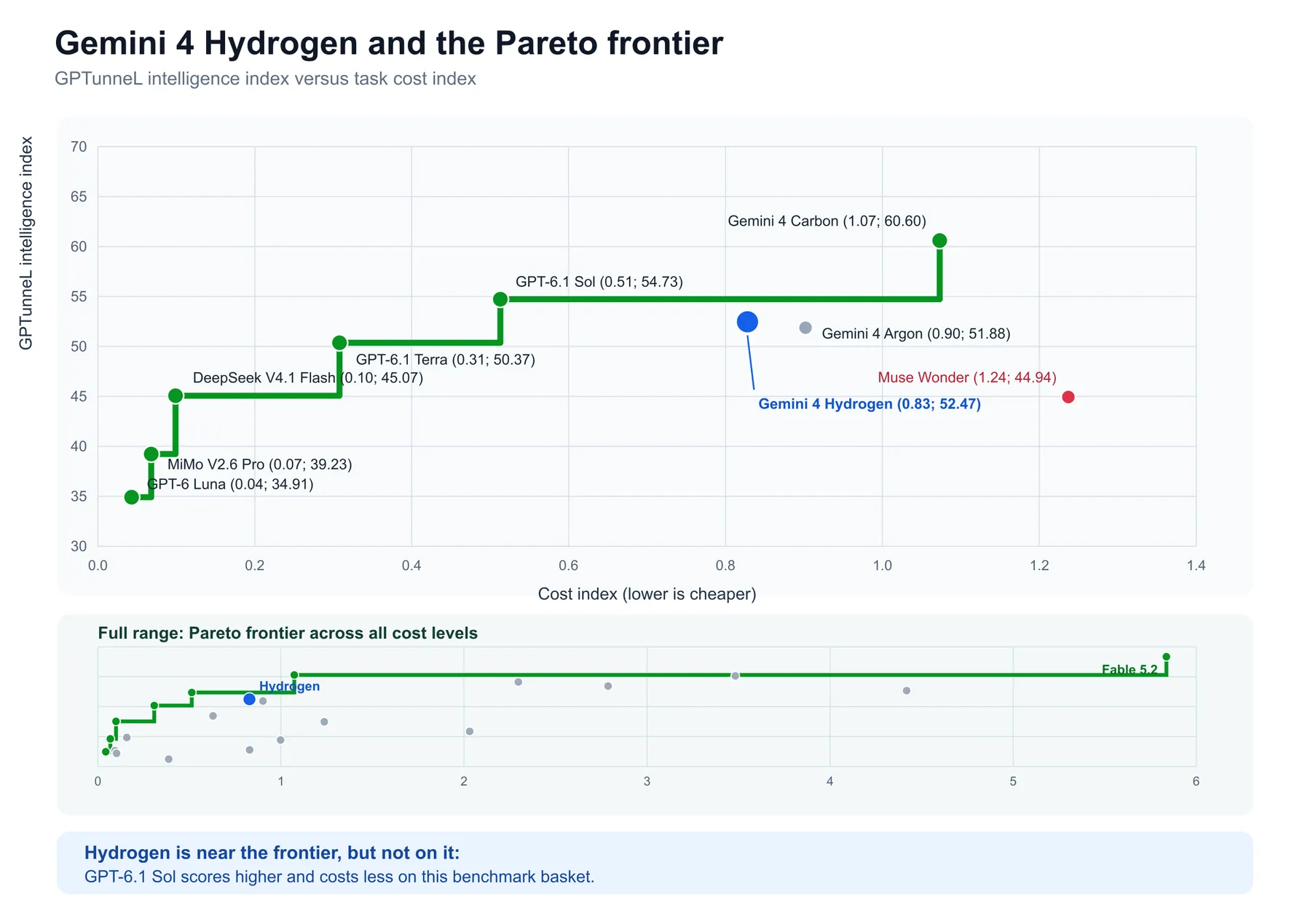
In this comparison, Hydrogen sits outside the strict Pareto frontier: Sol scores 54.73 vs 52.47 and costs 38% less.
Practical Test: Auditing a 5,000-Row Keyword Campaign Report
To examine how the model performs on real-world work, we tasked Gemini 4 Hydrogen, GPT-6.1 Sol, and DeepSeek V4.1 Flash with auditing an actual 5,000-row paid search performance report. The dataset contained three deliberate traps: one synthetic row with corrupted metrics, an entry with inflated revenue numbers, and a duplicate row differing only by letter case.
All three models identified all three planted traps.
Beyond the planted traps, the dataset featured 18 natural ambiguities and edge cases. Claude Fable 5.2 acted as an independent judge, evaluating how each model handled all 18 cases and cataloging factual errors in their summaries.
Relative spend is compared against DeepSeek (set to 1x). For Sol, expenses reflect its active 50% discount.
| Model | Relative Spend vs DeepSeek | Planted Traps | Edge Cases (Fable 5.2) | Factual Errors | Fable 5.2 Score |
|---|---|---|---|---|---|
| DeepSeek V4.1 Flash | 1x | 3 of 3 | 14 of 18 | 5 | 9 |
| GPT-6.1 Sol | 40.95x | 3 of 3 | 18 of 18 | 0 | 18 |
| Gemini 4 Hydrogen | 47.36x | 3 of 3 | 11 of 18 | 1 | 10 |
Hydrogen produced the most expensive run and delivered a comparatively dry summary.
GPT-6.1 Sol produced the most comprehensive and actionable audit. Hydrogen's report was succinct but missed nuanced business insights. DeepSeek performed respectably, but made one calculation error by double-counting conversions from the duplicate row despite having identified the duplicate earlier. Under Fable's rubric, Sol earned a perfect 18 points, versus 10 for Hydrogen and 9 for DeepSeek.
These runs reflect single evaluations on one workload; results may differ on different datasets.
How Fast Is Hydrogen?
To compare throughput and latency, we look at the standardized Artificial Analysis task duration metric.
For repetitive background workflows, latency is critical. Once accustomed to getting results in 60 seconds, waiting 5 minutes disrupts engineering flow. Looking at Hydrogen's score neighbors with latency included shifts the picture in its favor:
| Model | Intelligence Index | Relative Cost Index | AA Duration, min |
|---|---|---|---|
| GPT-6.1 Terra | 50.37 | 0.308 | 14.7 |
| GPT-6.1 Sol | 54.73 | 0.513 | 23.2 |
| Gemini 4 Hydrogen | 52.47 | 0.828 | 13.9 |
| Gemini 4 Argon | 51.88 | 0.902 | n/a |
| Gemini 4 Carbon | 60.60 | 1.073 | 28.6 |
Hydrogen completes the AA task suite in 13.9 minutes vs 23.2 minutes for Sol, saving roughly 40% in wall-clock time. In applications where user-facing latency is paramount, this speed advantage can justify the price premium.
Looking across the broader leaderboard:
| Model | Artificial Analysis Task Duration |
|---|---|
| GPT-6 Luna | 11.8 min |
| Mistral Large 4 | 12.3 min |
| Gemini 4 Hydrogen | 13.9 min |
| GPT-6.1 Terra | 14.7 min |
| Gemini 3.8 Flash | 14.9 min |
| GPT-6.1 Sol | 23.2 min |
| Gemini 4 Carbon | 28.6 min |
| Claude Fable 5.2 | 46.1 min |
Hydrogen ranks 3rd in speed among 20 models with published AA duration data.
Independent developer Simon Willison asked Hydrogen, Argon, and Carbon to code an SVG graphic of a pelican riding a bicycle. Hydrogen finished in 19 seconds, Argon took 2 minutes 29 seconds, and Carbon required 4 minutes 11 seconds. However, Hydrogen produced a noticeably simpler illustration, using fewer tokens. This illustrates the trade-off between execution speed and aesthetic or algorithmic depth. See Willison's benchmark.
In production, evaluate the triad: output quality, wall-clock latency, and cost per successful execution. A fast response that requires manual revision quickly becomes more expensive than a slower, ready-to-use answer.
Subscription vs API Usage
On API tiers, billing is strictly tied to token volume: reasoning overhead, repeated tool calls, and retries accumulate on your invoice. Under subscription tiers, pricing is flat-rate, but bounded by rate limits. Consequently, a model that is nominally more expensive per token via API may prove more economical within an existing subscription if quota allowances let it finish more workflows.
Another critical factor is prompt caching. When prompts share large prefixes, cached input tokens are billed at steep discounts. In a Hacker News discussion, an engineer from Artificial Analysis pointed out that cache hit ratios explain much of the variance in reported benchmark costs. For API buyers, evaluating effective cost per completed unit of work is far more informative than looking at raw list prices.
Hydrogen and Its Closest Competitors
A single aggregate score can obscure domain-specific strengths. Capabilities, pricing, and latency diverge significantly among models clustered around the same score tier.
| Model | Intelligence Index | Cost vs Hydrogen | AA Duration |
|---|---|---|---|
| Claude Fable 5.1 | 55.35* | 5.3x more expensive | 22.3 min |
| GPT-6.1 Sol | 54.73 | 38% cheaper | 23.2 min |
| Gemini 4 Hydrogen | 52.47 | baseline | 13.9 min |
| Muse Wonder Full | 52.34* | insufficient data | n/a |
| Gemini 4 Argon | 51.88 | 9% more expensive | n/a |
| GPT-6.1 Terra | 50.37 | ~2.7x cheaper | 14.7 min |
Asterisks denote one statistically imputed benchmark.
Hydrogen vs GPT-6.1 Sol:
Sol holds 54.73 vs 52.47 in overall intelligence and is 38% cheaper. Hydrogen is faster on AA: 13.9 vs 23.2 minutes. In targeted domains, Hydrogen beats Sol: 68.49 vs 63.94 on the Vals Index and +14.80% vs +12.40% in Agent Arena. However, Sol resolves significantly more hidden bugs on Bug Hunt: 44.3 vs 32.7 out of 105. Sol is the sensible default for complex batch reasoning; Hydrogen shines when latency matters.
Hydrogen vs Gemini 4 Argon:
Overall ratings are neck-and-neck: 52.47 for Hydrogen vs 51.88 for Argon. Hydrogen is about 8% cheaper. In LiveBench, Argon demonstrates stronger multi-step logic (95.1 vs 88.6) and fixes more bugs (40.7 vs 32.7). Hydrogen edges ahead in Agent Arena (14.80% vs 10.72%) and Vals Code Migration (82.7% vs 74.4%). Argon fits complex logic; Hydrogen suits structured, tool-assisted execution.
Hydrogen vs GPT-6.1 Terra:
The intelligence difference is minor: 52.47 vs 50.37. However, Terra is nearly as fast on AA (14.7 vs 13.9 min) and roughly 2.7x cheaper. Terra should be tested first for high-volume pipelines where budget efficiency outweighs incremental score gains.
Hydrogen vs Claude Fable 5.1:
Fable 5.1 scores 55.35 vs 52.47, but costs 5.3x more on our benchmark basket and takes 22.3 vs 13.9 minutes on AA. Hydrogen is far more pragmatic for standard operations where top-tier frontier compute is unnecessary.
Hydrogen vs Muse Wonder Full:
The score difference is a negligible 0.13 points: 52.47 vs 52.34. Given incomplete pricing data for Muse Wonder Full, running custom benchmarks on your specific pipeline is more informative than tenths of an index point.
What About Budget Models and Previous Generations?
DeepSeek V4.1 Flash 1017 scored 45.07 vs 52.47 for Hydrogen, but costs ~8.4x less. In code synthesis, the two are close, and DeepSeek leads in Bug Hunt: 42.7 vs 32.7 bugs fixed. MiMo V2.6 Pro is ~12.2x cheaper than Hydrogen, though lower on general benchmarks (39.23). For straightforward utility tasks, cost savings often outweigh Hydrogen's lead.
Comparing Hydrogen against Gemini 3.8 Flash highlights generational progress:
| Metric | Gemini 3.8 Flash | Gemini 4 Hydrogen |
|---|---|---|
| Intelligence Index | 35.54 | 52.47 |
| Average Relative Cost across 3 Tests | 0.829 | 0.828 |
| AA Duration | 14.9 min | 13.9 min |
| LiveBench: Overall | 57.3 | 77.0 |
| LiveBench: Data Analysis | 54.0 | 83.2 |
| Bug Hunt: Fixed Bugs (/105) | 18.0 | 32.7 |
| Agent Arena: Net Improvement | +2.34% | +14.80% |
Across this benchmark suite, token costs remained virtually identical while capabilities jumped significantly. However, short-context user tests can show higher expenditure with Hydrogen due to increased reasoning token allocation.
Domain Strengths and Weaknesses
Data Analysis: A Standout Area
In LiveBench Data Analysis, Hydrogen scored 83.2, ranking 3rd among 35 models. Only Carbon (86.5) and Argon (85.2) scored higher; it surpassed Astra (83.0), Sol (82.7), and Claude Fable 5.2 (81.5).
An independent evaluation by Plotly, creators of data visualization tooling, benchmarked models on DataAnalyticsBench across 43 analytical tasks, including finding hidden patterns and dataset flaws. Hydrogen and Sol both completed 43 of 43 tasks; Carbon solved 42, and Argon solved 41. With identical accuracy, Sol proved faster and cheaper: median 18s vs 32s per task, costing $2.61 vs $6.36 for the full suite. See Plotly's benchmark.
Hydrogen is exceptionally proficient at tabular data transformations, mathematical parsing, and summary generation.
Agentic Workflows: Highly Steerable
In Agent Arena, which measures agent workflows with tools and interactive feedback, Hydrogen achieved +14.80% in Net Improvement, taking 5th place. More remarkably, its Steerability reached 20.53%, ranking 2nd overall. Steerability measures an agent's ability to correct course after user feedback. For comparison, Carbon scored 19.06%, Opus 5.5 reached 18.41%, and Sol scored 13.25%; only Fable 5.2 ranked higher at 32.91%.
In real workflows, this translates into high reliability in iterative loops: "draft initial solution -> review -> revise." However, challenges emerge when bugs must be discovered independently without hints.
Programming: Strong Code Migration, Weaker Bug Hunt
| Benchmark | Hydrogen | Baseline Comparisons |
|---|---|---|
| Vals Code Migration: Porting working programs across languages | 82.7% | Carbon 80.1%; Argon 74.4%; Sonnet 87.4% |
| Arena WebDev: Frontend interface creation | 1704 Elo | Argon 1681; Sol 1743; Carbon 1768 |
| Bug Hunt: Locating and fixing unguided repository bugs | 32.7 of 105 | Argon 40.7; Sol 44.3; Carbon 57.3 |
This contrast is telling. In Code Migration, the logic is known: the model ports working functionality to another language. In Bug Hunt, the model must autonomously inspect an unfamiliar repository to pinpoint defect roots. Hydrogen excels at the former, but struggles on the latter.
Across three Bug Hunt runs, Hydrogen scored 43, 27, and 28 fixes, highlighting significant variance. Tooling environments also influence outcomes. Yet the model can tackle sophisticated bugs: in a hands-on review by MindStudio, Hydrogen isolated a backend defect causing Japanese and Korean currency conversions to display 100x lower than actual values.
Scientific and Long-Horizon Reasoning
On HLE-Diamond testing difficult expert questions, Hydrogen matched Sol at 58.8%. On Terminal-Bench-Science, which requires multi-step research with bash tools, coding, and math, it scored 49.5%, trailing Sol (58.1%), Terra (57.6%), and Argon (52.9%).
While capable of answering concise scientific questions, prolonged multi-step investigations expose consistency limits.
Tax, Financial, and Legal Analysis
On Vals Tax Agent, Hydrogen scored 52.30%, slightly ahead of Carbon (51.78%) and Argon (49.22%). On Vals Finance Index, it scored 66.14%, and on Legal Research, 53.85%. These numbers show promise for structured documents and statutory lookup, though its lead over Carbon in tax tasks (0.52%) is modest.
High-stakes compliance and legal workflows always warrant human-in-the-loop verification.
Visual Document Parsing
Strong tabular skills do not translate directly to complex chart or messy layout parsing. In Artificial Analysis's MKA evaluation for visual document understanding, Hydrogen scored 49.52%. In LiveBench Reasoning, it scored 88.6 vs 95.1 for Argon.
Standard tables are a strong suit; intricate infographic flowcharts or ambiguous scanned layouts still demand caution.
Two Models with Equal Total Scores, Divergent Strengths
Comparing Hydrogen with Claude Sonnet 5.5 illustrates this divergence. Both earned an identical 77.0 on overall LiveBench, but their internal profiles differ substantially:
| LiveBench Category | Hydrogen | Sonnet 5.5 |
|---|---|---|
| Data Analysis | 83.2 | 59.5 |
| Coding | 78.5 | 77.2 |
| Browser Navigation | 77.1 | 89.3 |
| Complex Reasoning | 88.6 | 91.6 |
Hydrogen outperforms Sonnet by 23.7 points in data analysis, but trails by 12.2 points in web browsing. Across our reference basket, Hydrogen is roughly 2.8x cheaper than Sonnet. Looking strictly at aggregate rank would miss these domain specializations.
What Developers and the Community Say
Discussions across Hacker News and Reddit are predominantly positive. Developers highlight a noticeable improvement over Gemini 3.8 Flash, fast latency, strong document comprehension, and rapid UI prototyping. Opinions diverge when comparing against Carbon, Argon, and Claude models.
Early Enterprise Case Studies
Google's launch announcement shared feedback from early access enterprise partners:
| Organization | Workload | Reported Result |
|---|---|---|
| Box | Processing large enterprise documents and spreadsheets | ~2x faster than 3.8 Flash, with 12% fewer tokens |
| Pixelcut | 276 visual design automation tasks | Completed all tasks, with a 1.8x speedup |
| Cartwheel | Complex technical bug unresolved with previous models | Hydrogen identified two architectural issues and resolved them |
| LatchBio | Antibody safety and toxicology screening | 67% success rate vs 37% for the best non-Gemini competitor |
| STAN | Strict JSON schema compliance and response latency | 28% latency reduction, 23% token savings |
See Partner case studies in Google's launch post.
Independent Experiments
Puter evaluated hallucination rates. Researchers posed 16 questions containing incomplete or intentionally false premises, repeating each three times against Hydrogen and Gemini 3.8 Flash. Across 48 responses per model, Hydrogen yielded one hallucination, compared to six from 3.8 Flash. Median latency was 3.2s vs 4.7s, though 48 calls cost $0.232 vs $0.047 on Flash due to expanded thinking tokens. See Puter's analysis.
MindStudio tested bug hunting and loan assessment. In one workflow, Hydrogen isolated a currency calculation flaw. In another, coordinating four subagents, it audited commercial loan files to flag cash flow mismatches, counterparty concentration, and collateral shortfalls. See MindStudio's review.
Reddit: Highlights and Pain Points
Hardware and PCB review: A developer in r/google_antigravity used several models to review a multi-layer circuit board design, noting that Hydrogen caught subtle signal integrity risks missed by Carbon, Argon, and Opus, alongside some false alarms.
Financial PDF extraction: In r/Bard, a user reported analyzing multi-page quarterly PDFs in 3–4 seconds in Hydrogen Medium with modest quota usage, where Argon previously took two minutes.
Game engine AI setbacks: In r/GeminiAI, a developer shared that Hydrogen introduced bugs into a complex game engine state machine, requiring Carbon to intervene and fix regressions.
Hacker News Insights
Speed does not always equate to lower invoices: Developer data-ottawa noted that while Hydrogen reduced task duration by 40–60% vs 3.8 Flash, cost per completed task rose by 37% due to internal reasoning tokens.
The executor model pattern: Developers frequently discuss setups where frontier models generate plans and Hydrogen executes file operations and tests. This mirrors Google's Antigravity Orchestrator concept.
Agent side-effect risks: A commenter in Hacker News observed that agents sometimes perform redundant actions or edit unintended files. In autonomous pipelines, predictability often matters more than raw benchmark numbers.
When to Choose Hydrogen vs Alternatives
| Use Case | Is Hydrogen the Right Choice? | Key Considerations |
|---|---|---|
| Spreadsheet analysis & reporting | Top candidate | 83.2 on LiveBench Data Analysis, 43/43 on Plotly; Sol may be cheaper |
| Iterative code & document refinement | Strong choice | 2nd place in Steerability, responsive to feedback |
| Porting code to another language | Strong choice | 82.7% on Code Migration; tests still required |
| Rapid UI prototyping | Viable | Good 3D & WebDev Elo; visual polishing may be needed |
| High-volume low-cost API calls | Compare Terra, DeepSeek, MiMo first | Far cheaper on high-volume pipelines |
| Autonomous bug hunting in large repos | Consider Sol or Carbon | Hydrogen resolved fewer unknown bugs on Bug Hunt |
| Multi-stage research & calculation | Consider deeper reasoning models | Lower Terminal-Bench-Science scores |
| Tax and legal document drafting | Viable co-pilot | High benchmark scores, specialist review required |
| Working within subscription quotas | Evaluate platform rate limits | Per-token API formulas do not match subscription caps |
Conclusion
Gemini 4 Hydrogen is a fast, specialized frontier-class model. It secured 8th place among 23 models in GPTunneL's Intelligence Index, made the top 3 on LiveBench for data analysis, and ranks among the fastest in Artificial Analysis task duration.
Its standout strengths are tabular processing, code migration, tool execution, and steerability. More modest results in unguided bug hunting and multi-stage scientific research emphasize that other models remain better suited for deep autonomous debugging.
The core decision: Sol provides higher aggregate intelligence at lower cost; Hydrogen delivers noticeably lower latency; Terra offers comparable speed at lower expense; Carbon offers deeper reasoning at higher cost. Choose based on the required task fidelity, budget boundaries, and acceptable turnaround time.
Sources and Methodology
Six primary benchmark suites: Artificial Analysis, Vals Index, LiveBench, Arena WebDev, Agent Arena, Bug Hunt Bench. All numerical results reflect GPTunneL's consolidated dataset as of November 13, 2026.
Intelligence Index: Each raw score is converted to a Z-score relative to a fixed baseline of 16 reference models, divided by their standard deviation. The final index equals 50 + 10 × weighted sum of normalized scores. Weights: 13.33% each for AA, Vals, and LiveBench; 25% for WebDev; 17.5% each for Agent Arena and Bug Hunt. Single missing metrics are imputed statistically. This represents comparative benchmark capability, not absolute intelligence.
Cost Index: Task costs on AA, LiveBench, and WebDev are divided by fixed anchor baselines: $5.225 (AA), $1.873 (LiveBench), $1.475 (WebDev). Formula: C = [(AA/R_AA) × (LiveBench/R_LB) × (WebDev/R_WD)]^(1/3). Ratios represent relative expense across the composite suite. GLM 5.3 uses one estimated cost metric; Muse Wonder Full omitted due to insufficient data.
Measurement notes: Benchmark measurements reflect published configurations and tool integrations. Agent environments vary. AA duration metrics reflect standardized testing workloads and may not reflect production network latency.