

Learning a foreign language often means not having enough time, confidence, or the right conditions to practice. New neural networks make learning more effective: personalized training, automatic text checking and live dialogues that mimic real communication are now available right on your phone.
Real-world cases show that artificial intelligence in language learning lowers the barrier to entry for schoolchildren, students and adults alike. A learner can build vocabulary, get grammar explanations, or practice pronunciation without feeling self-conscious or being tied to a schedule.
How neural networks help with language learning
Technology has long been used in language education, and now a neural network for learning languages has become an integral part of practice. Its main role is personalization and scalability. These systems analyze a learner's progress, automatically select phrases and dialogues, and hold full conversations — as if this neural network were a tutor.
The structure of lessons adapts instantly: if a learner is struggling, the neural network explains the concept with a simple example or offers additional exercises. An important advantage is interactive learning, where AI for language practice reacts to mistakes instantly, builds role-play scenarios, and trains conversational speech.
Here are the key features of modern solutions:
- Creating dialogues with a neural network to develop speaking skills;
- Automatic translation and breaking grammar down into individual rules;
- Selecting themed exercises and flashcards based on error frequency;
- Adapting tasks to the current level;
- Feedback on pronunciation and style.
ChatGPT, Gemini, Claude and others become full-fledged conversation partners, available 24/7. Language skills grow with ChatGPT thanks to themed scenarios and gamification. For example, a student gets text analysis or personalized questions on a topic, while a corporate employee gets automatic reports for business correspondence.
Say you're a student and want to learn English. GPTunneL has an AI translation assistant built by one of our users that translates words right in the chat. Type any phrase, and the AI will translate it in a few seconds.

Setting up a neural network for language tasks
Before you start, define your goals: do you need to learn English with a neural network with an emphasis on speaking, grammar, or vocabulary building? Formulate this request, and you'll get a personalized scenario.
For a productive start, follow a simple structure:
- Assess your level and goals: What do you need to practice? Dialogues, memorization, or spelling.
- Choose the right AI tool on GPTunneL: Gemini is great for processing large texts, though its response style is analytical and dry; Claude excels at writing creative texts in any language, while ChatGPT is a great universal helper.
- Craft your prompt — clearly describe your question or task. Don't forget prompt elements such as role, context, task and others. Our prompt engineering guide covers this in more detail.
- Communicate with AI regularly in the target language — use themed conversations or role-play. Thanks to the context window, which lets models remember your questions throughout a chat session, neural networks can even be used as interactive diaries.
- Ask for and analyze feedback. A neural network acting as a tutor can always explain what went wrong, how to phrase something better, or how a real examiner or language teacher would respond.
In these scenarios, neural networks for learning English compete with native speakers. Practice shows that simulating real conversations reduces stress and speeds up progress. AI-assisted pronunciation training comes with instant hints, accent analysis and a focus on common mistakes.
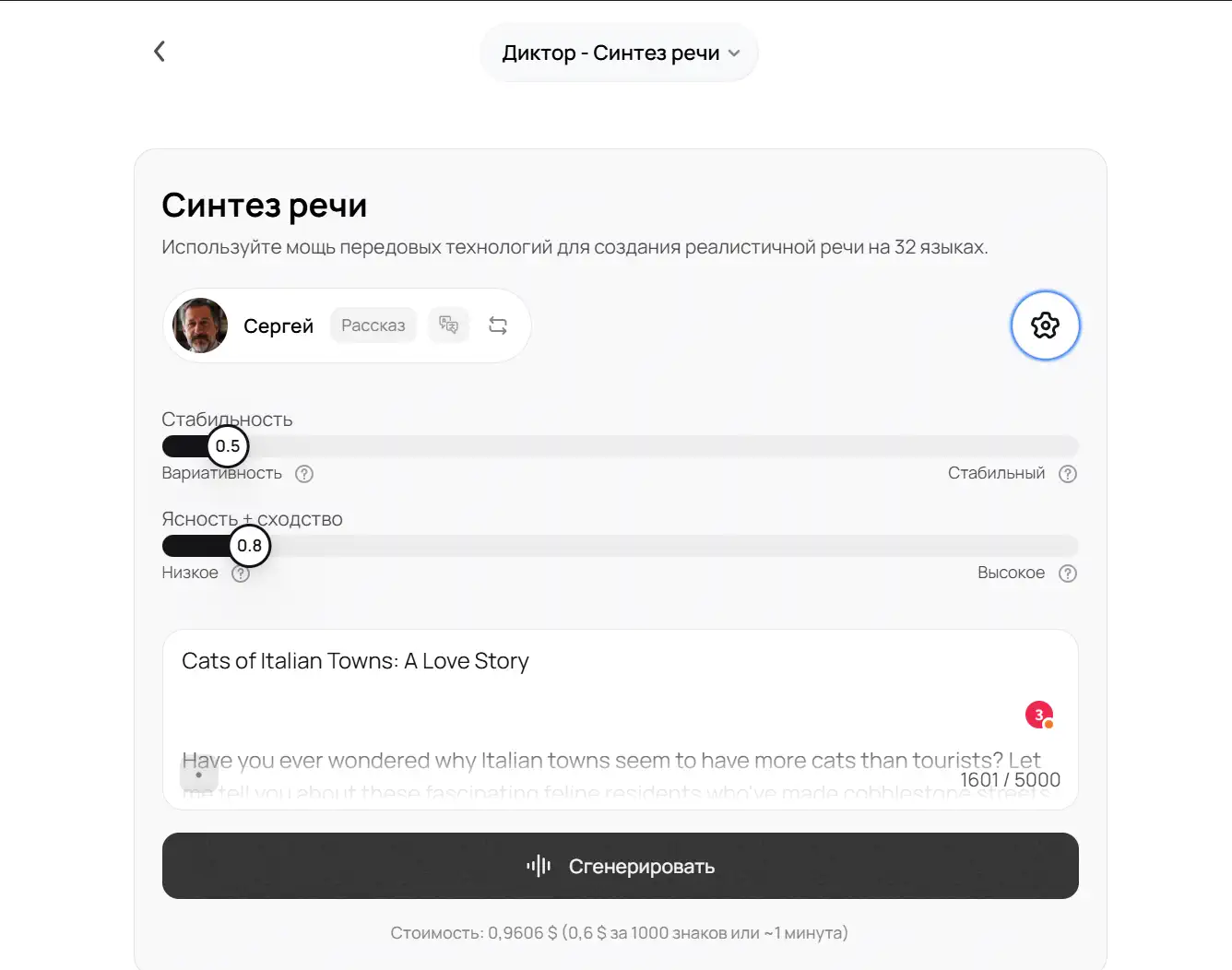
By the way, GPTunneL also has Narrator 2.0 — a voice generation tool for almost any language, built on ElevenLabs. You can generate any text for practice — say, about cats in Italian towns — and then feed it to Narrator to create an audio version and listen to it.
Prompt examples for effective learning
Many services only unlock their full potential with a precisely worded request. A good prompt structures the conversation, highlights personal goals and improves the result.
Useful types of prompts for practice:
The difference between some and any
"Explain in detail the difference between some and any: give clear rules, exceptions, a table of affirmative/question/negative forms, compare with no/none, add at least 5 example sentences with translation and a short comment for each situation."
Checking for grammar mistakes
"Check my text for grammar mistakes: list them with an explanation of the rule, suggest a corrected version of the whole text, highlight the changes, state the total number of mistakes, and advise which topics to review."
Exercises on the passive voice
"Create 8 exercises on the passive voice: 3 on converting active → passive in different tenses, 3 on filling in be + verb in the passive voice, 2 on choosing the correct option; after each one, give the answer key and a brief explanation."
Questions on the topic "Travel"
"Prepare 10 varied questions on the topic 'Travel': use different tenses, 2 conditionals, 1 with a modal verb, include questions about experience, plans, preferences; after the list, suggest possible sample answers."
Tools like these enable grammar learning with AI through interactive tasks or dialogues, as well as regular vocabulary expansion. A neural network for memorizing words builds repetition based on how often you struggle, and suggests synonyms and phrases in context.
How to choose the right neural network for your needs
The choice depends on the specific task: it's important to consider how well the target language is supported. For example, DeepSeek or Qwen are better for Chinese, while ChatGPT, Gemini or Claude are better choices for English.
Recommendations for choosing:
- Assess the level of automation: how quickly the neural network reacts to mistakes and selects new material.
- Check whether you can craft personal prompts for independent work.
- Make sure it offers pronunciation checking, text markup and themed conversation features.
Learning with AI is always personalized because all communication happens in chat. This lets you flexibly change the pace, format and difficulty of exercises, moving from basic flashcards to complex role-play models.
Commonly chosen services:
- Gemini 2.5 Pro (Google) — a model with a 1-million-token context window that can process long articles or even entire books. For language learning, this means not only holding long conversations but also getting analysis of literary works and discussing image content, making learning more interactive and versatile.
- OpenAI o3 (OpenAI) — one of the most popular models, whose strengths are creative text generation, analysis, and support for natural dialogue. It's excellent for writing practice, building exercises, and explaining grammar rules.
- Claude 4 Opus (Anthropic) stands out for its focus on safety and detailed, thoughtful responses. This model excels at writing and analyzing creative texts, which is useful for working with articles or books in a foreign language. Claude can help you understand context and stylistic nuances more deeply.
- DeepSeek V3 (DeepSeek AI) stands out for strong support of Chinese and English thanks to its architecture and training data. The model shows excellent results in programming and technical tasks, which can be used to learn specialized vocabulary in these fields.
Ultimately, every leading neural network has unique advantages for language learners. In the end, it's worth experimenting with different platforms to figure out which tool best fits your personal habits and learning goals.
In summary
Thanks to artificial intelligence in foreign language learning, students master new topics faster, make fewer repeated mistakes, and move to spontaneous communication with more confidence. Technology lowers the barrier to getting started — interactive learning is now available anywhere, with personalized settings.
Useful resources and links
For independent practice and testing prompts:
FAQ
Can you learn English with just one neural network?
A single neural network covers most tasks — vocabulary, grammar, basic dialogues — but for a stable, professional level, it's best to combine approaches: classic apps, live communication, and working with texts. Artificial intelligence in language education speeds up progress but doesn't replace a comprehensive approach.
Which neural network is best for conversation practice?
Gemini 2.5 Pro, Claude 4 Opus and GPT-4o are all well-suited for conversation practice — they generate dialogues on real-world topics, catch mistakes and keep a personal pace. Neural networks for developing conversational speech cover scenarios from everyday life to business.
Can neural networks explain grammar clearly?
Most popular AI services (Babbel, ChatGPT) structure rules to match the user's level, explain complex aspects with examples, and build mini-tests. Grammar learning with AI becomes consistent and varied.
How can you use ChatGPT to learn foreign words?
It's recommended to build short themed lists, generate flashcards based on your interests, ask for example sentences, simulate situations, and track progress by repeating problem words.