

On October 22, OpenAI opened its Decisions API to all developers. It's an API where GPT-6 Luna doesn't write text but answers a question with a choice - "yes" or "no", one of your options or a score on a scale - and immediately tells you how confident it is. Before that the API was in beta, tested by Box, Datadog, Ramp and Speak.
How it works
A normal request to a language model goes like this: you ask, the model writes an answer, you parse it. The Decisions API has no text at all. The request goes to a separate endpoint, /v1/decisions, to the gpt-6-luna model, and you get back a ready value of one of three types:
- Yes or no - a probability from 0 to 1 that the condition is true. For example, "is this email a complaint?".
- Choice - one of the options you listed yourself, plus a probability for each and an overall confidence. "Which team should get this ticket: sales, support or accounting?"
- Score - a level on a scale of 2 to 10 steps, also with a confidence. "How urgent is this request?"
One request can hold up to 400 such questions. Input can be text, images and JSON, but not files or audio.
Speed is the main point. Nikunj Handa, product lead for OpenAI's APIs, told TechCrunch that an answer that used to take one to three seconds now arrives in 100-180 milliseconds. OpenAI's documentation says the Decisions API returns answers about 10 times faster than the regular Responses API. OpenAI has already used it to make its own Dots voice assistant more responsive.
Why models that only choose
Most "routine" AI tasks aren't writing, they're choosing. Routing tickets to the right team, filtering spam, checking whether a product is in a photo, deciding which model should handle a request. Generating text for that and then pulling the answer out of it is slow and expensive. These are called decision models, or "System One" models - after the fast, intuitive mode of human thinking.
OpenAI isn't first in this category. It was created by Jev from the startup TypeSafe, valued at $7.6 billion. On scores as of October 23, OpenAI is still catching up. In the Artificial Analysis Decision Index the leaders - d1-ultra from Liquid and Elephant from Base Lab - have 65 points each, Jev has 57 and GPT-6 Luna 48. In the AIM System One Index the gap is smaller: the top four, led by d1-ultra, have 60 each, Jev 58 and GPT-6 Luna 56. TypeSafe CEO Diogo Almeida, for his part, advises not to trust leaderboards and to test models on your own task.
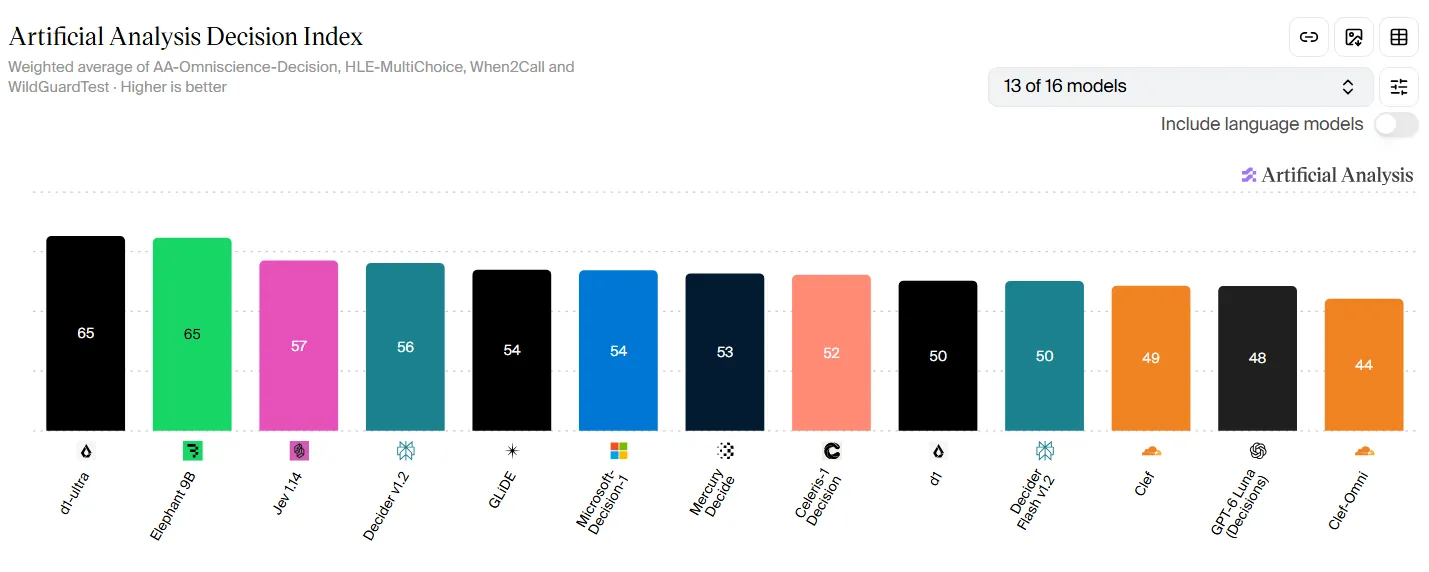
The Artificial Analysis index is a weighted average of four tests: AA-Omniscience-Decision, HLE-MultiChoice, When2Call and WildGuardTest. The chart shows 13 of the 16 models in the ranking, and GPT-6 Luna in the Decisions API is second to last.
My take
OpenAI came to this market neither first nor best by the rankings. But it has an argument the startups don't: the Decisions API lives in the same dashboard, with the same keys and the same contract as everything else. For a company that already works with OpenAI, that often matters more than a couple of places on a leaderboard. And the probability in the answer is a useful detail: it shows where the model is unsure and where it's better to call in a human.
What it means for you
If you're not a developer, you won't touch the Decisions API directly. But services around you will get faster where they now "think" for a second or two: email sorting, moderation, voice assistants.
If you are a developer, take a look when your task repeats the same choice thousands of times. For text, code and reasoning you still need a regular model.
Where to try it
There's no separate Decisions API in the GPTunneL catalog yet. But GPT-6 Luna, the model behind it, is already there - in the regular chat and via API, from $0.0004 per 1,000 input tokens. You can use it to see how the model handles your classification before building anything on OpenAI. We compared Luna with the bigger GPT-6 Sol in our GPT-6 Sol vs Luna breakdown, and all text models are in the catalog.
Sources
- Decisions API - OpenAI documentation: model, answer types, limits
- OpenAI makes its Jev competitor widely available - TechCrunch on the launch and competitors, October 22, 2026